Quick Answer: Agricola is a 1–5 player worker placement game where you manage a 17th-century farm over 14 rounds — collecting resources, growing crops, raising animals, and feeding your family. The player with the most victory points across multiple farm categories wins. First time playing? Use the Family Game variant (no cards) to learn the core loop before adding the full complexity.
Agricola has a reputation. Ask anyone who plays euros seriously and they’ll either light up or warn you it nearly ended their gaming group. Learning how to play Agricola for beginners isn’t just about memorizing rules — it’s about understanding why the game works the way it does, so your first play feels exciting rather than like homework. Let me walk you through everything.
What Is Agricola and How Does It Work?
Designed by Uwe Rosenberg and first published in 2007 by Lookout Games (Z-Man Games handles the English edition), Agricola seats 1–5 players for 90–150 minutes and sits at a BGG weight of 3.64/5. You’re running a small farm in 17th-century Europe — placing family members on action spaces to collect wood, clay, reed, stone, and food, then using those resources to plow fields, sow crops, raise animals, build rooms, and expand your household across 14 rounds.
The catch? You have to feed everyone at regular harvest phases. Fail and you’re collecting begging tokens worth -3 points each. That feeding pressure is what makes Agricola feel different from most worker placement games. You’re never quite comfortable, and that’s entirely the point.
Components: What’s in the Box
The 2016 revised edition includes a modular central board that scales by player count, plus five individual player farm boards — double-sided, one for the standard game and one for the Family variant. Setup takes 15–20 minutes until you know the game well. Five players need a proper gaming table; this thing spreads out.
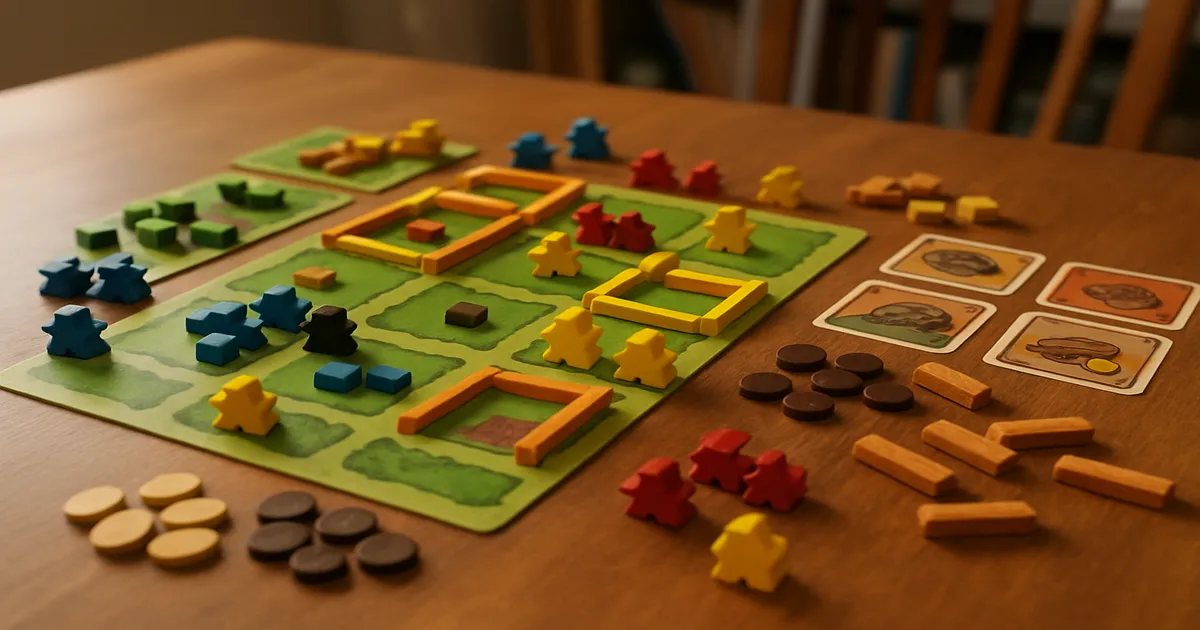
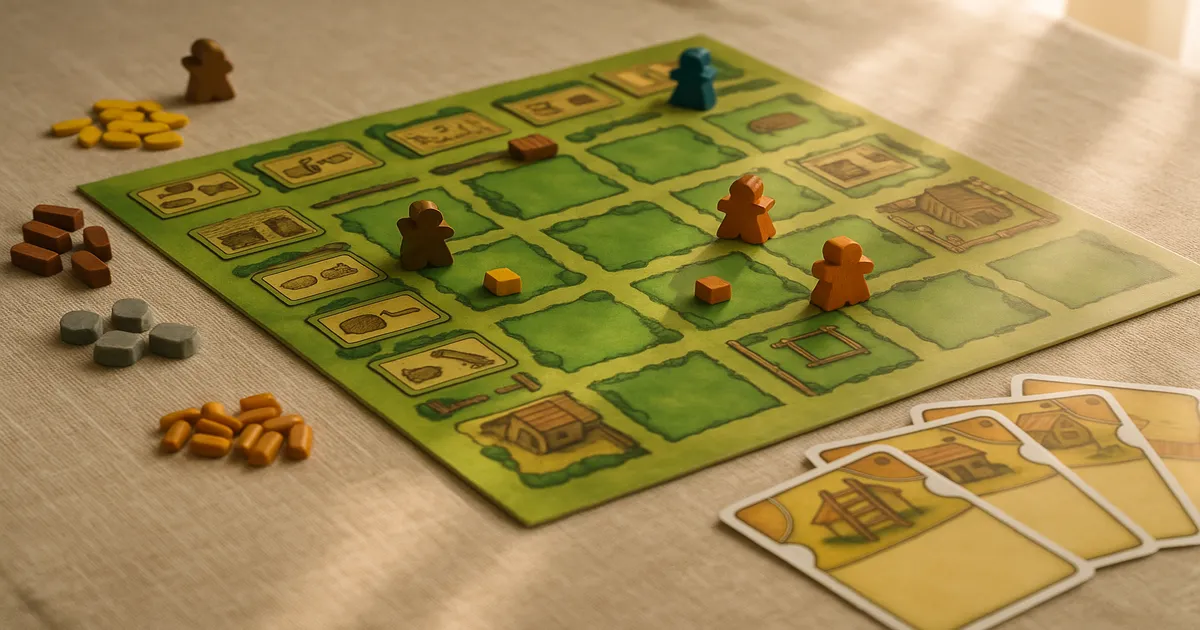
The physical components are genuinely satisfying. Five distinct wooden resource shapes (wood, clay, reed, stone, food), animal tokens in three species, wooden discs in five player colors, and all the fences, stables, room tiles, and field tiles you need to build out your farm. Watching an empty grid transform into a proper homestead with fenced pastures is one of the game’s quiet pleasures. (Agricola Revised Edition by Z-Man Games)
The game also includes 360 Occupation and Minor Improvement cards — the engine behind Agricola’s legendary replayability. These will get handled constantly, so sleeve them. (Dragon Shield Perfect Fit Sideloaders)
How to Play Agricola: Turn Structure and Core Rules
Worker Placement Basics
At the start of each round, one new action card flips face-up, adding a space to the board. Players then alternate placing one worker at a time, taking that action immediately before passing to the next person. The core rule: each space holds only one player’s worker per round. Someone grabs the wood pile before you? No wood for you this round.
One rule beginners consistently miss: resources left on action spaces accumulate. If nobody takes the clay for three rounds, that pile grows to three clay. Watching those piles build — and timing when to swoop in — is a big part of the strategic texture.
Harvest Phases
Harvest phases happen at the end of specific rounds, not every round. Each one has three steps:
- Field phase — One grain or vegetable is harvested from each sown field
- Breeding phase — Own 2+ of the same animal species with housing space? You gain one offspring
- Feeding phase — Pay 2 food per family member, or take begging tokens
That feeding step is the heartbeat of the game. A family of three needs 6 food. A family of five needs 10. Each food you can’t pay becomes a -3 point begging token. Three tokens is a -9 point swing. That’s game-altering, and it happens fast if you’re not paying attention.
The 14 Rounds and Six Stages
The 14 rounds are grouped into six stages, with a harvest at the end of each. Stages get shorter as the game progresses, so harvests come faster and the pressure intensifies. The final rounds feel completely different from the opening ones — there’s no coasting to the finish.
How Scoring Works in Agricola
Agricola scores across many categories simultaneously:
| Category | Max Points |
|---|---|
| Plowed fields | 4 |
| Pastures | 4 |
| Grain (in fields) | 4 |
| Vegetables (in fields) | 4 |
| Sheep | 4 |
| Boar | 4 |
| Cattle | 4 |
| Built rooms | varies |
| Family size | 3 per member |
| Fencing | varies |
| Occupation/Minor Improvement cards | varies |
| Empty spaces | -1 each |
| Begging tokens | -3 each |
Two things trip up beginners constantly. First, empty spaces: every unfilled space on your 5×3 farm board costs 1 point. Leave six spaces empty and you’ve handed away 6 points before counting anything else — I’ve seen players lose by exactly that margin without knowing why. Second, family size is worth 3 points per member and gives you more actions all game. It’s the most compounding investment on the board.
Key Decisions for Beginners Playing Agricola
When to Grow Your Family
To use the Family Growth action, you need a spare room already built. That room costs wood and reed. It feels like a big investment early on — but a worker placed in Round 5 will take roughly 9 more actions than one placed in Round 9. That gap almost always decides games.
Balancing Food Against Farm Development
This is the central tension. Every round spent gathering food is a round you’re not building rooms, plowing fields, or grabbing animals. There’s no clean answer, but arriving at a harvest with empty hands is a disaster. Plan your food 2–3 rounds ahead, always.
Playing Occupation and Minor Improvement Cards
An Occupation played in Round 2 might trigger seven or more times. The same card played in Round 11 might trigger twice. Play your best cards early — especially anything that generates food or reduces costs. Cards that compound over harvests are worth far more than their face value suggests.
Blocking Opponents
Sometimes taking an action space is less about what you need and more about denying it to someone else. Wood gets blocked constantly in the early game. Stone matters in the mid-game when players are upgrading rooms. Pay attention to what your opponents are building — it tells you exactly what to take away from them.
Common Beginner Mistakes in Agricola
Forgetting the harvest is coming. New players get absorbed in building and completely forget a harvest is two rounds away. Zero food, three family members, harvest arrives — that’s -6 points minimum.
Misunderstanding animal housing. Animals need fenced pastures or stables. Different species can’t share a pasture unless a card specifically allows it. Animals you can’t house are simply lost. Build at least one small pasture before you start collecting sheep.
Playing Occupations too late. If your best Occupation hits the table in Round 10, you’ve wasted most of its value. Get them down early.
Chasing stone rooms before securing food and family growth. Stone rooms look great on the scoring track. They’re also enormously expensive. Spending rounds 4–7 on stone while your opponent grows their family is a losing trade almost every time.
Ignoring empty spaces until Round 13. Audit your farm board around Round 10. Count the empty spaces. Figure out the cheapest way to fill them — a small pasture, a field, anything. Running out of time to fill them is preventable.
Agricola Strategy Tips for Beginners
Early game (Rounds 1–4): Lock in a food source before anything ambitious. Fishing works but it’s inefficient long-term — grain or a food-generating Occupation is better. Grab wood aggressively; it’s used for almost everything. Play at least one Occupation by Round 3.
Mid game (Rounds 5–9): If you haven’t grown your family by Round 7, it’s getting late. Prioritize that extra room and grab the Family Growth space. Get 2 sheep into a pasture — animals are easy points and they breed automatically. Watch the board and block when you can afford to.
Late game (Rounds 10–14): Stop acquiring resources you can’t use. Start converting what you have into points and food. The Cooking Hearth is one of the most powerful cards in the game precisely because it solves your biggest problem — feeding — while clearing board space and scoring points simultaneously. If it’s in your hand, play it early.
Should You Play the Family Game Variant First?
Yes. The Family variant removes all Occupation and Minor Improvement cards, cutting complexity roughly in half. You’re still doing full worker placement, resource management, farming, and feeding — you’re just not managing a hand of seven cards on top of it. Most new players find it clicks within a round or two, and the full game suddenly makes a lot more sense once you’ve played the underlying structure.
After one or two Family variant games, add the cards. The full game is where Agricola really shines — the cards are what make every session feel different. The Family variant is the tutorial; the full game is the actual experience.
If you want to practice before sitting down with a physical copy, Agricola on BoardGameArena is free and genuinely excellent. The mobile app is also solid for solo runs against AI opponents.
Agricola Alternatives: What to Play Before or After
Stone Age (2–4 players, 60–90 min, BGG weight 2.50) is the classic on-ramp to worker placement. Dice-based resource collection makes it friendlier, and the core loop prepares you well for Agricola.
Viticulture Essential Edition (1–6 players, 45–90 min, BGG weight 2.88) is another excellent stepping stone — medium-weight, forgiving, beautiful production, and it teaches resource-to-victory-point conversion without the feeding pressure.
Caverna vs. Agricola: Both are Rosenberg designs with similar DNA. The key difference is that Caverna has no feeding penalty. It’s broader and more forgiving; Agricola is tighter and more tense. My honest take: Agricola is the better game if your group enjoys pressure. Caverna is better if someone at the table finds Agricola stressful in an unfun way.
For something heavier, A Feast for Odin (1–4 players, BGG weight 3.92) goes deeper with polyomino placement and a Viking theme. For lighter two-player play, Agricola: All Creatures Big and Small strips out everything except animal husbandry and plays in about 30 minutes — it’s a genuinely great couples game.
Frequently Asked Questions About How to Play Agricola
How long does a game of Agricola take?
Budget about 30 minutes per player — roughly 90 minutes for three players, up to 150 for five. Your first game will run longer no matter what. Once your group knows the rules, it tightens up considerably.
Is Agricola too complicated for beginners?
It depends on your group. At BGG weight 3.64/5 it’s firmly medium-heavy — absolutely learnable, but not a casual gateway game. Use the Family variant for your first play and give yourself permission to make mistakes. The second game always feels dramatically better than the first.
What does the Family Game variant change?
It removes all Occupation and Minor Improvement cards, eliminating hand management entirely. You still do worker placement, farming, feeding, and scoring. It’s the fastest way to learn the core game, and yes — new players should use it for their first session.
How does feeding work in Agricola?
At each harvest phase, pay 2 food per family member. Can’t pay? Take begging tokens at -3 victory points each. With a family of four, that’s 8 food required per harvest. Running out is one of the most common and painful beginner mistakes, and it’s almost always avoidable with a bit of forward planning.
What’s the difference between Agricola and Caverna?
Both are Rosenberg worker placement games with resource management and farm-building themes. The biggest difference: Caverna has no feeding penalty and offers more player paths, making it feel more open. Agricola is tighter, more tense, and — for players who like that kind of pressure — more strategically interesting.