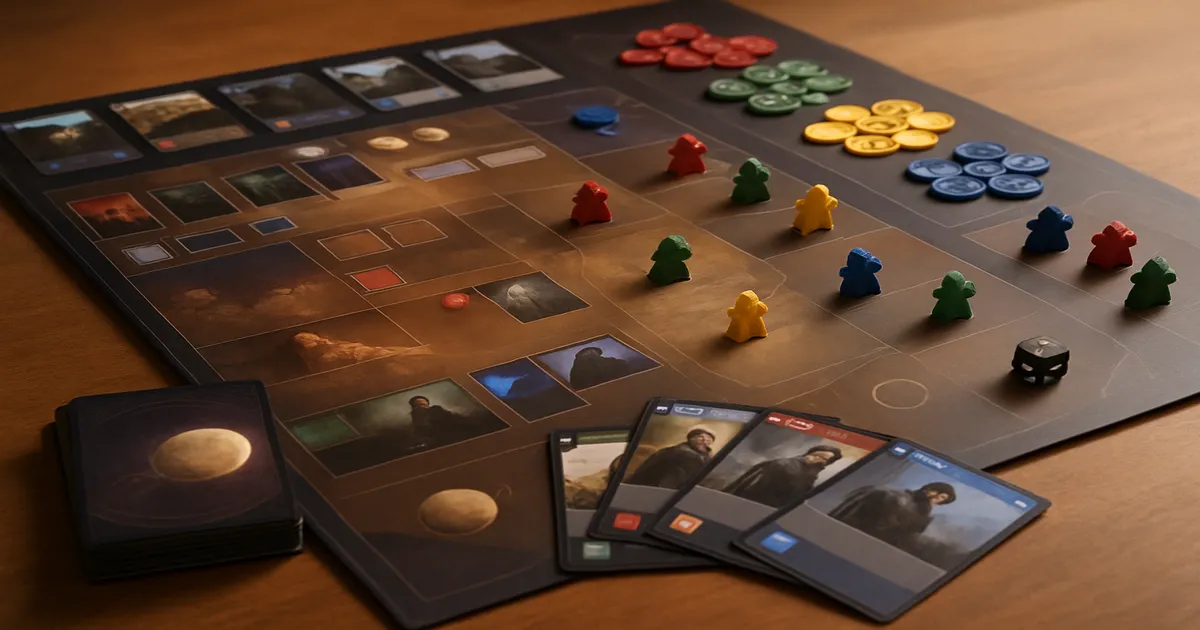
Quick Answer: Dune: Imperium is a hybrid deck-building and worker placement game for 1–4 players where you lead a Great House competing for spice, political influence, and military dominance on Arrakis. First player to 10 Victory Points wins, which typically takes 60–120 minutes. It’s medium-heavy (BGG weight 3.0/5) but genuinely learnable in a single session — and it’s been sitting in BGG’s top 20 for good reason.
Learning how to play Dune Imperium is straightforward enough. Actually understanding why the card-placement link is the whole game? That takes a little longer. This guide walks you through every phase of a round, the mistakes that trip up new players, and the strategies that separate winners from the people who built a 30-card deck and spent the whole game wondering why they kept losing.
What’s Inside the Box
The base game comes with:
- 1 large game board (Arrakis map + political landscape)
- 4 Leader cards (double-sided, each with unique abilities)
- 4 Player boards
- 60 Imperium cards (the shared market deck)
- 40 Starting deck cards (10 identical cards per player)
- 20 Intrigue cards
- 16 Conflict cards (three escalating tiers)
- 4 Alliance tiles
- Wooden Agents (cubes), Troops (cylinders), and Combat markers per player
- Resource tokens: Spice (orange), Solari (yellow), Water (blue)
- Victory Point markers, Influence markers, and the First Player marker
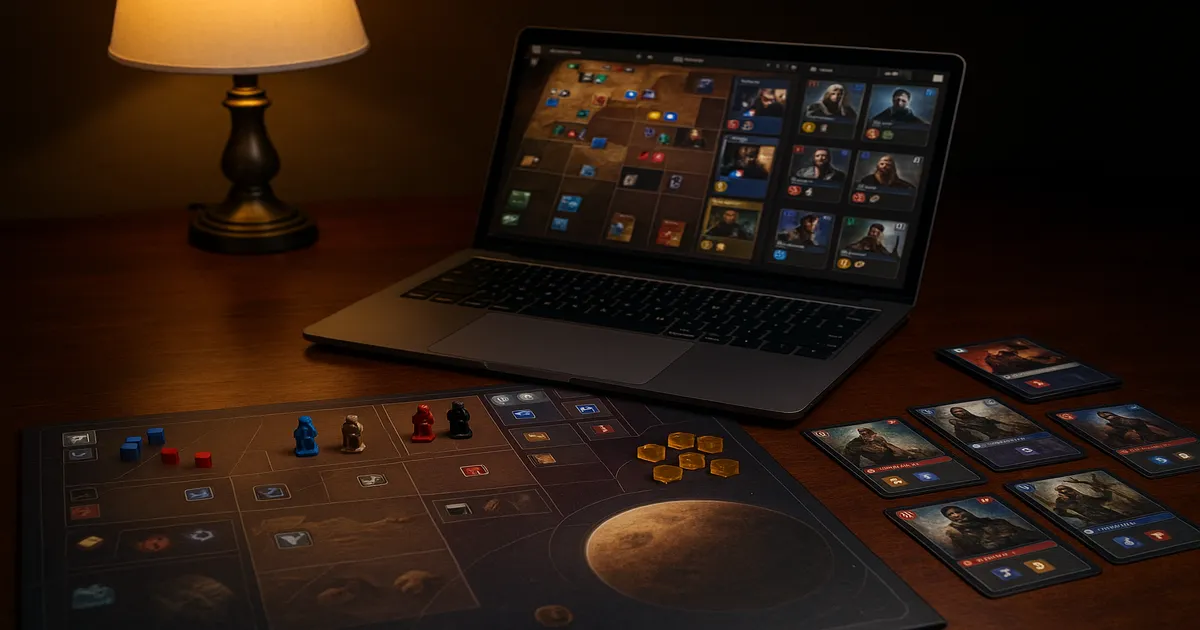
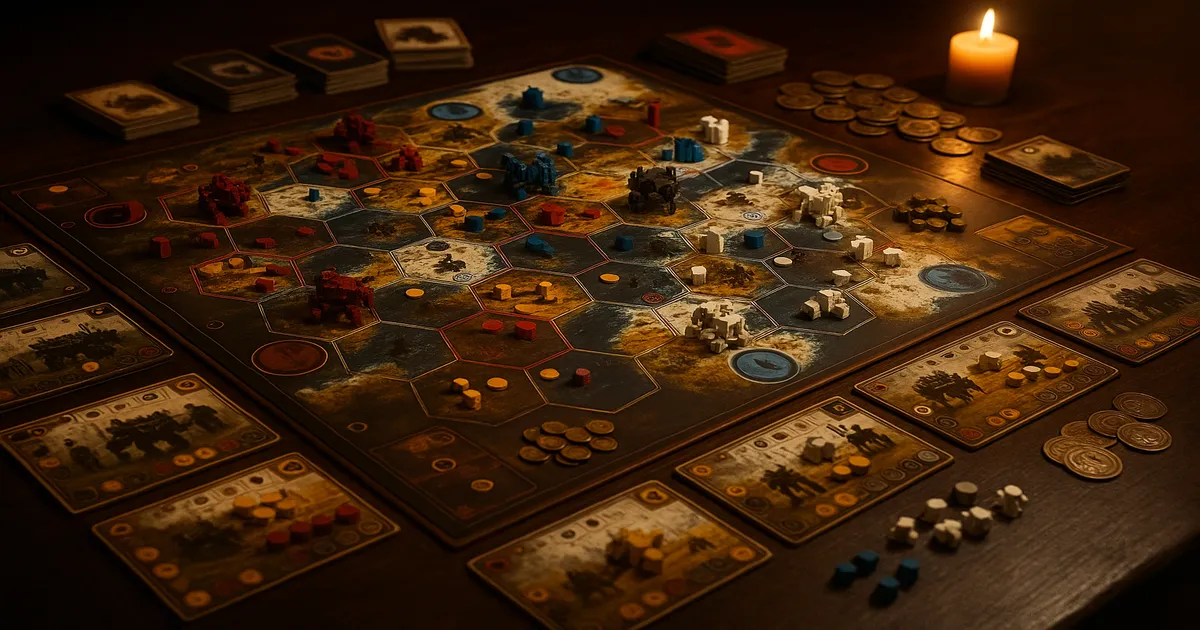
The art pulls straight from Denis Villeneuve’s 2021 film — dark, dusty, cinematic. Strong table presence. The wooden pieces are functional rather than fancy, but the chunky resource tokens feel satisfying to push around. The board’s iconography looks overwhelming at first glance, but it’s logically organized by faction and function. After one full round it starts clicking into place.
Should you sleeve the cards? Yes. The Imperium and starting deck cards get shuffled constantly, and cheap cardstock doesn’t survive a dozen plays. Standard Euro-size sleeves work for most of the deck.
Game Setup
Each player picks a Leader card — double-sided, so you’ve got options immediately. Paul Atreides plays very differently from Glossu Rabban, and that asymmetry is a big part of what gives the game its replay value. Take your player board, your 10-card starting deck, 2 Agents, a set of troops, and your influence markers.
Shuffle the Imperium deck and deal 6 cards face-up to form the Imperium Row — the shared card market for the game. Separate the Conflict cards into their three tiers (marked I, II, III) and stack them in order with Tier I on top. These escalate as the game progresses, with late-round Tier III cards offering the biggest VP swings.
Every player starts with the same hand and the same resources. Strategic differentiation comes entirely from your Leader ability, which cards you acquire, and where you place your Agents. No luck-of-the-draw in setup.
How to Play Dune Imperium: Turn Structure
Phase 1 — Round Start
Flip the top Conflict card face-up so everyone can see what’s at stake. Then each player draws 5 cards from their personal deck. Read that Conflict card before you plan anything — I’ve watched players completely ignore it and waste troops on a round where the rewards weren’t worth fighting over.
Phase 2 — Player Turns: Agent Turns vs. Reveal Turns
Players alternate taking turns. Each turn is either an Agent Turn or a Reveal Turn. You don’t declare in advance — you just choose when it’s your go.
Agent Turns: The Core Rule New Players Miss
On an Agent Turn, you play one card from your hand face-up and place one of your Agents on a board space. Here’s what most beginners get wrong: the card you play must have a matching icon for the space you want. You can’t just pick any open space. The icon in the card’s top-left corner determines your valid destinations.
Play a card with a Fremen icon? Fremen spaces only. Landsraad icon? Landsraad spaces only. This is the mechanic that makes the deck-building and worker placement feel genuinely fused — your hand doesn’t just buy things, it is your movement. Collect any immediate card effects when you place, too. A lot of new players skip this step entirely.
Reveal Turns: Buying Cards and Committing to Combat
When you’re out of Agents — or just choose not to place — you take a Reveal Turn. Flip all remaining cards in your hand face-up simultaneously, then count two things:
- Persuasion (blue circle): your buying power — spend it to acquire cards from the Imperium Row or basic card piles
- Swords (sword icons): your combat strength for this round’s Conflict
During your Reveal Turn you can also deploy Troops to the Conflict and play any Intrigue cards you’re holding. Don’t skip the troops. It’s a mistake beginners make constantly, and it costs them early Conflicts they could have won.
Phase 3 — Resolving Combat
Once all players have taken their Reveal Turns, compare total combat strength. Highest strength wins the Conflict card’s top reward — often 2 VP plus bonus resources. Second and sometimes third place get lesser rewards. Troops return to everyone’s supply after combat regardless of outcome.
Phases 4 & 5 — End of Round
Advance the Spice Blow track (spice accumulates on certain spaces each round it goes uncollected). Everyone recalls their Agents, discards their played and revealed cards, reshuffles when needed, and passes the First Player marker clockwise.
How to Win Dune Imperium: Victory Points
The moment any player hits 10 VP, the game ends — checked at the end of each round. VP comes from:
- Conflicts: Winning or placing earns VP directly
- Faction influence thresholds: Reaching 2 influence with any faction earns 1 VP; reaching 4 earns another
- Alliance tokens: First to 4 influence with a faction claims the Alliance tile (1 VP + a powerful ongoing ability)
- High-value Imperium Row cards: Some cards have VP printed directly on them
- The Swordmaster upgrade: Unlocks your third Agent and awards VP
- Certain Intrigue cards
The four factions — Emperor, Spacing Guild, Bene Gesserit, and Fremen — each have their own influence track and Alliance tile. New players treat these as a side quest. That’s a mistake. Faction influence is one of the most efficient VP paths in the game, especially if you commit to one or two factions early. Each Alliance has a distinct flavor: Fremen suits spice-heavy strategies, Bene Gesserit rewards hand manipulation, Emperor generates Solari, and Spacing Guild gives you board access flexibility.
The game can also end if the Conflict deck runs out (roughly 10 rounds), in which case highest VP wins. It can end faster than you expect — tracking opponents’ VP totals isn’t optional.
Common Mistakes New Players Make
Rules mistakes:
- Placing Agents freely — you cannot go wherever you want. The card icon must match the destination space.
- Forgetting card effects on Agent placement — many cards give you spice, water, or other resources when played on an Agent Turn.
- Mixing up Persuasion and Swords — Persuasion buys cards, Swords fight. They’re separate numbers on the same card.
- Not deploying troops — troops go to the Conflict during your Reveal Turn, not your Agent Turn. Easy to forget, costly to miss.
- Ignoring the one-Agent-per-space rule — blocking an opponent from a space they need is a legitimate and powerful move.
- Forgetting Intrigue cards — you can play them during your Reveal Turn or at specific triggered moments. They can flip combat results entirely.
Strategic pitfalls:
Buying every card that looks interesting is probably the most common strategic mistake in Dune Imperium. A bloated 30-card deck cycles slowly and hands you inconsistent turns. Aim for 15–20 cards and be picky about what earns a spot.
The other big one: ignoring faction influence. Combat feels exciting; influence tracks feel passive. But those 1 VP thresholds add up fast, and an Alliance token is worth a VP plus an ability that can reshape your whole strategy.
Strategy Tips for Winning
Keep your deck tight. Prioritize Persuasion-generating cards early so you can upgrade faster. Synergy beats raw power — a 3-cost card that works with your existing cards often beats a 6-cost card that doesn’t. Late game, pivot to cards with VP printed on them.
Block deliberately. Don’t just play reactively. If you know an opponent needs a specific space next turn, park your Agent there even if it’s not your top priority. The two city spaces — Arrakeen and Carthag — grant bonus Agents or card draws and are almost always worth contesting.
Pick a faction lane. Spreading influence across all four factions rarely gets you any Alliances. Pick one or two, race hard, collect the VP. Watch your opponents’ tracks — if someone is one step from an Alliance, decide whether you’re racing them or conceding it.
Know when to fold on combat. Losing a Conflict still costs you the troops you sent. Second place is often worth a small investment — many Conflict cards give meaningful resources or Intrigue cards to 2nd place. Save your big Intrigue cards for Tier 3 Conflicts where the VP rewards justify the fight.
Don’t sleep on the Swordmaster. A third Agent is a massive tempo advantage. Most experienced players target the Swordmaster space somewhere in rounds 3–5. Too early and you’ve stretched resources thin; too late and you’ve handed opponents a significant board presence advantage.
How Dune Imperium Compares to Similar Games
| Game | What It Shares | Key Difference |
|---|---|---|
| Wingspan | Engine building, card-driven | No worker placement conflict; purely personal engine |
| Viticulture | Worker placement, resource management | No deck building; lighter conflict |
| Clank! | Deck building, push-your-luck | No worker placement; dungeon crawl theme |
| Scythe | Area control, asymmetric factions | No deck building; heavier economic engine |
| Twilight Imperium 4E | Political intrigue, thematic overlap | Weight 4.3/5, 4–8 players, 4–8 hours — a different beast entirely |
What makes Dune Imperium stand out is the tight coupling between your hand and your board presence. You’re not just building a deck and placing workers — the two systems are genuinely fused in a way most games don’t pull off. It sits in a sweet spot complexity-wise: deep enough for strategy gamers, approachable enough that a motivated newcomer can play a full game on their first night.
The base game itself is the obvious starting point. (Dune Imperium)
Expansions worth considering:
Rise of Ix adds the Ix faction, dreadnoughts, and tech tiles — a solid expansion that adds meaningful new decisions without bloating the game. Immortality introduces the Tleilaxu faction and research mechanics. Both integrate cleanly with the base game.
Uprising (2023) is a standalone sequel with CHOAM mechanics, 6-player support, and a revised board. A lot of players consider it a straight upgrade to the base game, though I’d still recommend learning the original first.
If you want to try before you buy, the digital version on Steam, iOS, and Android is inexpensive and an excellent way to learn the rules without setting up the physical game.
Frequently Asked Questions About How to Play Dune Imperium
How long does a game of Dune Imperium take?
Most games run 60–120 minutes. With experienced players, 90 minutes is a reliable estimate. Your first game will probably run closer to two hours as you learn the board spaces and card interactions.
How many players is Dune Imperium best for?
It supports 1–4 players. The sweet spot is 3–4, where the blocking and political tension really shine. Two-player works but plays more directly — less chaos, more head-to-head.
Is Dune Imperium hard to learn?
The rules aren’t complicated, but there are several interlocking systems to internalize. Most people can play a full game after a 20-minute rules explanation. The tricky part is recognizing good decisions, not remembering the rules.
What’s the difference between Dune Imperium and Uprising?
Uprising is a standalone sequel — you don’t need the base game to play it. It adds CHOAM mechanics, new leaders, 6-player support, and a revised board. Many experienced players prefer it, but the base game is a complete, excellent experience on its own.
Can you play Dune Imperium solo?
Yes, and it’s genuinely good. The solo mode uses the Hagal House automa — a card-driven system that simulates an opponent’s actions. It’s one of the better solo implementations in the hobby. I’d actually recommend playing a solo game or two before your first multiplayer session just to get comfortable with the board spaces.