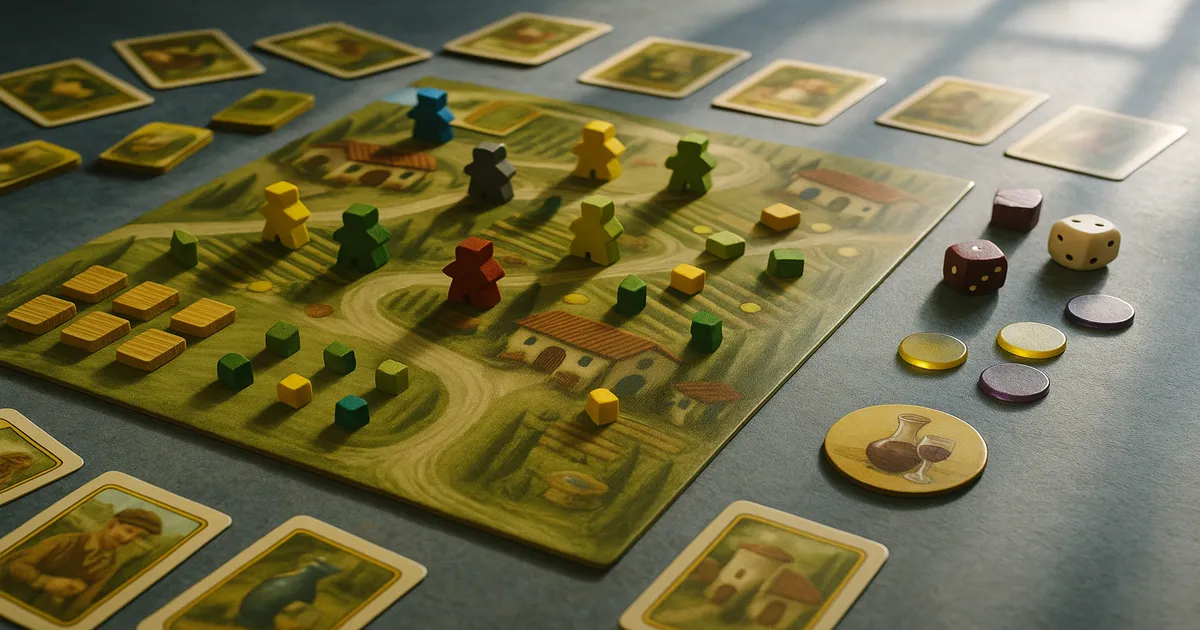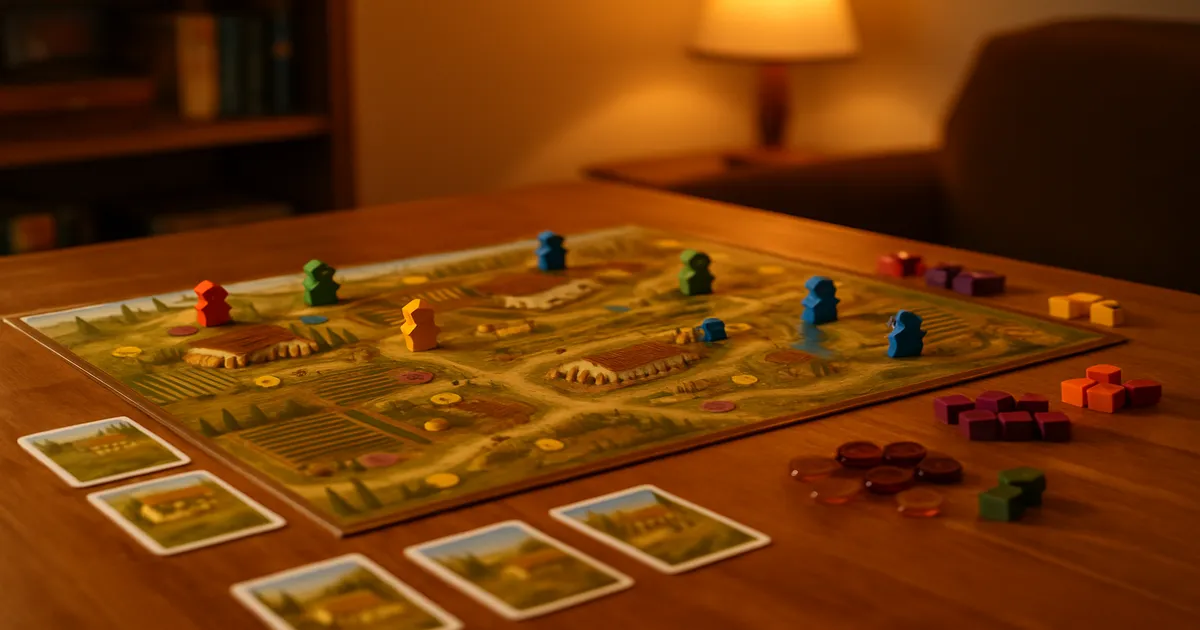
Quick Answer: Viticulture Essential Edition is a worker placement game for 1–6 players where you run a Tuscan vineyard — planting vines, harvesting grapes, making wine, and filling orders to earn victory points. The first player to reach 20 VP triggers the end game, and whoever has the most VP at the end of that year wins. At a BGG weight of around 2.9/5 and a real-world play time of 60–90 minutes, it’s one of the best entry points into medium-weight euro games. If you’re trying to learn how to play Viticulture Essential Edition, this guide covers everything from setup to strategy.
What Is Viticulture Essential Edition?
Theme, Setting, and Why It Stands Out
You inherited a modest Tuscan vineyard and a dream. Over several in-game years — each year is one round — you’ll plant vine cards, harvest grapes, age them into wine, and fulfill orders from buyers across the region. What makes Viticulture work is that the theme isn’t just window dressing. Planting a Sangiovese vine actually requires a Trellis. Your cellar literally can’t hold high-value wines until you upgrade it. The mechanics feel like winemaking in a way most euros don’t bother to achieve.
Beth Sobel’s artwork deserves a mention too. The warm, pastoral illustrations are a big part of why this game converts non-gamers — people pick it up because it’s beautiful, and they stay because it’s genuinely good. Viticulture was designed by Jamey Stegmaier and Alan Stone, and published by Stonemaier Games.
Essential Edition vs. Original Viticulture
The Essential Edition replaced the original in 2015, folding in the best parts of the Tuscany expansion — chiefly the Mama & Papa starting tiles that give each player an asymmetric setup, and the Automa solo system. If you’re buying today, don’t bother hunting down the original. The Essential Edition is simply the better game.
What’s in the Box
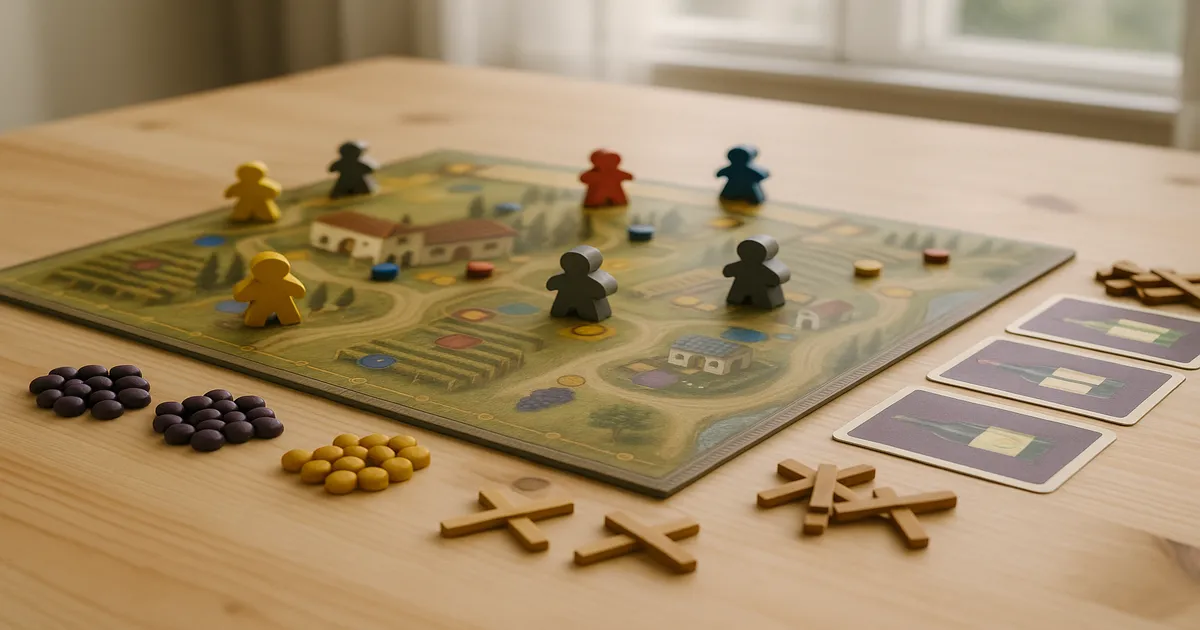
You get a large central board, six individual vineyard player mats, wooden meeples and cubes, a Grande Worker meeple per player, grape and wine tokens in red and white, and four card decks: Vine, Wine Order, Summer Visitor, and Winter Visitor. Component quality is solid — thick player boards, chunky wooden pieces, and a rulebook that’s actually well-written. The one weak spot is the cardboard coins, which many players swap out quickly. Card sleeves are also worth picking up given how often the decks get shuffled. (Dragon Shield Matte Standard Size)
If you want to grab the game itself: (Viticulture Essential Edition)
Game Setup
The Board and Player Mats
Place the central board in the middle of the table, shuffle all four card decks separately, and set up the VP track. Each player takes a vineyard mat showing three fields (value limits of 2, 3, and 5), a crush pad for grape tokens, and a cellar for wine tokens.
Mama & Papa Starting Tiles
Each player draws two Mama cards and two Papa cards, keeps one of each, and discards the rest. Mama tiles typically give you structures, workers, or vine cards. Papa tiles give coins, workers, or other resources. Your combination shapes your entire early game — no two players start identically, and it’s one of the best parts of setup.
Starting Resources
Everyone begins with 2 regular workers and 1 Grande Worker, plus whatever their Papa tile provides (usually 4–5 coins for the “take coins” option). Place your rooster on the Wake-Up Track and you’re ready.
How to Play Viticulture Essential Edition: The Four Seasons
Spring: The Wake-Up Track
Each year starts with players placing their rooster on one of seven Wake-Up Track positions. Position 1 means you go first all season — but you get nothing extra. Positions 2–7 grant increasing bonuses: an extra card, a coin, a victory point, or combinations. New players almost always default to position 1 out of habit, and it’s one of the most consistently costly mistakes in the game. The bonuses on positions 4–7 compound over a full game in ways that are easy to underestimate until you’ve been on the wrong end of them.
Summer Actions
Players alternate placing workers on Summer action spaces. Each space holds only one worker — with one major exception, covered below. Summer actions include:
- Draw Vine Cards — adds plantable grape varieties to your hand
- Buy a Structure — builds a Trellis, Irrigation system, Windmill, Tasting Room, or other building
- Plant a Vine — places a vine card onto one of your three fields
- Give a Tour — earns 2 coins; underrated, especially early on
- Play Summer Visitor Cards — powerful one-use effects
Fall: Draw a Visitor Card
Brief but meaningful. Each player draws one Visitor card, choosing between a Summer or Winter card. The choice matters more than it looks — you’re stocking your hand for what you’ll need next round.
Winter Actions
Winter is where the production chain pays off:
- Draw Wine Order Cards — gives you targets to work toward
- Harvest a Field — converts planted vines into grape tokens
- Make Wine — converts grape tokens into wine tokens in your cellar
- Fill a Wine Order — discard matching wine tokens to earn VP, coins, and advance on the residual payment track
- Play Winter Visitor Cards
- Train a Worker — pay 4 coins to add a worker (maximum 6 total)
Year End: Aging and Residual Payments
Workers return to their owners. Every grape token on your crush pad and every wine token in your cellar increases in value by 1 (up to their respective maximums). Then collect your residual payment — passive income from the track you advanced when filling orders. Then Spring begins again.
Workers and the Grande Worker
Regular workers can’t be placed on an already-occupied space. If someone beats you to Harvest a Field, you’re locked out for that season. The Grande Worker ignores this entirely — it goes anywhere, occupied or not. That makes it extraordinarily valuable, and new players consistently waste it by treating it like a slightly bigger regular worker. Save it. Use it deliberately to contest a blocked space when it matters.
Training a third regular worker (4 coins at the Train a Worker action) is usually worth it by year 2 or 3. The action economy difference between 3 and 4 workers is significant — you can harvest and make wine in the same Winter rather than choosing one.
From Vine to Wine: The Production Chain
Planting requires matching your vine cards to your fields. Each field has a value limit (2, 3, or 5), and the total value of all vines in a field can’t exceed it. Red vines typically need a Trellis; white vines often need Irrigation. Check your vine cards before assuming you can plant.
Harvesting converts all vines in a field into grape tokens. The grape value equals the sum of the vine values in that field.
Making wine converts grape tokens into wine tokens in your cellar — but your starting cellar only holds wines up to value 3. To store higher-value wines, you need a Medium Cellar or Large Cellar upgrade. Trying to make a value-5 wine without the right cellar is a rules error that catches a lot of first-timers.
Filling orders earns VP, coins, and residual income. That residual track is easy to overlook, but it compounds significantly — passive income every year from that point forward is a big deal.
Aging happens at year end: every grape and wine token goes up by 1 in value. This creates real tension. In practice, most players wait too long. A value-3 wine filled in year 2 usually beats a value-5 wine filled in year 4.
Common Mistakes When Learning How to Play Viticulture Essential Edition
Misusing the Grande Worker is the single most common error. If you’re placing it wherever is convenient rather than saving it to contest blocked spaces, you’re leaving most of its value on the table.
Aging confusion trips people up regularly. Grapes and wines age at year end, not year start. Your wine doesn’t age before you make it.
A few others worth flagging:
- Forgetting residual payments. Set a reminder. It adds up fast.
- Always grabbing Wake-Up position 1. Stop. The bonuses further down the track are real.
- Delaying structures. A Trellis feels expensive in year 1. It feels essential by year 3.
- Training workers too late. Still running 2 workers in year 4? Something has gone wrong.
Strategy Tips
Early game: Check your Mama & Papa tiles before anything else — they tell you what you have and what you need. If your vines require a Trellis, build it in year 1. Give a Tour (2 coins) is an underrated early action; coin starvation is a real problem. Aim for 2–3 fields planted by year 2–3.
Mid game: Don’t harvest everything at once. Stagger harvests and wine-making across seasons. Target orders worth 4+ VP — the efficiency gap between a 2 VP order and a 5 VP order is enormous over a full game. Train your third worker if you haven’t already.
Late game: Once anyone hits 15–17 VP, do the math. Can you close this year, or do you need one more? Stop building infrastructure you won’t use and pivot to direct VP. If you’ve been filling orders since year 2, your residual income should be doing real work by now.
Solo play: The Automa system is one of the best solo implementations in the worker placement genre. It doesn’t simulate all game actions — it competes on the VP track and occasionally blocks spaces, creating genuine pressure without requiring you to manage a full AI turn. Start with the standard Automa deck, then add the Automette deck when you want a harder challenge.
How Viticulture Essential Edition Compares to Similar Games
Tuscany Essential Edition is the direct expansion — it adds wine regions, a restructured board, and special workers. Play Viticulture a dozen times before adding it.
Wingspan (same publisher, ~2.5/5 weight) is Viticulture’s closest sibling in feel. Slightly lighter, card-driven, birds instead of wine. If someone loves one, they’ll almost certainly enjoy the other.
Agricola is where you go when you want worker placement with more teeth — heavier (~3.6/5), more punishing, relentless scarcity. Great game, but a different experience entirely.
For lighter options, Lords of Waterdeep is a solid gateway worker placement game, and Everdell scratches a similar card-engine itch with a whimsical aesthetic.
What makes Viticulture Essential Edition genuinely special is how many things it does well at once: thematic integration, accessibility, an excellent solo mode, beautiful production, and a setup that varies every game. It’s the rare euro where the theme and the mechanics feel like they were designed together from the start — because they were.
Frequently Asked Questions
Can the Grande Worker be blocked in Viticulture Essential Edition?
No. The Grande Worker can be placed on any action space regardless of whether another worker is already there. You can never be locked out of an action as long as your Grande Worker is still available.
How does wine aging work in Viticulture Essential Edition?
At the end of each year — after all player actions are complete — every grape token on your crush pad and every wine token in your cellar increases in value by 1, up to the respective maximums. It doesn’t happen at the start of the next year.
What’s the best player count for Viticulture Essential Edition?
Most experienced players land on 2–4 as the sweet spot. Two-player is tight and tactical; three and four feel like the fullest expression of the design. At five or six, the game slows down and action space competition gets chaotic in ways that aren’t always fun. The solo Automa mode is also excellent.
How long does a game of Viticulture Essential Edition take?
BGG lists 90 minutes, but experienced players usually finish in 60–75. Your first game will run longer as you learn the action spaces and production chain. After a few plays, 60 minutes is realistic for 2–3 players.
Do I need the Tuscany expansion?
Not at all. The Essential Edition already includes the best parts of Tuscany — the Mama & Papa tiles and the Automa solo system. Tuscany Essential Edition adds meaningful complexity and variety, but it’s for players who’ve already fallen in love with the base game, not a requirement to enjoy it.