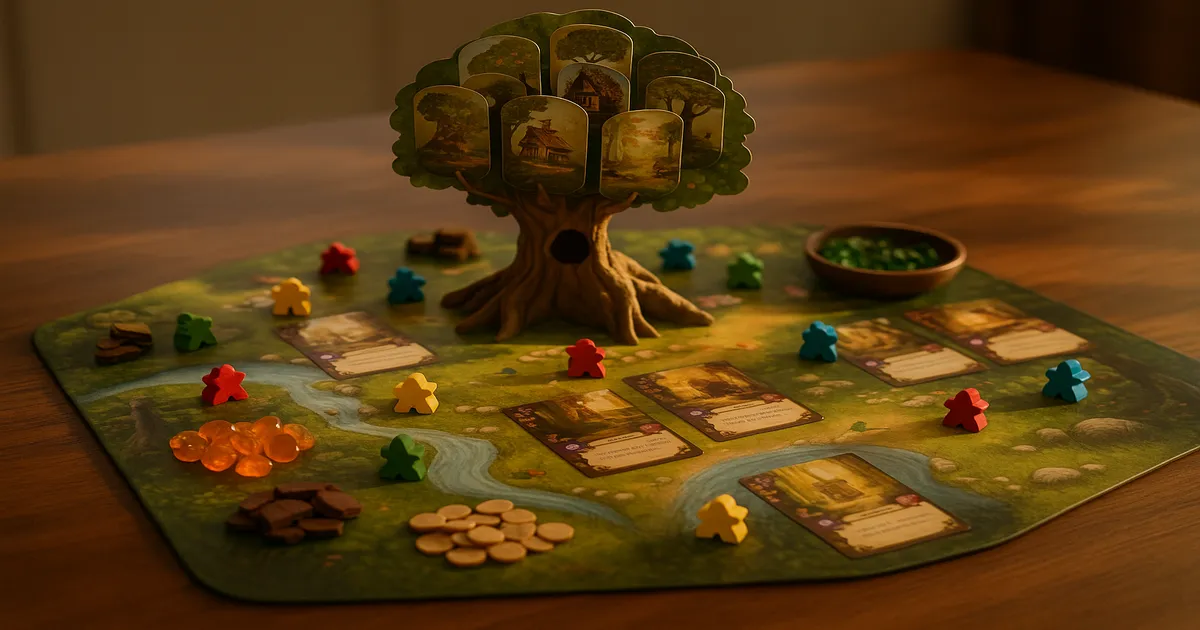
Quick Answer: Everdell is a 1–4 player worker placement and card engine-building game where woodland creatures build a city of up to 15 cards across four seasons. It plays in 40–80 minutes, sits at a BGG weight of 2.8/5, and strikes a near-perfect balance between approachable and genuinely strategic — making it one of the best “next step” games after you’ve outgrown pure gateway titles.
If you’re trying to figure out how to play Everdell for beginners, here’s the good news: the core rules fit on a single page. The depth comes from the cards — all 128 unique ones — but you don’t need to understand all of them to enjoy your first game. This guide walks you through setup, turn structure, scoring, common mistakes, and a few strategies that’ll keep you competitive right out of the gate.
What Is Everdell?
Designed by James A. Wilson and published by Starling Games in 2018, Everdell puts you in charge of a group of woodland creatures — squirrels, hedgehogs, mice, frogs — trying to build the most prosperous city in the valley. Over four seasons (Spring through Winter), you’ll place workers to gather resources, then spend those resources to play cards into your city. The game ends when everyone has passed through all four seasons, and the player with the most victory points wins.
What makes it click is the Construction/Critter pairing system — more on that in a minute — and the satisfying rhythm of watching your city grow from a handful of cards into a humming little engine. The BGG rating hovers around 8.0, putting it in the all-time top 100, and that’s not an accident.
Who is it for? You’ll love this game if you enjoyed Wingspan and wanted something with a bit more decision-making muscle. Families with kids around 10–11 can absolutely play it with some guidance (the box says 14+, but that’s conservative). Engine-building fans and anyone who geeks out over card synergies will feel right at home. It’s probably not for you if you want direct conflict or area control — Everdell is competitive but not confrontational. Fair warning, too: this game needs roughly a 3’ × 3’ table footprint. A card table is going to be a squeeze.
Components and Setup
What’s in the Box
The component list is impressive for a game in this price range (~$55–$70): (Everdell)
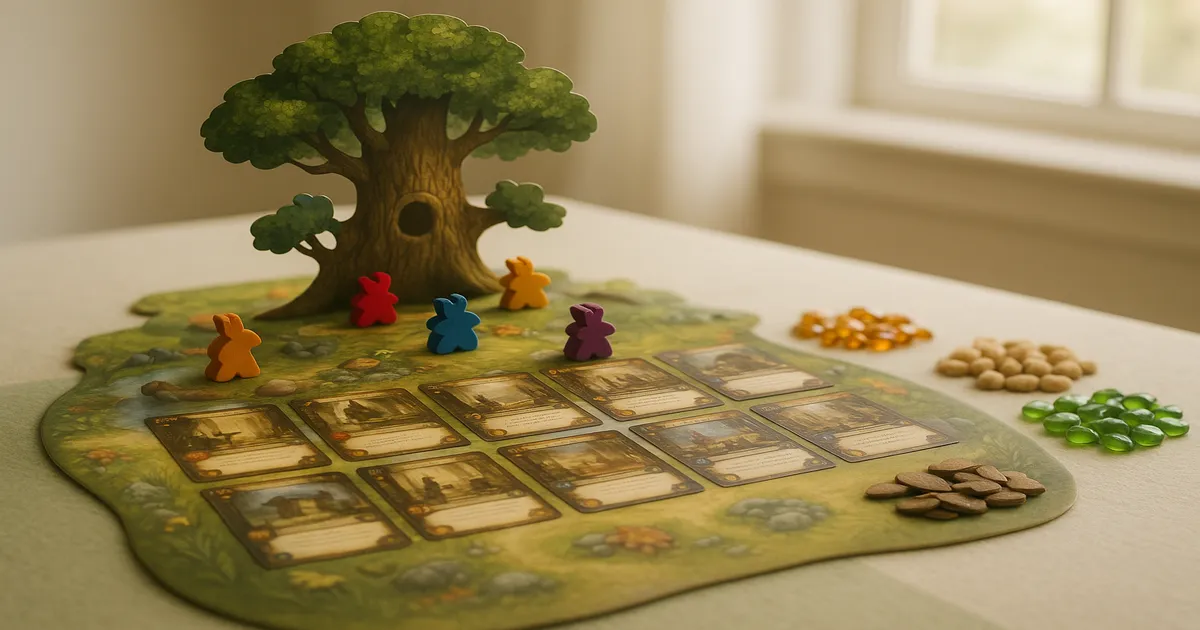
- 1 three-dimensional Ever Tree — the iconic centerpiece, assembly required
- 1 forest floor game board
- 128 unique city cards (Construction and Critter cards)
- 30 Event tiles and 20 Forest Location tiles (modular, so the board varies each game)
- Wooden resource tokens — Twigs, Resin, Pebbles, and Berries
- Cardboard VP tokens, wooden worker meeples in four player colors
- A cloth bag for resource storage
Andrew Bosley’s artwork deserves a special mention. Every one of those 128 cards has unique, painterly illustration work — warm autumnal tones, storybook style, the kind of art that makes people stop and stare at your table mid-game. It’s legitimately one of the most beautiful games ever made.
Setup and the Insert Problem
Assembling the Ever Tree takes about ten minutes the first time and thirty seconds every time after. Once it’s up, it holds cards on its branches and doubles as the main worker placement board. Set the forest floor board beside it, lay out a random selection of Forest Location tiles, place the basic Event tiles, and deal eight cards face-up to form the Meadow. Each player starts with a hand of five cards and a small supply of starting resources.
One honest warning: the original insert is genuinely bad. Resources mix together, pieces slide around, and setup becomes a chore. A dedicated organizer fixes this completely — I’d strongly recommend grabbing one before your second play. It’ll cut your setup time in half.
How to Play Everdell for Beginners: Turn Structure
The Three Actions
Every turn, you do exactly one of the following:
- Place a Worker — send a meeple to an available location to collect resources, draw cards, or trigger special actions
- Play a Card — pay the resource cost on a card from your hand (or directly from the Meadow) and add it to your city
- Prepare for Season — recall all your workers, collect your seasonal bonus, and advance to the next season
That’s it. The elegance is real — the complexity lives in the choices, not the rules.
Worker Placement
Workers go to locations on the Ever Tree (basic resource spots), Forest Location tiles (more specialized actions), or — and this surprises a lot of new players — to buildings in opponents’ cities that show an open gate symbol. That symbol means anyone can use that location. You’re not playing in total isolation even if the game feels low-conflict. Most locations hold only one worker at a time, so popular spots fill fast and timing matters.
Playing Cards
Pay the resource cost shown on the card and place it in your city. You can play cards from your hand or directly from the Meadow — the shared eight-card row. A lot of beginners miss that second option entirely. You don’t have to draw a card to hand before playing it; if you see what you want in the Meadow, just pay for it and take it straight to your city. Your city has a hard limit of 15 cards, so every slot counts.
Preparing for Season
When you’re ready to advance — or when you’ve run out of useful worker placements — you Prepare for Season. Recall all your workers, collect the seasonal bonus printed on the board, and gain new workers as appropriate. Don’t skip the bonus. It’s easy to rush past it, and it can mean a free card or a handful of resources.
The Four Seasons
| Season | Workers Available | Notes |
|---|---|---|
| Spring | 2 | Starting season for all players |
| Summer | 3 | Gain 1 new worker when you prepare from Spring |
| Autumn | 4 | Gain 1 new worker when you prepare from Summer |
| Winter | 4 | No new workers; game ends when all players have prepared from Autumn |
Players don’t advance together — someone might be in Summer while you’re still in Spring. That asymmetry is a big part of the strategic tension.
Resources, Cards, and Scoring
The Four Resources
Twigs and Resin feed Construction cards; Pebbles are rarer and used for more powerful buildings; Berries power Critter cards, which is usually where your VP engine lives. New players consistently undervalue Berries. Run dry on them mid-game and your Critter chain stalls while everyone else is building. Prioritize Berry income early.
The Free Critter Rule (Read This Twice)
This is the single most missed rule in Everdell, and it changes everything once you understand it.
Every Construction card has a paired Critter. If you’ve already built that Construction in your city, you can play the matching Critter for free — no resources required. A Farm lets you later play a Husband at zero cost. An Inn lets you play a Wanderer for free. The pairing is printed right on the card. Building Constructions early isn’t just about their VP value — it’s about setting up free card plays later. Think of it as a two-for-one deal.
Scoring
At game end, count VP from:
- Point values printed on cards in your city
- Events — tiles worth 3–6 VP each; anyone who meets the requirements can claim them during play
- Journey tokens — in Winter, you can send workers on Journey for bonus VP based on resources spent
- Special card abilities that generate VP during play
One thing that trips people up: resources don’t score VP at game end (they’re only a tiebreaker). Hoarding Berries into Winter isn’t saving them for a rainy day — it’s just leaving points on the table.
Check the Event tiles regularly. I’ve watched new players finish a game, look at the board, and realize they qualified for three Events all game and never claimed one. Don’t be that player.
Common Beginner Mistakes
- Forgetting the free Critter rule — build the Construction, play the Critter for free. Seriously, re-read that section.
- Not playing from the Meadow — you can take cards directly from the shared row without drawing them to hand first.
- Skipping seasonal bonuses — free stuff. Take it.
- Ignoring the open gate symbol — those buildings in opponents’ cities are worker spots you can use.
- Hoarding resources — Everdell rewards spending. If you’re heading into Autumn with 10+ resources and a half-empty city, something went wrong.
- Playing cards without thinking about synergies — a city full of unrelated 1-VP cards will lose to a focused 10-card engine almost every time.
Timing the seasons also matters more than it looks. Prepare too early and you arrive in the next season with a thin city. Prepare too late and the good board locations are gone. There’s no universal right answer — it depends on what you’re building — but make that choice consciously, not by default.
Beginner Strategy Tips
Spend, don’t hoard. Build Constructions early to unlock free Critters. Keep Berry income flowing. If you’re carrying more than 6–8 resources heading into Autumn, you’ve been too conservative.
Scout the Meadow every turn, even when you’re not taking from it. You need to know what’s available so you can plan. Cards that generate resources each season are the backbone of a strong city. Avoid filling early city slots with low-value filler — you’ll regret it when you draw the perfect card in Autumn and have nowhere to put it.
Four archetypes worth trying as a beginner:
- Prosperity Engine — cards that generate resources each season; slower start, strong finish
- Point-Salad City — maximize raw VP values; simpler to execute, solid ceiling
- Event-Focused — build around claiming multiple Event tiles; requires planning but the VP swings are real
- Critter Chain — lean into the free Critter system; build Constructions first, then play their paired Critters for free all game
For your very first play, consider either the solo mode against the villain Rugwort (low pressure, great for internalizing the rules) or a multiplayer game with open hands so everyone can talk through decisions together.
Expansions: What to Add Next
Once you’ve got the base game down, Pearlbrook is the near-universal first recommendation. It adds a river board, a Frog Ambassador worker, and pearl resources that unlock a whole new card category. It layers cleanly onto the base game without dramatically spiking the complexity.
Here’s a quick rundown of the full expansion lineup:
| Expansion | What It Adds | Best For |
|---|---|---|
| Pearlbrook | River board, Ambassador, pearls | Best first expansion |
| Spirecrest | Weather cards, large animal companions | Players wanting more complexity |
| Bellfaire | Player interaction, market | Balancing different player counts |
| Newleaf | Train station, visitor cards | Lighter, family-friendly feel |
| Mistwood | Legendary creatures, dungeon mechanics | Variety seekers |
| Farshore | Standalone coastal game | New buyers without the base game |
Honest advice: master the base game first. It has enough depth to keep you busy for a dozen plays before you need more.
How Everdell Compares to Similar Games
The Wingspan comparison comes up constantly, and both games genuinely deserve a spot on your shelf. Wingspan is more purely engine-building — you’re optimizing a bird habitat with minimal interaction. Everdell adds worker placement competition and the Construction/Critter pairing, which creates a different kind of decision-making. Everdell is slightly heavier (2.8 vs. Wingspan’s ~2.4 BGG weight), but both sit comfortably in the “gateway-plus” tier.
If you want competition for board locations and a tighter card-combo system, go Everdell. If you prefer a more serene optimization puzzle with a rich bird theme, go Wingspan. If someone’s making you pick just one: Everdell has more replayability in my experience.
| Game | Weight | How It Compares |
|---|---|---|
| Wingspan | 2.4/5 | Lighter, more peaceful, no worker placement competition |
| Viticulture Essential Edition | 2.9/5 | Similar seasonal structure, more competitive |
| Cascadia | 1.9/5 | Much lighter; tile-laying, no worker placement |
| Architects of the West Kingdom | 3.1/5 | Heavier, more confrontational, darker theme |
| Root | 3.7/5 | Woodland theme but radically different — asymmetric, wargame-adjacent |
| Tiny Towns | 2.0/5 | Lighter city-building, no hand management |
Buy Everdell if you want a beautiful, moderately complex game that rewards card synergies, plays well at 1–4, and you don’t mind a lot of card text.
Skip it if you want heavy conflict, hate reading cards, or your table is the size of a TV tray.
Frequently Asked Questions
How many cards can you have in your city in Everdell?
Your city has a hard limit of 15 cards. Once all 15 slots are filled, you can’t play any more cards for the rest of the game. Every card choice matters — filling early slots with low-value cards is one of the most common beginner mistakes.
Can you play cards directly from the Meadow?
Yes. The Meadow is the shared row of eight face-up cards, and you can pay a card’s resource cost and play it straight from there into your city — no need to draw it to hand first. Many beginners miss this entirely.
How does the free Critter rule work?
Every Construction card has a paired Critter. Build that Construction in your city and you can later play the matching Critter for free — zero resources required. Building a Farm, for example, lets you play a Husband at no cost. The pairing is printed on each card. It’s the most impactful rule new players miss.
Is Everdell good for 2 players?
Yes, it plays very well at two. Board locations feel more accessible with fewer players competing for them, the game moves faster, and the decision-making stays sharp. Two-player Everdell is a genuinely great experience and one of the better options in this weight class.
What age is Everdell suitable for?
The box says 14+, but that’s conservative. Most kids around 10–11 can handle it with a patient adult walking them through the first game. The card text is the main hurdle — there’s a lot to read and process. If your kid is comfortable with Ticket to Ride or Sushi Go Party and wants something more complex, Everdell is a reasonable next step. Playing with open hands for the first game helps a lot.