Quick Answer: Ticket to Ride is a 2–5 player gateway board game where you collect colored train cards and use them to claim railway routes across North America, completing secret city-to-city objectives called Destination Tickets. Each turn you do exactly one thing: draw cards, claim a route, or draw more tickets. Highest total points wins.
What Is Ticket to Ride?
If you’re trying to learn how to play Ticket to Ride, you’re in good company — it’s one of the best-selling hobby board games ever made, with over 10 million copies sold worldwide. Designed by Alan R. Moon and published by Days of Wonder in 2004, it won the Spiel des Jahres (the Oscars of board gaming) that same year and hasn’t left the gateway game conversation since.
The premise is simple: race to build railway routes across North America before your opponents block you out. What makes it stick is the tension between your secret objectives and what everyone else might be doing. You’re never quite sure whether that opponent hoarding blue cards is heading to Seattle or just messing with you.
Key Stats at a Glance
| Players | 2–5 (best at 3–4) |
| Play Time | 45–90 minutes |
| Age | 8+ |
| BGG Weight | 1.86 / 5 |
| Price | ~$44–$55 USD |
What’s Inside the Box
Days of Wonder has a reputation for premium production, and Ticket to Ride earns it. Here’s what you get:
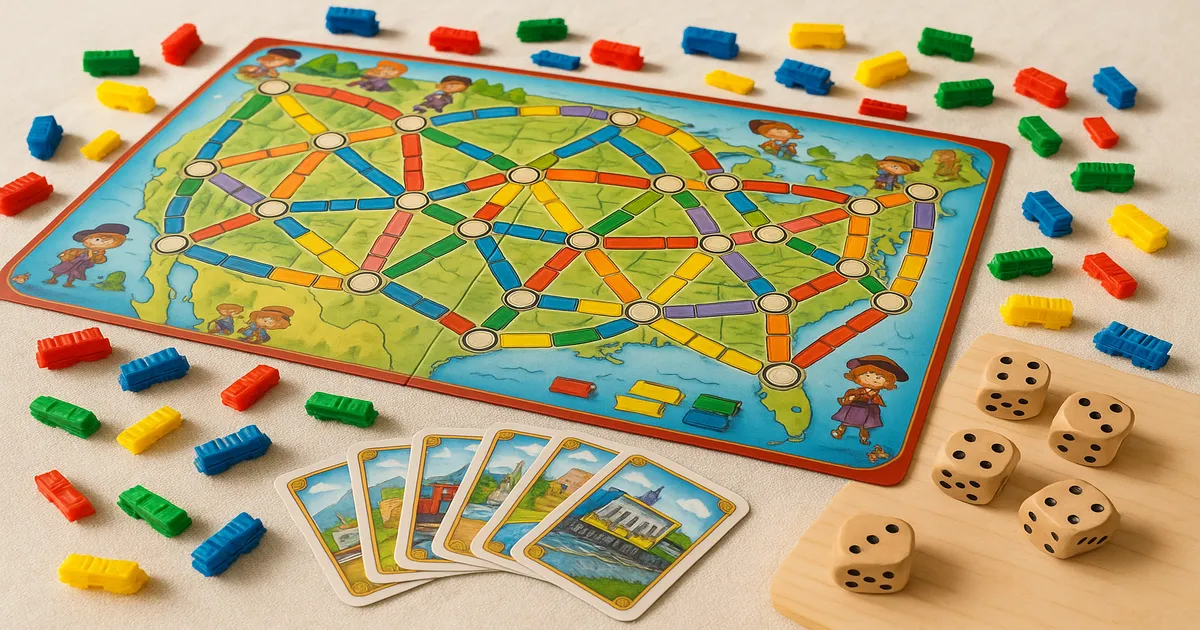
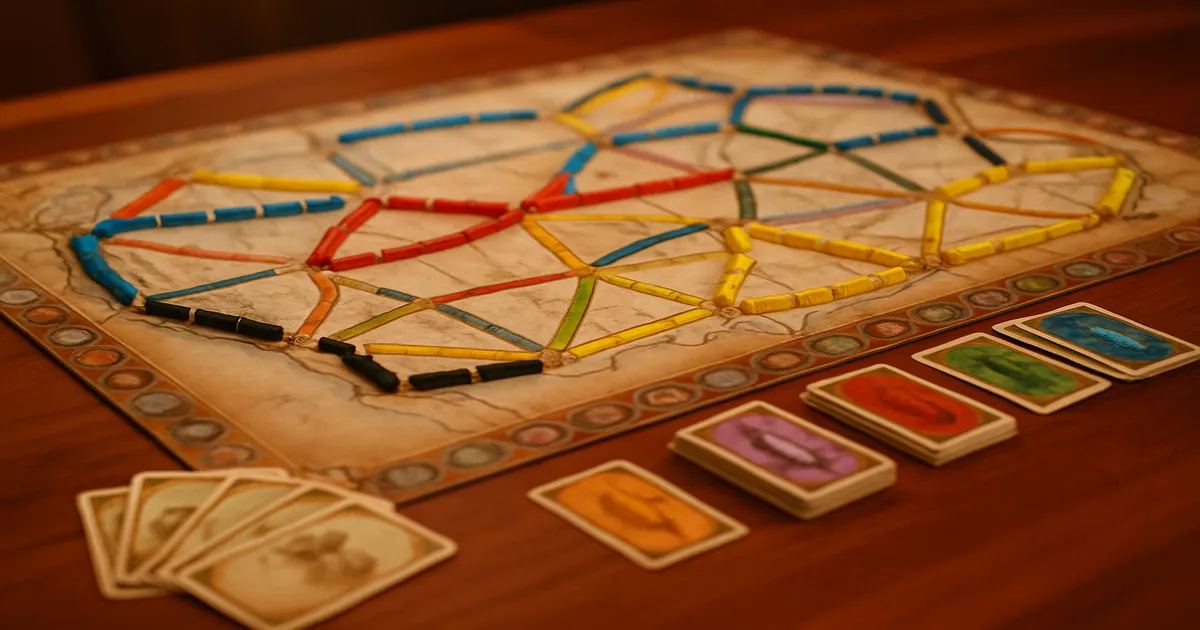
- 1 game board (North America map, approximately 28” × 20”)
- 240 colored Train Car Cards (8 colors plus locomotives)
- 225 plastic train pieces (45 per player in red, blue, green, yellow, and black)
- 30 Destination Ticket cards
- 1 Longest Train bonus card
- 5 wooden scoring markers
- Rules booklet
The plastic trains have a satisfying weight, the board is thick and glossy with a warm vintage travel-poster aesthetic illustrated by Julien Delval and Cyrille Daujean, and the whole thing looks great spread across a table. Cards are mini-Euro size (58mm × 89mm) — I’d recommend sleeving them for a game that sees this much table time.
A note on colorblind accessibility: The red-green colorblind experience is rough. Some routes and card colors are genuinely hard to distinguish without workarounds. Fan-made colorblind-friendly card sets exist and are worth tracking down if this affects anyone in your group.
How to Set Up Ticket to Ride
- Unfold the board in the center of the table.
- Each player takes 45 trains in their chosen color and places their scoring marker on the “1” space of the score track.
- Shuffle the Train Car Cards and deal 4 to each player. Place 5 face-up in a row (the display) and put the rest face-down as the draw deck.
- Shuffle the Destination Ticket cards into a separate deck.
- Each player draws 3 Destination Tickets and must keep at least 2. Return any unwanted tickets face-down to the bottom of the pile. Nobody sees what you returned.
That last step is the most important decision in the first five minutes. Look for tickets that share cities — if two tickets both pass through Chicago, the routes serving them will overlap and you’ll spend fewer trains completing both. Tickets that send you to opposite corners of the map are usually a trap for beginners.
How to Play Ticket to Ride: Turn Structure
Every turn, you do exactly one of these three things. That’s it — and the simplicity is a big part of why the game works.
Action 1: Draw Train Car Cards
Draw 2 cards — any combination of face-up display cards or blind draws from the top of the deck. Refill any gaps in the face-up display after drawing.
The locomotive rule that catches everyone: If you take a face-up locomotive (wild card), that counts as both of your draws. You get just that one card. Taking a face-down locomotive from the deck is fine — it counts as one of your two draws normally.
Action 2: Claim a Route
Play a set of matching colored cards equal to the length of the route, place your trains on the board, and immediately score points. Gray routes can be claimed with any single color, but all cards played must match each other — no mixing colors on a gray route.
Double routes (two parallel tracks between the same cities) have a player count rule worth knowing: in 2–3 player games, only one player can claim each double route. In 4–5 player games, both tracks are open.
Action 3: Draw Destination Tickets
Draw 3 Destination Tickets and keep at least 1. Return the rest face-down to the bottom of the pile. More tickets mean more potential points — but also more potential penalties if you can’t finish them.
Ticket to Ride Scoring Explained
Route Points
| Route Length | Points |
|---|---|
| 1 train | 1 pt |
| 2 trains | 2 pts |
| 3 trains | 4 pts |
| 4 trains | 7 pts |
| 5 trains | 10 pts |
| 6 trains | 15 pts |
This curve is the central strategic insight of the whole game. A 6-train route scores 15 points. Six separate 1-train routes score 6 points using the same number of trains. Long routes win games — full stop.
Destination Tickets
At the end of the game, reveal all your Destination Tickets. Completed tickets add their printed value to your score. Incomplete tickets subtract that value. A ticket worth 20 points that you didn’t finish costs you 20 points — that swing can absolutely decide a close game.
Longest Train Bonus
One player earns +10 points for having the longest continuous route on the board. It must be an unbroken chain — a branching network doesn’t count. In a tight game, 10 points is enormous.
Final Score
Add up: route points (already tracked on the score track) + completed ticket values − incomplete ticket values + 10 if you have the Longest Train bonus. Tiebreaker goes to whoever completed more Destination Tickets.
How the Game Ends
When any player has 2 or fewer train pieces left, the end game triggers — but the game doesn’t stop immediately. Every other player gets one final turn, then scoring begins. This is one of the most common rules mix-ups I see, so worth flagging early.
Common Mistakes New Players Make
Rules mistakes:
- Taking a face-up locomotive plus another card — you only get the locomotive.
- Mixing colors on a gray route — all cards must match.
- Returning all three tickets when drawing — you must keep at least one.
- Forgetting that unfinished tickets subtract points.
- Assuming the game ends the moment someone hits 2 trains — it doesn’t.
- Forgetting to move your scoring marker after claiming a route.
Strategic mistakes:
Hoarding cards is probably the most common beginner trap — waiting until you have “enough” before claiming anything, while opponents quietly block the routes you needed. The board fills up faster than it looks.
The other big one is chasing short routes for quick points. Those 1- and 2-train routes feel productive, but they’re terribly inefficient. If you finish a game with a bunch of short routes and your opponent claimed two 6-train routes, you probably lost to the scoring curve.
Ticket to Ride Strategy Tips
Early game: Keep tickets that share cities or overlapping corridors. Identify your “spine” — the longest route that serves multiple tickets — and claim it before someone else does. Don’t telegraph where you’re going in your first couple of turns.
Mid game: Always take the longer route when you have a choice. Watch what colors opponents are drawing — it usually signals where they’re headed. In 4–5 player games, blocking is a real strategy: sometimes claiming a route you don’t need is worth it to deny a critical connection. Save locomotives for routes where you’re short on the right color. Drawing blind from the deck occasionally hides what you’re collecting from observant opponents.
Late game: Watch your opponents’ train counts. If someone is burning through them fast, you have less time than you think. Avoid drawing new Destination Tickets in the final rounds unless you’re certain you can finish them. Before you trigger the end game, count whether you can actually complete everything you’ve committed to with the trains you have left.
Expansions and What to Play Next
Best Ticket to Ride Editions
Ticket to Ride: Europe is my honest recommendation for groups that have played the base game a few times. It adds tunnels, ferries, and train stations — the stations give you a second chance when you get blocked, which makes it slightly more forgiving and, frankly, more interesting.
Other editions worth knowing:
- First Journey — simplified for ages 6+, great for kids
- New York — 10–15 minutes, excellent for two players
- Rails & Sails — hybrid trains and boats across a world map
- Japan & Italy — double-sided map; Japan adds a bullet train mechanic
If you’re playing Ticket to Ride regularly, a custom insert or organizer makes setup dramatically faster — the out-of-the-box storage isn’t great once you start mixing in expansion maps.
Games to Try Next
| Game | Why Consider It |
|---|---|
| Carcassonne | Similar weight, tile placement, great gateway |
| Pandemic | Co-op gateway, similar play time |
| Azul | Abstract set collection, faster |
| Wingspan | More complex engine builder, popular next step |
| Railways of the World | Heavier train game for when you want more |
| Brass: Birmingham | Expert network builder, very different feel |
Quick guide:
- Absolute beginners → Ticket to Ride or Carcassonne
- Kids 6+ → First Journey
- Want more depth → Ticket to Ride: Europe or Railways of the World
- Competitive players who want crunchier decisions → Brass: Birmingham
Frequently Asked Questions
Can you block other players in Ticket to Ride?
Yes, and it’s completely legitimate. Claiming a route your opponent needs — even if you don’t need it yourself — is a real strategic move, especially in 4–5 player games where the board gets congested fast. Just don’t be surprised when they return the favor.
How does the Longest Train bonus work?
At the end of the game, the player with the longest single continuous chain of connected routes earns 10 bonus points. It has to be one unbroken path — your total network doesn’t count if it branches. In a close game, this bonus can flip the result.
Is Ticket to Ride good for 2 players?
It works, but it’s not the best experience. With only two players, the board stays open and the blocking tension largely disappears. If you’re regularly playing at two, I’d point you toward Ticket to Ride: New York instead — it plays tighter and faster.
What happens if you don’t complete a Destination Ticket?
You subtract the ticket’s printed point value from your final score. A 20-point ticket you didn’t finish costs you 20 points — the same amount it would have added. This is why drawing more tickets late in the game is risky.
What’s the difference between Ticket to Ride and Ticket to Ride: Europe?
The core rules are the same, but Europe adds tunnels (routes that may require extra cards to claim), ferries (require locomotives), and train stations (let you use one opponent route to complete a ticket). Europe is slightly more forgiving when you get blocked, and many experienced players consider it the better overall game.