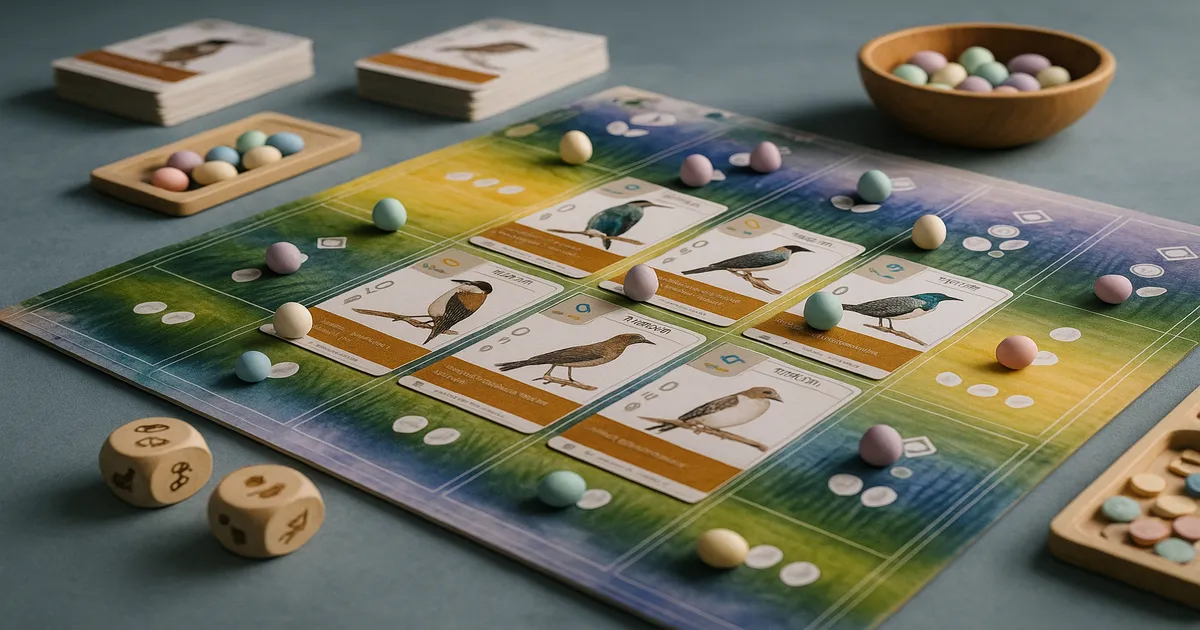
Quick Answer: Wingspan is a 1–5 player engine-building game where you attract birds to three habitats — Forest, Grassland, and Wetland. Each turn you take exactly one of four actions: play a bird, gain food, lay eggs, or draw cards. After four rounds of decreasing turns, the player with the most points across five scoring categories wins.
Wingspan (1–5 players, 40–70 minutes, BGG weight 2.45/5) is one of those rare games that hooks people who’ve never touched a hobby board game in their life. Designed by Elizabeth Hargrave and published by Stonemaier Games, it won the Kennerspiel des Jahres in 2019 and hasn’t slowed down since. If you’re figuring out how to play Wingspan — whether you just cracked open the box or you’re prepping to teach it to someone — this guide covers everything from setup to strategy.
What Is Wingspan? Overview and Components
The Goal of the Game
You’re a bird enthusiast building a wildlife preserve. Over four rounds, you’ll attract birds to three habitats, each of which powers a different core action. Birds generate cascading bonuses, and your tableau grows more powerful as you fill it out. At the end, whoever has accumulated the most points across birds, eggs, bonus cards, and round goals wins.
What’s in the Box
The component list is genuinely impressive for the price:
- 170 unique bird cards, each featuring a real species with factual information
- 26 bonus cards
- 75 wooden egg tokens in pastel colors
- 5 player mats (double-sided)
- 1 birdfeeder dice tower with 5 custom wooden dice
- 103 food tokens in five types: worms, berries, seeds, fish, and rodents
- 75 action cubes, round-end goal tiles, a scorepad, and solo Automa cards
Component Quality
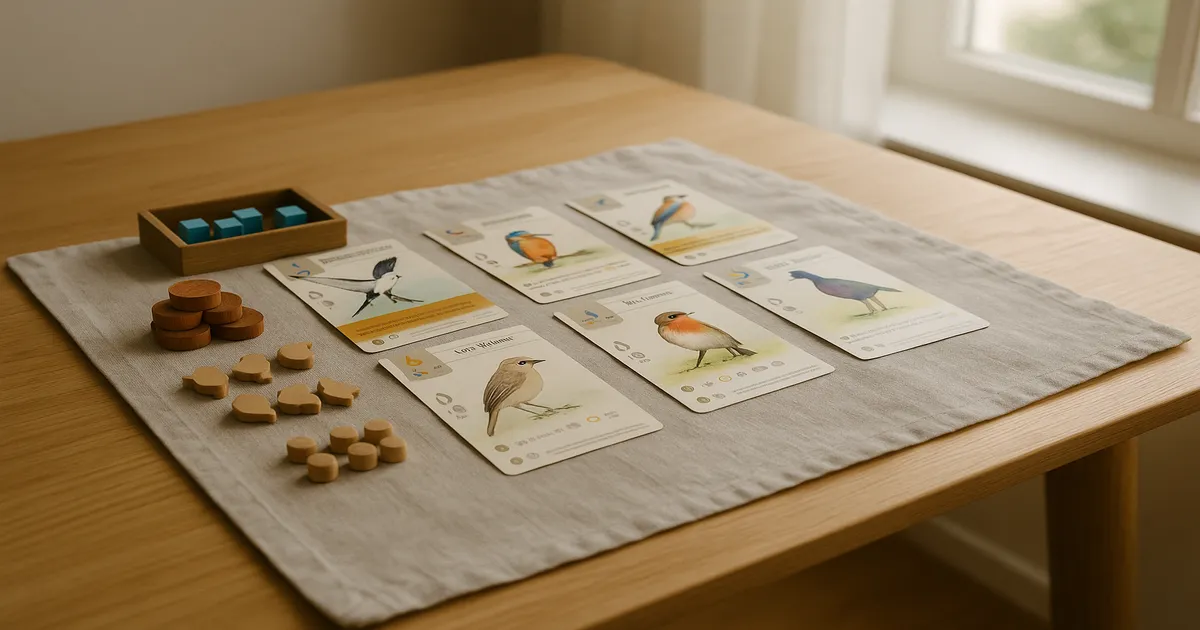
Honestly, the components are half the reason this game went viral. The pastel wooden eggs are small, tactile, and weirdly satisfying to handle. The birdfeeder dice tower is both functional and thematic — it solves the “where do I roll these dice” problem elegantly. The bird cards feature naturalistic artwork by Natalia Rojas, Ana Maria Martinez Jaramillo, and Beth Sobel that looks closer to a gallery exhibit than a game box. A fully set-up game of Wingspan is one of the most photogenic tables in the hobby.
One caveat: the player mats can warp over time. Plenty of players eventually upgrade to the neoprene version.
The bird cards are also worth sleeving — you’ll be shuffling them constantly, and the artwork deserves protection. (Mayday Games Standard American Sleeves)
Setting Up Your First Game of Wingspan
Dealing Out Bird and Bonus Cards
Each player gets a player mat, 8 action cubes, a starting hand of 5 bird cards, and 5 food tokens. You’ll discard some of each to balance your starting hand — the exact amounts depend on how many cards you keep. You’re also dealt 2 bonus cards and keep 1.
Read both bonus cards before you choose. This is the single most important setup tip I can give. A bonus card can be worth 5–10+ VP, and it should shape your entire game plan from turn one.
Setting Up the Bird Tray and Birdfeeder
Place 3 bird cards face-up in the central bird tray with the deck alongside it. Load all 5 dice into the birdfeeder tower and give it a shake. Whatever faces show are the food types available to the first player who gains food.
Round-End Goal Tiles
Draw 4 round-end goal tiles and place them face-up in the goal row — one per round. These are public from the start, so you can plan around them immediately.
How a Turn Works: Your Four Actions Explained
Each turn, you take exactly one of four actions. That’s the whole turn structure. The elegance is in how those actions interact with the birds you’ve already played.
Play a Bird Card
Choose a bird from your hand, pay its food cost, and place it in one of your three habitats. Birds in columns 2–5 also require eggs — 1 egg for column 2, up to 4 eggs for column 5. If the bird has a white “when played” power, trigger it immediately.
Gain Food (Forest Habitat)
Take dice from the birdfeeder matching the food types you want, then collect the corresponding tokens. If the feeder is empty, reroll all dice before taking yours — this rule gets skipped surprisingly often. Then activate your Forest birds from right to left.
Lay Eggs (Grassland Habitat)
Place egg tokens on birds in your Grassland, then activate Grassland birds right to left. Eggs are both a resource (you need them to play more birds) and end-game points.
Draw Bird Cards (Wetland Habitat)
Draw 1–2 cards from the face-up tray or the deck, then activate your Wetland birds right to left. Card draw fuels your future turns — a strong Wetland engine gives you options when you need them most.
Habitat Activation: Right to Left
This is the most misunderstood rule in the game, and getting it wrong breaks the engine-building mechanic entirely. When you take a habitat action, you activate birds in that row starting from the rightmost bird and moving left. The bird you just played doesn’t activate — only previously placed birds do.
Why does direction matter? Because birds you play earlier in a row activate more often. Your first Forest bird fires every time you gain food. Your fifth Forest bird fires exactly once — when you play it. That’s the whole engine-building loop. Early birds compound over time.
Round Structure and Scoring
The Four Rounds
The game runs four rounds with a shrinking turn count: 8 / 7 / 6 / 5 turns per player. Fewer turns as the game progresses creates real urgency. Rounds 1 and 2 are for building your engine; Rounds 3 and 4 are for cashing it in.
Round-End Goal Tiles
At the end of each round, players compare boards against that round’s goal tile — things like “most birds in the Wetland” or “most eggs on brown nest birds.” Points are awarded on a descending 4/3/2/1 track. You don’t have to win a goal to score from it — second or third place still earns points.
Five Ways to Score Points
- Printed VP on bird cards — each played bird is worth 0–9 points
- Bonus card objectives — your secret card rewards specific conditions you’ve built toward
- Round-end goal points — whatever you earned across all four rounds
- Eggs on birds — every egg still on your birds at game end = 1 VP
- Cached food and tucked cards — birds that store food or tuck cards under themselves contribute 1 VP per token or card
Winning scores typically land between 75–95 points in a competitive game. A rough breakdown might look like: 40 VP from birds, 8 from a bonus card, 9 from round goals, 14 from eggs, 8 from tucked cards. If you’re ignoring any of these five categories, you’re leaving points on the table.
Common Mistakes New Players Make
Activating Habitats Left to Right
Left to right feels intuitive. It’s wrong. Burn “right to left” into your memory before your first game.
Forgetting the Egg Cost to Play Birds
The food cost is printed prominently on the card. The egg cost — tied to which column you’re placing into — is easy to miss. Columns 2 through 5 cost 1 through 4 eggs respectively. Forgetting this makes your engine feel broken in ways that are hard to diagnose mid-game.
Mixing Up White, Brown, and Pink Powers
- White — trigger once, when the bird is played
- Brown — trigger when you activate that habitat (your main engine)
- Pink — trigger once between your turns, on other players’ turns
Pink powers especially get ignored. If you’ve got a bird that fires on opponents’ turns, pay attention to it — those points add up.
Forgetting Tucked Cards and Cached Food at Scoring
Each tucked card and cached food token is worth 1 VP at game end. I’ve seen players forget to count these entirely and lose by exactly that margin. Count everything.
Hoarding Resources Instead of Playing Birds
Don’t stockpile eggs and food without actually playing birds — your engine only runs if birds are in the habitats. And don’t play expensive 5–6 food birds in Round 1. They rarely generate enough value before the game ends.
Wingspan Strategy Tips
Specialize Early, Diversify Late
In Rounds 1 and 2, pick one or two habitats and load them with birds. A focused engine beats a scattered one every time. By Rounds 3 and 4, you’ll have the resources to branch out if needed.
Prioritize Brown Powers Over Raw VP
High-point birds with no powers are traps for new players. A 4-VP bird that tucks a card every time you activate its habitat will outperform a 7-VP bird that does nothing. Brown-power birds are the backbone of any strong engine.
Think About Each Habitat Differently
Forest is your food engine. Prioritize birds that generate bonus food or let you pick specific types. Predator birds that “hunt” by rolling dice can be swingy but rewarding.
Grassland is your egg engine, and eggs unlock everything else. A strong Grassland means you can afford to play more birds overall.
Wetland is your flexibility engine. Card draw gives you options, and options win games — especially in the late rounds when you need specific birds.
Commit to Your Bonus Card
You chose it at setup, so build toward it. If it rewards Wetland birds, bias your picks toward the Wetland. Players who treat their bonus card as an afterthought are giving up free points every single game.
When to Chase Round Goals
If a round goal aligns naturally with your strategy — say, “most eggs” when you’re already running a Grassland engine — lean into it. If chasing it would require abandoning your engine, it’s usually not worth the detour. A focused engine player who ignores round goals will often beat a goal-chaser who never builds momentum.
Solo Mode, Expansions, and What to Try Next
The Wingspan Solo Mode
The solo mode uses an Automa system designed by Morten Monrad Pedersen, and it’s one of the best solo implementations in the hobby. A small deck of Automa cards simulates an opponent who competes for round goals and bird tray cards without requiring you to manage a full second player. It plays in about 30–40 minutes and scales in difficulty. Genuinely worth your time even if you have people to play with.
Wingspan Expansions, Ranked
- Oceania (2020) — the best expansion, full stop. It adds 95 birds, a nectar food type, and revised player mats that improve the base game’s flow. Buy this one first.
- Asia (2022) — adds 90 birds, a 2-player duet mode, and can be played standalone. Great for couples or if you mostly play at two.
- European (2019) — the first expansion; solid but outclassed by later releases. Good for adding variety without changing the base game much.
- South America (2024) — the newest entry, continuing the geographic series with fresh mechanics.
Games Similar to Wingspan
| Game | Weight | Why You’d Like It |
|---|---|---|
| Everdell | 2.79 | Engine building, gorgeous art, similar complexity |
| Cascadia | 1.73 | Nature theme, lighter, great for families |
| Ark Nova | 3.72 | Conservation theme, heavier and meatier |
| Viticulture | 2.88 | Fellow Stonemaier game, resource management |
| Ticket to Ride | 1.86 | Lighter gateway game, set collection |
Frequently Asked Questions About Wingspan
How long does a game of Wingspan take?
Most games run 40–70 minutes depending on player count and experience. A 2-player game between people who know the rules can finish in under an hour. With 4–5 players who are learning, budget closer to 90 minutes.
Is Wingspan hard to learn?
Not really. BGG rates it 2.45/5 for complexity. The four-action turn structure is simple to explain, and the bird powers do most of the heavy lifting once you understand white, brown, and pink abilities. Most people are playing confidently by Round 2 of their first game.
How does scoring work in Wingspan?
Points come from five sources: printed VP on bird cards, your bonus card objective, round-end goal points, eggs remaining on birds (1 VP each), and cached food or tucked cards under birds (1 VP each). Add them all up on the scorepad — winning scores typically land between 75 and 95 points.
Can you play Wingspan solo?
Yes, and it’s excellent. The Automa system gives you a competitive opponent that interacts with the bird tray and round goals without needing to simulate a full player turn. It’s one of the most praised solo modes in the hobby and plays in around 30–40 minutes.
What’s the best Wingspan expansion to buy first?
Oceania, without hesitation. It adds 95 birds, introduces the nectar food type, and comes with revised player mats that many players consider an upgrade over the base game originals. It integrates seamlessly and adds meaningful depth without bloating the rules.