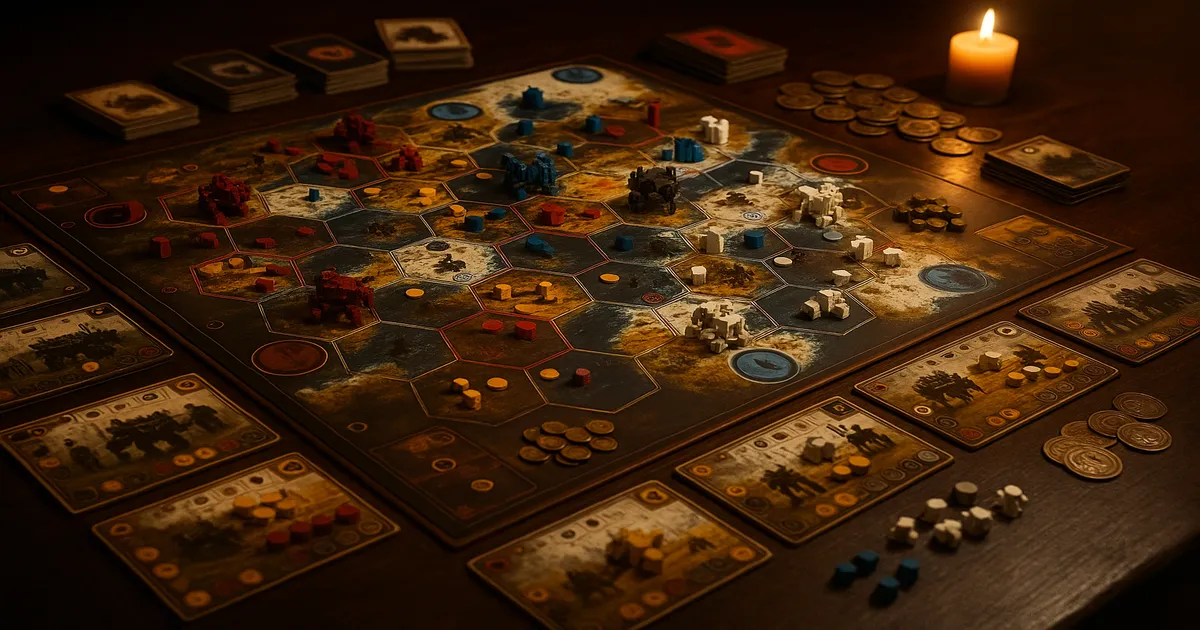
Quick Answer: Scythe is a 1–5 player engine-building area-control game set in an alternate-history 1920s Eastern Europe. Each turn you take paired actions to generate resources, build your economic engine, and race to place 6 Stars on the Triumph Track. Despite all the mechs on the table, combat is costly and often avoidable — the player who builds the most efficient engine usually wins. Expect 90–115 minutes with experienced players, longer with newcomers (BGG weight 3.4/5).
If you’ve been trying to figure out how to play Scythe but keep bouncing off the rulebook, you’re in good company. The box has a reputation, and it’s not entirely undeserved — there’s a lot going on. But here’s the thing: the core turn structure is genuinely elegant. Most people hit a wall in the first few turns, then somewhere around turn 5 or 6 something clicks, and suddenly it all makes sense. After that, it’s one of the smoothest games you’ll own.
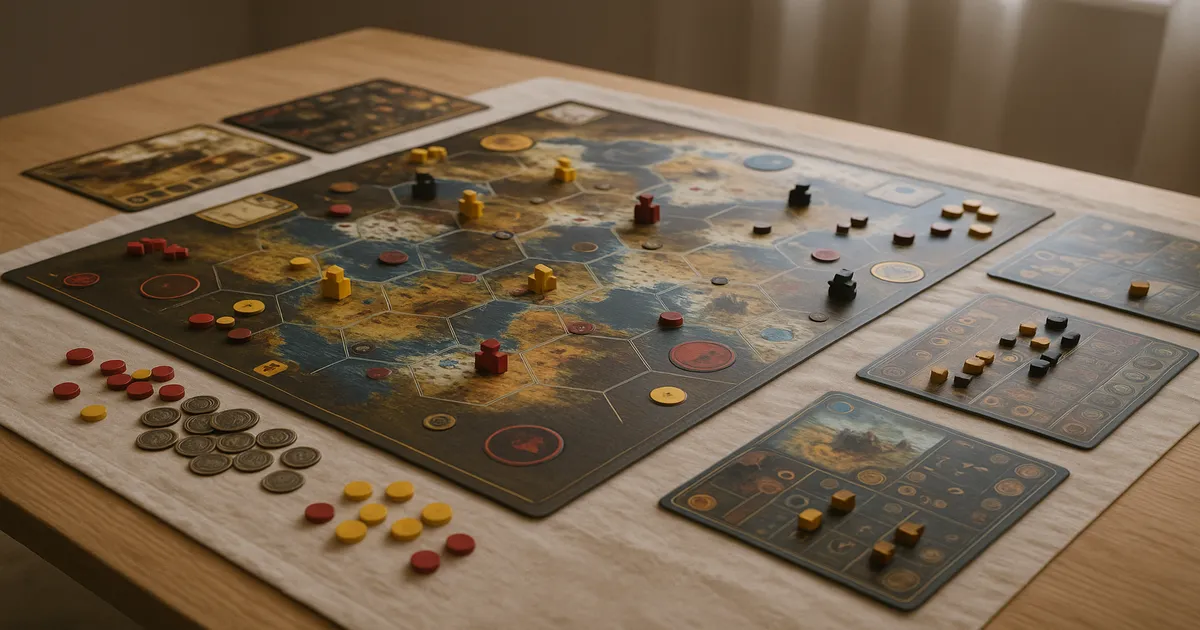
Scythe Overview: Theme, Components, and Table Presence
The World of Scythe
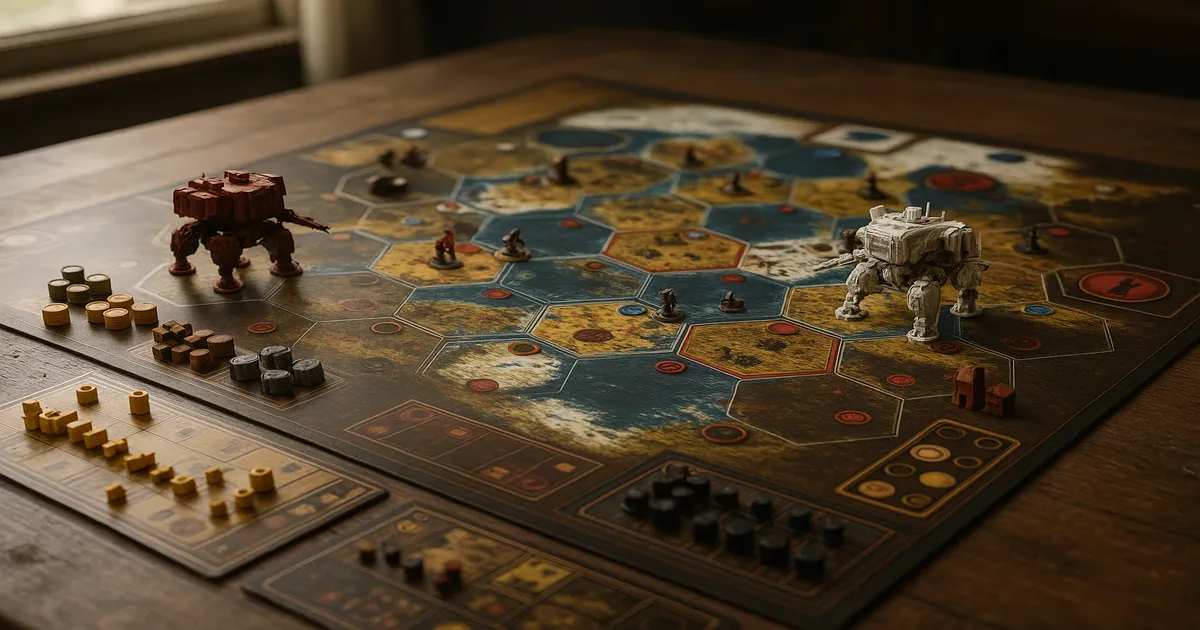
Scythe is set in a dieselpunk version of 1920s Eastern Europe, inspired by the paintings of Polish artist Jakub Różalski and his “1920+” art series. The result is genuinely strange in the best way: folk imagery and agrarian village life sharing space with massive iron mechs trudging through wheat fields. It shouldn’t work. It absolutely does.
The game was designed by Jamey Stegmaier and published by Stonemaier Games.
What’s in the Box
The base game comes loaded:
- 1 large game board (roughly 35” × 23”)
- 5 Faction Mats and 5 Player Mats
- 25 large plastic miniatures (1 character + 4 mechs per faction)
- Wooden worker tokens (8 per faction), resource tokens, and structure tokens
- Cardboard coins in multiple denominations
- Combat cards, encounter cards, objective cards, and an Automa solo deck
- Power dials and the Triumph Track overlay
The base game retails for around $80–$90 USD. (Scythe) The miniatures are exceptional for this price point — large, detailed sculpts that look great even unpainted. The cardboard coins are the one weak spot in the whole package, and upgrading to metal coins is genuinely worth it. A neoprene mat set is a popular upgrade too, both for aesthetics and to stop those player mats from sliding around mid-game.
When it’s all set up on the table, Scythe has a presence that’s hard to match. It’s one of those games that makes people stop and ask what you’re playing.
Scythe Setup: Factions, Player Mats, and Starting the Game
The Five Base Game Factions
Each faction has a unique ability, starting position on the board, and set of mech powers. Here’s the short version:
- Polania — Draws two encounter card options instead of one; rewards a mobile, aggressive character
- Rusviet — Can repeat the same action section on consecutive turns, which is uniquely powerful
- Crimea — Can spend combat cards as resources, giving incredible economic flexibility
- Nordic — Starts with extra workers and crosses rivers freely; built for early expansion
- Saxony — No cap on combat or objective stars; can win through pure military pressure
Faction Mats and Player Mats Are Separate
This trips up a lot of new players. Your Faction Mat (which faction you are) and your Player Mat (which action layout you use) are assigned independently. You might get Polania paired with the Militant Player Mat, or Rusviet paired with Agricultural. That random combination is a huge driver of replayability — each pairing plays differently, and figuring out how to make your specific combo work is half the fun.
Board Setup
Place encounter tokens on their printed territories, put the Factory card face-down at the board’s center, and have each player set their character and starting workers on their home territory. Starting resources, popularity, and power are printed on each Faction Mat — follow those exactly. Once you know what you’re doing, setup takes about 10 minutes.
How to Play Scythe: The Action Pair System
This is the heart of the game. Get this right and everything else follows.
Your Player Mat and the Action Pawn
Your Player Mat has four sections arranged in a grid. Each section has a top action and a bottom action. On your turn, move your Action Pawn to any section — then you may take the top action, the bottom action, both, or neither. You just have to pay the costs.
The critical rule: you cannot move your pawn to the same section you used last turn. This is the most commonly broken rule in the game. Write it on a sticky note if you have to.
Top Actions: Move, Bolster, Trade, Produce
- Move — Move up to 2 units one territory each, OR gain $1. Mechs, workers, and your character all count as units.
- Bolster — Gain power and/or combat cards. Essential for threatening combat without committing to it.
- Trade — Gain 2 resources (any combination of oil, metal, food, wood), OR gain popularity.
- Produce — Each territory you select with workers on it produces that territory’s resource type, up to the number of workers present. No workers means no production.
Bottom Actions: Upgrade, Deploy, Build, Enlist
Bottom actions cost resources, but this is where your engine actually gets built:
- Upgrade — Move a cube from a top action to a bottom action slot, permanently improving both. Do this early and often.
- Deploy — Place a mech on a territory with a worker, unlocking that mech’s unique ability. Mechs also expand your movement options and protect workers.
- Build — Place a structure (mill, mine, monument, or armory) on a worker territory for ongoing bonuses.
- Enlist — Gain a recruit bonus tile and a one-time reward. After enlisting, your neighbors trigger your bonus whenever they take that bottom action. Easy to forget, significant over time.
Why the No-Repeat Rule Matters
Forcing you off the same section every turn creates constant interesting tension. You’re always asking: do I need resources now, or should I push another upgrade? It prevents the repetitive optimal loops that make some engine-builders feel solved after a few plays. It’s a small rule with a big effect on how the game feels.
Combat, Stars, and How to Win Scythe
How Combat Works
Combat triggers when your character or mech moves into a territory occupied by enemy units. Both players secretly set their power dial (0 up to your current power level), then optionally play combat cards face-down. Reveal simultaneously — highest total wins. The loser retreats to their home base; the winner pays whatever power they committed.
Workers never fight. If you move into a territory with only enemy workers, those workers retreat automatically with no combat.
Combat Is Costly — and Often Avoidable
This surprises new players more than anything else. You can easily go an entire game with one or two combats, and that’s completely normal. Spending power leaves you exposed in future fights, and losing combat is a serious setback. The game is fundamentally about economic positioning. The mechs are mostly there to threaten combat and unlock movement abilities — not to actually fight.
Earning Stars on the Triumph Track
The game ends the moment any player places their 6th Star — immediately, mid-round if necessary. Stars come from eight sources:
- Winning combat (maximum 2 stars total)
- Completing all 6 upgrades
- Deploying all 4 mechs
- Building all 4 structures
- Enlisting all 4 recruits
- Placing all 8 workers on the board
- Completing an objective card
- Reaching maximum popularity or power (faction-dependent)
Final Scoring: Why Popularity Is Everything
When the 6th star triggers the end, everyone scores coins held, then multiplies stars, territories, and resources by a factor set by their popularity tier:
| Popularity | Stars | Territories | Resources |
|---|---|---|---|
| Low (0–3) | ×3 | ×2 | ×1 |
| Mid (4–12) | ×4 | ×3 | ×2 |
| High (13–18) | ×5 | ×4 | ×3 |
Structure bonuses apply on top of all that.
I’ve watched new players dominate the star race and lose by 20+ coins because they let their popularity sit at 2 the whole game. Popularity isn’t a side stat — it’s a multiplier across three scoring categories. Treat every point of it like money in the bank.
Common Mistakes New Scythe Players Make
- Repeating sections — You cannot return to the section you just used. Every single turn.
- Producing without workers — Territories only produce if you have workers there.
- Misreading the end condition — The game stops the instant someone places star 6, not at end of round.
- Forgetting Enlist bonuses — Once you enlist, those neighbor-triggered bonuses fire constantly and add up fast.
- Ignoring the Factory — Getting to the Factory at the board’s center gives you a fifth action option. It’s almost always worth the trip.
- Hoarding resources — Sitting on a pile of metal and oil feels safe. Spending it on bottom actions is what actually wins games.
Scythe Strategy Tips
Build the Engine First
Your first 4–6 turns should be almost entirely upgrades, deploys, and enlists. You’re building the machine before you race it. Resist the urge to expand aggressively before your action efficiency is where it needs to be. Attacking in turn 3 because you can almost always backfires.
Faction-Specific Tips
- Rusviet — Chain Produce turns. Their repeat-section ability is the strongest in the game when used to stack resources fast.
- Crimea — Bolster constantly. Spending combat cards as resources makes them economically explosive without ever needing to fight.
- Nordic — Get workers out fast and claim territories before opponents can react. Your early-game advantage shrinks as the game develops.
- Polania — Move your character to every encounter territory you can reach. Double choices from encounter cards compound quickly.
- Saxony — Play aggressively. You’re the one faction with no cap on combat or objective stars, so use that.
Advanced: Control When the Game Ends
Track your opponents’ star counts in the late game. Knowing who’s at 4 or 5 stars tells you whether to race for your 6th or slow down and optimize your scoring position. Sometimes the right move is deliberately not placing a star so you control when the game ends.
The Mine structure connects all tunnel territories on the board, letting you teleport units across the map in a single Move action. If your natural play involves the Build action anyway, place the Mine first.
Scythe Expansions Worth Knowing About
- Invaders from Afar — Adds the Albion and Togawa factions, expands the game to 7 players. The obvious first expansion.
- The Wind Gambit — Adds airships with unique abilities and alternative end-game triggers. Changes the pacing noticeably.
- The Rise of Fenris — An 8-episode campaign widely considered one of the best campaign experiences in the hobby. Don’t start it until your group knows the base game cold.
- Encounters — Just more encounter cards. Minor addition, but nice once you’ve played through the base deck.
Scythe: Digital Edition is also available on PC and mobile — genuinely good for learning the rules and for solo play.
Games Similar to Scythe
| Game | Why It’s Similar | Key Difference |
|---|---|---|
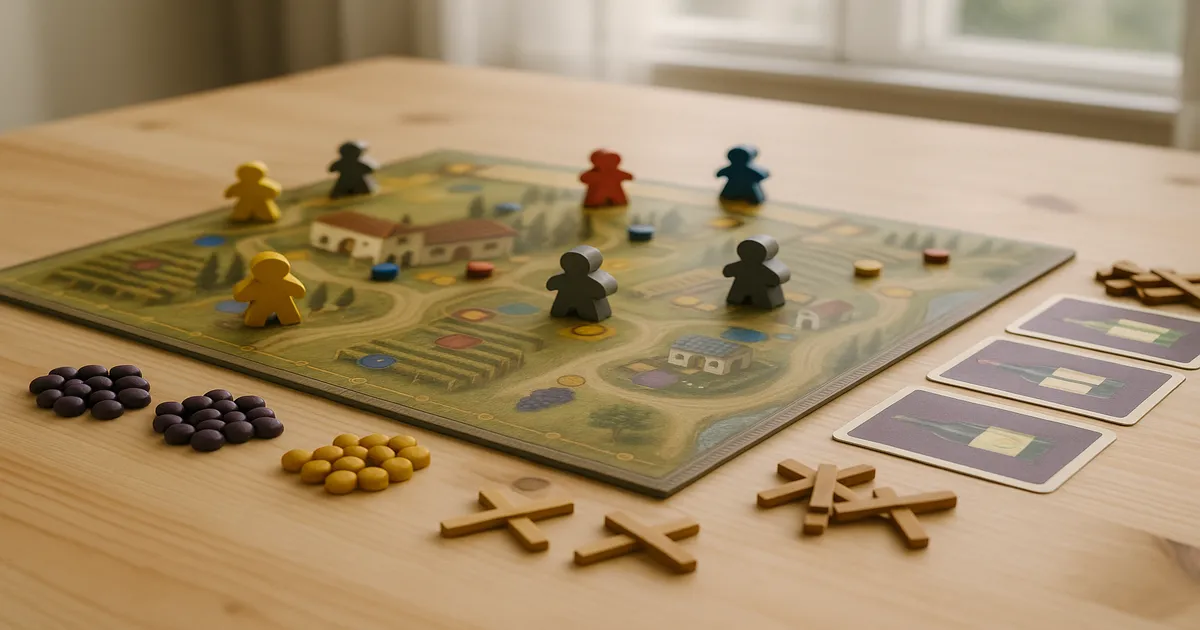
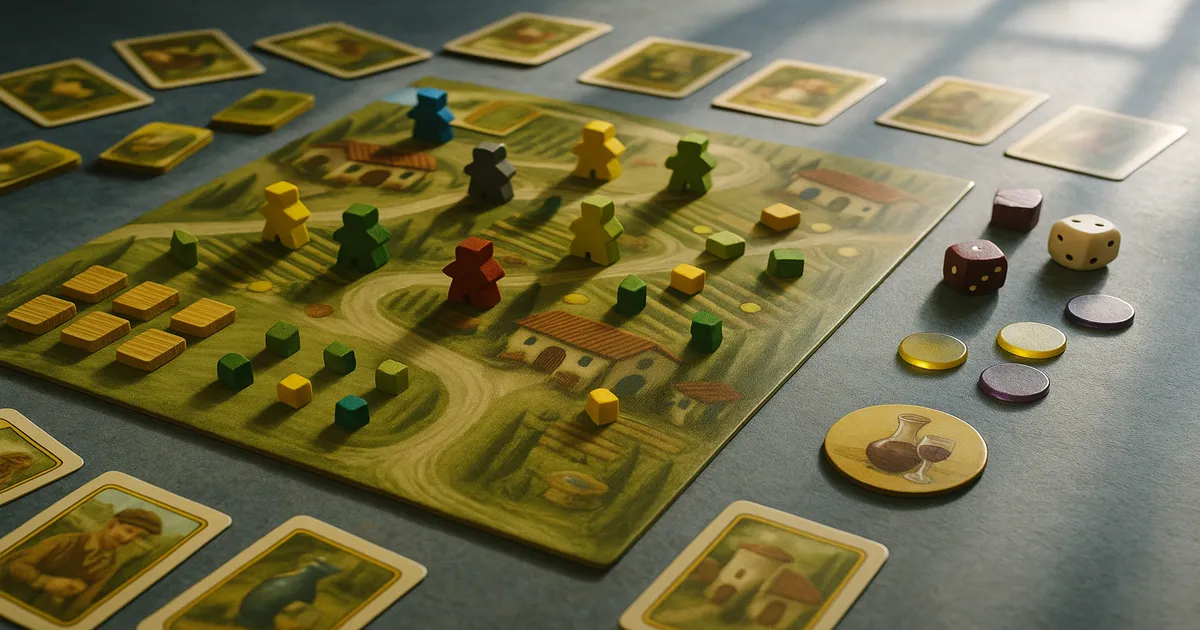
| Viticulture | Same designer, engine-building | Lighter, worker placement, wine theme |
| Root | Asymmetric factions, area control | Higher asymmetry, shorter play time |
| Wingspan | Engine-building, Stonemaier Games | No conflict, significantly lighter |
| Blood Rage | Minis, area control, combat | Much heavier combat focus |
| Terraforming Mars | Engine-building, tableau management | No area control |
| Rising Sun | Minis, area control | More combat and negotiation |
Frequently Asked Questions About How to Play Scythe
How long does a game of Scythe take?
With experienced players, expect 90–115 minutes. New player games routinely run 2.5–3 hours, especially if anyone tends toward analysis paralysis. The game gets noticeably faster as players internalize their faction’s rhythm — your third or fourth game will probably clock in under two hours.
Can you play Scythe with 2 players?
Yes, and it works well. Two-player games are more tense and direct since you’re not splitting attention across multiple opponents. Some people add the Automa (the built-in solo AI) as a third “player” to add board presence and competition for territories, though it’s not required.
What’s the best faction for beginners?
Nordic is probably the most forgiving starting faction — extra workers and free river-crossing make early expansion straightforward without requiring complex decision chains. Rusviet is powerful but demands that you really understand the repeat-section mechanic to use it well. Steer new players away from Saxony until they’re comfortable; the aggressive playstyle leads to costly early mistakes.
How does scoring work at the end?
Scoring triggers the moment any player places their 6th Star. You count coins held, then multiply your stars, territories, and resources by a factor determined by your popularity tier (low, mid, or high). Structure bonuses apply on top. The popularity multiplier is the part most new players underestimate — it applies to three separate categories simultaneously and regularly determines the winner.
Is Scythe hard to learn?
It’s medium-heavy (BGG weight 3.4/5), so it’s not a great first-ever board game. But for someone who’s played a handful of modern games — Catan, Ticket to Ride, Pandemic — it’s very teachable. The turn structure is simple once you grasp the action-pair system, and the rulebook is well-written. The complexity comes from strategic depth, not from a tangle of exceptions and special cases.