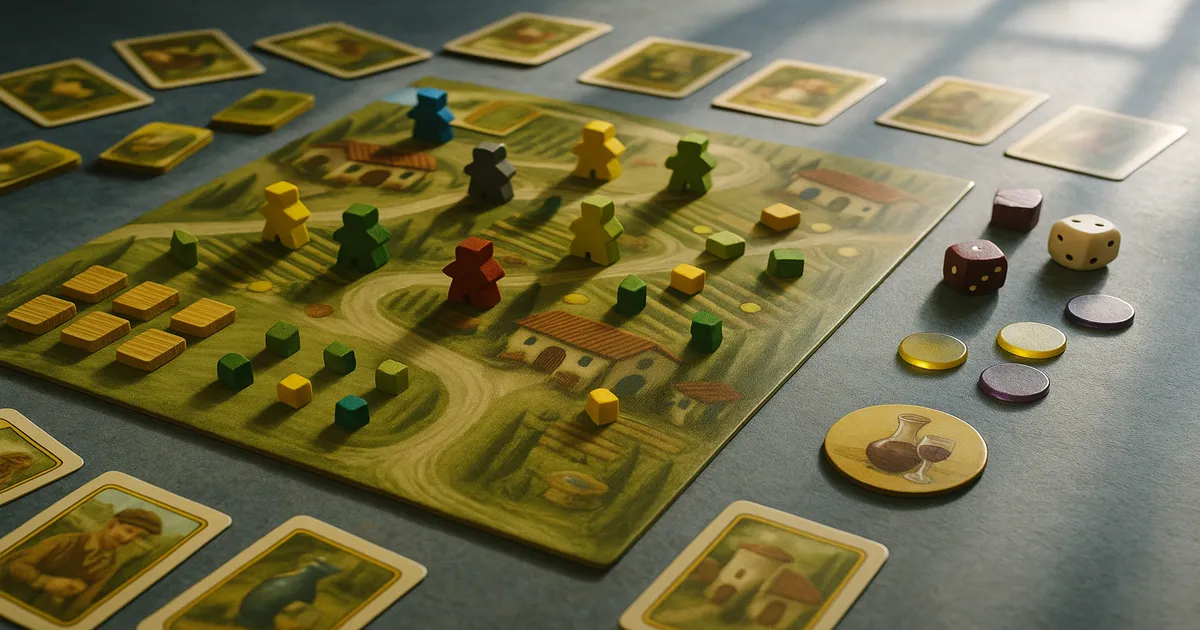
Quick Answer: Viticulture is a medium-weight worker placement game for 1–6 players (45–120 minutes, BGG weight 2.9/5) where you build a Tuscan winery, plant vines, make wine, and fill orders to reach 20 Victory Points first. The game runs on a satisfying four-season structure that gives every year a genuine narrative arc. Get the Essential Edition — it’s the definitive version.
If you’ve been wondering how to play Viticulture, the board game from Stonemaier Games, here’s the honest take: it’s one of those rare games where the theme actually makes the rules easier to learn. You’re running a small Tuscan winery, and almost every action — planting vines, harvesting grapes, aging wine, filling orders — maps onto something that just makes sense. That tight theme-mechanic fit is a big part of why this game has stuck around so long.
How Does Viticulture Work? The Core in 60 Seconds
Each year moves through four seasons: Spring (choose turn order), Summer (place workers on summer actions), Fall (draw a visitor card), and Winter (place workers on winter actions). Your whole engine is one chain: get vine cards → plant them → harvest grapes → make wine → fill orders → score VP. First to 20 points wins.
That’s genuinely it. The seasonal structure makes the rules feel logical rather than arbitrary, and most groups are playing confidently by the end of Year 2.
Who Is Viticulture Best For?
If you loved Wingspan or Everdell, you’ll almost certainly love this. It sits at a similar weight — teachable in about 20 minutes, with enough strategic depth to stay interesting after 30+ plays. It also has one of the best solo modes in the worker placement genre, so it holds up even when you can’t get a group together.
What’s in the Box
Main Board and Player Boards
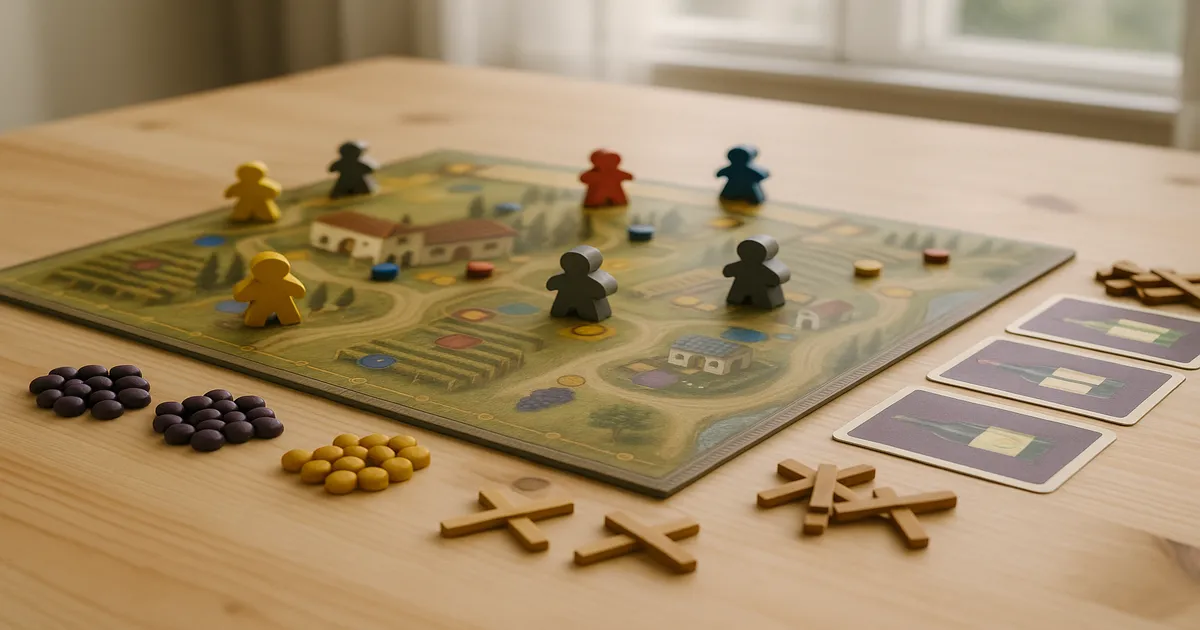
The central board holds all the seasonal action spaces. Each player gets their own vineyard mat — a thick individual board with spaces for your fields, crush pad, and wine cellar. The quality is genuinely good; these aren’t flimsy player aids.
Cards: Vines, Visitors, and Wine Orders
Four card decks drive the game:
- Vine cards — the crops you plant; each shows red and/or white grape values
- Summer Visitor cards — one-time effects played in summer
- Winter Visitor cards — one-time effects played in winter
- Wine Order cards — the orders you fill to score VP and build residual income
You also start with a Mama card and a Papa card, which give each player asymmetric starting resources — different mixes of lira, workers, structures, or cards. New players consistently underestimate how much these matter.
Tokens, Meeples, and the Grande Worker
The grape and wine tokens are cardboard in the base game, and they’re the most common upgrade target. Glass bead sets are popular and genuinely improve the tactile experience.
The Grande Worker is the standout component — an oversized meeple that can be placed on any action space, even one already occupied. It’s satisfying to hold and even more satisfying to drop at exactly the right moment.
The lira coins are also cardboard, which works fine but feels a little flat for a game this thematic. Stonemaier sells official metal lira coins separately, and if you play this regularly, they’re worth picking up. A custom insert helps a lot at setup too — the default tray is functional but slow.
Beth Sobel’s art throughout the Essential Edition is warm and painterly — sun-drenched Tuscan countryside, charming visitor portraits. It’s one of the most inviting-looking games you can put on a table.
Setting Up Your First Game of Viticulture
Place the main board in the center, shuffle each of the four card decks separately, and set out the tokens, lira, and VP markers. Each player takes a player board, meeples, a rooster token, and a residual income marker.
Deal each player one Mama card and one Papa card. Players look at both and keep one — the other is discarded. Mama cards typically give lira, workers, or vine cards; Papa cards often include structures or special starting conditions. Read both carefully before deciding, because your choice shapes your entire opening.
Skip any advanced variant rules on your first play. Just run the base game.
How to Play Viticulture: The Four-Season Turn Structure
Spring: Choosing Your Wake-Up Tile
At the start of each year, players secretly choose a Wake-Up tile numbered 1 through 7. Lower numbers mean earlier turn order; higher numbers come with bonuses — extra lira, a VP, a card draw, or special tokens. This is one of the most interesting decisions in the game, and new players almost always undervalue the higher tiles. Going last all game because you always want first pick is a real mistake.
Summer: Placing Workers
Starting with the player who chose tile 1, players alternate placing one worker at a time on summer action spaces. Key summer actions:
- Draw a vine card
- Plant a vine in one of your three fields
- Build a structure (Trellis, Irrigation, Wine Cellar, etc.)
- Give a tour for 2 lira
- Play a Summer Visitor card
Once all players pass, summer ends.
Fall: Drawing a Visitor Card
Each player draws one card — their choice of a Summer or Winter Visitor. It’s quick, but don’t rush it. The card you pick here can meaningfully set up your winter.
Winter: Placing Workers Again
Winter works the same as summer, but the action spaces are different:
- Harvest a field (move grape tokens to your crush pad)
- Make wine (convert grapes into wine tokens)
- Fill a wine order (deliver wine to score VP + residual income)
- Draw a wine order card
- Train a worker (pay 4 lira to add a meeple to your supply)
- Play a Winter Visitor card
End of Year
Once all players pass in winter: workers return to your supply, all grapes and wines age up by one value automatically, and residual income is paid out. Check if anyone has hit 20 VP. If not, Spring begins again.
The Resource Chain: From Vine to Victory Points
Vine Cards → Plant → Harvest → Make Wine → Fill Orders → VP
Internalizing this chain is the single most important thing a new player can do.
Planting requires checking your vine card first — many vines need a Trellis, Irrigation, or both before you can legally plant them. The most powerful vines almost always have prerequisites. Building infrastructure early isn’t glamorous, but it unlocks the cards that make your engine run.
Harvesting pulls grape tokens onto your crush pad — a red track and a white track, each running 1 to 9. The value depends on what’s planted in that field.
Making wine converts those grape tokens into wine tokens. Basic red and white wines need no upgrades. Rosé requires a Medium Cellar; sparkling wine requires a Large Cellar. Those upgraded wine types fill the highest-value orders, so building cellar upgrades mid-game is usually worth it.
Filling orders is where one rule trips up almost every new player: wine orders require wine of at least the stated minimum value, not exactly that value. If an order calls for a red wine of value 3, a red wine of value 5 fills it just fine. Don’t hold wine waiting to hit an exact number — that’s not how it works.
Aging happens automatically at year-end: every grape and wine token increases by one value. A red wine at value 4 becomes a 5 next year without you doing anything. Powerful — but aging wine while opponents race to 20 VP can cost you the game. Don’t let it become an excuse to delay filling orders.
Residual income is the compounding advantage most new players ignore. Every time you fill a wine order, your residual marker advances. At each year-end, you collect lira equal to your marker position. Players who build this to 3 or 4 by mid-game have a real economic edge that only grows. I’ve watched new players ignore this entirely and wonder why they ran out of money in Year 6.
Common Mistakes New Players Make
Forgetting the Grande Worker. It can go on any space, including occupied ones. New players either forget it exists or save it for a “perfect moment” that never comes. Use it.
Misreading vine planting requirements. Check your vine card before you take the Plant action. If it requires Irrigation and you haven’t built it yet, you can’t plant — full stop.
Confusing grapes with wine. Grapes on your crush pad are not wine. You cannot fill an order with grapes. You must take the Make Wine action first. Sounds obvious; people still try to skip it.
Defaulting to tile 1 every round. The VP bonus on tile 7 is often worth going last, especially mid-game when you have enough workers to still get things done.
Building too long without scoring. Viticulture moves faster than it looks. Players who spend three or four years building infrastructure without scoring VP routinely find themselves 8–10 points behind with no clean path back. Fill orders by Year 3 or 4 at the latest.
Strategy Tips
Early game: Build around your Mama/Papa cards. If you started with a Trellis, lean into planting high-value vines immediately. If you have extra lira, consider training a third worker in Year 1 or 2 — going from two to three workers is the single biggest efficiency jump in the game.
Mid game: Start filling orders even with modest wine. You want residual income flowing. Keep an eye on the VP track — once someone hits 15, you should be in full scoring mode.
Late game: Every action should be evaluated by its VP output. Building structures in Year 8 is almost never correct. Fill orders with whatever wine you have, use your Grande Worker to block contested spaces, and stop optimizing your engine.
Visitor cards: Don’t hoard them hoping for the perfect moment. Mid-game is when they’re most valuable — play them aggressively.
How Viticulture Compares to Similar Games
vs. Wingspan — Same publisher, same artist (Beth Sobel), similar weight, but they play quite differently. Wingspan is more self-contained tableau-building with less direct competition. Viticulture has more player interaction through worker placement blocking — you’ll genuinely feel the tension when someone takes the space you needed.
vs. Agricola — Agricola is the heavier, more stressful cousin. The starvation mechanic creates pressure that some players love and others find exhausting. Viticulture is more forgiving; you can recover from a bad year. If you want a pleasant evening, Viticulture wins easily.
vs. Everdell — Comparable weight, similarly beautiful art. Everdell has more complex card tableau synergies; Viticulture has tighter theme integration. Both are excellent — owning both is completely reasonable.
If you want to go deeper after the base game, the Tuscany Essential Edition expansion is the recommended next step and is widely considered to make an already great game even better.
Frequently Asked Questions About Viticulture
How does the Grande Worker work in Viticulture?
The Grande Worker is an oversized meeple that can be placed on any action space, including ones already occupied by other players’ workers. Each player has exactly one. It doesn’t give you a free action — it just removes the blocking restriction, which in a contested game is enormously powerful.
How does wine aging work in Viticulture?
At the end of every year, all grape tokens on your crush pad and all wine tokens in your cellar automatically increase by one value — no action required. This rewards patience, but aging wine while opponents race to 20 VP can cost you the game. Don’t let it become an excuse to delay filling orders.
Do you need the exact wine value to fill a wine order?
No — and this trips up almost every new player. Wine orders require wine of at least the stated minimum value. If an order asks for a white wine of value 2, any white wine of value 2 or higher satisfies it. You never need to hit an exact number.
How do you play Viticulture solo?
The Essential Edition includes an Automa deck — a card-driven solo opponent system designed by Morten Monrad Pedersen. Each round you flip Automa cards to determine which action spaces the Automa “blocks,” simulating a competitive opponent without a second player. It’s one of the best solo implementations in the worker placement genre and plays in about 45 minutes.
What’s the difference between Viticulture and Viticulture Essential Edition?
The original Viticulture (2013) was a solid game, but the Essential Edition (2015) incorporated the best content from the Tuscany expansion — including the improved Wake-Up track, Mama & Papa starting cards, and revised action spaces — into the base box. It’s the definitive version and the one the community actively plays. Unless you find an original copy for almost nothing, there’s no reason to buy anything other than the Essential Edition.