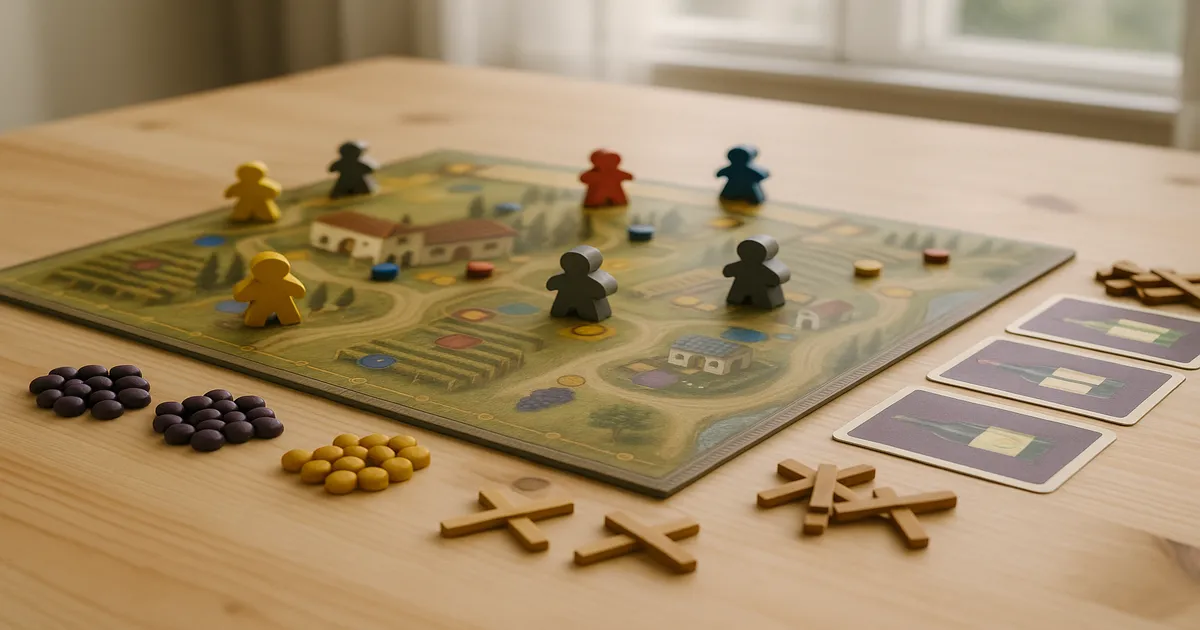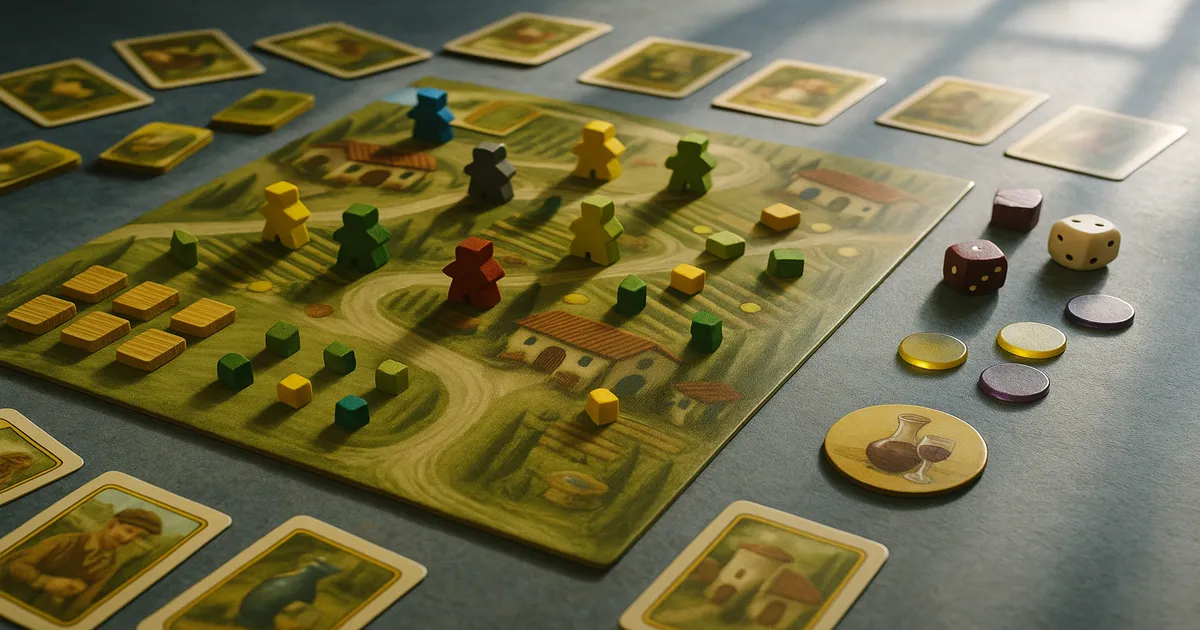
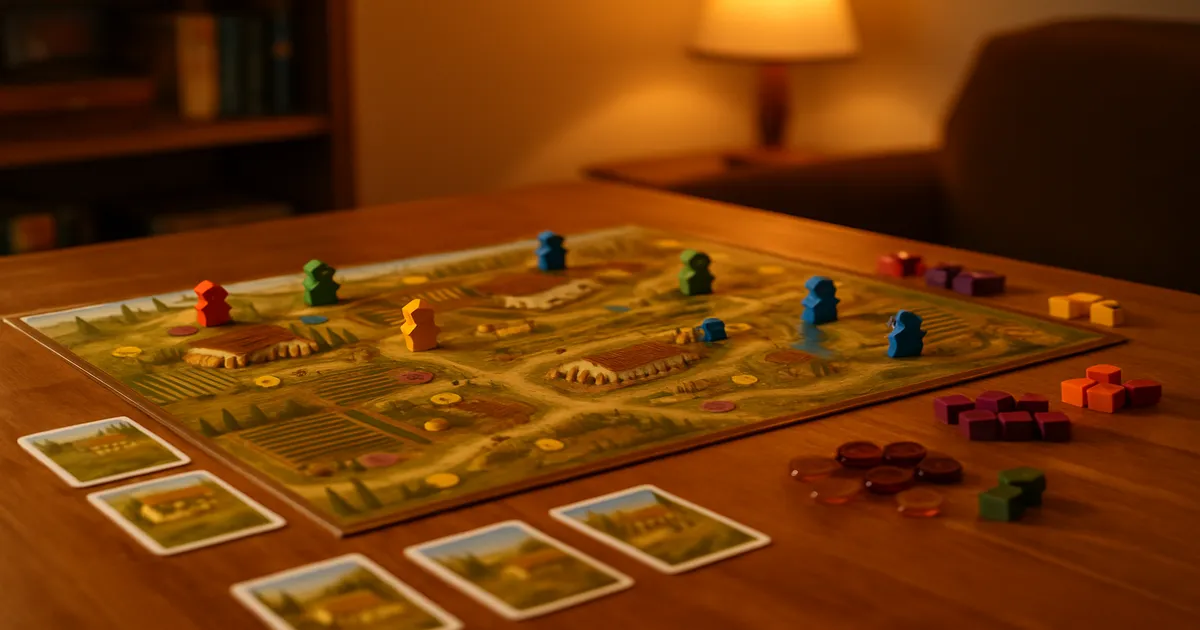
Quick Answer: Tuscany Essential Edition is an expansion for Viticulture Essential Edition — you need the base game to play it. Together they create one of the best worker placement games around: a 1–6 player game about running a Tuscan winery, with Tuscany adding modular layers of complexity you can introduce gradually. Expect sessions of 60–120 minutes once Tuscany is in the mix.
If you’re trying to figure out how to play Viticulture Tuscany, the first thing to know is that Tuscany isn’t a standalone game. It’s an expansion that snaps onto Viticulture Essential Edition, replacing the main board and adding several optional modules you can mix and match. The result is one of the most satisfying medium-weight euros on the market — thematically coherent, mechanically elegant, and genuinely fun to teach.
What You Need to Play Viticulture Tuscany
You need Viticulture Essential Edition plus Tuscany Essential Edition . Tuscany isn’t optional fluff — it substantially reworks the game. Designer Jamey Stegmaier curated the Essential Edition specifically to include only the most beloved and well-balanced modules from the original 2014 Tuscany release, cutting content that had received mixed reception. It’s a tighter package, and for most players it’s the better buy.
Game at a glance:
- Players: 1–6 (2–4 is the sweet spot)
- Play time: 60–120 minutes with Tuscany
- BGG weight: ~2.9–3.1/5 depending on modules
- Theme: Running a Tuscan vineyard — planting grapes, making wine, filling orders, building structures
You don’t have to add all of Tuscany at once. The modules are designed to layer in gradually, so you can start simple and ramp up as your group gets comfortable.
How Viticulture Works: Core Rules
The Seasonal Turn Structure
Each round represents one year, split into four seasons. You cycle through Spring, Summer, Fall, and Winter before retrieving your workers and starting again. The game typically runs seven rounds and ends the moment any player hits 20 victory points — whoever has the most VP at that point wins, with lira as a tiebreaker.
Spring: The Wake-Up Track
Spring is deceptively simple: players place their rooster on the wake-up track to set turn order. Going first gives you priority on action spaces, but going later earns compensatory bonuses — extra lira, cards, or a free victory point.
This is one of Viticulture’s cleverest mechanics. New players almost always default to going first, and it’s almost always the wrong call. Those late-position bonuses compound over seven rounds in ways that are easy to underestimate.
Summer and Winter: Placing Workers
In Summer, players alternate placing workers on action spaces to draw and plant Vine cards, build structures, give tours for lira, and play Summer Visitor cards. Winter follows the same rhythm but shifts to harvesting fields, making wine, filling orders for VP, training new workers, and playing Winter Visitor cards.
Fall: Drawing Visitor Cards
Fall is quick — each player draws one Summer or Winter Visitor card of their choice. Don’t skip past this step mentally. Visitor cards are some of the most powerful tools in the game, and picking the right type based on your current situation is a real decision.
Year End: Aging Grapes and Wine
At the end of each year, every grape on your crush pad and every wine in your cellar ages by one value. A red grape at value 2 becomes a 3; a white wine at value 4 becomes a 5. This is the step people most often forget — set a reminder until it’s habit, because skipping it quietly breaks the game’s economy.
How to Play Viticulture Tuscany: Every Module Explained
The Extended Board and Influence Map
The Tuscany board fully replaces the original. It’s larger, better laid out, and introduces the Influence Map — a stylized region of Italy divided into territories. During the game you can place influence tokens on these territories, and at game end, whoever holds majority presence in each region scores bonus VP.
This is the one module I’d never play without. It adds a compelling end-game layer without much rules overhead, and it gives players something to fight over beyond action spaces.
Special Workers
These workers are purchased during play and each has a unique ability:
- Farmer — can be placed on an occupied space (similar to the Grande Worker, but cheaper to acquire)
- Innkeeper — after you use a space, opponents can’t use it that round
- Mentor — triggers all training bonuses when placed on the train worker action
- Handyman — builds structures at a discount
- Vendor — draws extra cards when placed on card-drawing actions
New Structures
Tuscany adds buildable structures beyond the base game. The Cottage is the standout — it lets you draw a free Visitor card every Fall, which dramatically accelerates your hand quality over a full game. The Tasting Room rewards you for giving tours. Both are worth prioritizing when they’re available.
Mamas and Papas: Asymmetric Starting Setups
Each player draws a Mama card and a Papa card at game start, giving everyone a unique combination of starting resources — different amounts of lira, workers, cards, or pre-built structures. Tuscany adds more of these cards on top of what’s already in the Essential Edition. This module alone adds massive replayability without adding much complexity.
Which Modules to Start With
Start with the Extended Board (it’s nearly mandatory for the improved layout and Influence Map) and Mamas & Papas. Once your group has a few games under their belt, layer in Special Workers and the New Structures. Throwing everything in at once with new players is a recipe for analysis paralysis — don’t do it.
Common Mistakes New Players Make
Forgetting year-end aging is the most common rules error. Put a sticky note on the board if you have to.
Misunderstanding cellar tiers trips up almost everyone early on. Your base cellar holds wines only up to value 3. The medium cellar unlocks values up to 6; the large cellar goes up to 9. You can’t make a value-5 wine before building the medium cellar — check your wine orders first, then plan your cellar upgrades accordingly.
Ignoring the wake-up track bonuses is a slow bleed. Going last and collecting a free VP every round adds up to 7 VP over a full game. That’s often the margin of victory.
Wasting the Grande Worker is painfully common. The Grande Worker goes on a full space — one already occupied by another player’s worker. New players treat it like a regular meeple and miss its entire purpose. Save it for the spaces your opponents have already claimed.
Tuscany-specific: ignoring the Influence Map entirely and handing opponents 5–10 end-game VP for free. Even a modest presence in two or three regions pays off.
Strategy Tips
Build your wine pipeline early. Plant vines in years 1–2, harvest in years 2–3, and aim to fill your first orders by year 3–4. Read your wine orders before you plant — grow what you need, not just what’s available.
Train a third worker in year 1 or 2. Starting with two workers is genuinely constraining. More actions means a faster engine, and a faster engine means earlier VP. Don’t delay this.
Treat the wake-up track as a resource. Your position is a deliberate choice every round, not a default. Going later costs you turn priority but pays you in lira, cards, or VP. Factor it in.
Claim the Influence Map early. Staking early claims is far cheaper than fighting for territory later. Two or three tokens in the right regions can be worth 4–6 VP at game end — treat it as a background investment.
The Innkeeper and Handyman offer the most consistent value among special workers. The Innkeeper can lock opponents out of key spaces at critical moments; the Handyman saves lira on structure builds. Budget for at least one special worker per game.
Component Quality and Upgrades
Stonemaier’s component quality is genuinely good, and Beth Sobel’s watercolor art gives the game exceptional table presence. Two upgrades are worth considering for heavy play. The cardboard lira coins are functional but feel cheap — a metal coin set is a satisfying tactile upgrade. Resin grape and wine tokens replace the abstract cubes with tokens that actually look like grapes and wine bottles, which new players in particular respond well to. If you’re playing frequently, card sleeves are worth it to protect the visitor and vine decks.
How Viticulture Tuscany Compares to Similar Games
| Game | Weight | Players | Play Time |
|---|---|---|---|
| Viticulture + Tuscany | ~3.0 | 1–6 | 60–120 min |
| Agricola | 3.6 | 1–4 | 30–150 min |
| Wingspan | 2.5 | 1–5 | 40–70 min |
| Everdell | 2.8 | 1–4 | 40–80 min |
Agricola is heavier and more punishing — scarcity mechanics create a tenser, more stressful experience. Viticulture is friendlier; you’re rarely blocked out of everything you need. Wingspan is lighter and more forgiving, and if Viticulture is your gateway to euros, Wingspan is arguably the gateway to Viticulture. Everdell occupies similar weight territory but leans harder into card engine building, while Viticulture is about optimizing a production pipeline. I’d reach for Everdell with players who love tableau building; Viticulture suits players who enjoy sequencing a plan and watching it pay off.
What makes Viticulture with Tuscany genuinely special is that it works as a gateway game and holds up for experienced players. The seasonal structure is immersive, the wake-up track is one of the most elegant turn-order solutions in the genre, and Tuscany’s modularity means you can scale complexity to match your group. That combination is rare.
Frequently Asked Questions
Do you need Viticulture to play Tuscany?
Yes. Tuscany Essential Edition is an expansion, not a standalone. You need Viticulture Essential Edition (or the original Viticulture) to use it — Tuscany replaces the main board and adds components, but the base game’s cards, player mats, and core rules are still required.
Which Tuscany modules should beginners start with?
Start with the Extended Board and Mamas & Papas. The board is nearly essential for the improved layout and Influence Map; Mamas & Papas adds asymmetric starting setups without much rules overhead. Layer in Special Workers and New Structures once your group is comfortable.
What’s the difference between Tuscany Essential Edition and the original Tuscany?
The original 2014 Tuscany contained more modules than the Essential Edition. Jamey Stegmaier later curated Tuscany Essential Edition (released 2015) to include only the most popular and balanced content, trimming modules that had received mixed reception. For most players, the Essential Edition is the better buy.
How long does a game of Viticulture with Tuscany take?
Expect 60–90 minutes for an experienced group of 2–4 players, and up to 120 minutes at higher player counts or with new players learning the Tuscany modules for the first time.
Is Viticulture good for two players?
Yes — it’s quite good at two. The two-player side of the board adjusts action space availability, and the game becomes more tactical with direct blocking mattering more. Some players actually prefer it at two. The solo Automa mode is also worth trying; it’s one of the better solo implementations in the genre.