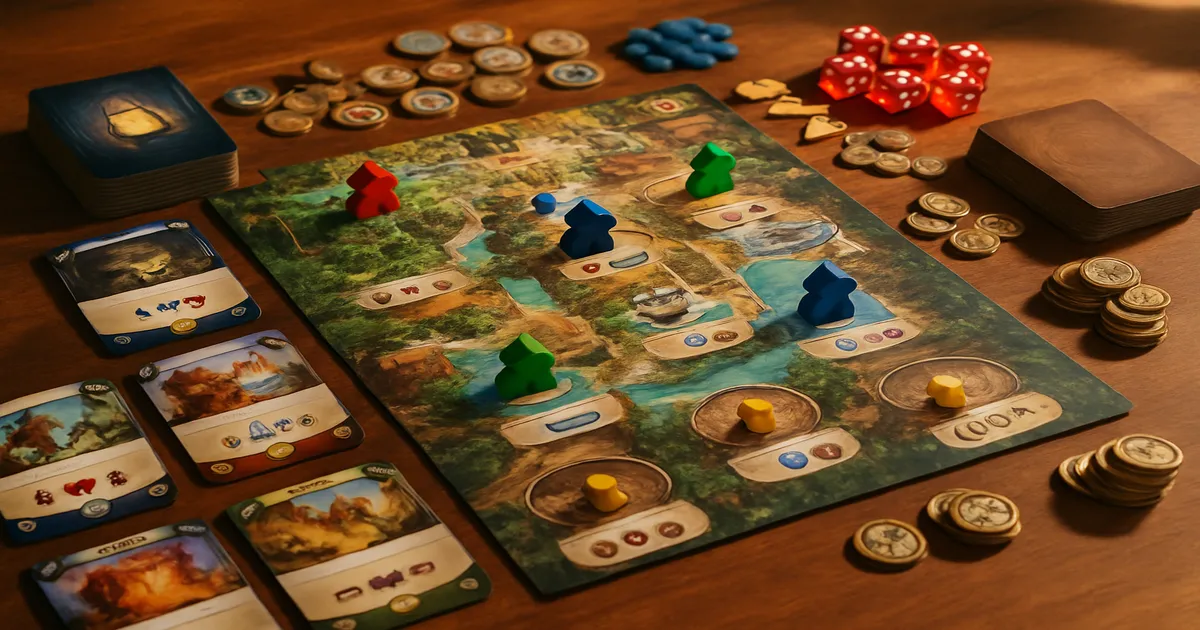
Quick Answer: Lost Ruins of Arnak is a 1–4 player euro game that blends worker placement, deck building, and track advancement into one surprisingly cohesive package. Over exactly 5 rounds, you’ll explore a jungle island, fight guardians, buy powerful cards, and climb the Research Track to earn victory points. The player with the most VPs at the end wins — and the Research Track is almost always where the game is decided.
If you’re trying to figure out how to play Lost Ruins of Arnak, the good news is that the rules click together faster than you’d expect for a game with this much going on. Designed by Mín and Elwen, published by Czech Games Edition, it’s been sitting in BGG’s top 50 — sometimes top 20 — since its 2020 release (English edition 2021), and for good reason. The three-mechanism hybrid feels genuinely clever rather than gimmicky, and the pulp-adventure theme is better integrated than most euros manage.
What Is Lost Ruins of Arnak?
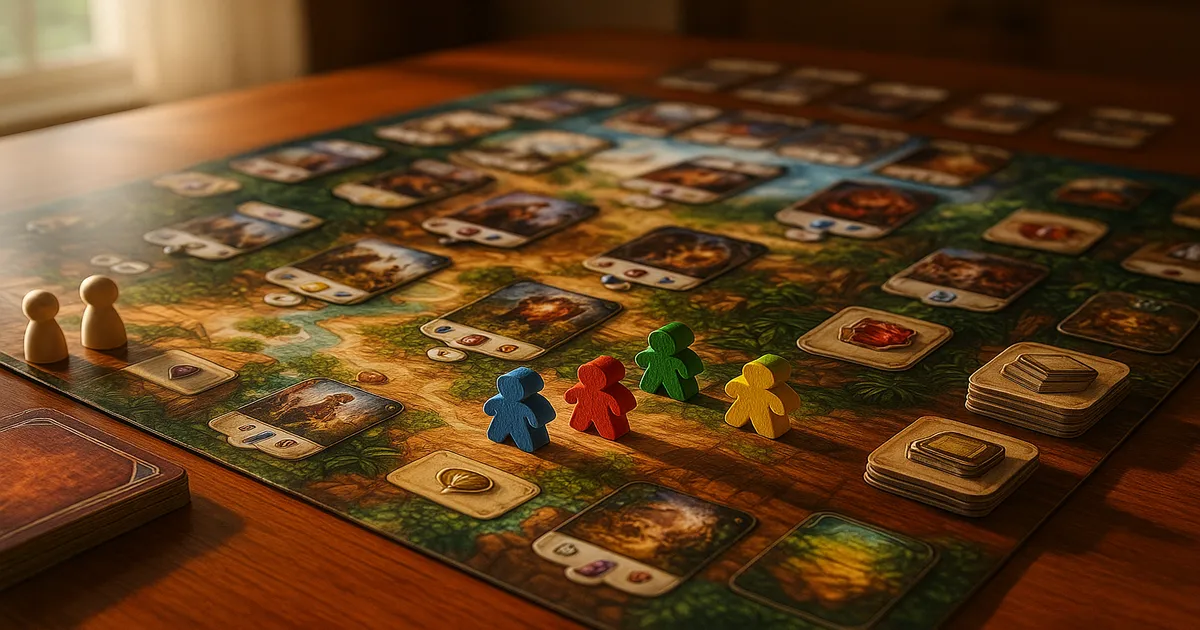
You’re a rival expedition leader exploring the mysterious island of Arnak — uncovering ruins, battling supernatural guardians, and piecing together ancient secrets. The vibe is somewhere between Indiana Jones and a South Asian archaeological dig, and the artwork absolutely sells it. Warm golden tones, lush jungle scenes, genuinely characterful card art — this is one of the best-looking games on the shelf.
The box says 1–4 players, ages 12+, 60–120 minutes. In practice, budget about 30 minutes per player once everyone knows the rules. Two or three players is the sweet spot; four works but adds noticeable downtime. The age recommendation is conservative — I’ve taught this to a sharp 10-year-old without much trouble.
Components and Setup
What’s in the Box
- Main game board (double-sided: standard and advanced)
- Research Track board
- 4 player boards (double-sided)
- 4 sets of player tokens: researchers, assistant, magnifying glass
- 90+ cards: starting decks, items, artifacts, Fear cards
- Location tiles, guardian tiles, idol tokens
- Resource tokens: coins, compasses, tablets, arrowheads, jewels
- Round marker, first player token, quick reference cards
Component quality is genuinely excellent. Tokens are thick and chunky, card stock is solid with a linen finish, and the table presence when everything’s set up is impressive. The original insert is mediocre — most people eventually upgrade to a third-party organizer.
If you’re picking up a copy, it’s worth grabbing sleeves for the cards too — they get handled a lot over multiple plays. (Dragon Shield Matte Standard sleeves)
Setup
Place the island map in the center and randomly arrange the numbered site tiles — this is what gives the game its replayability. Set up the card market supply row with item and artifact cards, place guardians on their designated sites, and put the Research Track board alongside the island. Each player gets a board, a set of tokens, and an identical starting deck (mostly basic resource cards with a couple of Fear cards mixed in). Everyone starts with two coins, one compass, and a hand of cards. Determine first player and you’re ready.
Resources and What They Do
Five core resources drive everything:
- Coins — buy cards from the market
- Compasses — explore new sites on the island
- Tablets — advance on the Research Track’s left path
- Arrowheads — defeat guardians and advance on the right path
- Jewels — wild resource for Research Track advances only
Fear cards are the anti-resource. When you explore a site with a guardian and don’t defeat it, a Fear card goes into your discard pile. They’re dead weight during play and each one costs you 1 VP at game end. That sounds minor until you’ve got four of them and lose by three points.
Idol tokens are found at certain sites and act as wild resources — but only for the Research Track, not for buying cards or fighting guardians. This trips up almost every new player. Save them for pushing up the track late in the game.
How to Play Lost Ruins of Arnak: Turn Structure
One Action at a Time
Players take turns in round-robin order, each taking exactly one main action, until everyone passes. No action points, no simultaneous play. This keeps things moving and means you’re constantly watching what opponents are doing.
The Main Actions
- Dig at a Site — place a researcher on a known location, pay the compass cost, collect the site’s resources
- Discover a New Site — place a researcher on a face-down tile, flip it, pay the cost, gain rewards
- Overcome a Guardian — spend arrowheads (or other required resources) to defeat the guardian at a site where your researcher already stands; earn the guardian tile
- Buy a Card — spend coins to take a card from the market row; it goes to your discard pile, not your hand
- Play a Card — play a card from your hand for its effect
- Research — advance your magnifying glass token on the Research Track, pay the required resources, gain the immediate bonus
- Pass — end your participation for the round
Free Actions and the Assistant
Most item cards are played as free actions — alongside a main action, not instead of one. The assistant token works similarly: place it on one of the small assistant spaces to grab a minor bonus. New players almost always forget about the assistant. It’s essentially a free extra action every round, so use it.
End of Round
Once everyone passes: collect end-of-round Research Track bonuses based on your current position, return all researchers from sites, and draw back up to 5 cards. Repeat for 5 rounds, then score.
The Research Track: Where Games Are Won and Lost
The track has five rows. You advance by paying resources — tablets for the left path, arrowheads for the right, jewels as wild. Each space you land on gives an immediate bonus right then. At the end of every round, you also collect an end-of-round bonus based on your current position, whether you moved there this round or three rounds ago.
This is the single most common rules confusion in the game, so to be clear: immediate bonus = when you move there. End-of-round bonus = collected every round based on where you currently sit. They’re different things. Check both columns when you advance.
The paths diverge at row 4. Left favors tablets and knowledge-heavy strategies; right favors arrowheads and guardian combat. Both reach the top. By round 2 or 3, commit to one — splitting between them is inefficient.
Don’t treat the track as optional. The top positions are worth massive VP advantages, and the end-of-round bonuses compound over multiple rounds. I’ve watched new players spend five rounds building a beautiful deck and lose by 15 points to someone who barely bought any cards but climbed the track relentlessly. It’s not close.
Scoring
- Research Track position — the single largest VP source for most players
- Guardian tiles — each defeated guardian scores points
- Artifact cards — worth VPs plus powerful abilities
- Item cards — some have VP icons
- Idol tokens — unconverted idols score points at game end
- Fear cards — minus 1 VP each
Resources score nothing at game end. In round 5, leftover coins and compasses are worthless — convert everything you can into Research Track advances. It’s one of the more satisfying late-game pivots in the game.
Common Mistakes
Rules errors:
- Not taking a Fear card when you explore a site without defeating its guardian
- Confusing immediate vs. end-of-round Research Track bonuses
- Placing the assistant token on main site spaces instead of assistant spaces
- Expecting to play a card you just bought (it goes to your discard pile first)
- Using idols as general wildcards (Research Track only)
Strategic mistakes:
- Ignoring the Research Track — the most common losing strategy, full stop
- Buying too many mediocre cards early and diluting your deck
- Letting Fear cards pile up until round 4 when it’s too late to remove them
- Hoarding resources in round 5 instead of converting them to track advances
Strategy Tips
Rounds 1–2: Get on the Research Track immediately, even if it’s just one or two spaces. End-of-round bonuses accrue from round 1, so every round you delay costs you. Prioritize compass generation to unlock sites, and use your assistant every single round.
Rounds 2–4: Artifact cards are generally stronger than item cards and worth more VPs — they’re pricier, but the investment pays off. Commit to your track path. Deal with Fear cards now, not in round 5.
Rounds 4–5: Your only goal with leftover resources is pushing up the Research Track. Don’t buy cards you won’t play. Count your Fear cards and remove them if you have a mechanism to do so. Spare arrowheads? Grab guardian tiles — those points add up.
Always: Efficiency beats volume. One action generating three resources beats three actions generating one each. Watch your opponents’ track positions — end-of-round bonuses are collected by everyone at the same level, so being tied isn’t a disaster, but falling behind is.
How Lost Ruins of Arnak Compares
vs. Wingspan: Wingspan is cleaner and more streamlined — great for groups who want less cognitive overhead. Arnak has more direct competition through worker placement conflicts and more strategic depth. Wingspan is closer to multiplayer solitaire; Arnak has you watching opponents much more carefully.
vs. Dominion: Dominion is the foundational deck-builder, and Arnak builds on it by layering in worker placement and track advancement. If your group loves Dominion’s card synergies and wants more complexity and theme, Arnak is a natural next step — just know they feel quite different in play.
vs. Everdell: Both combine worker placement with card acquisition, but Everdell uses a card tableau rather than a deck builder and has a noticeably lighter feel. Everdell is better for mixed groups or families. Arnak is the pick when you want more strategic depth.
This game is ideal for people who enjoy medium-weight euros (BGG weight 2.89/5), want a thematic experience that actually feels connected to its mechanics, and are ready to juggle multiple interlocking systems. If your group has outgrown Ticket to Ride and Wingspan but isn’t quite ready for Brass or Twilight Imperium, Arnak is an excellent fit.
The Expedition Leaders expansion adds asymmetric leader abilities and is widely considered a must-have upgrade once you’ve played the base game a few times.
Frequently Asked Questions
How long does Lost Ruins of Arnak take to play?
Budget about 30 minutes per player once everyone knows the rules — 60 minutes for two players, up to two hours for four. Your first game will run longer. The game always lasts exactly 5 rounds, so it doesn’t drag.
Is Lost Ruins of Arnak good for beginners?
It’s not a beginner game in the way Catan or Ticket to Ride are, but it’s very approachable for anyone who’s played a few hobby games. BGG weights it at 2.89/5 — solidly medium. If someone is brand new to the hobby, start them on something lighter first.
What happens if you don’t defeat a guardian?
You take a Fear card into your discard pile. Fear cards are useless during play and each one costs 1 VP at game end. You can defeat a guardian on a later turn by taking the Overcome a Guardian action while your researcher is still at that site.
Is the solo mode any good?
Yes — it’s one of the better solo implementations in modern euros. You play against an automaton Rival that scores primarily through Research Track position, which keeps constant pressure on you to climb aggressively. It captures most of what makes the multiplayer game interesting without requiring a second player.
Do you need the expansion?
No — the base game is complete and fully satisfying on its own. That said, Expedition Leaders adds asymmetric leader abilities that meaningfully change how each player approaches the game, and most people who play Arnak regularly consider it a worthwhile upgrade after a handful of base game plays.