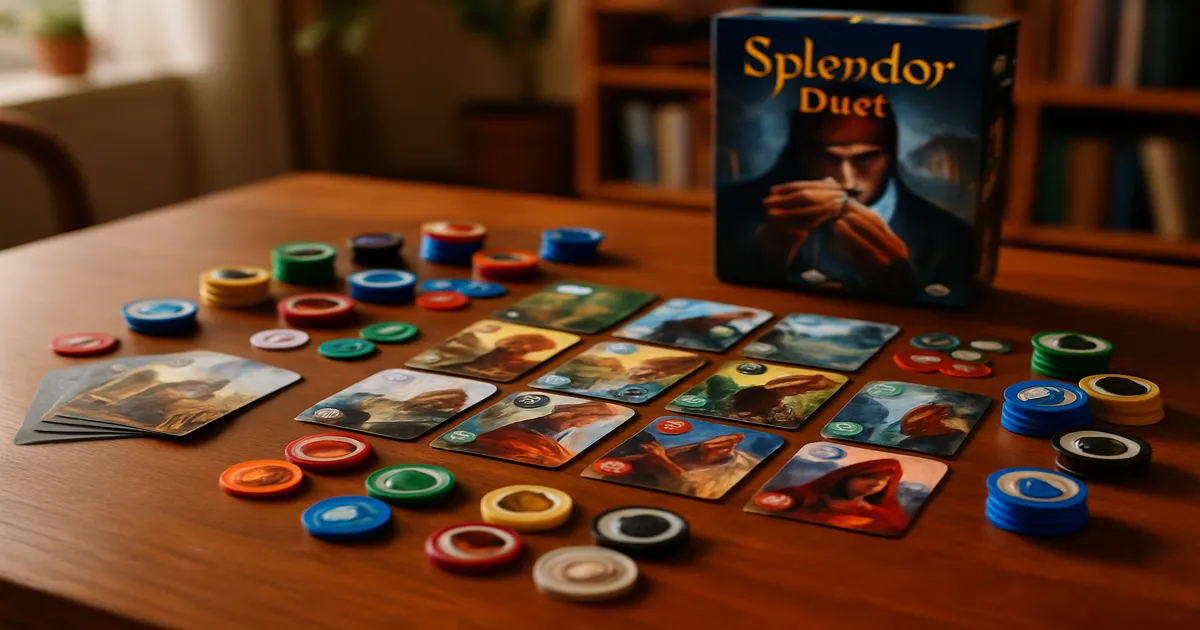
Quick Answer: Splendor Duel is a 2-player gem-drafting game where you take tokens from a 5×5 grid, buy development cards, and race to victory across one of three win conditions: 20 Prestige Points, 10 Crowns, or owning at least one card in each of the 6 gem colors. Designed by Marc André and Bruno Cathala, it plays in 30–45 minutes with a BGG weight of ~2.4/5 — and it’s one of the best two-player games published in the last decade.
If you’re trying to learn how to play Splendor Duel, the good news is the rules fit on a single player aid card. The bad news is there’s a lot of strategic depth hiding underneath, and a couple of rules trip up almost everyone on their first play. This guide covers setup, turn structure, all three win conditions, and the Privilege Scroll mechanic that causes the most confusion.
What Is Splendor Duel?
Splendor Duel is a standalone two-player game published by Space Cowboys in 2022. It’s not an expansion to the original Splendor — it’s a purpose-built head-to-head design by Marc André (who made the original) and Bruno Cathala (who has a long track record with two-player designs, including 7 Wonders Duel). Same Renaissance gem merchant theme, but considerably more tense and interactive.
What’s in the Box
- 1 double-sided gem board (the 5×5 grid)
- Gem tokens in 7 types: 6 colored gems plus pearl wildcards (gold is a gem color here, not a wildcard like in the original)
- Development cards in three tiers
- Royal cards (this game’s version of nobles)
- Privilege Scroll tokens (3 total)
- Player aid cards — use these, they’re good
The gem tokens are thick, weighted cardboard discs that feel satisfying to handle. The card art is rich and jewel-toned, and the whole thing has a small enough footprint that it works well at a café table.
How to Set Up Splendor Duel
The Gem Board
Place the board in the center. Draw gem tokens from the cloth bag and fill all 25 spaces on the grid. That randomness is part of what makes each game feel different — the opening gem layout shapes your first several turns.
Development Cards and Royals
- Shuffle each tier of development cards separately.
- Lay out three face-up cards beside each tier’s face-down deck.
- Shuffle the Royal cards and place the specified number face-up above the card rows (the rulebook tells you how many — it’s based on player count, which is always two, so it’s a fixed number).
Starting Resources
Each player takes one Privilege Scroll. No starting gems. That’s it.
The board is double-sided — the reverse offers a different gem distribution for experienced players. Stick with the standard side until you’ve played a few games.
How to Play Splendor Duel: Turn Structure
Each turn, you take exactly one action. Four options:
Action 1: Take Gems from the Board
Take up to 3 gems in an orthogonally connected line — horizontal or vertical, no gaps, no diagonals. This adjacency rule is the biggest mechanical departure from the original Splendor. Gem-taking becomes a spatial puzzle, not just a resource grab.
Key rules:
- You can’t hold more than 10 gem tokens at the end of your turn. Discard down if you go over.
- Taking a pearl or gold gem immediately earns you a Privilege Scroll (taken from your opponent if they have one, otherwise from the supply).
Action 2: Purchase a Development Card
Spend gem tokens and/or card bonuses to buy any face-up development card, or one you’ve previously reserved. Cards give you permanent gem bonuses that reduce future costs — this is your engine. Some cards also provide Crowns or a Privilege Scroll on purchase.
Action 3: Reserve a Card
Take any face-up card (or the top of a face-down deck) and hold it in front of you. Maximum 3 reserved cards at a time.
You do NOT receive a gold token for reserving. This is the rule that trips up almost every player coming from the original game. There are no gold tokens in Splendor Duel at all — gold is just another gem color on the board.
Action 4: Use a Privilege Scroll
Spend one Privilege Scroll to take any single gem from the board, ignoring the adjacency rule entirely. This is a precision tool — grab exactly what you need, wherever it sits on the grid.
The Three Win Conditions
This is what makes Splendor Duel genuinely interesting. You win immediately upon achieving any one of these at the end of your turn:
20 Prestige Points
Accumulate 20 Prestige Points from development cards and Royals. Familiar territory if you know the original Splendor, though the threshold there is 15.
10 Crowns
Certain development cards have Crown symbols. Collect 10. New players consistently underestimate this path — if your opponent isn’t watching for it, a Crown rush can come out of nowhere.
Color Dominance: All 6 Gem Colors
Own at least one development card in each of the 6 gem colors. This rewards diversification and is the condition most likely to catch both players off guard.
Royals
Unlike the nobles in original Splendor, Royals don’t come to you automatically when you meet their requirements. You have to actively purchase them using bonuses from your development cards — they cost an action. They’re worth it: Royals grant Prestige Points and sometimes Crowns, and timing a Royal purchase well can swing a close game.
The central tension of Splendor Duel is that you must monitor all three win conditions — yours and your opponent’s — at the same time. Focusing only on points while your opponent quietly assembles 10 Crowns is exactly how you lose a game you thought you were winning.
Privilege Scrolls: The Mechanic That Makes Splendor Duel Unique
Each player starts with one scroll. After that, you earn them by taking a pearl or gold gem from the board. The key detail: you take the scroll from your opponent if they have one, or from the general supply if they don’t. There are only 3 scrolls in the game total, so control of them matters.
Spend a scroll as your action to take any single gem from the board without the adjacency restriction. Enormously useful in the mid-to-late game when the gem you need is isolated.
New players treat scrolls as a nice bonus. Experienced players treat them as a priority resource. That difference in perspective often determines who wins. When you’re choosing between two equally good actions, pick the one that earns or preserves a scroll.
Common Mistakes New Players Make
Rules errors:
- Taking gems that aren’t in a connected orthogonal line
- Giving yourself a gold token on reserve (doesn’t happen here — leave that rule in the original game)
- Forgetting that taking a pearl or gold gem earns a Privilege Scroll
- Waiting for Royals to come to you automatically
Strategic mistakes:
- Ignoring the Crown win condition entirely — this is how you lose to a Crown rush
- Tracking only one of your opponent’s win paths instead of all three
- Over-reserving cards you can’t afford, which locks you out of further reservations
- Undervaluing Privilege Scrolls
Splendor Duel Strategy Tips
Early Game: Keep Your Options Open
Prioritize gem diversity in your first several turns. You want to keep all three win conditions viable as long as possible, and a broad bonus engine does that. Watch what your opponent is taking — the adjacency rule means their choices directly reshape what’s available to you.
Mid Game: Control and Denial
If your opponent is ignoring the Crown path, race it. Ten Crowns can arrive faster than 20 Prestige Points, and most players don’t start defending until it’s too late. Think offensively about gem-taking too: sometimes you grab gems you don’t urgently need just to break up a line your opponent was planning.
Build through Tier I and II before targeting expensive Tier III cards. The temptation to reach for Tier III early is real, but you’ll spend too many turns unable to buy anything while your engine is still weak.
Late Game: Threaten Two Conditions at Once
The strongest late-game position is threatening two win conditions simultaneously. If your opponent has to block both a Crown win and a Prestige Point win, they physically can’t do it efficiently. Count their Crowns and card colors. In the last few turns of a close game, you should know exactly how many moves away they are from each condition.
Splendor Duel vs. Original Splendor
| Feature | Splendor (2014) | Splendor Duel (2022) |
|---|---|---|
| Player Count | 2–4 | 2 only |
| Win Condition | 15 Prestige Points | 3 possible paths |
| Gem Taking | 3 different or 2 same | Adjacency grid rule |
| Reservation Reward | Gold token | No token |
| Noble/Royal Claiming | Automatic | Must purchase |
| BGG Complexity | ~1.8/5 | ~2.4/5 |
| Play Time | ~30 min | 30–45 min |
If you’re primarily playing with two people, Splendor Duel is the better game — the decisions are more meaningful, the interaction is higher, and the three win conditions give it a strategic richness the original doesn’t have. The original Splendor is the right call if you need something for 3–4 players or want a lighter experience for casual players.
For two-player comparisons: 7 Wonders Duel is a direct peer — slightly heavier (~3.0 BGG weight) and similarly excellent. Jaipur is lighter and faster if you want something quicker. Targi scratches the resource-management-and-denial itch at higher complexity.
Frequently Asked Questions About How to Play Splendor Duel
Do you get a gold token when you reserve a card in Splendor Duel?
No — and this trips up almost everyone coming from the original. Reserving a card gives you nothing except the card itself. There are no gold tokens in Splendor Duel; gold is simply a gem color on the board.
Can you take two of the same gem in Splendor Duel?
No. All gems must be taken in an orthogonally connected line on the 5×5 grid. Since each token is a unique physical piece, you’re always taking distinct gems.
How do Privilege Scrolls work?
You earn a scroll by taking a pearl or gold gem from the board, or through certain card effects. Scrolls are taken from your opponent first if they have any, otherwise from the supply — only 3 exist in the game. On your turn, spend a scroll as your action to take any single gem from the board without the adjacency restriction.
How many ways can you win Splendor Duel?
Three. Reach 20 Prestige Points, collect 10 Crowns, or own at least one development card in each of the 6 gem colors. All three conditions are live throughout the game, which means you’re always tracking six win paths — three yours, three your opponent’s.
How is Splendor Duel different from the original Splendor?
Splendor Duel is strictly 2 players; gems come from a spatial grid with adjacency rules rather than a central pile; there are three win conditions instead of one; you don’t get a gold token when reserving; and Royals must be actively purchased rather than claimed automatically. It’s a meaningfully more complex and interactive game.