Quick Answer: Ark Nova is a 1–4 player card-driven engine builder (BGG weight ~3.7/5, 90–180 minutes) where you develop a zoo by playing action cards from five slots, each with a different power level. You win by balancing two scoring tracks — Appeal and Conservation — until they cross. Neglecting either track is the fastest way to lose.
Learning how to play Ark Nova feels like drinking from a firehose the first time. The rulebook doesn’t help — it’s notoriously hard to navigate — but the game itself is actually pretty elegant once the core systems click. This guide walks you through everything you need to get your first game on the table and, more importantly, to actually understand what you’re doing while you play.
How to Play Ark Nova: The Core Idea
What Kind of Game Is It?
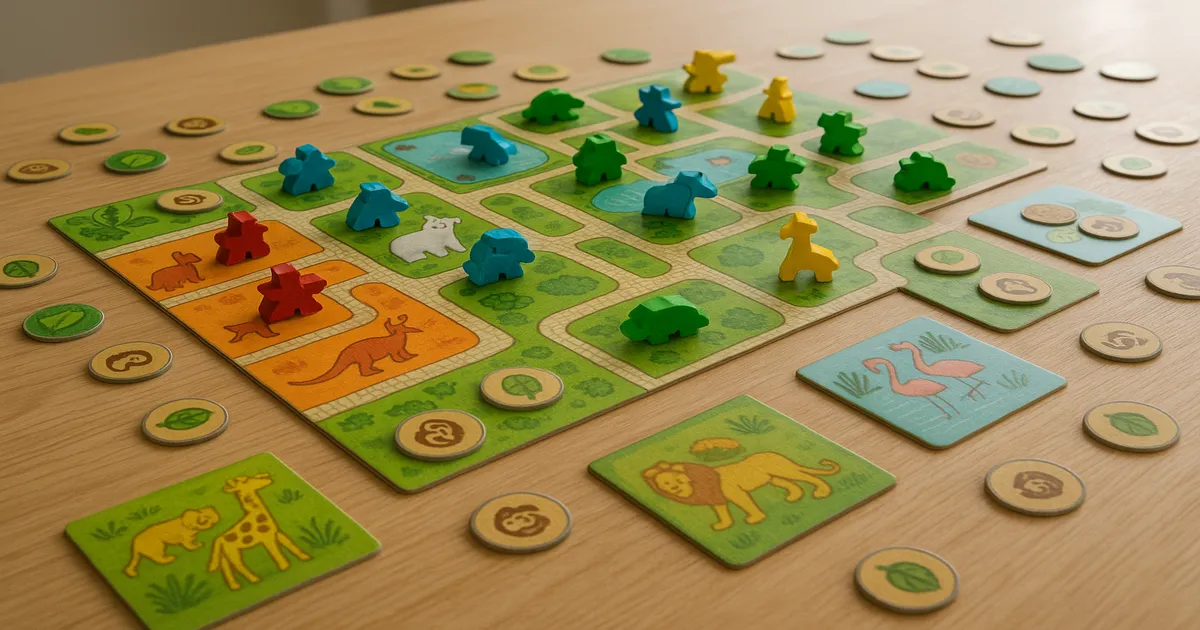
Ark Nova sits firmly in the heavy euro category. You’re building a zoo, acquiring animals, constructing enclosures, and funding conservation projects — and the theme isn’t just window dressing. The mechanics genuinely reinforce the idea that a good zoo does more than display animals; it supports science and conservation. Designed by Mathias Wigge and published by Capstone Games (and Feuerland Spiele in Germany), it’s been in the BGG Top 10 since its 2021 release, and it’s earned that spot.
The Core Loop
Each turn, you pick one of your five action cards, resolve its effect at the strength of its current slot position, then move it to the weakest slot. That’s the whole turn. No rounds, no phases — play keeps moving until someone’s two scoring markers cross on the shared track. Simple to execute, endlessly deep in practice.
Components and Setup
What’s in the Box
The production quality is genuinely impressive. You get:
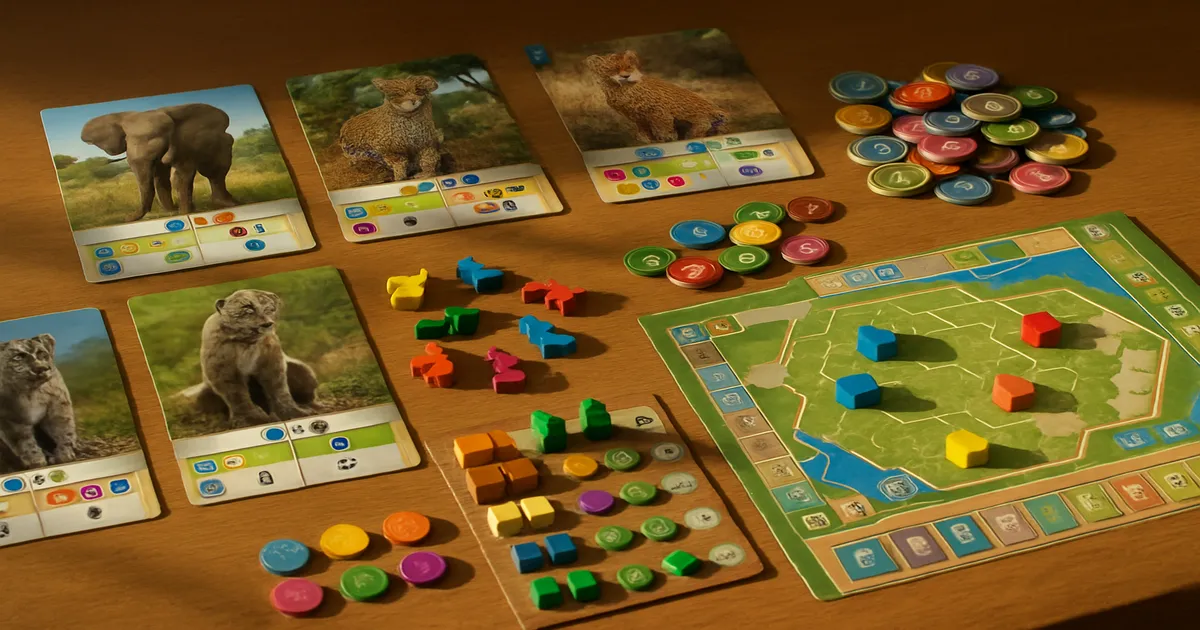
- 255 zoo cards — animals, sponsors, conservation projects, and special enclosures, all with realistic wildlife photography
- 4 double-layered player boards with recessed spaces that hold your tokens in place
- Polyomino enclosure tiles in sizes 2–7 spaces
- Shaped wooden animal meeples — the penguins are a fan favourite and they’ve earned it
- Central conservation board, money tokens, break tokens, appeal/conservation markers
- Solo Automa materials for single-player games
Setting Up Your First Game
- Give each player a player board, a set of five action cards placed in slots 1–5, and a starting hand of zoo cards
- Seed the central card display with six face-up cards from the main deck
- Set up the conservation board with project tiles and partner zoo/university spaces
- Place all players’ scoring markers at their starting positions on the shared track
One honest heads-up: the rulebook is poorly organised. Watch a 20-minute video walkthrough alongside it, or keep the BGG FAQ open on your phone for the first game. The rules aren’t complicated — the book just explains them in a frustrating order. If you play this regularly, a third-party insert makes a real difference to setup time.
Understanding the Win Condition
This is the single most important thing to grasp before you play. Get it wrong and the whole game feels broken.
Appeal Track vs. Conservation Track
Every player has two markers on a shared scoring track. The Appeal marker moves forward as you build enclosures, add animals, and develop zoo attractions. The Conservation marker moves forward as you fund conservation projects and partner with universities. They start on opposite ends of the track and move toward each other.
How the Game Ends
The game ends immediately when any player’s two markers meet or cross. Your final score is the combined value of both markers at that moment. The player who triggered the end doesn’t automatically win — everyone’s combined score is tallied and highest wins.
Why You Can’t Ignore Conservation
Neglecting Conservation is the number-one new-player mistake, and it’s not close. I’ve watched players build gorgeous, animal-packed zoos and finish dead last because their Conservation marker never moved. Both tracks need to advance throughout the game — not just in the final turns.
How to Play Ark Nova: The Action Card System
Your Five Action Cards
Every player works with the same five actions all game:
- Cards — Draw zoo cards, refresh the display, and collect money tokens from cards that have been passed over
- Build — Place enclosure tiles and construct kiosks, pavilions, or special buildings on your zoo map
- Animals — Play animal cards from your hand into matching enclosures
- Association — Send workers to the conservation board, claim partner zoos, and unlock university tiles
- Sponsors — Play sponsor cards that provide ongoing economic benefits or immediate bonuses
How the Slot System Works
Your five action cards sit in numbered slots on your player board. Slot 1 is weakest; slot 5 is strongest. When you use an action, you pull that card out, resolve it at its current slot strength, then place it in slot 1. Everything else shifts up by one.
The strength of a slot determines how much you can do. Playing Animals from slot 5 lets you place up to five animals in a single turn (money permitting). Playing it from slot 1? Just one. This applies across all five actions — Build in slot 5 lets you place more tiles, Cards draws more cards, and so on.
The elegant part is that this self-regulates. The action you just used is now your weakest option, which naturally pushes you toward variety. Using the same action twice in a row is rarely optimal because you’re playing it from slot 1 both times.
A Sample Turn
Say your Animals card is sitting in slot 4:
- Pick up the Animals card from slot 4
- Resolve the Animals action at strength 4 — play up to four animals from your hand into enclosures, paying their costs
- Place the Animals card in slot 1; cards in slots 1–3 each shift up by one
- Pass play to the left
No complex phase structure, no bookkeeping beyond moving the card.
Cards, the Display, and Hand Management
The Four Card Types
The 255-card deck contains four types. Animal cards are the core — each requires a matching enclosure and has tags (Africa, Bird, Reptile, Predator, etc.) that create synergies. Sponsor cards provide economic or scoring infrastructure and are consistently undervalued by new players. Conservation projects are how you push your Conservation marker forward. Special enclosure cards add unique buildings to your zoo.
How the Display Works
Six cards sit face-up in the display at all times. Cards on the left are freshest and most expensive; as new cards push in from the left, older cards drift right and get cheaper. When a card is skipped over, a money token accumulates on it — so when you eventually take it, you collect those tokens too. This means the Cards action can generate income as a side effect of refreshing the display.
Tags and Enclosure Sizes
Tags matter because many cards have prerequisites (“you must have 2 reptiles in your zoo”) or trigger bonuses when certain tags are present. Picking a thematic direction early — bird-heavy, Africa-focused, predator synergies — makes your card selection much more efficient.
Enclosures must match your animals’ size requirements. An animal needing a size-4 enclosure can go into a size-5 (with a small penalty), but not a size-3. Building mismatched enclosures is one of the most common early mistakes and it cascades badly.
Common Mistakes New Players Make
- Misreading the win condition — it’s not a point threshold, it’s two markers crossing. Big difference.
- Forgetting slot strength — always check what slot your action card is in before deciding whether to use it
- Wrong action for conservation projects — contributing to projects requires the Association action, not Animals
- Missing animal prerequisites — read the tag requirements before trying to play an animal card
- Hoarding money — Ark Nova rewards players who keep resources flowing. Sitting on a pile of cash while your engine idles is a losing strategy.
- Building too many small enclosures early — a bunch of 2-space enclosures feels safe but limits your options badly in the mid-game
- Missing the scoring window — there’s a point in every game where you need to stop building and start racing toward the finish line. New players almost always miss it.
Strategy Tips
Early game: Plan your zoo grid before placing your first enclosure tile. The polyomino puzzle is unforgiving if you don’t think a step ahead. Grab a university tile early via the Association action — the ongoing bonuses compound significantly.
Mid game: Watch your opponents’ Conservation markers. If someone is close to crossing, you may need to pivot from building to scoring faster than planned. Conservation projects are worth more than most new players realise — the completion bonuses and ongoing effects can swing a game.
Late game: Calculate roughly how many points you need on each track to cross. Over-investing in one track while the other lags is a losing position. Sometimes the right play is accelerating your own crossing rather than trying to slow an opponent.
Always: Keep the reference cards on the table even after you know the game — the iconography is dense enough that they’re always useful. And if you haven’t tried the solo mode, start there. The Automa system is well-designed, and a game or two solo is the fastest way to internalise the action system without the cognitive load of multiplayer.
How Ark Nova Compares to Similar Games
Ark Nova vs. Wingspan
Both are nature-themed engine builders, but the comparison only goes so far. Wingspan (BGG weight ~2.4, 45–70 minutes) is a genuinely great gateway game — approachable, pretty, satisfying. Ark Nova is what you graduate to when Wingspan starts feeling too light. The dual-track win condition and slot system create strategic tension that Wingspan simply doesn’t have.
Ark Nova vs. Terraforming Mars
This is the closer comparison. Both are heavy card-driven engine builders with a threshold-style win condition, both run 90–150 minutes, both reward long-term planning. Ark Nova’s slot system is more elegant than Terraforming Mars’s generation structure — it creates natural tempo variation without needing a round-end trigger. The solo mode in Ark Nova is also widely considered superior. That said, Terraforming Mars has a larger card pool and more direct player interaction if that’s what your group wants.
What Makes Ark Nova Unique
The slot-based action system genuinely doesn’t exist anywhere else at this scale. The dual-track win condition prevents runaway leaders in a way that feels built into the game’s DNA rather than bolted on. And the realistic animal photography gives it a visual identity that stands out on a shelf full of fantasy and sci-fi art. If you’re going to sleeve the cards — and with 255 of them, you probably should — standard European size sleeves fit the zoo cards.
Marine World Expansion
The 2023 expansion adds roughly 100 new cards, aquatic animals, aquarium enclosure types, and new conservation projects. It’s modular, so you can mix in as much or as little as you want. (Ark Nova Marine World)
Don’t buy it until you’ve played the base game five or six times. Marine World is well-regarded and adds genuine variety, but the base game has more than enough content to stay interesting for a long time. Add it when you feel like you’ve seen most of what the base game offers.
Frequently Asked Questions About Ark Nova
How does the win condition work in Ark Nova?
Each player has two scoring markers — one for Appeal, one for Conservation — that start on opposite ends of a shared track and move toward each other. The game ends immediately when any player’s markers meet or cross. Your final score is the combined value of both markers at that moment, and the highest combined score wins.
How long does a game of Ark Nova take?
Expect 90–150 minutes at two players once everyone knows the game. With new players or at three to four players, 180 minutes is realistic. The first game almost always runs long — budget extra time and don’t rush the rules explanation.
Is Ark Nova too complex for beginners?
It depends on your baseline. If you’ve never played anything heavier than Ticket to Ride, Ark Nova will be overwhelming. If you’ve played Wingspan, Pandemic, or a few mid-weight euros, you can handle it — just expect the first game to be a learning experience. The BGG weight of 3.7/5 is accurate; this is a genuinely heavy game.
What is the slot system in Ark Nova?
Your five action cards sit in slots numbered 1–5, where slot 5 is the most powerful. When you use an action, it drops to slot 1 and everything else shifts up. The action you just used is now your weakest option, which naturally encourages variety. Timing matters too — saving a key action until it’s in a high slot can be the difference between a good turn and a great one.
How does Ark Nova compare to Wingspan?
Both are nature-themed engine builders, but Wingspan is significantly lighter (BGG weight ~2.4 vs. 3.7) and faster. Wingspan is the better choice for mixed groups or newer players. Ark Nova is the natural next step for Wingspan fans who want more strategic depth and a win condition that demands you balance two things at once rather than just maximising one scoring track.