Quick Answer: Lost Ruins of Arnak: Expedition Leaders is a 1–4 player deck-building and worker placement hybrid where you lead an archaeological expedition across a mysterious island, researching ancient knowledge and battling guardians over five rounds. The Expedition Leaders expansion adds six asymmetric leader characters — each with a unique starting deck and special ability — and is widely considered the definitive way to play the game. You do need the base game to use it.
If you’ve been searching for how to play Lost Ruins of Arnak Expedition Leaders, you’re probably already sold on the theme and just want to get the rules straight before you hit the table. Smart move — this is a game where knowing the structure upfront saves you a lot of mid-game rulebook fumbling.
What Is Lost Ruins of Arnak Expedition Leaders?
Base Game vs. Expedition Leaders Expansion
The base game (designed by Mín and Elwen, published by Czech Games Edition in 2020) is a standalone medium-weight euro where everyone starts with identical decks and player boards. Expedition Leaders (2021) layers six asymmetric leaders on top of that foundation. Each one replaces the standard player board with a unique version, a custom starting deck, and a special ability that genuinely changes how you play.
The expansion also adds new item and artifact cards for the shared market, new research bonuses, and an optional Side Quest module. Player count stays at 1–4 and the core rules don’t change — it just makes every game feel different depending on which leader you pick. (Lost Ruins of Arnak Expedition Leaders)
Is This Game Right for You?
This is a great fit if you like engine-building games but want more tension than something like Wingspan delivers. BGG weight sits around 3.1–3.2/5 with Expedition Leaders — solidly medium-heavy, but the iconography is clean enough that experienced gamers pick it up in one play. Expect roughly 30 minutes per player: 60–75 minutes at two players, up to two hours with four.
Components: What’s in the Box
Base Game Components
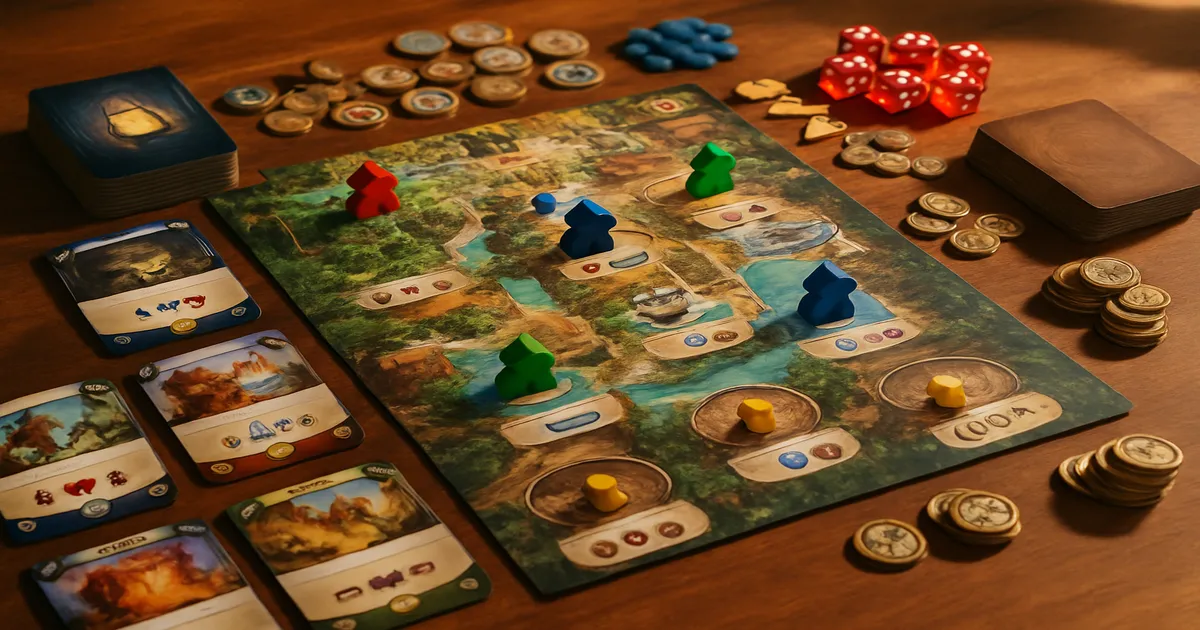
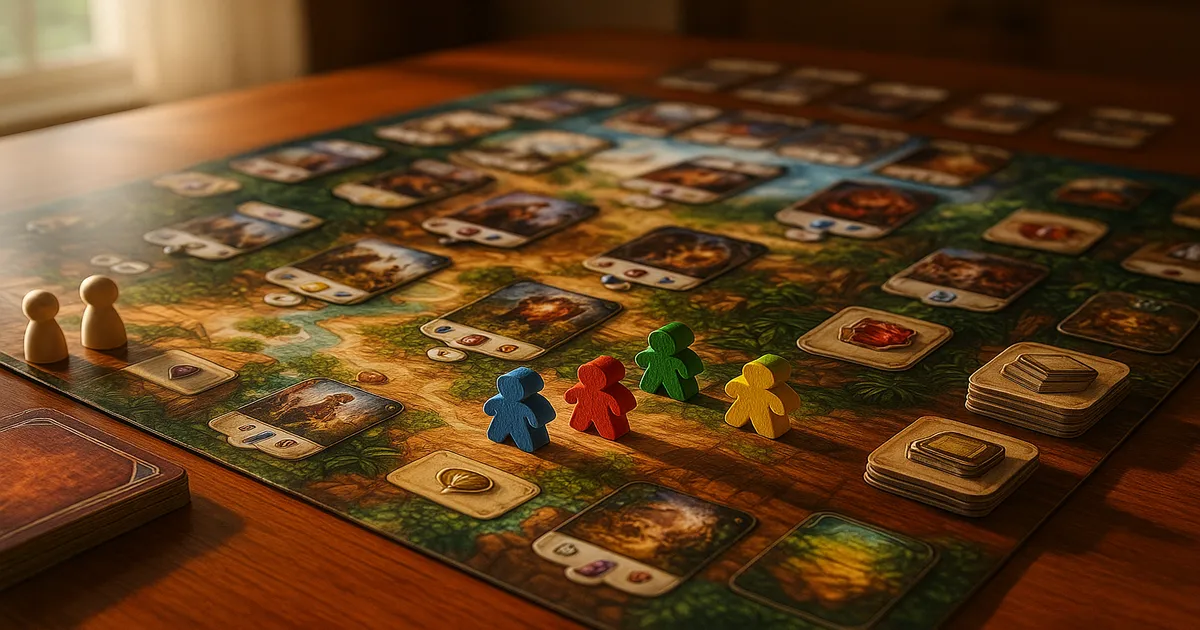
The base game includes a double-sided main island board (one side for 1–2 players, one for 3–4), a Research Track board, four standard player boards, wooden archaeologist meeples in four colors, location tiles, guardian tiles, item and artifact card decks, resource tokens (Compass, Arrowhead, Jewel, Tablet, and Idol, plus Gold and Silver wildcards), Fear cards, and a full solo mode rival system.
What Expedition Leaders Adds
- Six large leader boards replacing the standard player boards
- Six unique starting decks (five cards each, customized per leader)
- New item and artifact cards expanding the shared market decks
- New Research Track bonus tiles
- Side Quest cards (optional module)
- New guardian tiles
- Updated solo and two-player rival components
Component Quality
The cards are genuinely excellent — linen finish, crisp printing, among the best in the hobby at this price point. Sleeve them with 63.5mm × 88mm sleeves. The resource tokens are chunky and satisfying. The one weak spot is the insert — mediocre in the base game and basically useless once you add Expedition Leaders. Most dedicated players grab an aftermarket organizer.
Core Rules: How a Game of Arnak Works
Round Structure
The game runs exactly five rounds. Each round follows the same sequence:
- Draw Phase — Everyone draws exactly 5 cards. Fixed. No exceptions.
- Action Phase — Players alternate taking one action at a time until everyone has passed. Actions include playing a card, placing a worker on a location, discovering a new location, overcoming a guardian, buying from the market, advancing on the Research Track, or passing.
- End of Round — All workers return, the market refreshes, and the round marker advances.
- Final Scoring — After round 5, count up all VP sources.
Once you pass, you’re done for that round — so timing your pass matters more than new players usually expect.
The Five Resource Types
- Compass — General-purpose; used for discovering locations and buying cards
- Arrowhead — Combat resource; used to overcome guardians
- Jewel — Research-focused; used to advance on the Research Track
- Tablet — Higher-level research and some artifact costs
- Idol — Collected during exploration; used for Research Track advancement and certain card costs
Fear cards aren’t a resource — they’re a penalty. They go into your hand when you discover a guarded location, crowd out the cards you actually want, and cost −1 VP each at game end.
How the Research Track Works
The Research Track is where a lot of new players quietly lose the game. Advancing costs resources (usually Jewels, Tablets, or Compasses) and pays out either an immediate one-time bonus or an ongoing/end-game reward. The further you go, the more powerful the returns — and the VP from reaching the upper Temple track levels can be enormous. Ignore it and you’ll wonder why you lost by 20 points.
How to Play Lost Ruins of Arnak Expedition Leaders: The Six Leaders
How Leaders Change the Game
Each leader replaces your standard player board entirely. You use their board, their starting deck, and their special ability for the whole game. Read your leader board fully before the game starts — it’s the difference between playing your leader well and accidentally playing them like a worse version of the base game.
Archaeologist — Best for Beginners
A generalist with a flexible resource toolkit. She doesn’t push hard in any one direction, which means she adapts to whatever the board offers. Start here before touching the other five.
Pilot — Location Access Specialist
Her ability centers on movement and location access — she can reach spots that would cost other players too much to discover. Get to high-value locations early and lock in their benefits before opponents can compete. Her advantage evaporates if she doesn’t explore aggressively.
Professor — Research Track Expert
If you want to race the Research Track, play the Professor. Her ability multiplies the value of every research action, so beelining the track isn’t just correct — it’s basically mandatory. Playing the Professor while ignoring the Research Track is one of the bigger strategic errors you can make.
Mystic — Artifact Engine Builder
Built around artifacts. Her ability squeezes more value out of artifact cards than any other leader, so the goal is simple: buy artifacts early and build the biggest artifact engine you can. She rewards players who know the artifact deck well.
Captain — Action Efficiency Master
Her ability scales with how many actions she takes in a round, so you want to be doing something every single turn — even small, efficient ones. Strong pick for players who like maximizing their turn count.
Navigator — Exploration Focused
Reduces the cost of discovering new locations, making it viable to explore spots other leaders would find prohibitively expensive. She tends to accumulate location-based VP and Idol tokens faster than anyone else at the table.
Scoring and Win Conditions
VP comes from guardian tiles defeated, Research Track position (especially the upper Temple levels), artifact cards in your play area, Idol tokens, discovered location tiles, Research Track bonus tiles, and end-game resource conversion (at a terrible rate — don’t plan around it).
Fear cards are −1 VP each, but the real damage is what they do to your hand during play. A player with five Fear cards in their deck is drawing one or two dead cards almost every round. Overcome guardians to remove them — that’s the intended pressure valve.
Scores typically land between 50 and 90+ points. If you finish below 50, you probably neglected the Research Track or let Fear cards pile up.
Common Mistakes New Players Make
Rules errors:
- Fear cards go to your hand, not your discard pile — the most common mistake, and it matters a lot
- Workers return at end of round, not end of your turn
- The 5-card draw is fixed; playing cards doesn’t let you draw replacements
- Shuffle your discard pile immediately when your draw pile runs out mid-round
- Artifacts stay in your play area after being played; items go to your discard pile
Strategic pitfalls: Ignoring the Research Track is the most reliable way to lose. Over-buying cheap cards is a close second — there’s no card removal in Arnak, so every purchase lives in your deck forever. A bloated deck means you’ll see your best cards less often.
Don’t try to do everything. Five rounds isn’t enough time to max the Research Track, explore every location, defeat every guardian, and build a huge deck. Pick a lane by round 2.
Expedition Leaders-specific: Skimming your leader board is a real problem. These boards have nuanced abilities and missing a key rule about your own leader is surprisingly common the first time out. The Pilot and the Professor have almost nothing in common strategically — don’t play them the same way.
Strategy Tips for Winning
Get on the Research Track early. A bonus tile earned in round 2 pays off across three more rounds; the same tile in round 4 barely matters. Aim for the second or third level by round 2 or 3.
Keep your deck lean. You draw exactly 5 cards per round, so a 10-card deck cycles every two rounds. A 15-card deck might never show you your best cards at the right moment. In my experience, players who buy the fewest cards often win — it sounds counterintuitive in a deck-builder, but Arnak rewards efficiency over volume.
Fight guardians that block locations you want to use repeatedly, or that offer high-VP tiles. Don’t fight one just because you have the resources — ask whether that VP is worth more than what else you could do with them.
Round 5 is pure point generation. Stop buying cards — they’ll never be played. Every action should directly produce VP: Research Track advancement, guardian fights, artifact plays, Idol spending. Players who don’t make this mental shift leave significant points on the table.
If you’re using Side Quests, draft them early and build around completing one or two. In solo mode, prioritize blocking the rival’s Research Track advancement — the rival scores efficiently and punishes you for ignoring it.
How Arnak Compares to Similar Games
Arnak vs. Dune: Imperium — These are the two games I’d put in the same conversation most readily. Both are deck-building plus worker placement hybrids at medium-heavy weight with strong solo modes. The difference is feel: Dune is more confrontational, with direct conflict and political maneuvering baked in. Arnak is more puzzle-like — you’re optimizing against the board more than against other players. Want more player interaction? Dune. Want a tighter personal engine puzzle? Arnak.
Arnak vs. Wingspan — Wingspan is gentler and more forgiving, a great gateway euro. But it doesn’t scratch the same itch. Arnak has more tension, more decision points per turn, and more meaningful interaction with other players’ choices.
Arnak vs. Clank! — Clank! is more chaotic and more accessible. Great pick-up-and-play deck-builder, but it doesn’t have Arnak’s strategic depth. For a casual group, Clank! wins on accessibility. For a group that wants more to think about, it’s not close.
What makes Arnak with Expedition Leaders stand out is that the two core mechanics genuinely reinforce each other, the asymmetry is meaningful without being unbalanced, and the solo mode is one of the best implementations in the medium-weight euro space. It earns its spot in the BGG Top 50.
Frequently Asked Questions
Do you need the base game to play Lost Ruins of Arnak Expedition Leaders?
Yes. Expedition Leaders is an expansion and requires the base game. It doesn’t include the main island board, base resource tokens, or the core card decks. You need both boxes to run a complete game.
How many leaders are in Expedition Leaders, and which is best for beginners?
Six leaders. The Archaeologist is the best starting point — she’s a generalist whose flexible ability doesn’t demand a specific strategy. Once you’re comfortable with the base game’s flow, the Professor and Mystic offer more interesting strategic constraints.
How long does a game take?
Plan for roughly 30 minutes per player. Two players who know the game finish in about 60–75 minutes. Four players, especially with anyone newer, will run closer to two hours. The five-round structure keeps it from going longer.
What’s the difference between items and artifacts?
Items are single-use — play them from your hand, they go to your discard pile. Artifacts stay in your play area after being played and can be used every round, making them far more powerful over the course of the game. They cost more to buy, and that cost is usually worth it.
Is the solo mode any good?
Genuinely yes — it’s one of the better solo implementations in this weight class. The rival archaeologist advances the Research Track and competes for locations, giving you a meaningful opponent rather than a pushover. Blocking the rival’s track advancement becomes a real strategic priority.