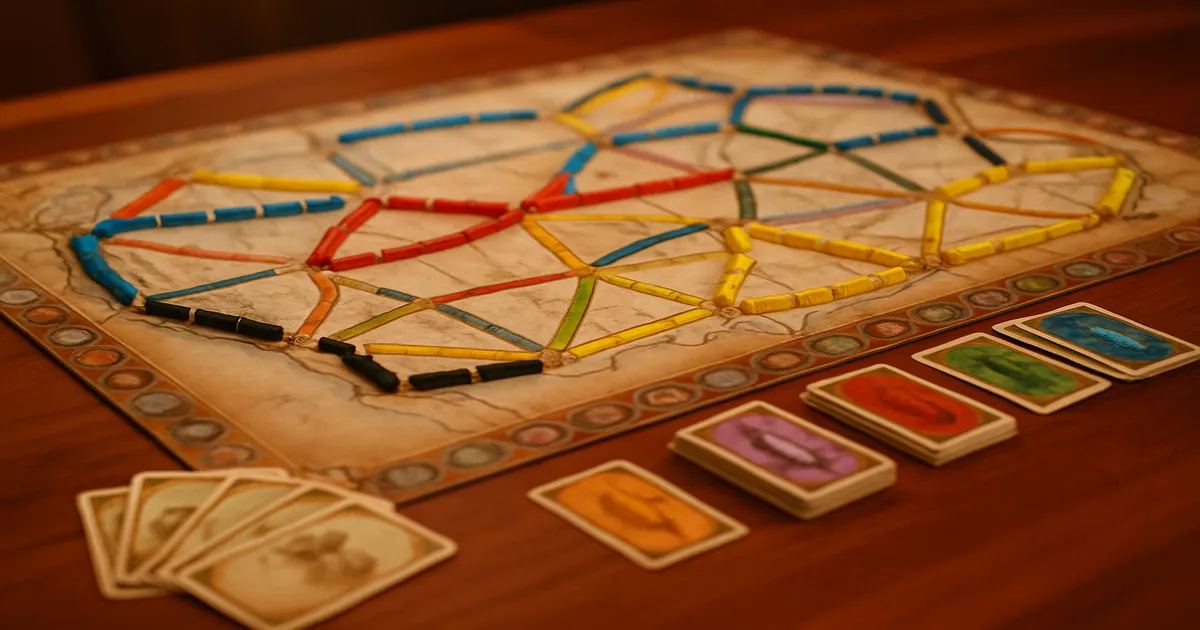
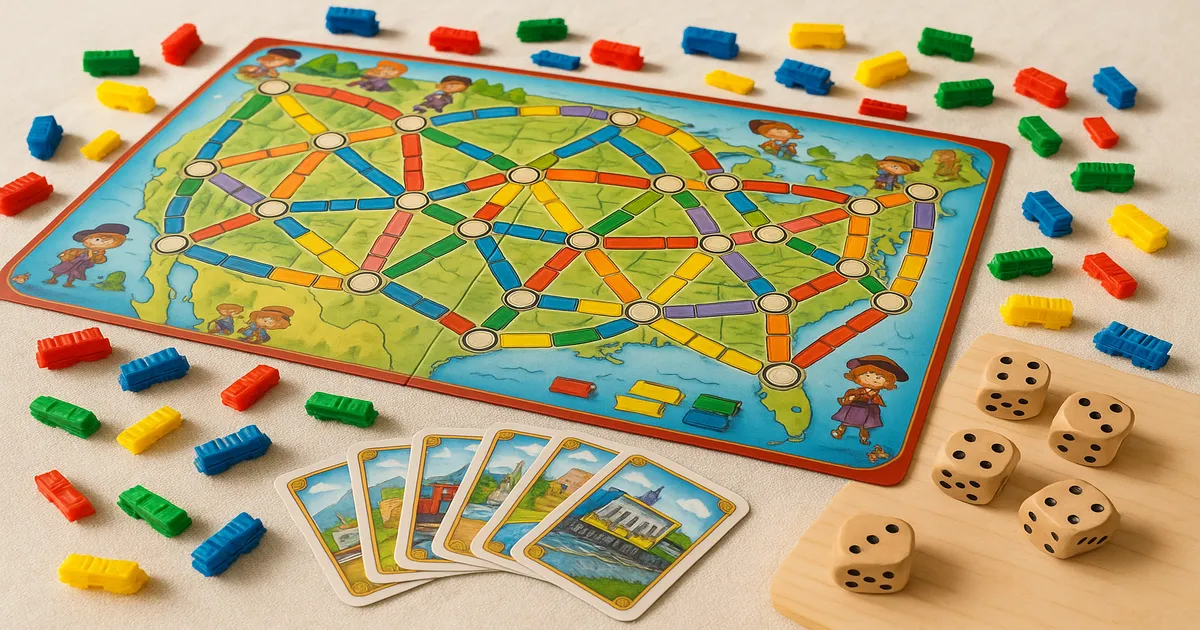
Quick Answer: On your turn in Ticket to Ride First Journey, you either draw two train car cards or spend matching colored cards to claim a route on the map. Connect the two cities shown on your destination tickets to complete them, then immediately draw a new one. First player to complete 6 tickets wins. That’s genuinely the whole game — it’s one of the simplest, cleanest Ticket to Ride experiences ever made.
If you’re trying to figure out how to play Ticket to Ride First Journey, here’s the good news: you can learn it in about five minutes and be playing in ten. Designed by Alan R. Moon and published by Days of Wonder in 2016, it’s built specifically for kids ages 6 and up — though I’ve watched plenty of adults get completely sucked into its tight little coast-to-coast race. It plays 2–4 players, runs 15–30 minutes, and sits at a BGG complexity of just 1.1 out of 5. If you’ve bounced off heavier games with younger kids, this is the one that actually works.
What Is Ticket to Ride First Journey?
First Journey is the kid-focused entry point in the Ticket to Ride family. Same core idea — claim railroad routes on a map to complete destination tickets — but stripped down to exactly what a six-year-old needs and nothing more. No point scoring, no wildcards, no punishing kids for unfinished tickets. It’s a race, not a calculation.
USA Edition vs. Europe Edition
There are two versions, and the choice mostly comes down to which map you find more interesting. The USA edition covers the continental United States and includes a coast-to-coast bonus win condition (more on that below). The Europe edition covers major European cities. Both share the exact same rules — the only real differences are the map, the city names, and some minor visual theming. Either one is a great pick.
How First Journey Differs from Standard Ticket to Ride
This isn’t just “Ticket to Ride with smaller pieces.” The changes are meaningful:
| Feature | First Journey | Ticket to Ride (Original) |
|---|---|---|
| BGG Weight | ~1.1 | ~1.9 |
| Play Time | 15–30 min | 45–75 min |
| Ticket Penalties | None | Yes (negative points) |
| Locomotive (Wild) Cards | No | Yes |
| Longest Route Bonus | No | Yes |
| Win Condition | First to 6 tickets | Most points |
| Age Recommendation | 6+ | 8+ |
What’s in the Box
- 1 game board (roughly half the size of the standard Ticket to Ride board)
- ~40 plastic train cars per player in four colors: red, blue, green, yellow
- 72 colored train car cards
- 30 destination ticket cards
- 1 rulebook (short, illustrated, genuinely child-friendly)
The trains are chunkier than the adult version — clearly designed for small hands — and the cards have Days of Wonder’s usual linen finish, which holds up well to repeated shuffling by kids who are not exactly gentle. The board’s city labels are large and readable, which matters more than you’d think when you’re playing with a seven-year-old still working on their geography. Setup is fast because the organization is obvious: the box insert sorts trains by color, and the whole thing is on the table in under five minutes once you’ve done it once.
Setting Up Ticket to Ride First Journey
- Place the board in the center of the table.
- Sort the plastic trains by color and give each player their matching set.
- Shuffle the train car cards, lay five face-up in a row next to the board, and place the rest face-down as a draw pile.
- Shuffle the destination tickets and deal 2 face-down to each player. Everyone looks at their own tickets but keeps them secret.
- Youngest player goes first.
No complex card drafting, no choosing which tickets to keep. Everyone takes their two tickets and goes.
How to Play Ticket to Ride First Journey
Each turn, you do exactly one of two things. That simplicity is the whole point.
Option 1: Draw Train Car Cards
Draw 2 cards from the face-up display, the face-down deck, or any mix of the two. No restrictions. Unlike the adult game, there are no locomotive (wild) cards with special rules — every card is just a color, and you pick whatever you want.
Option 2: Claim a Route
Choose a route on the board between two adjacent cities. Discard the required number of matching colored cards, then place your plastic trains on it. That route is now permanently yours — nobody else can use it for the rest of the game. Routes in First Journey are short, typically 1–3 trains, so you don’t need a massive hand before you can do anything useful.
How Destination Tickets Work
You start with 2 tickets, each showing two cities. When your trains form a continuous connected path between those cities — through whatever routes you’ve claimed — that ticket is complete. Flip it face-up immediately and draw a new ticket from the deck. That replacement draw is the rule people forget most often, and skipping it genuinely changes how the game plays.
Uncompleted tickets at game end are simply ignored. No penalty. This is a big deal for families coming from the adult game, where unfinished tickets cost you points.
The Coast-to-Coast Instant Win (USA Edition)
In the USA edition, if your train network connects any city on the East Coast to any city on the West Coast, you win immediately — even if you haven’t completed 6 tickets yet. It’s a dramatic moment that kids love, and it creates a secondary threat worth watching for. The Europe edition doesn’t have an equivalent rule, though tickets that span the full map create similar tension naturally.
If the train supply runs low before anyone hits 6 tickets, the player with the most completed tickets wins.
Common Mistakes New Players Make
Carrying over adult Ticket to Ride rules. This is the big one. If you’ve played the original, you’ll instinctively look for locomotive cards, gray routes, and ticket penalties. None of those exist here. Treat First Journey as its own game.
Forgetting to draw a new ticket after completing one. Players complete a ticket, feel good, and just move on. But drawing a replacement is mandatory and keeps your pipeline moving. A small token on the ticket deck works as a visual reminder.
Hoarding cards instead of claiming routes. Routes cost 1–3 cards. You do not need eight cards in hand before you start spending them. If you have the right cards, claim the route.
Misunderstanding route exclusivity. Young players sometimes don’t grasp that a claimed route is gone for everyone else. Physically point to the placed trains and explain: “Those tracks belong to that player now.” A quick demo before the first game saves a lot of confusion.
Ignoring the coast-to-coast bonus. In the USA edition, point out the East and West Coast cities during setup. A player building naturally across the map might be closer to an instant win than anyone — including them — realizes.
Strategy Tips for Winning
Think trains spent per ticket, not just speed. A single 3-train route that connects two of your tickets is almost always better than two separate 1-train routes that don’t help either one.
Claim bottleneck cities early. Some cities have only one or two routes connecting them. If your ticket runs through one of those, grab that route before you’ve even drawn the right cards for everything else. Losing a bottleneck to an opponent can force a long, painful detour.
Watch where opponents are building. If someone keeps claiming routes heading toward the same city, they probably have a ticket going there. You don’t need to play aggressively in a family game, but awareness helps you protect your own routes.
Keep your ticket pipeline moving. The win condition is 6 completed tickets. The faster you complete and replace them, the faster you get there. Don’t let your ticket supply sit at zero.
Playing with young kids? Narrate your decisions out loud: “I need two red cards to connect these cities.” It teaches strategic thinking naturally without feeling like a lesson. Avoid hard blocking — it’s not fun for them and it’s not really a test of skill at this age. The game is balanced enough that you don’t need to obviously throw it; just play a touch less efficiently.
What to Play Next
Once kids have First Journey down, Ticket to Ride: New York is the ideal bridge game. It’s compact, plays in 10–15 minutes, and introduces taxis and tourist attractions without the full complexity of the original. After that, the standard Ticket to Ride USA or Ticket to Ride Europe are natural progressions.
For other games in the same age range:
- Catan Junior — slightly more complex, but the same “gateway to gateway” positioning
- Kingdomino — tile-laying, 2–4 players, ages 8+, plays in about 15 minutes
- Sushi Go! — card drafting, faster and more chaotic, great for the same crowd
No official expansions exist for First Journey — it’s intentionally self-contained. The natural “expansion” is just graduating to the rest of the Ticket to Ride line.
Frequently Asked Questions
How many tickets do you need to win Ticket to Ride First Journey?
Six completed destination tickets. The moment a player finishes their sixth, the game ends and they win immediately. If the train supply runs low before anyone hits 6, whoever has completed the most tickets at that point wins instead.
What’s the difference between First Journey and the original Ticket to Ride?
First Journey removes locomotive (wild) cards, ticket penalties, the longest route bonus, and all point scoring. The win condition is a race to 6 completed tickets rather than a points tally, and it plays in 15–30 minutes versus 45–75 for the original. It’s also two years younger in recommended age — 6+ versus 8+.
Is Ticket to Ride First Journey good for 2 players?
It works fine at 2 and plays even faster — usually closer to 15 minutes. The board feels more open with fewer players, which means less natural blocking, but the race to 6 tickets is still engaging. Three or four players is livelier, but 2-player is a perfectly solid experience.
What happens when the destination ticket deck runs out?
The game continues without new tickets being drawn. Players who complete a ticket after the deck is empty simply don’t draw a replacement — they keep working toward 6 with whatever tickets they have left. This rarely comes up in a normal game, but good to know so it doesn’t cause a mid-session rules argument.
Is Ticket to Ride First Journey suitable for 5-year-olds?
The official recommendation is 6+, and that’s pretty accurate. The main hurdle for younger kids is reading city names on the tickets and board. A 5-year-old who isn’t reading yet will need an adult to help identify cities each turn. Some families make it work with parental assistance, but it flows best once a child can read basic words independently.