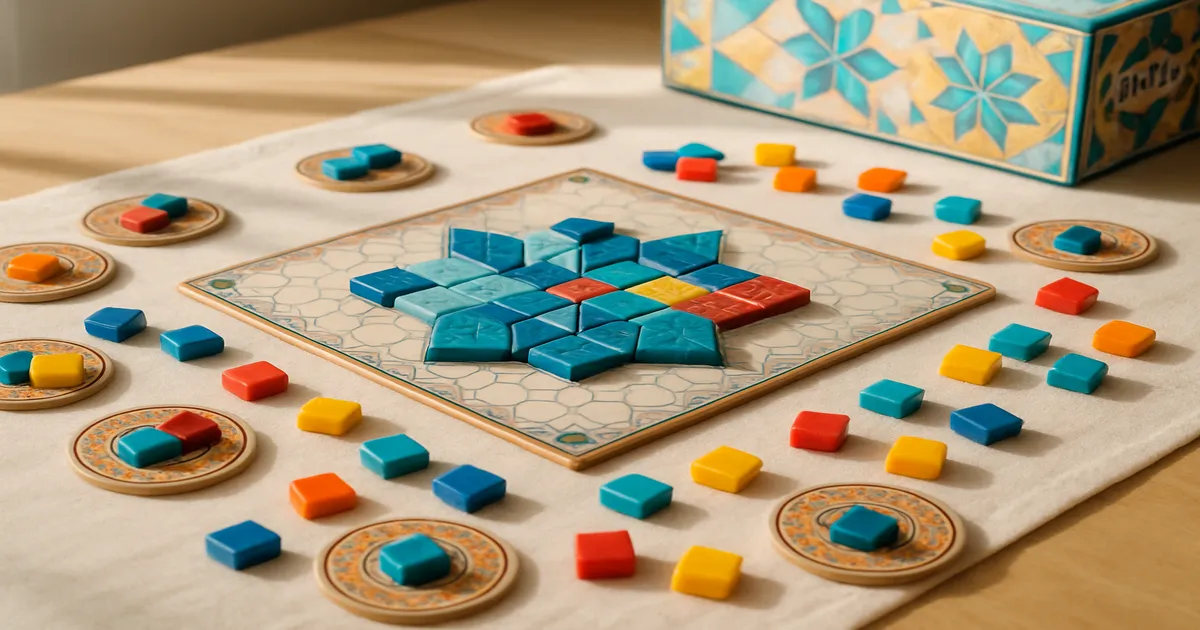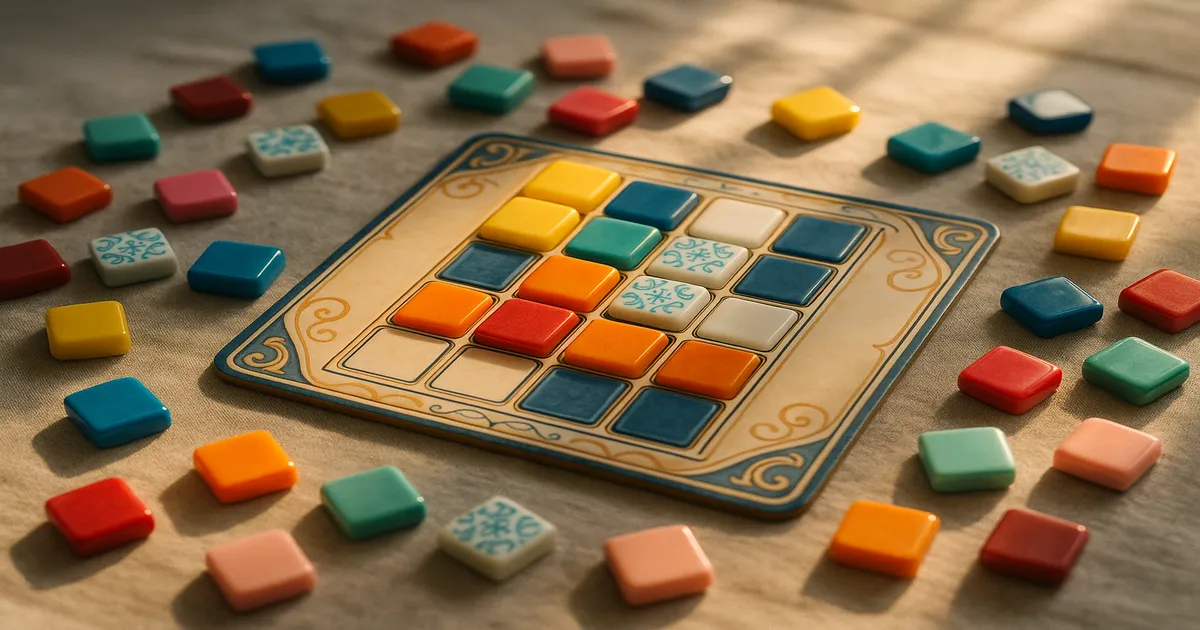
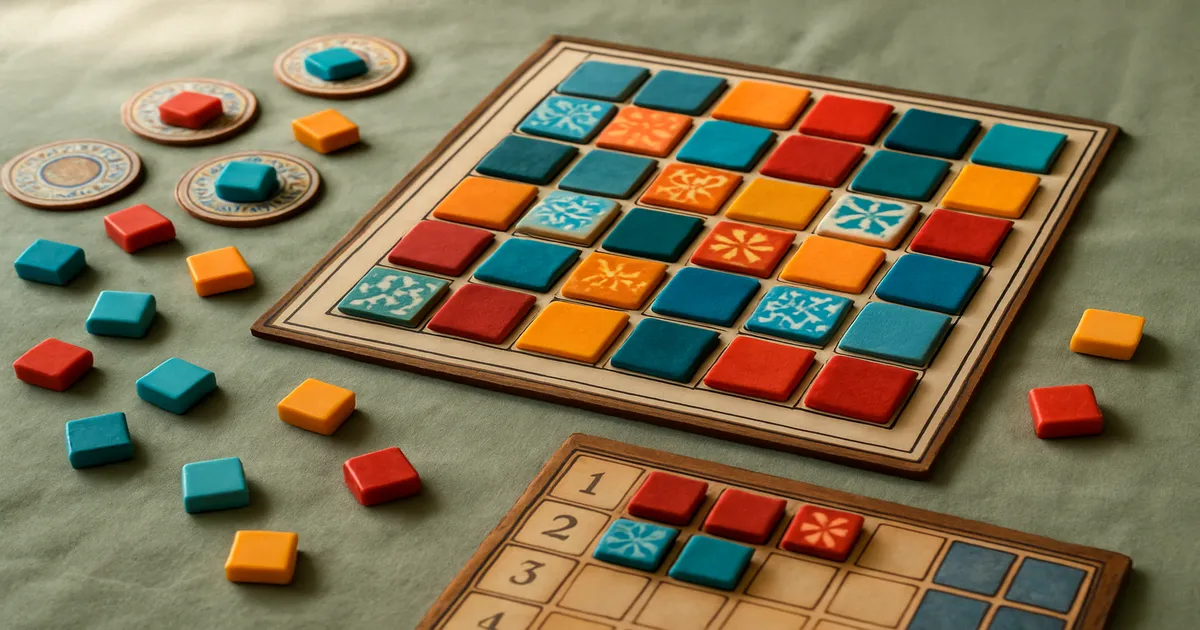
Quick Answer: In Azul Queen’s Garden, players draft hexagonal flower tokens from factory displays, then immediately place them on their personal garden board following adjacency rules. Fill the right spaces and you’ll unlock 3D garden features — trees, benches, pavilions — that earn bonuses and end-game points. Most points after all rounds wins; unplaced tokens cost you. It plays 2–4 players in about 45–75 minutes, with a BGG weight of ~2.5/5.
If you’re trying to figure out how to play Azul Queen’s Garden, you’ve come to the right place — and fair warning, this is the most complex entry in the series. It takes the drafting loop everyone loves from the original and layers on a hexagonal grid, 3D garden elements, and a light engine-building system that makes every round feel like a genuine puzzle. It’s also, in my opinion, the most satisfying of the bunch once it clicks.
What Is Azul Queen’s Garden?
Released in 2022, Queen’s Garden is the fourth main entry in Michael Kiesling’s Azul series, published by Next Move Games (distributed by Plan B Games). The theme puts you in the role of a royal gardener designing a spectacular garden for the Queen of the Netherlands. Unlike a lot of abstract game themes that feel completely tacked on, this one actually shows up in the components — your finished garden looks genuinely beautiful on the table.
Where It Fits in the Azul Series
The original Azul sits at a BGG weight of 1.8/5. It’s a clean, elegant gateway game. Queen’s Garden clocks in at ~2.5/5, roughly the same neighborhood as Azul: Summer Pavilion. It’s not a heavy game by any stretch, but it asks more of you than the original — more spatial thinking, more overlapping objectives, more to track.
What Makes It Different
Two things change everything. First, the tokens are hexagonal, which means placement decisions happen across six directions instead of four. That single shift multiplies the spatial complexity considerably. Second, the 3D garden features — trees, benches, pavilions — add a light engine-building layer the original completely lacks. Unlocking a tree mid-game can genuinely reshape how you draft for the rest of the session.
Components: What’s in the Box
- 1 central market board
- 4 double-sided personal garden boards (standard and advanced layouts)
- Factory display tiles (quantity scales with player count)
- Hexagonal flower tokens in 6 colors
- 3D tree, bench, and pavilion pieces
- Scoring track
- First-player marker
- Cloth bag for token drawing
- Penalty tiles
The hexagonal tokens are the best-feeling pieces in the entire Azul series — thick, satisfying, and genuinely tactile. The 3D garden elements, especially the trees, create a striking mid-game visual that makes the table look impressive. Finished gardens are legitimately photogenic, which partly explains why this game does so well on social media.
One accessibility note worth flagging: players with color vision deficiencies may find some color pairs tricky to distinguish, since iconographic differentiation between colors is limited in some editions. Worth knowing before you buy. The box insert is functional but nothing special — I’d grab some small zip-lock bags or a dedicated organizer to keep the colors sorted between sessions.
Game Setup
The Central Market
Sort the flower tokens by color and put them in the cloth bag. Then fill the factory displays with randomly drawn tokens — the number of displays scales with player count. Getting this right matters: too many or too few displays is one of the most common first-game setup errors, and it throws off the entire draft economy. Place the central market board in the middle of the table, set up the scoring track, and put the first-player marker nearby.
Personal Garden Boards
Each player takes a garden board and places it in front of them. For your first game, use the standard side. The advanced layout is great once you know what you’re doing, but it’ll overwhelm new players before they’ve even internalized the placement rules.
Scaling for Player Count
The number of factory displays increases with player count to ensure there are always enough tokens in the draft. Check your rulebook for the exact numbers — but the key point is that both the number of displays and the number of tokens per display must be correct for your player count. Set this up wrong and the whole draft feels off.
How to Play Azul Queen’s Garden: Turn-by-Turn Rules
The Draft Phase
On your turn, you do one of two things:
- Pick a factory display — take all tokens of one chosen color from that display; the remaining tokens slide to the center market.
- Take from the center market — take all tokens of one chosen color from the pile in the middle.
There’s a catch with option 2: the first player each round to take from the center market also takes the first-player marker, which carries a one-point penalty. Subsequent players who also take from the center that round do not take additional penalties. This trips people up constantly, so burn it into your memory now.
The Placement Phase
After drafting, you immediately place your tokens on your garden board. You can’t hold them for later — placement happens right now, on your turn. Tokens must go in valid hexagonal spaces following the color and adjacency rules printed on your board.
Any tokens you can’t legally place go to your penalty row. This feels minor until it isn’t. A rough round can cost you 6–10 points, which is a significant swing in a game where margins matter.
Unlocking Garden Features
As you fill specific adjacent spaces on your board, you unlock garden features. Each type does something different:
- Trees — typically grant extra tokens or placement flexibility
- Benches — often provide scoring bonuses
- Pavilions — usually score based on what’s adjacent to them at end of game
You can only unlock a feature once the required surrounding spaces are filled. Trying to claim one early is a rules error, not a strategy.
End of Round and Final Scoring
Once all factory displays and the center market are empty, the round ends. Assess penalties, then refill the displays from the bag for the next round. The first-player marker goes to whoever claimed it during drafting.
The game ends when the token bag is exhausted or after a set number of rounds. Final scoring adds:
- Points for completed flower color groups
- Points for activated garden features
- Points for bonus tiles and row/column completions
- Deductions for accumulated penalty tokens
Tiebreaker is fewest penalty tokens. Most points wins.
Common Mistakes New Players Make
- Holding tokens between turns. Placement is immediate. Draft, place, done.
- Treating the grid like it has four directions. Hexagonal adjacency has six. This changes everything about how you plan.
- Underestimating penalties. New players wave off the penalty row until they lose by eight points because of it.
- Thinking everyone pays the center penalty. Only the first player to take from the center each round takes the marker and its penalty point.
- Wrong factory display count. Double-check the player count scaling in the rulebook every time until it’s second nature.
Tunnel vision on one color is probably the most common strategic trap. Your board needs multiple colors to function, and hoarding one while ignoring others leaves you with unplaceable tokens and a half-finished garden. Also: don’t reflexively avoid the first-player marker. Yes, it costs a point. But controlling turn order in a tight round can be worth far more than that.
Strategy Tips for Azul Queen’s Garden
Drafting: By round two, you should have a read on which colors each opponent is prioritizing. Use that — not to play constant denial, but to time it when it really hurts them. Tokens that fill a needed space and unlock a feature are almost always worth taking over tokens that do only one job.
Placement: Plan two turns ahead, not one. Hexagonal adjacency bonuses chain together, and thinking only about your current turn leaves points on the table. Identify the two or three garden features most valuable on your board layout early, then protect the spaces you need to unlock them. A useful heuristic: fill from the edges inward. It tends to preserve flexibility in the center of your garden longer.
Scoring: Complete flower groups fully rather than leaving them one or two tokens short. The scoring curve is steep — a complete group scores disproportionately more than an almost-complete one. Half-finished sets are where points go to die. If you’re going to take excess tokens you know will hit your penalty row, do it in rounds where you’re already taking the first-player penalty. Stacking penalties on an otherwise clean round is just waste.
Player count: In a two-player game, denial is direct and powerful — what you take genuinely prevents your opponent from getting it. At four players, you can’t control the board that way. Optimize your own engine and let the chaos sort itself out.
How Azul Queen’s Garden Compares to Other Azul Games
| Game | BGG Weight | What’s Different |
|---|---|---|
| Azul (Original) | 1.8/5 | Simplest rules, square tiles — the best entry point |
| Stained Glass of Sintra | 2.2/5 | Column-based placement, more chaotic, divisive |
| Summer Pavilion | 2.5/5 | Wild tiles, most forgiving placement |
| Queen’s Garden | 2.5/5 | Hexagonal tokens, 3D features, deepest strategy |
If your group is new to the series, start with the original Azul. It’s tighter, faster, and teaches the core drafting instincts you’ll need for Queen’s Garden. Come back to Queen’s Garden once everyone’s comfortable — it rewards the familiarity.
Queen’s Garden is the right call if your group already knows the original, enjoys spatial puzzles with overlapping objectives, and wants something in the 60–75 minute range. The visual payoff of the finished garden is genuinely satisfying in a way that makes it a crowd-pleaser even with casual players.
Similar Games Worth Knowing
- Calico (Kevin Russ, 2020) — hexagonal tile placement with pattern scoring; very similar spatial feel, slightly lighter
- Cascadia (Randy Flynn, 2021) — tile and token drafting with habitat building; more forgiving, excellent at two players
- Sagrada (Daryl Andrews & Adrian Adamescu, 2017) — dice drafting with a window-building puzzle; lighter feel, beautiful table presence
- Patchwork (Uwe Rosenberg, 2014) — two-player only, spatial puzzle with an economic layer
Frequently Asked Questions About Azul Queen’s Garden
Is Azul Queen’s Garden harder than the original Azul?
Yes, meaningfully so. The original sits at a BGG weight of 1.8/5; Queen’s Garden is ~2.5/5. The hexagonal grid, the feature-unlocking system, and the overlapping scoring objectives all add cognitive load. It’s still accessible — just expect a steeper first-game learning curve.
How many players is Azul Queen’s Garden best for?
Most players find it shines at three, where the draft is competitive without being chaotic and denial play is still meaningful. Two players is excellent if you enjoy direct head-to-head tension. Four works well but the game opens up and becomes more about optimizing your own board than controlling opponents.
How long does a game of Azul Queen’s Garden take?
Plan for about 60 minutes once everyone knows the rules. First games with new players will run 75–90 minutes including rules explanation. Experienced groups can finish in 45–50 minutes.
Does Azul Queen’s Garden have a solo mode?
No official solo mode exists as of 2024. The game’s design is fundamentally competitive. If solo play matters to you, Cascadia or Calico are better options in this genre.
Do you need to own the original Azul to play Queen’s Garden?
Not at all — Queen’s Garden is completely standalone with its own components and rulebook. That said, playing the original first will make the drafting mechanics click faster, since the core loop is the same. It’s not a requirement, just a helpful primer.