Quick Answer: Azul Duel is a two-player tile-drafting game where you take same-colored tiles from factory displays, place them on your board to build scoring patterns, and try to complete rows, columns, and color sets before your opponent does. A full game runs 20–40 minutes. The rules click in about five minutes, but the denial game and bonus scoring give it real staying power.
Azul Duel Quick Overview
What Is Azul Duel?
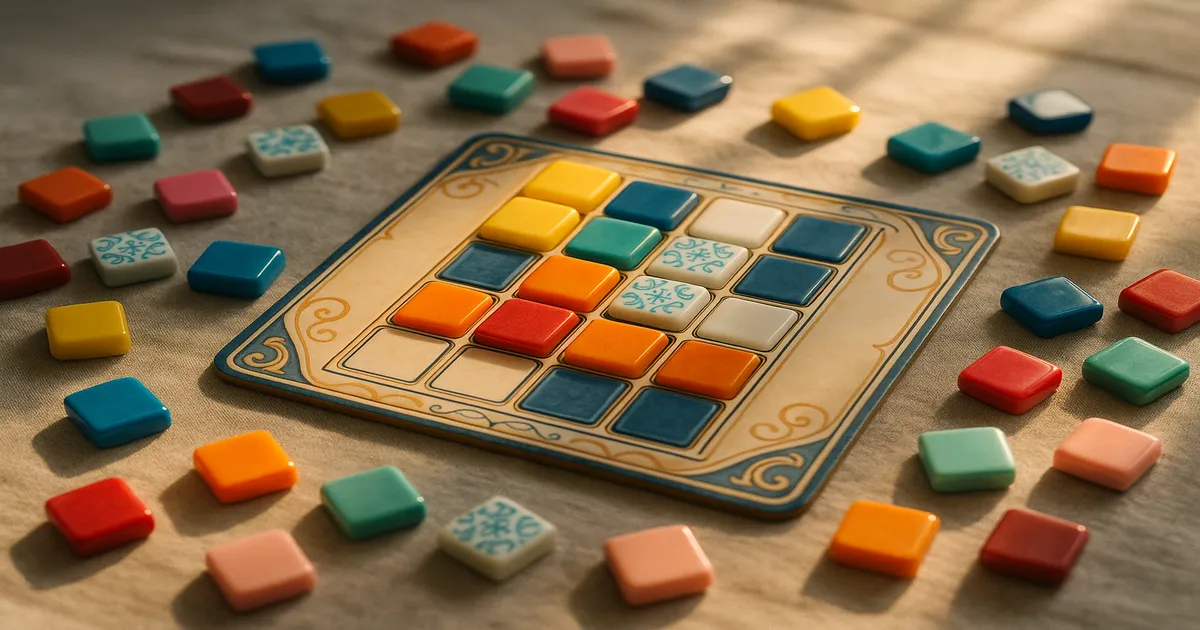
Azul Duel is a two-player abstract strategy game designed by Michael Kiesling — the same designer behind the Spiel des Jahres-winning original Azul — and published by Plan B Games (Next Move Games in North America). Like the rest of the Azul line, it draws inspiration from Moorish azulejo tilework, the decorative ceramic tiles found throughout Portuguese palaces. The aesthetic isn’t just window dressing; laying tiles on your board genuinely feels like building a mosaic.
What sets this version apart is that it’s built specifically for two players. The supply is tighter, every pick directly affects your opponent, and the denial element is sharper than in the base game. If you want a two-player game you can teach in five minutes but still be thinking about after twenty plays, this is one of the best in the hobby.
Key Stats at a Glance
| Players | 2 |
| Play Time | 20–40 minutes |
| BGG Weight | ~2.0 / 5 |
| Recommended Age | 10+ |
| Designer | Michael Kiesling |
| Publisher | Plan B Games / Next Move Games |
Components: What’s in the Box
The Tiles
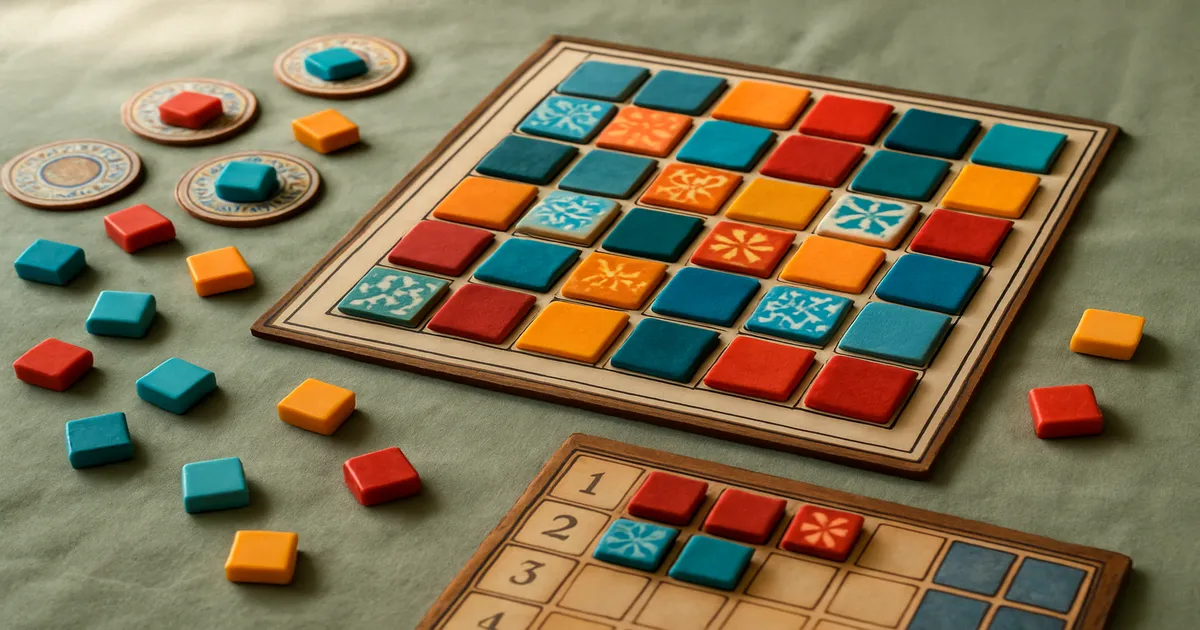
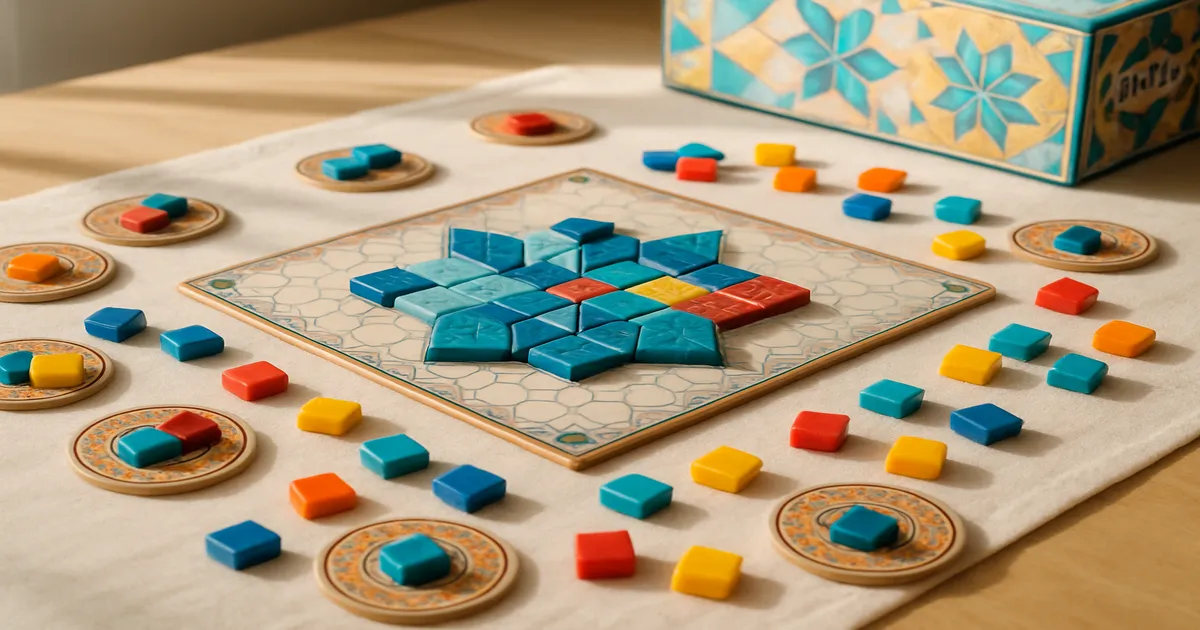
The tiles are the reason people pick this game up off a shelf. They’re thick, chunky, resin-style pieces in five colors — blue, yellow, red, black, and white — and they feel substantial in a way cardboard tokens never do. Holding a handful of them is genuinely satisfying. They’re widely regarded as some of the best physical components in modern board gaming, and that reputation is earned.
Everything Else
- Double-sided player boards — each side offers a slightly different layout, which adds replayability without adding rules overhead
- Circular factory display discs — hold the tiles each round and sit in the center of the table
- Scoring track — integrated into the player boards
- Cloth drawstring bag — for randomizing tile draws
- Box insert — Plan B Games is unusually good about this; everything fits cleanly and setup takes under two minutes
Setting Up Azul Duel
Place the factory display discs in the center of the table. Draw tiles randomly from the bag and place four on each factory display. Set the first-player marker nearby. That’s it — you’re ready to play.
Each player takes a board and picks a side. Decide who goes first however you like. The rulebook suggests the most recent visitor to a tiled building, which is a nice touch.
How to Play Azul Duel: Turn Structure
Drafting Tiles
On your turn, take all tiles of one color from either a factory display or the central pool. If you take from a factory display, any remaining tiles on that disc slide into the central pool. This is how the pool grows throughout the round — and it matters.
The first player to take from the central pool also picks up the first-player marker, meaning they go first next round. There’s a penalty attached to this (a tile goes straight to your floor line), so it’s not a free action.
Placing Tiles
After drafting, place your tiles on legal spaces on your board. The core rule: you cannot place two tiles of the same color in the same row. Each row has designated spaces, and you’re working toward completing full rows, columns, and color sets to trigger bonus points.
The Floor Line
Any tiles you draft but can’t legally place go to your floor line. At the end of the round, each tile there costs you points — and the penalty scale increases as it fills. New players underestimate this constantly. Taking a big batch of tiles feels great until you realize you only had room for two of them.
End of Round
When all factory displays are empty, the round ends. Score points for placed tiles, subtract floor line penalties, refill the displays from the bag, and start the next round.
Winning the Game
The game ends when a player completes a set number of rows, columns, or another specific condition — check your edition’s rulebook, as the exact trigger can vary slightly. After final scoring (including all bonuses), the player with the most points wins. Ties go to whoever completed more full color sets.
Scoring in Azul Duel
Basic Tile Scoring
Each tile you place scores based on how many tiles it connects to. A lone tile scores 1 point. A tile that extends an existing row of three scores 3 points — one for each tile in that connected group. The longer your chains, the more each new placement is worth. This is why board layout matters from round one.
Bonus Points
This is where the big points live, and it’s where new players leave the most on the table. Completing a full row earns a bonus. A full column earns a bonus. Completing all five tiles of a single color across your board earns a bonus. These bonuses are large enough that chasing them should drive most of your decisions — not just filling whatever spaces happen to be convenient.
Floor Line Penalties
The penalty scale typically runs:
- 1st–2nd tile: -1 point each
- 3rd–4th tile: -2 points each
- 5th tile onward: -3 points each
The best way to manage the floor line isn’t to avoid it entirely — sometimes taking a penalty is the right call — but to always know your placement options before you draft. Never grab tiles speculatively.
How to Play Azul Duel Well: Strategy Tips
Play the Denial Game
In a four-player game, blocking is situational. In Azul Duel, it’s a first-class strategy. There are only two of you drawing from the same pool, so every tile you take is one your opponent can’t have. The best players think about their opponent’s board at least as much as their own. If your opponent desperately needs blue to complete a column, taking blue when you have marginal use for it can be the highest-value move available.
Diversify Early, Specialize Late
In the first two or three rounds, keep multiple scoring paths open. Draft flexibly and don’t overcommit to a single color. As the tile supply shrinks, shift to committing hard on the patterns that will yield the biggest bonuses. Going all-in on a color set in round one tips your hand — and your opponent will cut off supply.
Time the Center Pool
The center pool grows throughout the round as tiles spill off factory displays. By mid-round it often holds a large, attractive batch. Taking it at the right moment — when it’s grown genuinely useful but before your opponent grabs it — is a high-skill play. Just don’t let it sit so long that they benefit more from it than you would have.
Count the Tiles
Azul Duel has a finite tile supply. There are a fixed number of each color in the bag, and experienced players track roughly how many remain. If you know there are only three yellow tiles left and you need four to complete your set, adjust your plan now — not after the bag comes up empty.
Common Mistakes New Players Make
Ignoring the floor line. Before you draft, count how many of those tiles you can actually place. If the answer is fewer than you’re about to take, think twice.
Forgetting the first-player marker penalty. Taking from the center pool first earns you the marker — and a penalty tile on your floor line. New players forget this and then wonder where their points went.
Tunnel vision. Azul Duel punishes players who only watch their own board. Spend a few seconds each turn scanning what your opponent is close to completing. That information is free and often changes your best move.
Ignoring bonus patterns. A player who places tiles efficiently but skips bonus patterns will consistently lose to someone who plans around completing rows, columns, and color sets. The bonuses aren’t a nice extra — they’re a core part of the scoring engine.
Azul Duel vs. Base Azul
Base Azul plays 2–4 players and has a more relaxed supply dynamic at higher counts. Azul Duel strips that down to a tight head-to-head where every decision has an immediate, visible impact on your opponent. It plays more like a chess match than a shared puzzle. If you mostly play with two people, Azul Duel is the better buy. If you want one game that works across player counts, start with the base game.
Similar Games Worth Trying
- Azul: Summer Pavilion — widely considered the most strategically rich of the trilogy; adds a wild tile mechanism and plays 2–4
- Patchwork — Uwe Rosenberg’s two-player tile-placement classic with a time-track twist; similar weight and play time, and an excellent alternative if you want something with a different feel
- Targi — two-player-only euro, slightly heavier but similarly compact; worth it if you want more crunch in the same footprint
- Cascadia — tile and token placement for 1–4 players; won Spiel des Jahres 2022 and is a great next step for players who want something a touch more involved
Frequently Asked Questions
What’s the difference between Azul and Azul Duel?
Base Azul plays 2–4 and was designed with group play in mind. Azul Duel is built for exactly two players — tighter supply, sharper denial, more directly competitive. The core drafting mechanic is similar, but the feel is quite different. Azul Duel plays like a duel; base Azul plays more like a shared puzzle with occasional interference.
Is Azul Duel good for beginners?
Yes. The rules take about five minutes to explain and the turn structure is simple: draft tiles, place tiles, manage your floor line. Strategic depth reveals itself over multiple plays rather than hitting you all at once. It’s one of the better entry points into modern abstract games, especially for two-player households.
How long does a game of Azul Duel take?
Most games run 20–40 minutes once both players know the rules. Your first couple of games might stretch toward 45 minutes while you look up placement rules, but experienced players move quickly. It’s a good length — substantial enough to feel satisfying, short enough to play twice in an evening.
How do bonus points work?
Bonus points are awarded at end of game for completing full rows, full columns, and full sets of a single color. These bonuses are large and should shape your strategy from round one. A player who finishes with two or three completed bonus patterns will almost always beat someone who ignored them, even if that player placed more tiles overall.
What happens when you take tiles from the center pool?
The first player to take from the center pool picks up the first-player marker — they go first next round. In most editions, a penalty tile also goes directly to their floor line. It’s a classic Azul tension: the center pool often holds a valuable batch, but claiming it costs you points. Deciding when that trade is worth it is a big part of what makes the game interesting.