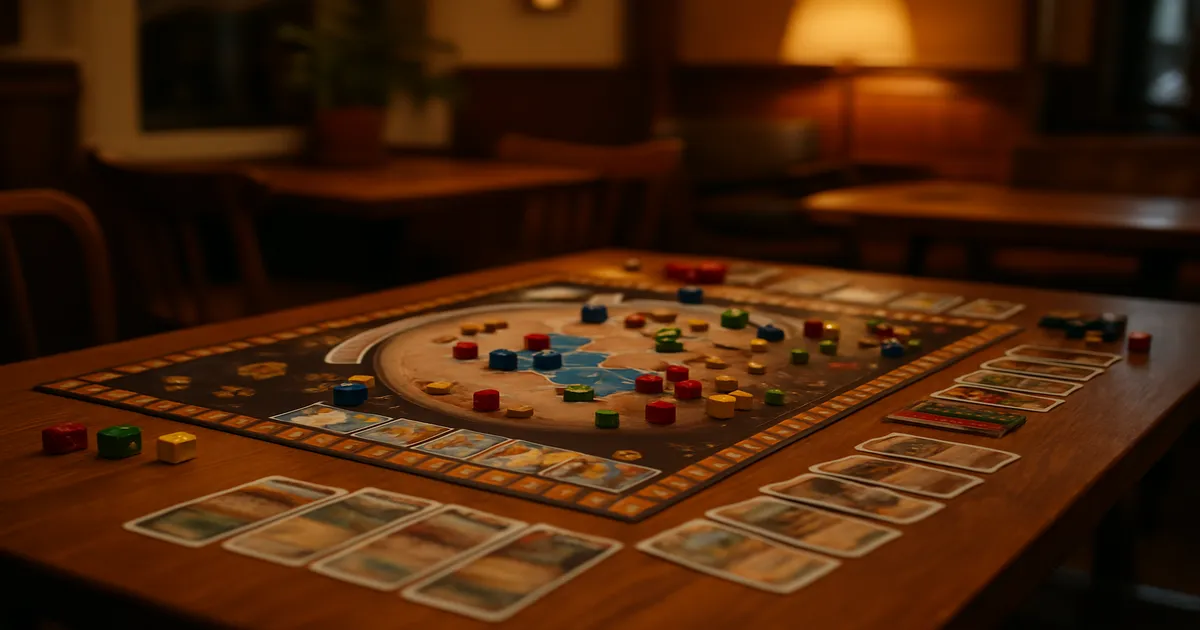
Quick Answer: Terraforming Mars is a medium-heavy engine builder for 1–5 players where corporations compete to raise Mars’s temperature, oxygen, and ocean levels through card play and tile placement. The game ends when all three global parameters are maxed out, and whoever has the most victory points wins. Expect 120–180 minutes and a satisfying learning curve — BGG weight 3.26/5.
If you’ve heard that learning how to play Terraforming Mars is intimidating, that reputation is only half-deserved. The rules themselves aren’t that complicated — there are just a lot of moving parts that take a game or two to internalize. This guide walks through everything you need to sit down and play confidently, from setup and turn structure to strategy tips and common mistakes.
What Kind of Game Is Terraforming Mars?
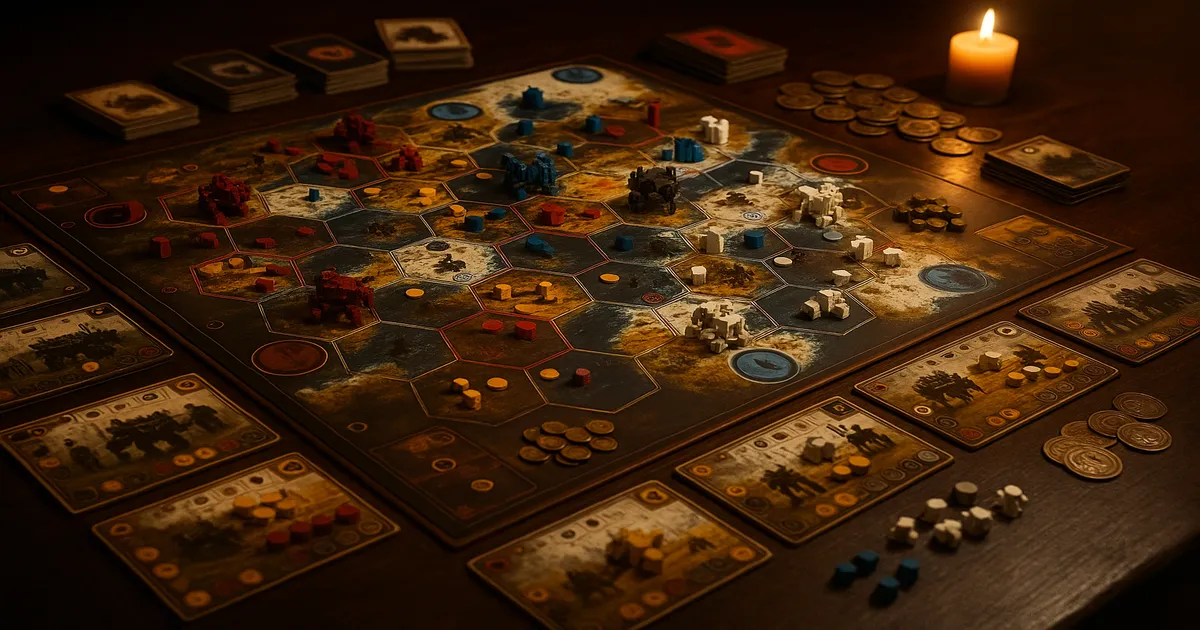
Terraforming Mars is an engine builder with tile placement. You’re building a tableau of project cards that generate resources, trigger bonuses, and combo off each other — while competing with other players to place cities, forests, and oceans on a shared hex-grid map of Mars.
What makes it click is the shared terraforming track. Every player contributes to raising the global parameters, but only one player wins. That tension between collective progress and individual competition is baked into every decision you make.
Game at a Glance
- Players: 1–5 (best at 3)
- Play Time: 120–180 minutes
- BGG Weight: 3.26/5
- BGG Ranking: Consistently top 10 of all time
- Designer: Jacob Fryxelius
- Publisher: FryxGames (distributed by Stronghold Games in North America)
Components: What’s in the Box
The box contains a lot, but it’s organized logically once you know what you’re looking at:
- 233 Project Cards — the heart of the game, split into green, blue, and red types
- 17 Corporation Cards — each with unique starting resources and abilities
- 1 Mars Game Board — the shared hex grid with global parameter tracks along the edges
- 5 Player Boards — individual resource and production tracking boards
- Plastic Cubes — six colors for tracking resources and production
- 200+ Tiles — ocean, greenery, and city tiles placed on the board
- 1 First Player Marker
Honestly, the components are the weakest part of an otherwise excellent game. The player boards are thin cardboard that warps, and the cubes slide around constantly — a genuine annoyance when you’re tracking six resources per player. Card stock is serviceable but not great, and given how often the project cards get shuffled and handled, sleeving them is basically mandatory. (Dragon Shield Matte Standard Size)
The good news is there’s a thriving aftermarket for upgrades. Folded Space and Broken Token both make excellent inserts that solve the cube-sliding problem and keep everything organized between sessions. Metal resource cubes are also popular and genuinely improve the tactile experience. The base game is worth playing as-is, but if this is going to hit your table regularly, the upgrades are worth it.
Setup and Corporations
Place the Mars board in the center of the table. All three global parameter tracks start at their minimums: temperature at -30°C, oxygen at 0%, and oceans at 0 (no tiles placed). Each player takes a player board and a set of cubes.
Deal each player two corporation cards and four project cards. Players look at everything privately before deciding.
Choosing Your Corporation
This is the most important decision of the game. Your corporation sets your starting MegaCredits, initial production levels, and a unique ability that defines your strategy for the entire session. Here’s a quick look at five base game corporations:
- Ecoline — Converts plants to greenery at 7 plants instead of 8; built for spamming forests
- Helion — Can spend heat as MegaCredits; run high heat production and use it like money
- Mining Guild — Gains steel production whenever you place a tile on a steel or titanium bonus space
- Phobolog — Titanium is worth 4 MC instead of 3; build a space-tag heavy deck
- Teractor — 20% discount on Earth-tagged cards; prioritize Earth tags in card selection
First-time players can use the Beginner Corporation, which gives a flat 42 MegaCredits and skips some of the early complexity.
After choosing your corporation, you select which of your four starting project cards to keep — paying 3 MC per card kept. Everything else is discarded. Then the game begins.
How to Play Terraforming Mars: Turn Structure
Each round is called a generation and runs through four phases.
Phase 1: Player Order
The first player marker passes left. Players can pay 3 MC to compete for first player, but it’s rarely worth it early on.
Phase 2: Research Phase
Every player draws 4 project cards and decides which to keep. Here’s the rule new players miss most often: you pay 3 MC per card you keep, not per card drawn. Drawing is free; keeping costs money. Think of it as a filter — if a card isn’t worth 3 MC to hold right now, leave it.
Experienced groups can add the Card Draft variant here, passing drawn cards around the table before buying. It adds meaningful decisions and is worth trying once everyone knows the base game.
Phase 3: Action Phase
Players take turns clockwise. On your turn, you take 1 or 2 actions — your choice. Play continues until everyone has passed. You can pass early if you have nothing useful to do, but you’re out for the rest of that generation.
Your available actions:
- Play a project card (pay its cost, resolve its effects)
- Use a Standard Project (fixed-cost options printed on the board)
- Claim a Milestone (8 MC if you meet the threshold)
- Fund an Award (escalating cost: 8/14/20 MC)
- Use a blue card action (once per generation per card)
- Convert 8 plants into a greenery tile (+1 oxygen, +1 TR)
- Convert 8 heat to raise temperature (+1 TR)
Phase 4: Production Phase
All players produce resources simultaneously based on their production tracks. One important order of operations: energy converts to heat first, then new energy is produced. New players get this backwards constantly.
Cards, Milestones, and Awards Explained
The Three Card Types
- Green cards (Automated) — Play once for an immediate effect. They stay face-up; their tags count permanently.
- Blue cards (Active) — Have a reusable action (marked with a red arrow) usable once per generation. Flip a cube onto the card to track use.
- Red cards (Events) — Immediate effect, then flip face-down. Their tags don’t count after play.
Steel and titanium are cost reducers: steel saves 2 MC per unit on building-tag cards, titanium saves 3 MC per unit on space-tag cards. Building production around these makes expensive cards dramatically more affordable.
Milestones and Awards
Milestones cost 8 MC to claim and are worth 5 VP each at game end. You must meet the threshold when you claim them. Only 3 of the 5 available milestones can be claimed total — first come, first served.
Awards work differently. You pay to fund one (8 MC for the first, 14 for the second, 20 for the third), and the winner is determined at game end. First place gets 5 VP, second gets 2 VP. You don’t have to be winning the category when you fund it, but you should be close. Max 3 awards can be funded.
Both are consistently the best VP-per-MC value in the game, and both are consistently ignored by new players until it’s too late.
How to Win Terraforming Mars
Game End Trigger
The game ends at the close of the generation in which all three parameters are complete:
- Temperature reaches +8°C
- Oxygen reaches 14%
- All 9 ocean tiles are placed
The game doesn’t stop mid-generation — everyone finishes their actions once the last parameter is hit.
Scoring
- TR: 1 VP per point of Terraform Rating
- Greenery tiles: 1 VP each
- City tiles: 1 VP per adjacent greenery tile
- Milestones: 5 VP each (claimed)
- Awards: 5 VP for 1st place, 2 VP for 2nd
- Card VPs: Many cards contribute VPs directly or through accumulated resources
Why TR Is the Most Important Number on Your Board
TR is both your score and your income. Every time you raise a global parameter, your TR goes up by 1 — meaning you earn 1 more MegaCredit every production phase for the rest of the game. A player at TR 25 earns 25 MC every production phase. Beginners consistently undervalue early TR gains, not realizing they compound across every remaining generation.
Common Mistakes New Players Make
Rules mistakes:
- Paying for cards drawn instead of cards kept (drawing is always free)
- Confusing production increases with resource gains — gaining 1 steel production is not the same as gaining 1 steel
- Using a blue card action more than once per generation
- Forgetting “when you play” tag triggers on other cards
- Placing ocean tiles on non-ocean spaces, or greeneries non-adjacently when adjacency is required
Strategic traps: Hoarding cards is the big one. Keeping 6–8 cards you can’t afford for three generations is just burning money in the Research Phase. Be ruthless about what you keep.
Ignoring milestones and awards until generation 5 is the second most common mistake. By then, someone else has claimed what you wanted, and awards cost 14–20 MC instead of 8. Check which milestones are achievable from generation 1 and build toward one intentionally.
Strategy Tips
Early game: Production beats stockpiling, every time. A steel production of 3 pays off for the rest of the game; 3 steel in hand is gone after one card. Match your corporation to your starting hand — if you’re playing Phobolog, you want space tags. Only keep a card if you can realistically play it within 2–3 generations.
Mid game: Build your engine before pushing parameters hard. Accelerating the game end when your engine isn’t running yet is a recipe for losing. Fund awards when you’re clearly leading a category and the cost is still 8 MC.
Late game: Do a rough VP count before the final generation. If you’re ahead, push parameters to end the game. If you’re behind, slow down — don’t contribute to parameters you don’t have to. Convert plants and heat aggressively in the last 2–3 generations. A well-placed city surrounded by 3–4 greeneries can swing the game.
Expansions Worth Adding
Prelude is the consensus best first expansion and it’s not close. It adds starting boost cards that dramatically speed up the early game — those slow first 2–3 generations essentially disappear. Add it after your first few games.
Hellas & Elysium gives you two alternate Mars boards with different milestones and awards. Significant replayability, zero new rules overhead. Great second purchase.
Venus Next adds a fourth global parameter and extends play time. Colonies adds off-world colony tiles for extra resource generation — more complex, but fun. Turmoil is the most divisive expansion: it adds a political layer that some players love and others find genuinely frustrating. Save it until you know the base game cold.
Similar Games Worth Considering
- Terraforming Mars: Ares Expedition — Same designer, same theme, streamlined into a ~60-minute card game. Great if you love the theme but want something faster.
- Wingspan — Lighter engine builder, nature theme, excellent gateway into the genre.
- Race for the Galaxy — Faster card engine builder with a steeper iconography learning curve. Scratches a similar itch in half the time.
- Gaia Project — Heavier space game with deeper faction asymmetry. A step up in complexity.
Frequently Asked Questions
How long does a game of Terraforming Mars take?
The box says 120 minutes, but expect 150–180 minutes with new players. Experienced groups who know their corporations can finish in 90–120 minutes. Player count matters too — a 2-player game is noticeably faster than a 5-player game.
How many players is Terraforming Mars best with?
Most experienced players land on 3 as the sweet spot — enough competition for milestones and awards without the downtime of 4–5 players. Two players works well and plays faster. Five players is chaotic and slow; avoid it until everyone at the table knows the game.
What is Terraform Rating and why does it matter?
TR is your score and your income. Every time you raise a global parameter, your TR increases by 1, which means you earn 1 more MegaCredit every production phase for the rest of the game. At game end, each TR point is also 1 VP. It’s the most efficient resource in the game, and beginners consistently undervalue it.
Can you play Terraforming Mars solo?
Yes, and it’s a solid solo experience. You race to complete all three global parameters within a set number of generations (14 in the standard solo mode). There are difficulty variants. It’s not as dynamic as multiplayer, but it’s a great way to learn the cards and practice engine building without the pressure of opponents.
What’s the difference between green, blue, and red cards?
Green cards are automated — played once for an immediate effect, tags count permanently. Blue cards are active — they have a reusable action you can use once per generation. Red cards are events — they fire immediately then flip face-down, and their tags no longer count. Learning to recognize these at a glance makes the game flow much faster.