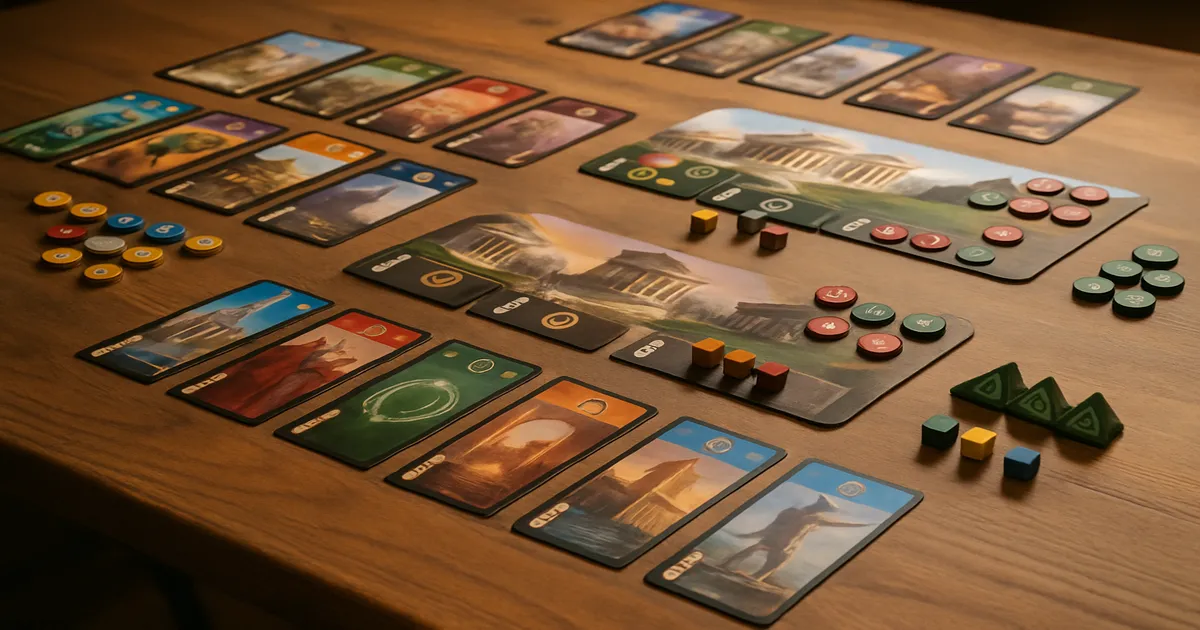
Quick Answer: 7 Wonders is a card-drafting game for 2–7 players where everyone simultaneously picks cards from a shared hand, builds an ancient civilization, and scores points across three Ages — all in about 30–45 minutes. Designed by Antoine Bauza and published by Repos Production, it plays just as fast with 7 people as with 3, which is one of its best features. Pick a card, take an action, pass the hand, repeat.
What Is 7 Wonders and How Does It Work?
Game at a Glance
Antoine Bauza designed 7 Wonders, and Repos Production first published it in 2010. It supports 2–7 players, runs 30–45 minutes, and sits at a BGG weight of around 2.33/5 — medium-light, meaning you can teach it in one sitting but the strategy takes longer to master. A revised Second Edition arrived in 2020 with upgraded components and cleaner iconography.
The game has won a pile of awards and consistently ranks in the top 50 on BoardGameGeek. It’s one of the best-selling hobby games ever made, and it earns that reputation.
The Core Loop in Three Sentences
Everyone starts with a hand of 7 cards and secretly picks one. All players reveal simultaneously, each takes an action with their chosen card, then passes the remaining hand to a neighbor. Do this six times per Age, across three Ages, then count up victory points.
Components: What’s in the Box?
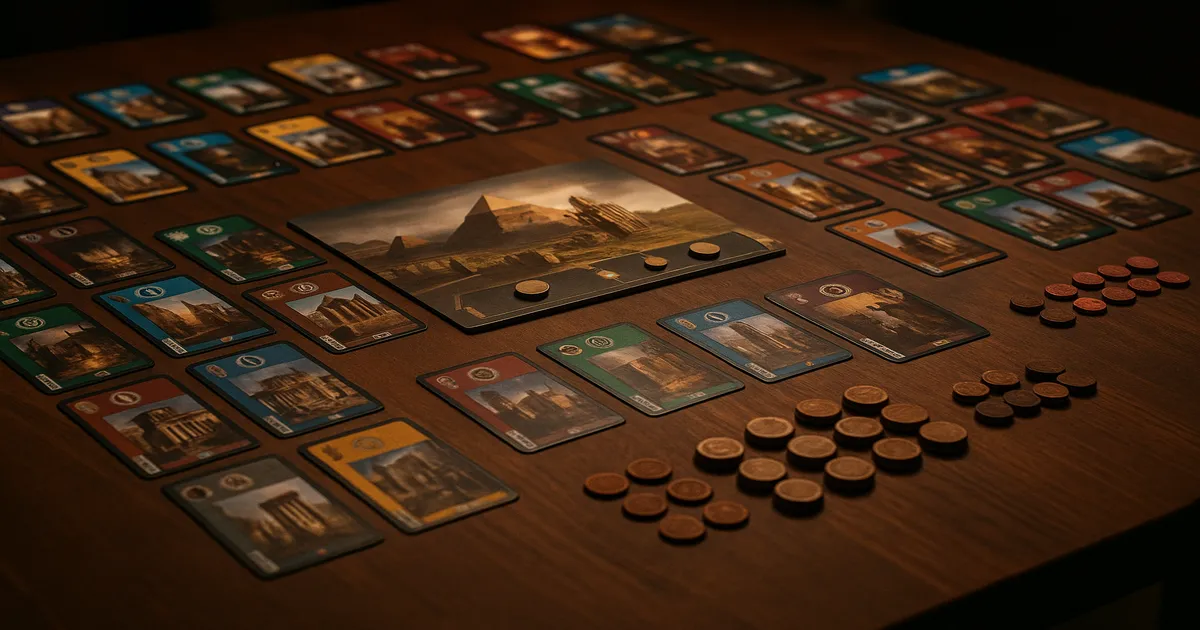
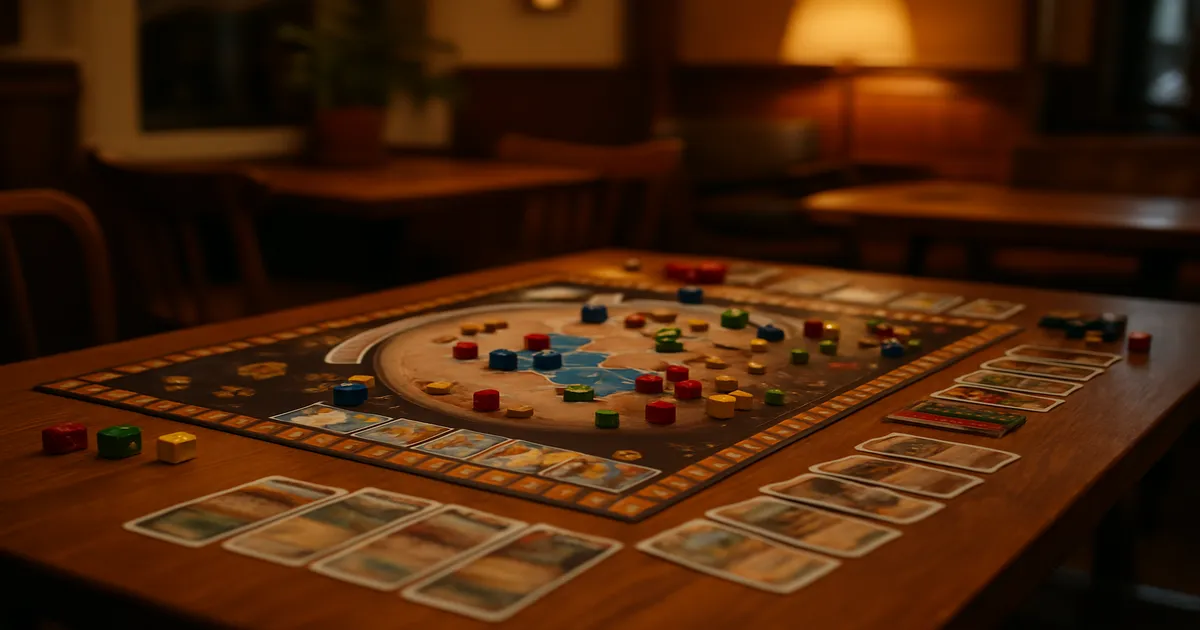
The box includes 7 double-sided Wonder boards — 14 unique wonders total — and roughly 155 cards split across three Age decks. The purple Guild cards live in the Age III deck. Each Age deck has a distinct card back, which makes sorting and setup easy.
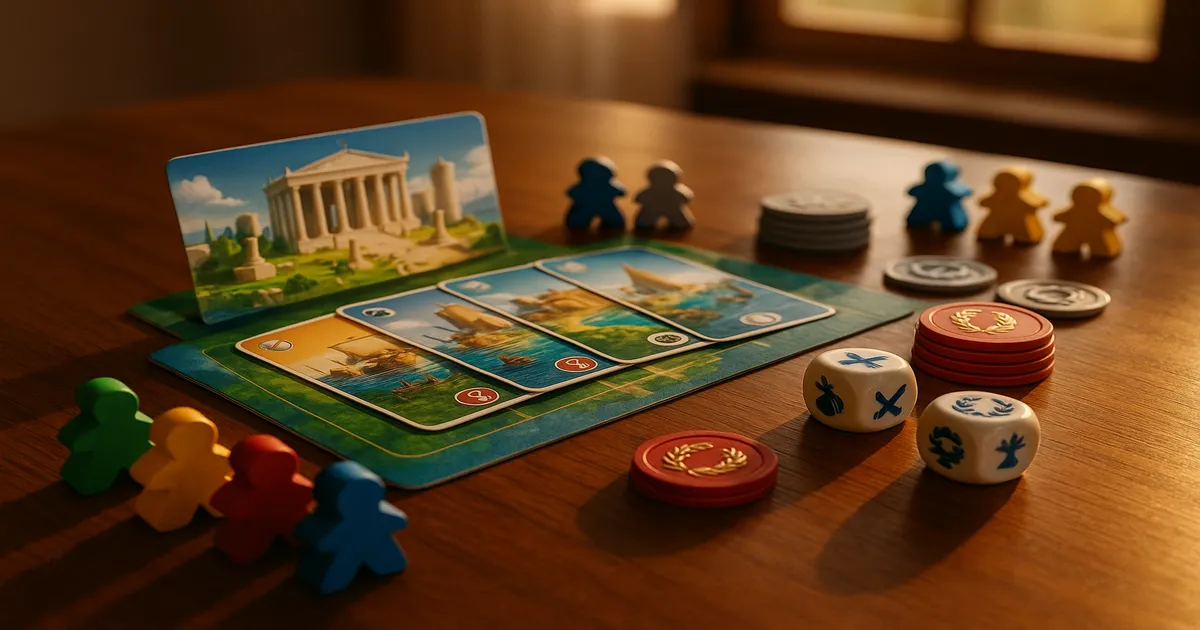
You also get cardboard coins in 1- and 3-value denominations, conflict tokens (Victory and Defeat markers), a score pad, and a quick-reference card for each player. Don’t skip the reference cards for your first few games — they’re genuinely useful.
The 2020 Second Edition meaningfully improved the physical game: thicker cards, sturdier Wonder boards, revised artwork, and cleaner iconography that reduces misreads. If you’re buying new, get the Second Edition without hesitation. One thing that hasn’t changed: the coins are still cardboard. Many players eventually swap them out for a metal coin set, which feels noticeably better at the table.
How to Play 7 Wonders: Setup
Choosing Wonder Boards and Dealing Cards
Randomly deal one Wonder board to each player. Each board is double-sided — pick whichever side you want (A or B) and place it face-up in front of you. This is your civilization for the game.
Separate the three Age decks and shuffle the Guild cards into the Age III deck. Give each player 3 gold coins, then deal a 7-card hand from the Age I deck.
Adjusting Card Counts for Player Count
This is the step people skip and then wonder why the math feels off. With fewer than 7 players, you remove cards randomly from each Age deck before dealing — the rulebook specifies exactly how many per player count. Don’t eyeball it.
Turn Structure and the Three Ages
The Five Steps of Every Round
- Choose a card from your hand secretly.
- Reveal simultaneously — everyone flips at the same time.
- Take one of three actions with your chosen card:
- Play it (pay any resource costs and add it to your tableau)
- Bury it to build the next stage of your Wonder (pay the Wonder stage cost)
- Discard it for 3 gold coins
- Pass your hand to a neighbor.
- The last card in each hand is discarded without being played.
Age I: Build Your Resource Base
Age I is where you establish your economy. Brown and grey resource cards are cheapest here and most valuable over the long run. Leave Age I without a solid resource foundation and you’ll spend the rest of the game paying neighbors 2 gold per resource — which adds up fast.
Age II: Your Engine Starts Running
Commercial (yellow) cards become more impactful, military escalates, and science players start locking in their symbols. The key thing people forget: hands pass RIGHT in Age II, not left. This is the most common rules mistake I’ve seen at the table, and it can completely distort the draft.
Age III: Guilds, Scoring, and the Final Push
Age III introduces the purple Guild cards — the most powerful and most situational cards in the game. They score based on what you and your neighbors have built, so drafting a Guild that rewards your neighbor’s tableau is just throwing points away. Blue civic cards also show up in force here, giving reliable VP to close out the game.
Military Conflicts at the End of Each Age
At the end of each Age, compare your total Shield icons with each neighbor separately:
- Win: +1 VP (Age I), +3 VP (Age II), +5 VP (Age III)
- Lose: −1 VP (any Age)
- Tie: 0 VP for both
Military snowballs. Winning all six conflicts (two neighbors × three Ages) is a significant chunk of points.
How Chain Builds Work
Some cards have a small symbol in the corner. If you played the card with the matching symbol in a previous Age, you can build the new card for free — no resources, no gold required. Beginners consistently miss this. Before paying for any card, check whether you’ve already unlocked its chain prerequisite. It comes up multiple times per game.
Card Types: Every Color and What It Does
Brown and Grey — Resources Are Everything. Brown cards produce raw materials (Wood, Stone, Ore, Clay). Grey cards produce manufactured goods (Glass, Papyrus, Linen). Both are the foundation of everything else. Grey cards are the most undervalued type for new players — Glass, Papyrus, and Linen appear as requirements on many Age II and III cards, and skipping them is expensive. One iconography note: a slash between two resources means you produce one of the two, not both. This trips people up constantly.
Yellow — Trade and Commerce. Yellow cards reduce the cost of buying resources from neighbors, generate gold, or provide flexible resources. The standout Age II picks are Caravansery (flexible raw material) and Forum (flexible manufactured good). These two quietly fix resource gaps without requiring a full commitment to yellow.
Blue — Reliable Victory Points. Blue civic cards give you straight VP — no conditions, no combos. Not flashy, but consistent. New players undervalue blue; experienced players respect it.
Red — Military Shields. Red cards add Shield icons for conflict resolution. The strategic question isn’t whether to build red — it’s whether you’re going all-in or staying out entirely. A half-hearted military investment usually just wastes cards.
Green — The Science Engine. Green cards feature three symbols: Compass, Tablet, and Gear. Scoring is exponential:
- Identical symbols score count² VP (3 Gears = 9 VP, 4 Gears = 16 VP)
- One complete set of all three different symbols = 7 VP
Science is the highest-ceiling strategy in the game, but it demands consistent commitment across all three Ages.
Purple — Guild Cards. Guilds only appear in Age III and score based on specific things you and your neighbors have built. Powerful when they align with your tableau, nearly useless when they don’t.
Scoring: How to Count Victory Points
Use the score pad and go through these one by one — it’s easy to miss something:
- Blue civic cards — face value printed on each card
- Completed Wonder stages — VP printed on each stage
- Military — sum of victory tokens minus defeat tokens
- Science — count each symbol type, square it, add 7 VP per complete set
- Gold — every 3 coins = 1 VP (round down)
- Guild cards — calculated based on your and neighbors’ tableaux
- Some yellow cards — check for VP icons
Ties go to whoever has the most gold remaining. Don’t spend your last coin on something marginal in Age III if you’re in a tight race.
Common Mistakes New Players Make
- Forgetting chain builds — check the small symbol on every card before paying
- Misreading either/or resource cards — slash means pick one, not get both
- Getting the Age II hand direction wrong — right in Age II, left in Ages I and III
- Going halfway on military — commit enough shields to beat your neighbors or redirect those cards elsewhere
- Spreading too thin — one card of every color feels balanced but rarely scores well; go deep on 2–3 types
- Hoarding gold — it converts at 3:1 for VP, which is a bad rate; spend it on resources or cards
- Never building Wonder stages — burying a useless card for a strong Wonder ability is almost always the right call
Strategy: How to Win at 7 Wonders
Establish your resource base in Age I. It’s the cheapest time to do it, and you’ll pay for skipping it in every subsequent Age.
Commit to 2–3 card types and go deep. Sampling everything feels safe but scores poorly. Pick a direction and lean into it.
Science is the strongest strategy when it works, but it demands consistency. Green cards get contested quickly at higher player counts, so draft them aggressively and early. The Babylon Wonder is purpose-built for science — its ability to play the last card of a hand gives you extra flexibility to complete sets.
Military is most impactful in 3–4 player games where the point swings are easier to control. In 6–7 player games, science or blue often outperforms. Count your neighbors’ shields before committing — if both are going heavy red, you’re spending resources fighting for ties.
Yellow cards work best as support. Caravansery and Forum in Age II are efficient enough to draft even if commerce isn’t your main focus.
Wonder-specific tips:
- Alexandria — flexible resource ability is forgiving; good for newer players
- Olympia — one free card per Age is game-changing; plan ahead to grab your most expensive target
- Babylon — pair with science; the “play last card” ability is most valuable when chasing a specific symbol
- Halikarnassos — track the discard pile actively; the ability to build from discards is only as good as your awareness
- Giza — straightforward VP accumulation; focus on efficient resources and let the stages do the work
On drafting and denial: if a card is good for you and your neighbor, take it even if you can’t use it right now — bury it or discard it. Passing a strong card to the player who needs it most is a real mistake.
Expansions and Alternatives
Expansions Worth Adding
- Leaders — draft leader cards before each Age; adds player powers and complexity; the most natural first expansion
- Cities — introduces black city cards with debt and espionage mechanics; spikier and more chaotic
- Babel — adds a communal structure that affects all players; changes the game significantly
- Armada — naval fleets and a new resource type; best for groups who want more moving parts
- Edifice — the newest expansion; adds a shared construction project that rewards timing
Play the base game at least 5–10 times before adding anything. Leaders is the right starting point.
7 Wonders Duel: The Best Two-Player Option
The base game technically works at 2 players with a modified variant, but honestly — just play 7 Wonders Duel instead. It’s a standalone game designed specifically for two players, with a completely different card-drafting structure and three distinct win conditions (military dominance, scientific supremacy, or VP). It’s one of the best two-player games ever made.
Games Like 7 Wonders
| Game | Why Choose It Instead |
|---|---|
| Sushi Go! | Same drafting mechanic, much lighter — perfect for families or casual groups |
| Race for the Galaxy | Similar simultaneous feel and tableau building, but steeper learning curve |
| Terraforming Mars | You want deeper civilization building and don’t mind 2+ hours |
| Ticket to Ride | A gateway game with less player interaction and a gentler learning curve |
Frequently Asked Questions About How to Play 7 Wonders
Can you play 7 Wonders with 2 players?
Technically yes — there’s an official 2-player variant — but it’s not the best experience the game offers. 7 Wonders Duel is a standalone two-player game built from the ground up for that count, and it’s significantly better. If you’re buying specifically for two players, get Duel.
How do chain builds work in 7 Wonders?
Some cards show a small symbol in their cost area. If you previously played the card that matches that symbol in an earlier Age, you can build the new card for free — no resources or gold required. Always check for chain symbols before paying; it comes up more often than you’d think.
What’s the best Wonder board?
There’s no single best board, but a few stand out. Olympia (free card per Age) and Babylon (play last card of hand) are widely considered strong. Alexandria is forgiving for newer players thanks to its flexible resource ability. Halikarnassos has a high ceiling but requires active tracking of the discard pile. Honestly, “best” depends on what strategy you’re running.
What’s the difference between the First and Second Edition?
The Second Edition (2020) upgraded the physical components substantially: thicker cards, sturdier Wonder boards, revised artwork, and cleaner iconography. Some cards received minor tweaks for balance. The core rules are unchanged. If you already own the First Edition, it’s not a mandatory upgrade — but if you’re buying new, the Second Edition is the obvious choice.
How long does a game of 7 Wonders take?
About 30–45 minutes, regardless of player count. Because all players act simultaneously, adding more players doesn’t meaningfully extend the play time. It’s one of the few strategy games that genuinely scales from 3 to 7 without a time penalty.