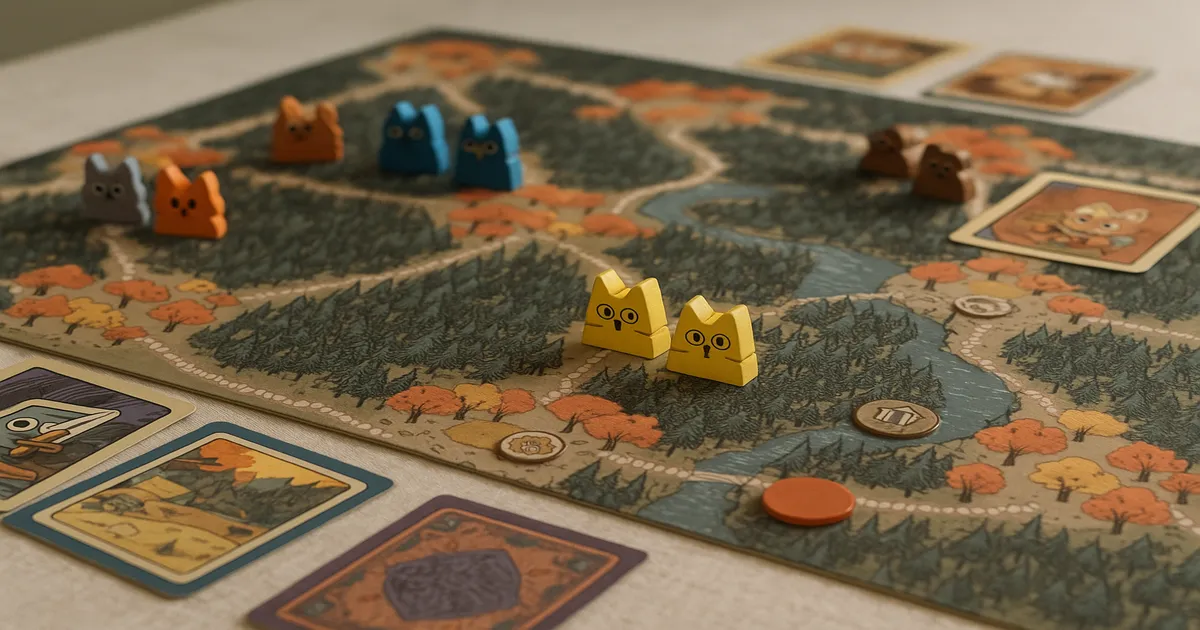
Quick Answer: The Vagabond is Root’s lone wandering hero — a single pawn, no clearings to control, no warriors to deploy. You score by completing quests, aiding other factions, crafting cards, and picking fights only with factions you’ve turned Hostile. Master your item management and relationship track, and you’ll sneak to 30 VP while everyone else is busy tearing each other apart.
If you’re figuring out how to play Root as the Vagabond, here’s the first thing to get straight: you’re not playing the same game as everyone else at the table. While the Marquise is cranking out sawmills and the Eyrie is chaining decrees, you’re a hooded figure slipping through the woods — looting ruins, running errands, and quietly stacking points. Root (2–6 players with expansions, 60–90 minutes, BGG weight ~3.4/5) is already a complex game, and the Vagabond is its strangest piece. Most players who struggle here aren’t misunderstanding the rules. They’re misunderstanding the role.
What Makes the Vagabond Different from Every Other Faction
Every other faction wins by dominating the map. The Vagabond doesn’t care about the map in that sense — no clearings to hold, no structures to build, and losing a fight doesn’t cost you territory. Your single pawn just keeps moving.
What you do care about is your satchel of items. Those items are your action economy. No items, no actions. It’s that simple, and it’s what makes the Vagabond feel completely unlike anything else in the base game.
There are really three engines driving you to 30 VP:
- Aid actions — giving items to other factions earns VP and builds relationships
- Quests — spending pairs of matching items to complete quest cards for solid VP rewards
- Crafting — using Hammers to craft cards from your hand for immediate VP
Combat can score points too, but only against factions you’ve deliberately made Hostile. It’s a strategic choice, not a default playstyle.
The Vagabond’s Turn Structure
Birdsong: Refresh Items and Slip
Birdsong is short but non-negotiable: refresh your exhausted items. The number you can refresh equals the number of Torches in your satchel. Start with one Torch, refresh one item. Find a second Torch, refresh two items per turn. That’s multiplicative — more Torches means more actions every single turn for the rest of the game.
You can also Slip during Birdsong, moving to an adjacent clearing without spending a Boot, as long as you have a Torch. Easy to forget, genuinely useful for repositioning.
Daylight: Actions and Their Costs
This is where you actually play the game. Take as many actions as you have items to spend:
| Action | Item Required | What It Does |
|---|---|---|
| Move | Boot | Move to an adjacent clearing |
| Battle | Sword | Initiate combat in your clearing |
| Explore | Torch | Take a hidden item from a ruin |
| Aid | Any item (given away) | Give an item to a faction here; gain 1 VP and improve relations |
| Strike | Crossbow | Remove 1 enemy piece without rolling dice |
| Repair | Hammer | Fix a damaged item in your satchel |
| Craft | Hammer | Craft a card using your clearing’s suit |
| Quest | 2 matching items | Complete a quest card for VP and a reward |
Every action costs something. You’re constantly trading movement, scoring, and engine maintenance against each other.
Evening: Draw Cards
Draw 1 card, plus 1 additional card for each ruin you’ve previously explored. Quiet bonus, but it compounds — exploring ruins early doesn’t just get you items, it permanently upgrades your card draw for the rest of the game.
How to Play Root as the Vagabond: Choosing Your Character
Tinker: Best for Beginners
The Tinker starts with Hammer, Bag, Torch, Boot — the most forgiving loadout in the game. The Hammer lets you craft immediately, the Bag gives you extra item capacity right away, and the second Torch means you’re refreshing two items per turn from day one. In my experience, the Tinker consistently outperforms the other characters in newer players’ hands because it rewards patience and engine-building over aggression.
Thief: High Risk, High Reward
Starting with Sword, Torch, Boot, Crossbow, the Thief is built to go Hostile with a target faction and farm VP through combat. It works brilliantly when timed right and falls apart when you pick the wrong enemy. Not your first Vagabond experience.
Ranger: The Flexible Option
The Ranger (Sword, Torch, Boot, Hammer) sits between the two. Fight when you need to, craft when you don’t. Genuinely adaptable, which makes it a solid pick once you understand the faction but still want room to react to different table states.
Bottom line for beginners: play the Tinker. Its natural playstyle — explore, craft, quest, aid — teaches you the Vagabond’s core loops without forcing risky combat decisions on you.
The expansions add more characters (Scoundrel, Adventurer, Ronin, Arbiter), each with distinct mechanics worth exploring once you’ve got the fundamentals down. (Root: The Underworld Expansion)
Mastering the Relationship Track
The Four States: Indifferent, Friendly, Allied, Hostile
Every faction starts Indifferent toward you. Aid them and you move to Friendly, then Allied. Attack them and you become Hostile.
- Friendly/Allied: Move through their warriors freely; Allied factions fight alongside you in combat
- Hostile: You lose 1 VP every time you remove one of their pieces
That VP loss on Hostile kills is the rule that surprises people most. Careless aggression doesn’t just damage relationships — it actively costs you points.
Aid Chains: The Most Underused Action
Aid is probably the most overlooked action among new Vagabond players. Each Aid gives you 1 VP immediately and improves your relationship. Aid the same faction repeatedly and you’re stacking VP while unlocking Allied combat bonuses. It compounds fast. Pick one or two factions to Aid consistently — by mid-game, a faction you’ve Aided six times has given you 6 VP and now fights alongside you in battle.
When Going Hostile Is Worth It
Deliberately turning a faction Hostile — usually with the Thief — can work if you commit fully. The math only makes sense when you’re removing multiple pieces per turn from a faction threatening to win. Going Hostile against the leader to slow them down while farming VP is legitimate. Going Hostile by accident because you attacked carelessly is just a mistake.
Allied Combat Bonuses
Most frequently forgotten rule in the game: when you battle in a clearing where your Allied faction has warriors, they fight with you. Their warriors count as additional dice in your favor. It’s a massive advantage that most players leave on the table.
Item Management: The Heart of Vagabond Gameplay
Exhausted vs. Damaged items — these are not the same thing. Exhausted items refresh next Birdsong. Damaged items were hit in combat and are completely out of commission until you spend a Hammer to repair them. A damaged Torch sitting unrepaired is costing you an action every single turn.
Torches are your most valuable item. Each one means one more item refreshed per Birdsong, which means one more action every turn. A second Torch effectively doubles your action economy. Prioritize picking up Torches from ruins.
Bags matter more than they look. Your satchel has a default capacity, and Bags increase it. Pick up an item that exceeds your capacity and it’s gone — permanently. Grab Bags early, especially since you’ll be exploring ruins and accumulating items quickly.
Turns 1–3, your main job is exploring ruins. Every ruin gives you an item and eventually a card draw bonus. The Vagabond who spends their first three turns exploring is operating at a fundamentally higher level by mid-game than one who wanders around doing Aid and Move actions. Build your engine first.
How to Score Points Fast as the Vagabond
Quests are your most efficient VP engine. They require two matching items and reward you with VP plus a bonus item or card. New players skip quests because the item cost looks steep — don’t. A completed quest in the mid-game is often worth 3–4 VP plus a reward, and the items you spent will refresh next turn anyway.
Crafting can be explosively efficient once you have a Hammer and access to the right clearing suits. Late-game crafting of high-value cards can net 3–4 VP in a single action. Keep cards in hand that match your most common clearing suits.
Combat VP: only attack Hostile factions. This needs to be stated plainly — attacking a non-Hostile faction scores you zero VP and damages your relationship with them. Don’t use your Sword just because you have one.
Common Mistakes New Vagabond Players Make
Forgetting to refresh items in Birdsong. The number one mistake. You start Daylight, try to move, realize your Boot is exhausted, and the whole turn falls apart. Refresh first, every turn, no exceptions.
Attacking carelessly and triggering Hostility. Once a faction is Hostile, you lose VP on every piece you remove. Worse, you can no longer Aid them at all — that VP engine is permanently closed.
Skipping quests because the item cost looks high. The items come back next Birdsong. The VP doesn’t go away. Quests are almost always worth completing.
Playing the Vagabond like a military faction. You will not out-fight the Marquise. You will not out-fight the Eyrie. Players who try to win through combat almost always plateau around 15 VP and watch someone else hit 30.
Ignoring the Coalition option. If you’re trailing late and another player is close to winning, you can use a Dominance Card to form a Coalition — if they win, you win too. It’s the Vagabond’s political trump card, and most players forget it exists until it’s too late to use it.
Advanced Strategy: Early, Mid, and Late Game
Early game: Head toward ruins in contested areas — you’ll pick up items while watching the political situation develop. Aid at least one faction in your first two or three turns. The compounding effect of early Aid is substantial by turn ten.
Mid game: With a full satchel, questing becomes your primary VP engine. Maintain at least one Allied faction and protect that relationship carefully. Use Strike (Crossbow) selectively on high-value targets, but only if you can afford the relationship cost.
Late game: If you’re at 20 VP and someone else is at 27, stop and evaluate the Coalition. Forming one with the leader is often better than scrambling for 10 more VP on your own. Time it right — too early and you’ve given up your own win; too late and they’ve already crossed 30.
The kingmaker reality: Experienced players know the Vagabond decides who wins Root. By choosing whom to Aid, whom to attack, and whom to Coalition with, you’re steering the entire game’s outcome. Use that explicitly. Tell other players what you want in exchange for Aid. Make deals. The Vagabond who negotiates openly is far more dangerous than one who just plays quietly.
Frequently Asked Questions About Playing the Vagabond in Root
Can the Vagabond win with a Dominance Card?
Not in the traditional sense. Other factions use Dominance Cards to win through map control, but the Vagabond can’t do that. Instead, you use a Dominance Card to form a Coalition with another player — if they reach 30 VP, you both win. Completely different use of the same card.
How many items can the Vagabond hold?
Your starting capacity is set by your character card, and each Bag token increases it. If you pick up an item that would exceed your current capacity, it’s discarded immediately and permanently. Grab Bags early.
Which Vagabond character is best for beginners?
The Tinker. Its starting loadout (Hammer, Bag, Torch, Boot) gives you the most flexibility on turn one and naturally leads you into crafting and questing — the safest, most consistent path to 30 VP. (Root: A Game of Woodland Might and Right)
How does the Vagabond score points?
Four main ways: Aid actions (1 VP each), completing quests (variable VP), crafting cards (VP listed on the card), and removing pieces from Hostile factions in combat (1 VP per piece). That last one only applies to factions you’ve deliberately made Hostile — attacking anyone else scores nothing.
Can two players both be the Vagabond?
Not in the base game — there’s only one Vagabond faction. The Riverfolk Expansion introduces rules for running two Vagabonds simultaneously using additional character cards. It’s chaotic fun once everyone knows the faction well.
Root’s base game supports 2–4 players. With the Riverfolk Expansion it goes to 5, and with Underworld to 6. If you’re playing with a full table, a good card sleeve set keeps your hand cards in shape through repeated shuffling. (Dragon Shield Matte Standard Size sleeves)