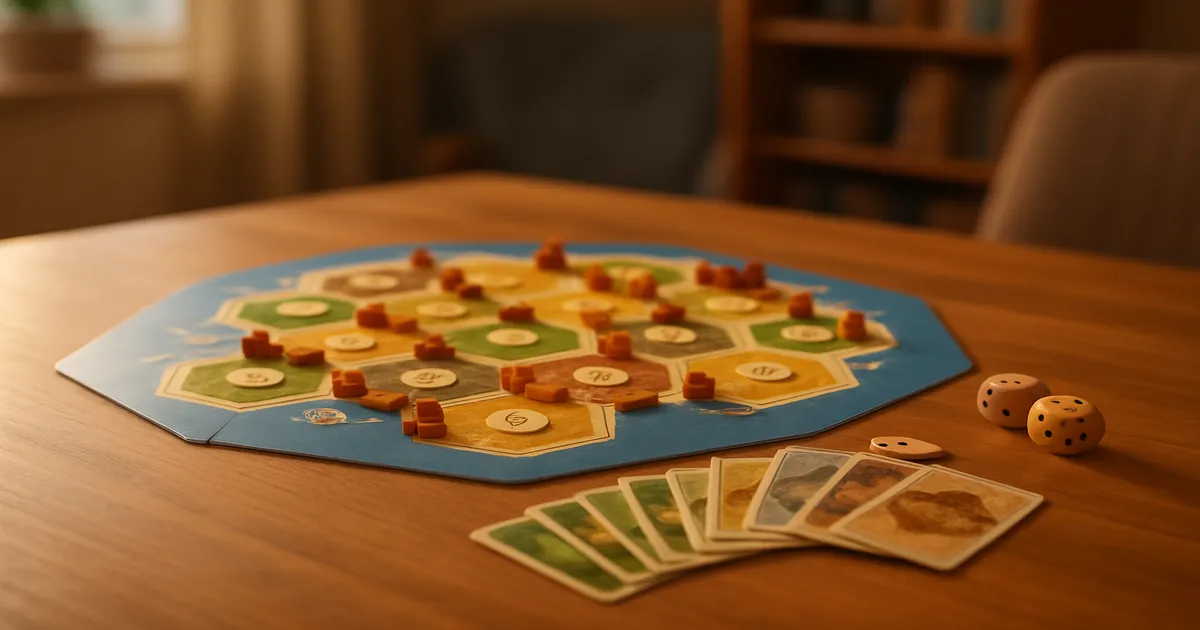
Quick Answer: Catan is a 2–4 player resource-collection and trading game where you roll dice to gather Lumber, Brick, Wool, Grain, and Ore, then spend them building roads, settlements, and cities on a modular hex island. First player to 10 Victory Points wins. Games run 60–120 minutes, it’s recommended for ages 10+, and it’s one of the easiest “real” strategy games to teach newcomers.
Knowing how to play the Catan board game is practically a rite of passage for anyone getting into tabletop gaming. Since winning the Spiel des Jahres in 1995, it’s sold over 40 million copies worldwide — and honestly, that number makes sense. The rules click into place in about 15 minutes, but there’s enough strategic depth underneath to keep experienced players genuinely engaged. This guide covers everything from setup through strategy, so whether you’re punching out your first copy or trying to finally beat your friends, you’re in the right place.
What’s in the Catan Box
Sort your components before your first game. It saves a lot of mid-setup scrambling.
Terrain Hexes and the Modular Board
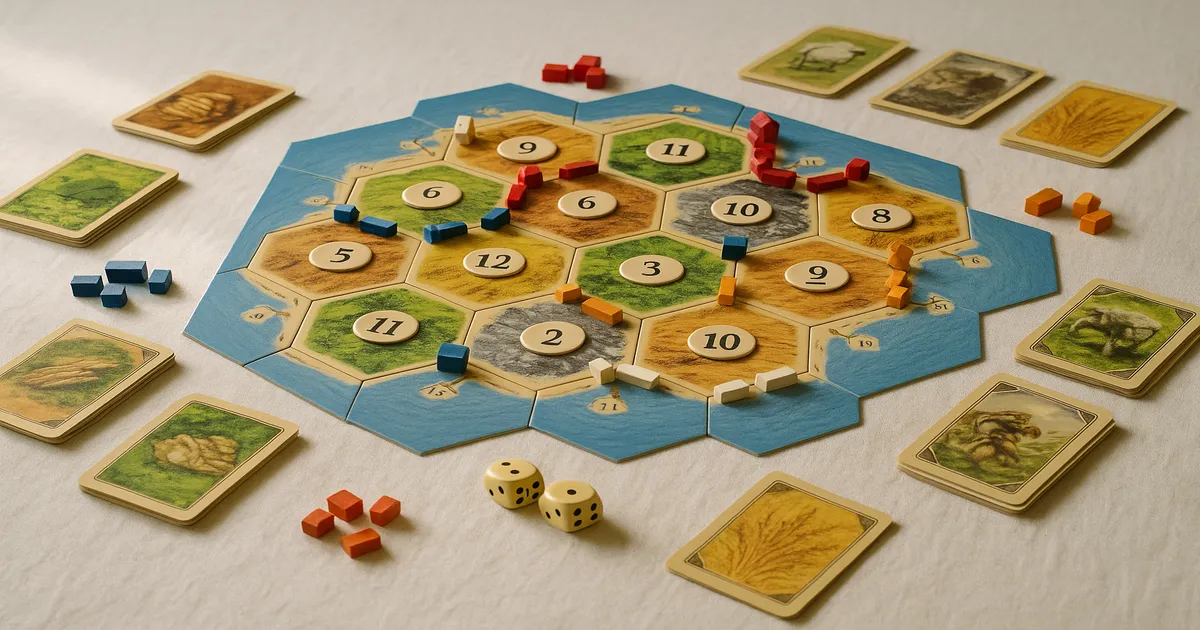
The island is built from 19 terrain hexes in six types: Forest (Lumber), Hills (Brick), Pasture (Wool), Fields (Grain), Mountains (Ore), and one Desert. These are surrounded by 6 sea frame pieces and 9 harbor pieces that slot around the border. The board changes every game, which is a big part of why Catan hasn’t gotten stale after three decades.
You’ll also get 18 circular number tokens marked 2–12 with letters A–R to guide placement. Each token has small dots (pips) underneath the number — more dots means that number gets rolled more often. New players should absolutely pay attention to those dots. The 6 and 8 tokens are printed in red as an extra visual cue that they’re the most valuable spots on the board.
Resource Cards and Development Cards
There are 95 resource cards (19 of each type) and 25 development cards. The development deck contains Knights, Road Building, Year of Plenty, Monopoly, and Victory Point cards. Keep these two decks separate — they work very differently.
Building Pieces and the Robber
Each player color gets 5 settlements, 4 cities, and 15 roads. Current editions use plastic pieces; older editions had wooden ones that felt noticeably more premium. Functionally identical, but if you find a used wooden copy cheap, grab it. You’ll also get 2 special cards (Longest Road and Largest Army), 1 Robber pawn, and 2 standard dice.
How to Set Up Catan
Building the Island
Assemble the sea frame first, then fill the interior randomly with the 19 terrain hexes. Once the hexes are placed, distribute the number tokens using the A–R letter guide — the rulebook’s spiral pattern ensures the red 6 and 8 tokens don’t end up adjacent to each other. Experienced groups often just place tokens randomly and accept whatever chaos results. Both approaches are fine.
The 9 harbor pieces slot into designated notches around the frame. Five are 2:1 ports (one specific resource), and four are 3:1 general ports. Their positions are either fixed or randomized depending on your group’s preference.
Initial Settlement Placement — the Most Important Decision in the Game
Starting positions use a snake-draft: the first player places a settlement and road, play continues clockwise, and once the last player places their first settlement, they immediately place a second one, then the order reverses back around.
After placing your second settlement, you collect one resource card for each terrain hex adjacent to it. This rule gets forgotten constantly by new players — don’t skip it.
I’d argue initial placement is the single most important decision in Catan. Your starting positions lock in your resource access for the whole game. Choose wisely and you’ll have options; choose poorly and you’ll spend 90 minutes begging for Ore.
How to Play Catan: Turn Structure
Step 1: Roll the Dice and Collect Resources
Every player — not just the active player — collects resources from any settlement or city adjacent to a hex matching the number rolled. Settlements yield 1 card; cities yield 2.
Step 2: The Robber on a Roll of 7
Rolling a 7 triggers three things:
- No resources are produced that turn.
- Any player holding more than 7 resource cards must discard half, rounded down.
- The active player moves the Robber to any hex (blocking all production there) and steals one random card from any opponent adjacent to it.
The Robber stays put until another 7 is rolled or someone plays a Knight card.
Step 3: Trading
The active player can trade with anyone at any mutually agreed ratio — no restrictions on domestic trades. Bank trading defaults to 4:1. A 3:1 general port improves that, and a 2:1 resource port lets you trade two of that specific resource for one of anything.
One rule that trips people up: trading must happen before building. You can’t build a road, realize you’re short on Grain, and then try to trade. The phases are sequential.
Step 4: Building
| Build | Lumber | Brick | Wool | Grain | Ore |
|---|---|---|---|---|---|
| Road | 1 | 1 | — | — | — |
| Settlement | 1 | 1 | 1 | 1 | — |
| City | — | — | — | 2 | 3 |
| Dev Card | — | — | 1 | 1 | 1 |
You can build multiple things in one turn. New settlements must connect to your road network and must be at least two road segments away from any existing settlement — this is the distance rule, and it’s one of the most-broken rules in the game.
Step 5: End Your Turn
Pass the dice clockwise. That’s it.
Development Cards Explained
- Knight — Move the Robber and steal a card. Most common card in the deck.
- Road Building — Place 2 free roads immediately.
- Year of Plenty — Take any 2 resource cards from the bank.
- Monopoly — Name a resource; every other player hands you all of their cards of that type.
- Victory Point — Worth 1 VP, kept secret until you win.
You cannot play a development card on the same turn you bought it. Buy it this turn, play it next turn. Victory Point cards are the exception — you reveal them only when declaring victory.
Victory Point Sources
- Settlements: 1 VP each
- Cities: 2 VP each
- Longest Road (5+ continuous segments, longest on the board): 2 VP
- Largest Army (3+ Knights played, most on the board): 2 VP
- Victory Point development cards: 1 VP each (hidden)
Hit 10 VP on your turn and you win immediately.
Common Mistakes New Catan Players Make
The biggest setup mistake is ignoring probability. Settling on a 4 and an 11 because they’re geographically convenient is a trap. Chase the 6s and 8s first, then 5s and 9s. Point your starting roads toward open land with good numbers — not toward the coast or into a corner with no room to expand.
Rules mistakes that actually change the game:
- Forgetting to discard on a 7. If you’re holding 8+ cards when a 7 hits, you lose half. This changes how aggressively you should hoard.
- Violating the distance rule. Two road segments of separation from all settlements, including opponents’.
- Misunderstanding Longest Road. An opponent can build a settlement in the middle of your road chain and break it, costing you the bonus. It must be a continuous, unbroken path.
- Trading after building. Can’t do it. Trade first, build second.
Strategically, over-investing in Lumber and Brick early is the classic beginner trap. Roads and settlements feel productive, but it’s cities — Ore and Grain — that actually win games. Also, hoarding resources makes you the Robber’s favorite destination. Spend down when you can.
Catan Strategy Tips
Resource Engine Strategies
Commit to one of these early:
- Ore/Grain City Engine — Stack cities and Dev Cards. Doubles your production and scores VP simultaneously. Strongest late-game strategy in my experience.
- Brick/Lumber Road Rush — Expand fast, lock down territory, claim Longest Road. Transitions to cities later. Works best when the board has open space.
- Dev Card Strategy — Focus on Ore, Grain, and Wool. Aim for Largest Army while quietly accumulating VP cards. Hard for opponents to track.
Mid-Game and Advanced Tips
Use the Robber politically. Blocking the leader sends a message; you can also use it as leverage in trade negotiations. Trade generously early when everyone needs resources — but late game, handing someone the cards they need to hit 10 VP is how you lose.
Always know the visible VP count for every player. Anyone sitting at 7–8 VP with a pile of Dev Cards is dangerous. The table needs to respond collectively.
The “sheep problem” is real: Wool is often overproduced and hard to spend. A 2:1 Wool port or a Dev Card-heavy strategy turns that surplus into an actual advantage.
Catan Expansions Worth Exploring
Cities & Knights is the best expansion, and it’s not particularly close. It adds barbarian invasions, commodity cards, and city improvements that completely transform the mid-game. BGG weight climbs to around 3.1/5, but it’s still very learnable. Play it after you’re comfortable with the base game.
Seafarers adds ships and island exploration — great if you love the base game and want more of the same with a different board shape. Less mechanically transformative than Cities & Knights, but a lot of fun.
The 5–6 Player Extension is essential if your group regularly has five or six people. Games will run longer and the Robber gets more chaotic, but it’s worth it.
Traders & Barbarians is a scenario collection — some scenarios are excellent, others forgettable. Explorers & Pirates feels quite different from base Catan; worth it for dedicated fans.
Games to Try After Catan
| Game | Weight | Play Time | Best For |
|---|---|---|---|
| Ticket to Ride | 1.9/5 | 45–75 min | Families, low-conflict groups |
| Dominion | 2.4/5 | 30–60 min | Players who prefer solo engines over negotiation |
| Wingspan | 2.5/5 | 40–70 min | Engine-builders who want low conflict and beautiful components |
| Agricola | 3.6/5 | 90–150 min | Players ready for a heavier Euro with no trading |
| Brass: Birmingham | 3.9/5 | 60–120 min | Experienced gamers who want more strategic depth and less luck |
Ticket to Ride is the obvious next step for Catan families. Brass: Birmingham is where you end up after a few years in the hobby.
Frequently Asked Questions About How to Play Catan
How many players can play Catan?
The base game supports 2–4 players. With the official 5–6 Player Extension, you can play with up to six. Two-player Catan works but feels flat — the trading and negotiation that make the game shine really need at least three people.
How does the Robber work in Catan?
When a 7 is rolled, the active player moves the Robber to any terrain hex. That hex produces no resources until the Robber moves again. The active player also steals one random card from any opponent with a settlement or city adjacent to the Robber’s new location. Anyone holding more than 7 cards when the 7 is rolled must discard half, rounded down. A Knight development card also lets you move the Robber outside of a 7 roll.
What are the Longest Road rules?
Longest Road is worth 2 VP and goes to the first player who builds a continuous, unbroken road of at least 5 segments. Branches don’t count toward the length — only the longest single path through your network does. An opponent can break your Longest Road by building a settlement in the middle of it, which can flip the bonus to whoever has the next-longest road.
Can you play a development card the same turn you buy it?
No. You must wait until a subsequent turn to play any development card you’ve purchased. The exception is Victory Point cards, which you reveal at the moment you declare victory. This rule exists to prevent someone from buying and immediately playing a Monopoly or Knight on the same turn — which would be pretty brutal.
How long does a game of Catan take?
Most games run 60–120 minutes. Experienced players who know the rules usually finish in 60–75 minutes. New players should budget closer to 90–120 minutes — trading negotiations and rules lookups add up fast. The 5–6 player version reliably runs longer regardless of experience level.