Quick Answer: Root is a 2–4 player asymmetric area-control game where each faction plays by completely different rules. First player to 30 Victory Points wins — but getting there looks wildly different depending on whether you’re the industrial Marquise de Cat, the momentum-driven Eyrie Dynasties, the insurgent Woodland Alliance, or the lone Vagabond. Expect 60–90 minutes with experienced players, and budget two hours for your first game.
If you’ve heard that learning how to play Root is complicated, that’s not quite right. The rules themselves aren’t that complex — the challenge is that each faction has its own rules, so you’re essentially learning four different games at once. The base game supports 2–4 players, plays in 60–90 minutes, and sits at a BGG weight of 3.72/5. The art is adorable. The gameplay is cutthroat. That contrast is the whole point.
How to Play Root: The Short Version
Root is an asymmetric area-control game set in a woodland realm. “Asymmetric” means more than different starting positions — each faction has unique actions, a different scoring engine, and different things it’s even trying to do. The Marquise builds factories. The Eyrie expands a growing list of mandatory decrees. The Alliance spreads sympathy tokens like a guerrilla insurgency. The Vagabond wanders around completing quests and managing relationships. They all share the same map and the same card deck, but they’re playing almost entirely different games.
Each player picks a faction and sets up according to their faction board. On your turn, you move through three phases — Birdsong, Daylight, Evening — taking faction-specific actions to score Victory Points. Combat uses two dice: the attacker gets the higher roll, the defender gets the lower, with losses capped by warriors present. First to 30 VP wins. There’s an alternate win condition via Dominance cards (controlling specific clearings), but most games end on the VP track.
Components and Setup
What’s in the Box
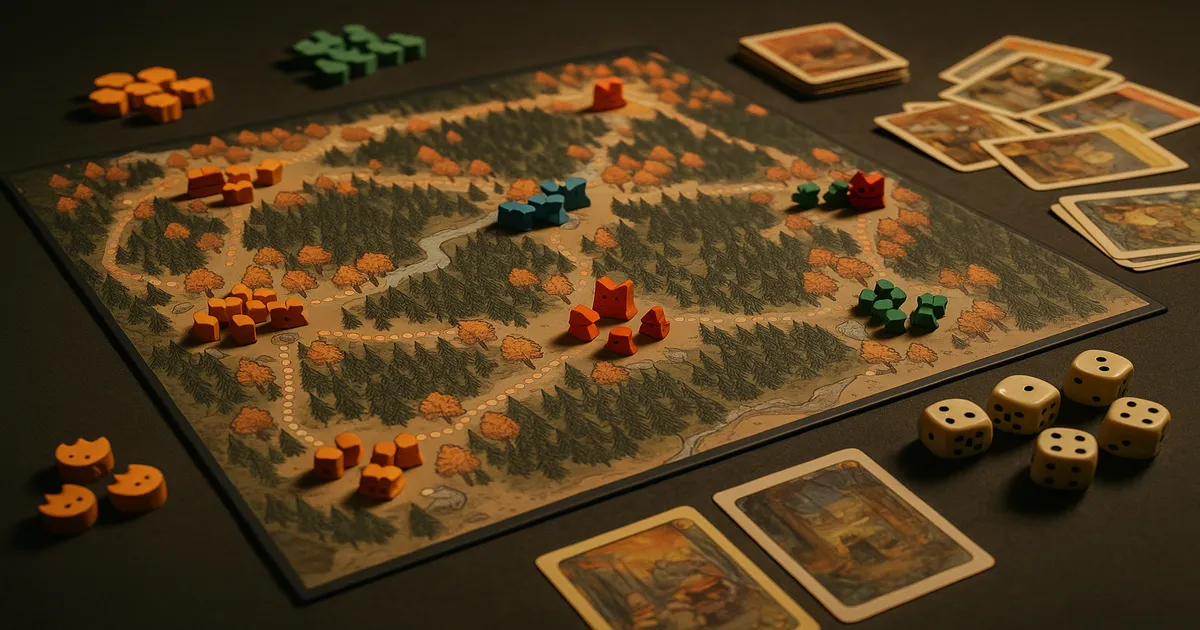
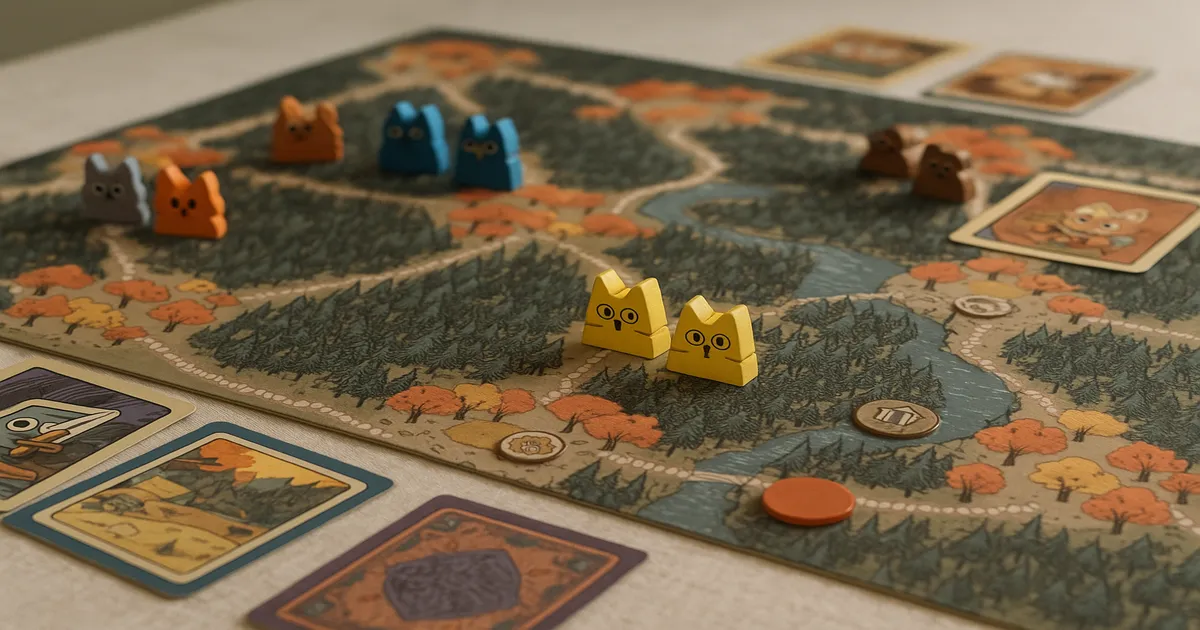
The box contains a double-sided mounted game board, four faction boards, 300+ wooden pieces in distinct faction colors, a shared card deck organized by suit (Fox, Rabbit, Mouse), custom dice, a VP track, and the Law of Root — a thorough rules reference that supersedes the rulebook when conflicts arise. Component quality is genuinely good for the price. Kyle Ferrin’s storybook illustrations make the board a pleasure to look at even when someone is using it to destroy you.
Worth picking up a set of card sleeves for the shared deck — it sees a lot of shuffling. (Dragon Shield Matte Standard sleeves)
Faction Boards Explained
Each faction board is a cheat sheet and a rulebook in one. It tells you what to do in each phase, what your buildings cost, what your special mechanics are, and how you score. New players should read their own board several times before the game starts. You don’t need to memorize everyone else’s, but knowing yours cold makes everything smoother.
Setting Up the Game
Setup order matters. The Marquise sets up first, placing warriors in every clearing and a Keep in one corner. Other factions set up in turn order, each following their board’s specific instructions. The clearings on the map are marked with suits (Fox, Rabbit, Mouse) — this matters for crafting and for the Alliance’s sympathy placement. The shared item supply goes in the center of the board.
Core Rules: How a Turn Works
Birdsong, Daylight, Evening
Every faction follows the same three-phase structure, but what happens inside each phase is completely faction-specific.
- Birdsong — Beginning-of-turn effects: the Eyrie adds to their Decree, the Alliance may spread sympathy, the Marquise gains wood tokens.
- Daylight — The main action phase: movement, battle, building, crafting. This is where most of the game happens.
- Evening — End-of-turn scoring, card draw, cleanup. The Eyrie scores VP here based on roosts; the Marquise scores based on buildings.
How Clearing Control Works
Control of a clearing goes to whoever has the most pieces there — warriors plus buildings combined. Control matters for crafting and certain faction abilities, but it’s checked at the moment it’s relevant, not tracked continuously. New players often over-track this. Don’t.
Combat
The attacker rolls two dice. Higher result = attacker’s hits, lower result = defender’s hits. Losses are capped by the number of warriors each side has in the clearing — so a roll of 3 against a defender with only 1 warrior still only removes 1 piece. The defender chooses which of their pieces are removed, which creates real decisions when buildings are on the line.
Crafting Items for Victory Points
To craft a card, you need warriors in clearings matching the card’s suit requirements. Crafted items either give immediate VP or provide ongoing abilities. The item supply is shared and limited — once an item is gone, it’s gone. Racing for high-value items early is a legitimate strategy, especially for the Vagabond.
The Four Factions
Marquise de Cat: The Industrial Empire
The Marquise starts with warriors in nearly every clearing — she’s dominant from turn one. Her engine runs on wood tokens produced by Sawmills, which she spends to build Workshops and Recruiters. More buildings means more VP and more actions. The Field Hospital mechanic means warriors killed in clearings where she has a warrior return to the Keep instead of being permanently removed, making her surprisingly resilient.
Difficulty: Beginner-friendly. The most intuitive faction in the box.
Eyrie Dynasties: The Snowballing Birds
The Eyrie scores VP passively each Evening based on how many Roosts are on the board — a well-managed Eyrie becomes terrifying fast. The catch is the Decree: each turn you add a card to a growing list of mandatory actions. Fail to fulfill even one, and you go into Turmoil, losing VP and resetting to a new leader. High reward, high risk, and it punishes greedy deckbuilding hard.
Difficulty: Moderate. The Turmoil mechanic trips up new players constantly.
Woodland Alliance: The Guerrilla Insurgents
The Alliance starts with almost nothing on the board. Their power comes from spreading Sympathy tokens — and the Outrage mechanic forces any player who disturbs them to hand over cards. Eventually the Alliance stages revolts to build Bases and train Officers, which fuel their action economy. Weak early, genuinely dangerous late.
Difficulty: Hard. Requires patience and good threat assessment from opponents.
The Vagabond: The Lone Adventurer
The Vagabond is immune to normal area control — they move freely through any clearing without triggering control, and they can’t hold clearings themselves. Instead, they complete Quests for VP, explore Ruins for free items, and manage Relationships with other factions. Helping factions scores VP; going hostile burns relationships and can make the whole table turn on you.
Difficulty: Moderate-to-hard. The item exhaustion and refresh cycle confuses new players.
How to Win Root
Scoring Victory Points by Faction
- Marquise: 1 VP per building placed on the map.
- Eyrie: VP each Evening equal to the number of Roosts on the board (scales up as you add more).
- Alliance: 1 VP per Sympathy token placed; bonus VP for Bases.
- Vagabond: VP from completed Quests, aiding other factions, and removing enemy pieces.
Dominance Cards
Instead of racing to 30 VP, a player at 10+ VP can play a Dominance card and switch to a different win condition: control specific clearings by the end of a round. The Vagabond can’t use these. What’s interesting is that holding a Dominance card changes the game even if you never play it — other players have to account for the threat.
Watch the VP Track
Root games can end without warning. Someone hits 30 VP and it’s over — no final round, no last chance. Watching the VP track isn’t optional; it’s one of the core skills. If the Eyrie has five Roosts and you let them take another Evening phase, you might lose before your next turn.
Beginner Strategy Tips
For Everyone
- Watch the VP track every single turn. Know who’s at 20, who’s at 25.
- Cards are your most flexible resource. Don’t hoard them, but don’t burn them carelessly either.
- Never ignore the Woodland Alliance early. An uncontested Alliance is nearly impossible to stop by mid-game.
- In a 3–4 player game, who you attack matters as much as what you build.
Marquise de Cat
Protect the Keep — losing it hurts badly. Prioritize Sawmills early; wood is your bottleneck. A focused Marquise with a strong core region is harder to crack than a sprawling one with thin defenses.
Eyrie Dynasties
Build your Decree conservatively. Every card you add is a permanent obligation — only commit to suits you can reliably fulfill every turn. The Builder leader is the best starting choice for new players; their crafting ability makes the early game much more forgiving. Always have a Turmoil recovery plan before you need it.
Woodland Alliance
Spread Sympathy in high-traffic clearings to maximize Outrage triggers. Be patient in turns 1–3; your job is to survive, accumulate cards, and wait for the right moment to revolt. Protect your Bases fiercely — losing one strips you of Officers and cripples your action economy.
Vagabond
Explore Ruins on your very first turn. The free items there are your foundation. Complete Quests before going hostile with anyone — relationships are VP, and burning them early for combat gains rarely pays off. Stay mobile; your greatest strength is being able to show up anywhere.
Common Mistakes New Players Make
Rules errors that come up constantly:
- Marquise Field Hospital: Killed warriors return to the Keep, not the supply. Gets forgotten every game.
- Eyrie Turmoil: Failing any single decree action triggers full Turmoil. Partial completion doesn’t save you.
- Alliance Outrage: Other players will forget to pay. The Alliance player has to remind them — build this habit early.
- Vagabond exhaustion: Exhausted items must be refreshed via Rest before they can be used again.
Strategic blunders that cost games:
Ignoring the Alliance early is the most common way experienced players lose. Letting the Eyrie get five or six Roosts without interference is almost always fatal. The Vagabond going hostile before completing several quests wastes their best early window. And not glancing at other factions’ boards — even briefly — is how you get blindsided by mechanics you didn’t know existed.
How to Teach Root Without Overwhelming People
Teach the Marquise first. She’s the most intuitive faction: build things, score points for buildings, fight to protect them. Give one-sentence summaries of the others (“they score by spreading tokens everywhere,” “they score passively but might implode if they miss an obligation”), then let players read their own boards. Don’t try to explain all four factions in full before the game starts — nobody retains it, and you’ll lose the table before you’ve placed a single piece.
Expansions, Player Counts, and What to Try Next
Recommended Player Counts
Four players is the optimal base game experience. Three works well. Two players with just the base game is genuinely rough — Root is designed around multiple factions creating political tension, and with only two it can feel lopsided. If you want to play at two players regularly, the Clockwork Expansion is effectively essential; it adds automated bot factions that fill out the player count and make solo play viable too.
Root Expansions Worth Getting
- Clockwork Expansion — Essential if you ever want to play solo or at two players.
- Riverfolk Expansion — Adds the Otter traders and Lizard Cult; the service-selling mechanic is clever and changes table dynamics significantly.
- Underworld Expansion — Adds two strong factions and a mountain map. The Duchy and Corvid are both excellent.
- Marauder Expansion — Adds the Hirelings system, which injects variety into any game. Good after you’ve played the base game a dozen times.
None of these are necessary. The base game is complete on its own.
Games Similar to Root
- Oath: Chronicles of Empire and Exile — Cole Wehrle’s follow-up to Root. Heavier, semi-legacy, brilliant. Play Root first.
- Inis — Card-driven Celtic area control. Less asymmetric but similarly political and elegant.
- Scythe — Similar weight and audience, engine-building with asymmetric factions. Friendlier to new players.
- Dune — The grandfather of asymmetric faction games. Root owes it a clear debt.
Frequently Asked Questions About How to Play Root
Which faction should beginners play in Root?
The Marquise de Cat, without question. Her turn structure is the most intuitive — build things, place warriors, score points for buildings. The other factions have more unusual mechanics that are easier to appreciate once you’ve played a full game and understand the board state.
Can you play Root with 2 players?
Technically yes, but the base game isn’t well-balanced at two — Root is designed around multiple competing factions creating political tension. The Clockwork Expansion adds bot factions that fill out the player count and makes two-player and solo games genuinely enjoyable. Without it, I’d wait for a third player.
How long does a game of Root take?
Experienced players finish in 60–90 minutes. Budget two hours for a first game — not because the rules are slow, but because new players spend time reading their faction boards and thinking through unfamiliar decisions. After three or four plays, games tighten up considerably.
Is Root good for families?
The art absolutely is — Kyle Ferrin’s woodland creatures are charming and inviting. The gameplay is not a family game in the traditional sense. The complexity is real, and the political dynamics (attacking other players, kingmaking) can create friction. I’d say ages 12+ with at least one patient, experienced player at the table to guide things.
Do you need expansions to enjoy Root?
Not at all. The base game is one of the best games published in the last decade and stands completely on its own. (Root) Expansions add new factions, maps, and systems, but they’re for players who’ve already gotten significant mileage out of the base box — not prerequisites.