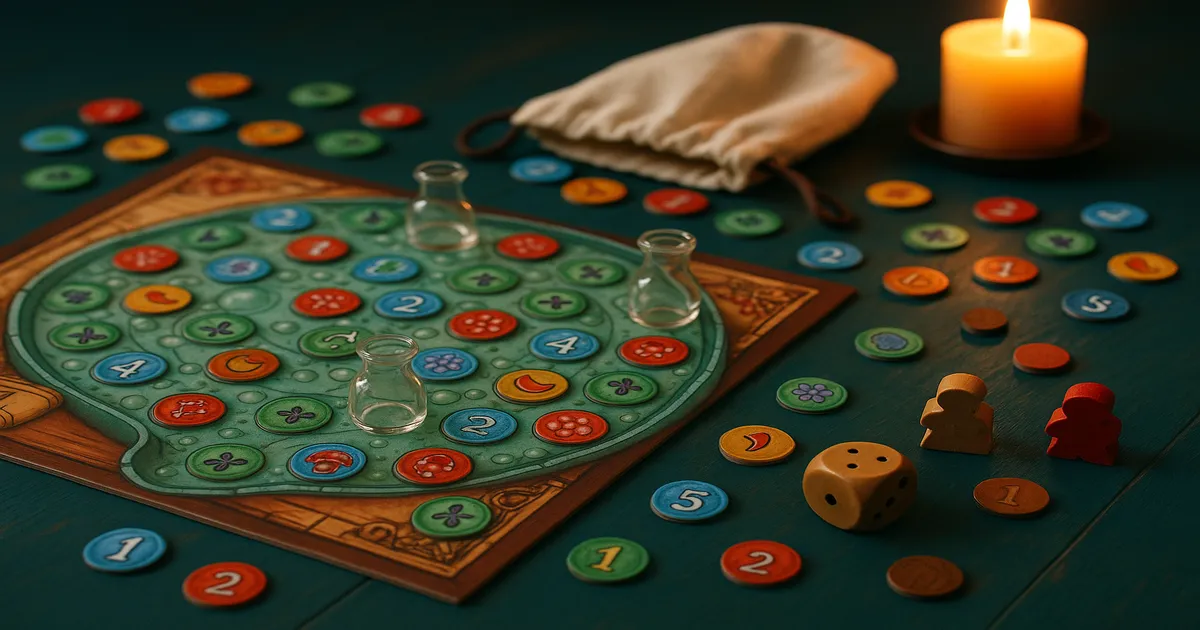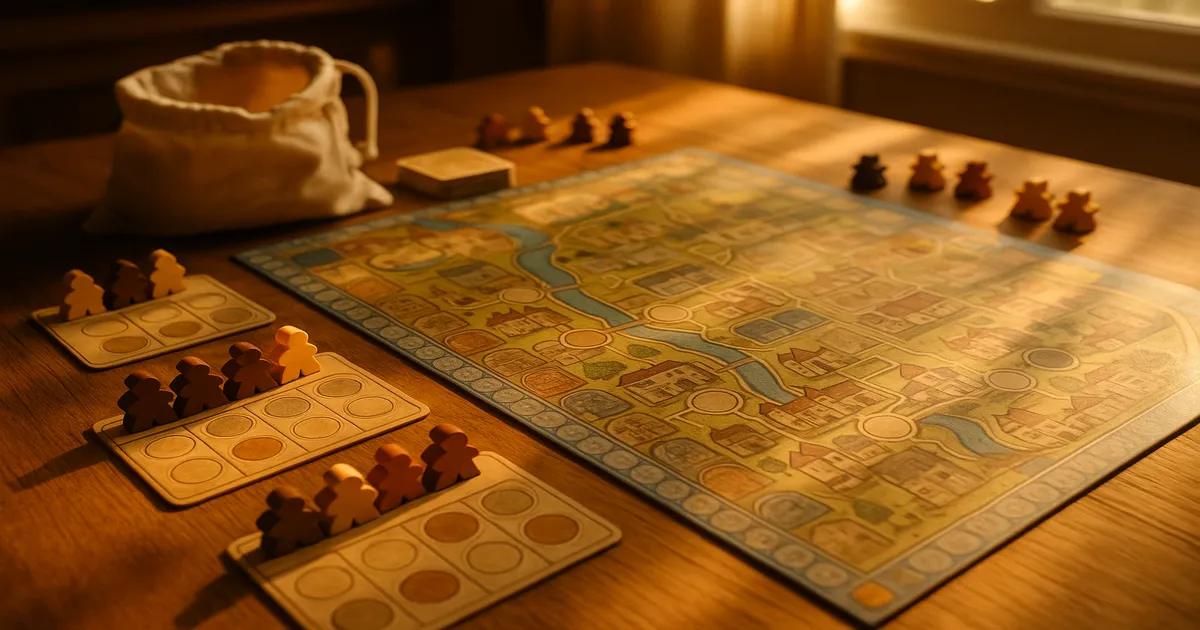
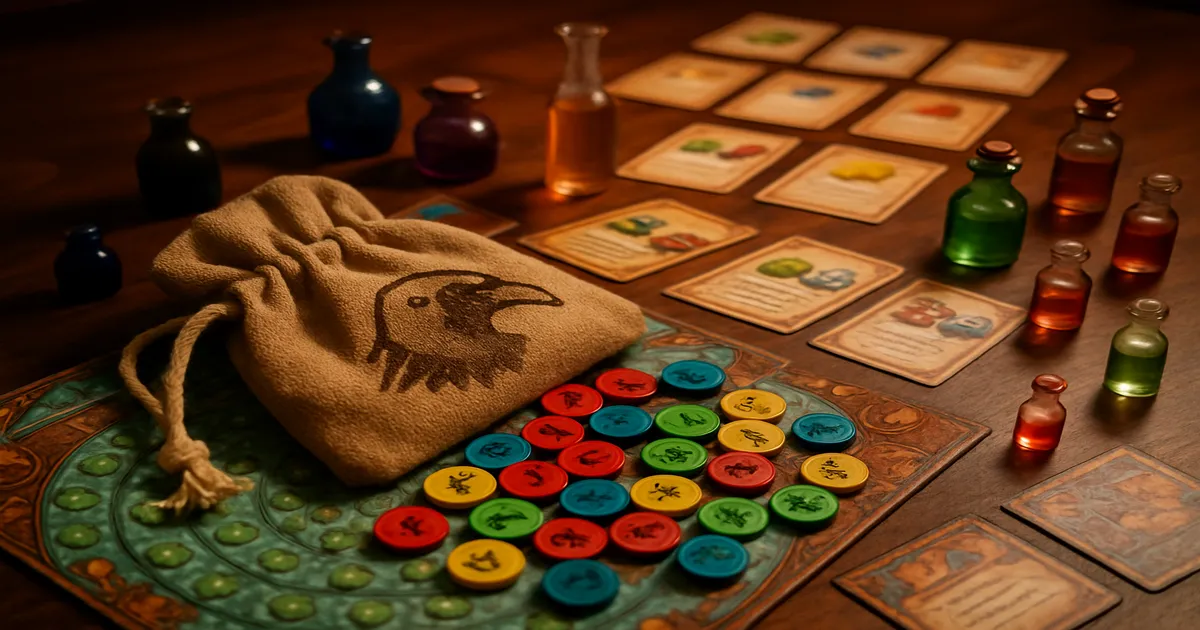
Quick Answer: In Quacks of Quedlinburg, each player draws ingredient chips one at a time from their own cloth bag, trying to advance as far as possible on their cauldron spiral without letting their white chips add up to more than 7 — which causes an explosion. Over 9 rounds, you spend earned currency to buy new chips and build a better bag. Most victory points after round 9 wins. It plays in 45–75 minutes with 2–4 players, and it won the Kennerspiel des Jahres in 2018.
If you’ve been trying to figure out how to play Quacks of Quedlinburg, you’re in good company. This game has been a consistent recommendation for families and casual gamers since it launched in 2018, and it earns that reputation. It’s one of those rare designs where the core tension clicks in about five minutes, but you’ll still be discovering new wrinkles after a dozen plays.
What Is Quacks of Quedlinburg?
You’re a charlatan potion brewer at a medieval market, pulling mysterious ingredients from your bag and hoping your concoction doesn’t blow up in your face. The theme is deliberately silly — nobody’s taking the quack doctor premise seriously — but it does a surprisingly good job of making each draw feel like a genuine moment of suspense.
This is a 2–4 player game published by Schmidt Spiele (North American edition by North Star Games) that runs 45–75 minutes with a BGG weight of around 2.0/5. Designer Wolfgang Warsch — who also made The Mind and Wavelength — has a real talent for games that feel breezy on the surface but reward thoughtful play. Quacks hits a sweet spot for families who’ve outgrown Ticket to Ride but aren’t ready to commit to a three-hour euro.
Two things set it apart from similar games. First, all players draw from their bags simultaneously, so there’s no sitting around waiting for your turn. Second, the physical act of reaching into a cloth bag and pulling out a chip creates genuine tension that dice or cards just don’t replicate. It’s tactile and immediate in a way that’s hard to describe until you’ve played it.
What’s in the Box
- 4 double-sided cauldron player boards (beginner/advanced sides)
- 4 cloth drawstring bags, one per player
- Ingredient chips in 8+ colors, in denominations of 1, 2, 3, and 4
- 2 ingredient books (the shared market)
- 9 Fortune Teller cards, one per round
- VP track board
- Rubies (red wooden tokens) and Droplets (blue wooden tokens — the currency)
- Rat stone, bonus die, round marker, and flame tokens
- Rulebook
The cloth bags are genuinely great — durable, tactile, and thematic in a way that feels intentional rather than incidental. The chips are thick cardboard and feel substantial in hand. Art by Dennis Lohausen keeps everything colorful and readable without being cluttered. The box insert is functional but nothing special; I sort my chips into labeled zip-lock bags, which cuts setup time significantly.
Each player starts with a bag pre-loaded with a standard set of chips, places their marker at position 0 on the cauldron spiral, and the shared ingredient books go in the center of the table. Use the beginner side of the player boards for your first game — it’s genuinely helpful and not just hand-holding.
How to Play Quacks of Quedlinburg: Round-by-Round Structure
The game lasts exactly 9 rounds. Every round follows the same sequence.
Step 1: Move the Rat Stone
At the start of each round, move the rat stone forward based on how many players exploded in the previous round. This is a catch-up mechanism that shifts the starting position for everyone, giving trailing players a small boost. New players forget this constantly — put the rat stone somewhere obvious.
Step 2: The Draw Phase
Everyone draws simultaneously. Pull one chip, place it on your spiral starting from the rat stone’s position, then decide: keep going or stop? Every chip advances your marker and improves your end-of-round rewards, but white chips are ticking clocks. The push-your-luck tension here is the whole game.
Step 3: Did You Explode?
If the combined value of all white chips you drew exceeds 7, your pot explodes. Note that it’s value, not count — a white “4” and a white “3” is already 7, so drawing one more white chip of any value means you’ve exploded. This is the single most misunderstood rule in the game, so say it out loud when you teach it.
Step 4: Collect Rewards
Your position on the spiral determines how much money (droplets) and how many rubies you earn. Non-exploded players collect both. Exploded players must choose one or the other — not a reduced amount of each, just one category entirely.
Step 5: Reveal the Fortune Teller Card
One card per round, each with a unique bonus or rule tweak. Easy to skip when you’re learning, but they matter. Read the card every round.
Step 6: Shopping Phase
Spend your droplets to buy new ingredient chips from the ingredient book. The book is shared, so what your opponents buy affects what’s available to you — this matters more than new players expect.
Step 7: Add New Chips to Your Bag
Purchased chips go into your bag at the end of the round. They’re not available until next round.
Step 8: Roll the Bonus Die
Players trailing on the VP track roll the bonus die for extra resources. Don’t skip this — it’s a real catch-up tool and trailing players forget it constantly.
Ingredient Chips: Colors and Effects
White chips (Cherry Bombs) are your starting chips and your biggest liability. You begin with several in your bag, and the goal over the course of the game is to dilute their concentration by buying other colors. Don’t buy more white chips. There’s almost no situation where that’s correct.
Book 1 Chip Reference
| Color | Name | Effect |
|---|---|---|
| White | Cherry Bombs | Cause explosions if total value exceeds 7 |
| Orange | Pumpkins | Block white chip advancement — a safety net |
| Green | Herb Witch | Draw an extra chip when pulled |
| Purple | Spider Legs | Score bonus points based on current position |
| Red | Toadstools | Reposition chips on the spiral |
| Blue | Crow Skulls | Multiply the value of the next chip drawn |
| Yellow | Mandrake Root | Draw extra chips under certain conditions |
| Black | Black Cat | High-value chips that push far on the spiral |
Book 2 swaps out several chip types for a different ingredient set, creating a meaningfully different strategic landscape. Stick with Book 1 for your first three or four games, then rotate to Book 2 once everyone knows what they’re doing. It adds a lot of replay value without adding rules complexity.
Common Mistakes New Players Make
Misreading the explosion rule. It’s the combined value of white chips — not the number — that causes an explosion. One white “4” plus one white “3” equals 7. Drawing one more white chip of any value after that means you’ve exploded. Track this carefully as you draw.
Getting the exploded player choice wrong. Exploded players pick money OR rubies. Not both, not a reduced amount of both — one category, full stop. It sounds harsh until you realize it’s exactly what creates the meaningful tension around pushing your luck.
Forgetting the rat stone, Fortune Teller card, and bonus die. These three get skipped constantly. The rat stone moves at the start of each round based on last round’s explosions. The Fortune Teller card gets revealed every round. Trailing players should always roll the bonus die. A quick checklist on a notecard helps for the first few sessions.
Buying white chips or hoarding rubies. Buying more white chips is almost always wrong. And don’t save rubies exclusively for end-game VP conversion — spending them mid-game to advance your cauldron marker can unlock significantly better reward thresholds that pay off over multiple rounds.
Strategy Tips for Quacks of Quedlinburg
The insight that separates experienced players from beginners: buying non-white chips doesn’t just add new abilities — it dilutes the concentration of white chips in your bag, making every draw statistically safer. More total chips means each individual draw is less likely to hit a white. Think of it as managing a ratio, not just accumulating power.
Orange (Pumpkin) chips are massively underrated. They block white chips from advancing past them, acting as a safety net that lets you push further with real confidence. Green (Herb Witch) chips can chain into each other for rapid advancement — a green-heavy strategy can cover enormous ground in a single turn. Purple (Spider Legs) chips scale with position, so they pair well with any strategy that reliably reaches the far end of the spiral.
In rounds 1–3, prioritize bag safety. Buy pumpkins, avoid explosions, and don’t over-push. Mid-game is when you develop synergies and start using rubies to advance your marker toward better reward thresholds. In rounds 7–9, push hard — the game’s almost over and the explosion penalty matters much less than maximizing your final position.
One more thing: watch the shared ingredient book. If another player is buying all the green chips, don’t fight them for it — pivot. Chasing a strategy someone else is executing better is a losing proposition. Flexibility is a real competitive advantage.
How Quacks Compares to Similar Games
| Game | BGG Weight | Play Time | Key Difference |
|---|---|---|---|
| Clank! | 2.5/5 | ~90 min | Dungeon-crawl bag-building; more complex and longer |
| Dominion | 2.3/5 | ~30 min | Pure deck-building; no push-your-luck element |
| Incan Gold | 1.5/5 | ~20 min | Pure push-your-luck with no building; great gateway to Quacks |
| Potion Explosion | 1.9/5 | ~45 min | Similar theme; marble-drafting instead of bag-building |
Incan Gold is a great stepping stone — if your group loves the push-your-luck tension but finds Quacks intimidating, start there. Clank! is the natural next step after Quacks for players who want something meatier.
Expansions Worth Knowing About
The Herb Witches adds new ingredient types, a new scoring mechanism, and a solo mode. It’s widely considered the best expansion and honestly feels close to essential once you’ve played the base game a handful of times.
The Alchemists brings more ingredient variety and mechanics aimed at experienced players. Don’t rush to it — get comfortable with The Herb Witches first.
The Mega Box bundles the base game with expansions and is worth it if you already know you want everything. If you’re just testing the waters, start with the base game.
And if you want the base game itself:
Frequently Asked Questions
What happens when you explode in Quacks of Quedlinburg?
Your pot explodes when your white chips’ combined value exceeds 7. You still collect rewards based on your position on the cauldron spiral, but you must choose between taking money (droplets) or victory points (rubies) — not both. Non-exploded players collect both, which is a meaningful advantage that compounds over the game.
How do white chips work in Quacks of Quedlinburg?
White chips are your starting ingredient chips and the primary explosion risk. Each one has a value (1, 2, 3, or 4), and if the total value of all white chips you’ve drawn in a single turn exceeds 7, your pot explodes. It’s the combined value that matters, not the number of chips.
How many rounds are in Quacks of Quedlinburg?
Always exactly 9. After round 9, players convert rubies to victory points (2 rubies = 1 VP), and whoever has the most VP wins. Ties go to remaining rubies, then remaining droplets.
Is Quacks of Quedlinburg more luck or skill?
Both, genuinely — but skill matters more than it looks at first. Experienced players consistently outperform beginners because they manage bag composition, understand probability, and make better buying decisions. The luck element keeps outcomes exciting and prevents the game from feeling solved, which is a big part of why it stays fun after many plays.
What do rubies do in Quacks of Quedlinburg?
Two things. During the shopping phase, you can spend them to advance your cauldron marker, which earns better end-of-round rewards. At game end, unspent rubies convert to VP at 2 rubies per 1 VP. New players tend to hoard them for the conversion, but spending them strategically mid-game is usually the stronger play.