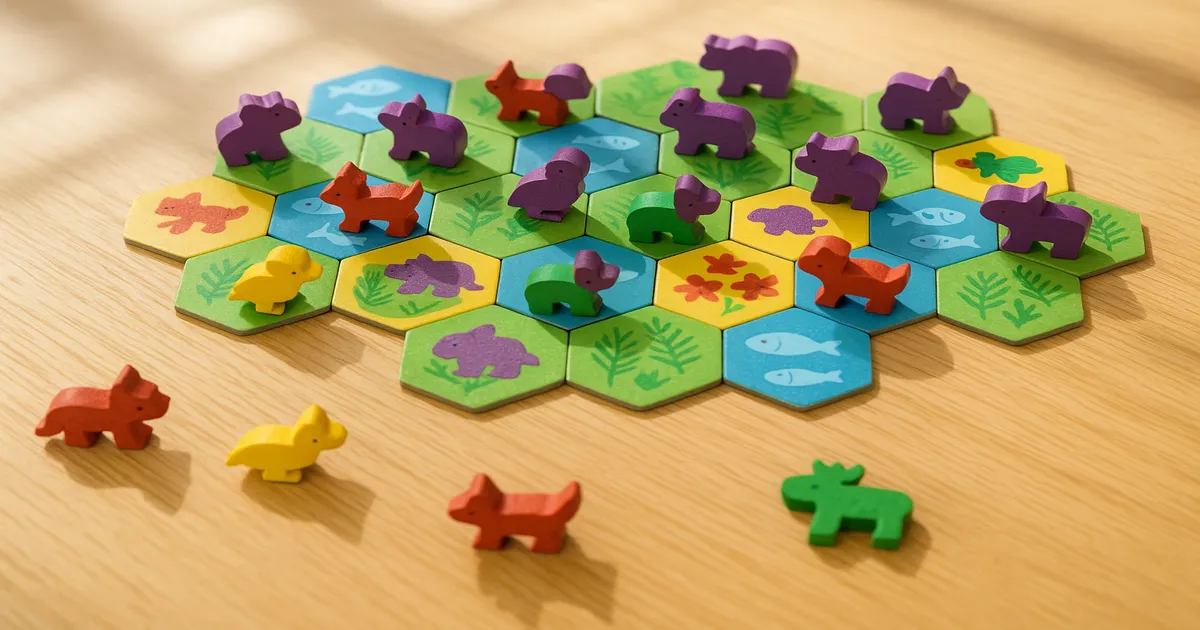
Quick Answer: On your turn in Cascadia Junior, you pick one habitat tile and wildlife token pair from the central offer, add the tile to your growing landscape, and place the animal on a matching habitat. Repeat until the supply runs out, then score points for connected terrain groups and correctly placed animals. Highest score wins. It’s designed for ages 6+ and plays in about 15–25 minutes.
Cascadia Junior is one of those rare children’s games that doesn’t feel like a dumbed-down version of something better. If you’re trying to figure out how to play Cascadia Junior — whether you’re teaching a six-year-old or just want a breezy 20-minute option for game night — the rules are genuinely approachable, and there’s just enough decision-making to keep adults from zoning out.
What Is Cascadia Junior?
Theme and Setting
Designed by Randy Flynn (the same designer behind the original Cascadia) and published by Flatout Games, Cascadia Junior drops players into the Pacific Northwest wilderness. You’re building a personal landscape of forests, wetlands, mountains, prairies, and rivers, then populating it with bears, salmon, elk, foxes, and hawks. The art is warm and slightly cartoonish — child-friendly without being cloying.
How It Differs from the Base Game
The base Cascadia is a meaty puzzle game. Junior strips away the variable scoring cards and complex wildlife placement rules in favor of simple icon-based scoring that a first-grader can actually follow.
| Feature | Cascadia Junior | Cascadia |
|---|---|---|
| Age | 6+ | 10+ |
| BGG Weight | ~1.2 / 5 | ~2.1 / 5 |
| Play Time | 15–25 min | 30–45 min |
| Scoring | Simplified icons | Variable scoring cards |
| Wildlife Goals | Fixed, simple | Different each game |
Who Is Cascadia Junior For?
Families with kids ages 6–9 are the obvious audience, but I’ve played this with adults who just wanted something light and it holds up fine. It’s not a “sit through it for the kids” game — there’s genuine fun here for everyone at the table.
Components: What’s in the Box
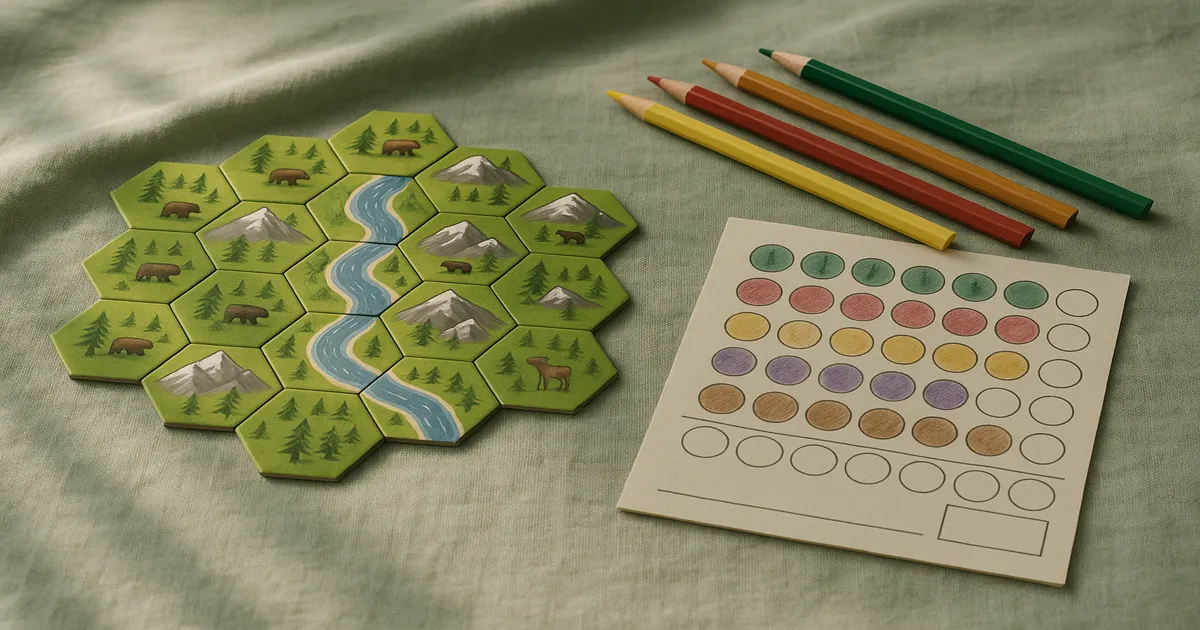
Habitat Tiles
Thick, chunky cardboard tiles depicting five Pacific Northwest biomes. They’re noticeably larger and more colorful than the base game’s tiles — easier for small hands to grab and place.
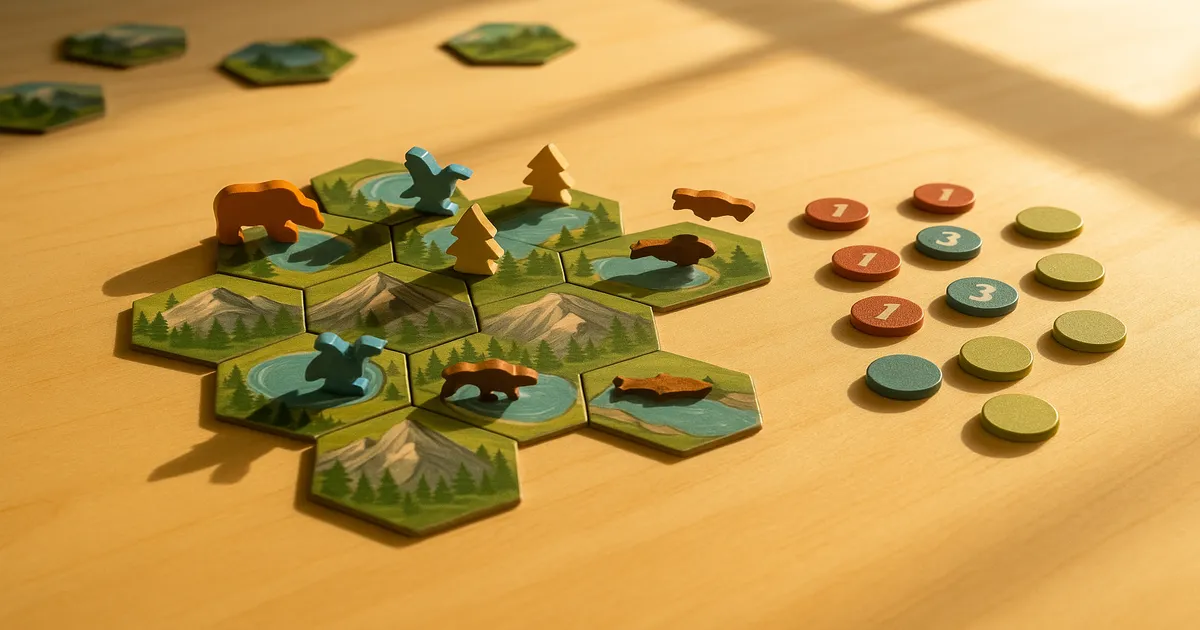
Wildlife Tokens
Cardboard tokens for the five animals: bear, salmon, elk, fox, and hawk. These feel great to handle. It’s a hallmark of the Cascadia line that component quality is consistently good.
Scoring References and Player Aids
Icon-heavy scoring tiles and player aid cards that show which animals prefer which habitats. Critically, these use pictures rather than text, so kids who aren’t strong readers can follow along without help.
Pinecone Tokens
A small supply of pinecone tokens that act as a wild/exchange currency. More on how to use these below — they’re easy to forget about, and most new players do exactly that.
How to Play Cascadia Junior: Turn Structure
Each turn has four steps, and they move fast once everyone gets the hang of it.
Step 1: Choose a Tile-and-Token Pair
The central offer shows several face-up habitat tile and wildlife token combinations. You pick one pair — you can’t split them up. This is where most of the game’s tension lives: the tile you want might be paired with an animal you don’t need, and the animal you want is stuck to a tile that doesn’t fit your landscape.
If you don’t like any of the available pairs, you can spend a pinecone token to swap out a token in the offer, effectively customizing a pair before you take it.
Step 2: Place Your Habitat Tile
Add the tile to your personal play area. It has to connect to at least one tile you’ve already placed (or your starting tile on your very first turn). You’re trying to group matching terrain types into connected regions — that’s where the big points come from.
Step 3: Place Your Wildlife Token
Place the animal token on any eligible habitat space in your play area. Each animal has preferred habitat types shown on the player aid, and the token must go on a matching space. You can’t skip this step, so plan ahead — if you keep painting yourself into corners, you’ll end up with animals on the wrong terrain.
Step 4: Replenish the Central Offer
Refill the central display from the draw piles so it’s ready for the next player. Simple.
How the Game Ends
The game ends when either the tile supply or the token supply runs out. Everyone then does final scoring. There’s no “last round” countdown — it just stops, so keep an eye on those draw piles in the late game.
Scoring: How to Win Cascadia Junior
Points for Connected Habitat Groups
The biggest scoring category. Connected regions of matching terrain score points based on their size — a large connected forest beats a bunch of scattered forest tiles every time. Getting two or three big habitat groups is usually the path to winning.
Points for Correct Animal Placement
Each animal token placed on its preferred habitat scores points. Tokens on the wrong habitat score nothing, so placement decisions matter more than they might seem in a 20-minute game.
Illustrated Goal Cards
There are also illustrated goal cards that reward specific accomplishments — things like having a certain number of one animal type or filling a habitat completely. These use pictures instead of text, which is great for accessibility. Walk through them with the group before the first game. Honestly, this is the part most people skim and then argue about at the end, so don’t skip it.
Final Score Calculation
Add up your habitat group points, animal placement points, and goal card points. Highest total wins. Ties? Flip a coin and move on. It’s a 20-minute game.
Common Mistakes New Players Make
Placing tiles without a plan. Placing tiles wherever they fit is the fastest way to lose. Even young kids can grasp “try to put forests next to forests” — frame it that way and the lesson sticks.
Forgetting to place a wildlife token. It happens constantly in the first game. Build a reminder into your table talk: “tile down, animal down.”
Ignoring the pinecone tokens. Players forget these exist for entire games. Put the pinecones somewhere visible before play starts and explicitly remind everyone what they do.
Misreading scoring icons. The icon-based scoring is great for accessibility but occasionally ambiguous. Read through the scoring cards together before you start — it takes two minutes and saves a lot of confusion at the end.
Not watching the draw piles. Keep them visible. When they start running low, players need to know so their final placements actually count.
Strategy Tips for Cascadia Junior
Commit to a Terrain Type Early
The first few turns set the shape of your landscape. Pick one or two dominant terrain types and build outward from them. Trying to collect all five biomes evenly usually means scoring well in none of them.
Stay Flexible with Animal Choices
Don’t get attached to one animal type and wait for it. Take what the offer gives you and build your strategy around what’s available. The players who adapt win more often than the players who wait.
Use Pinecone Tokens When You See the Opportunity
I’ve watched players save their pinecone tokens for a “perfect” moment that never comes. Use them when a good opportunity shows up — they’re worth nothing at game end.
Watch Your Opponents at Higher Player Counts
At three or four players, sometimes the right move is taking a pair specifically to deny it to someone else, even if it’s not your ideal pick. This matters more in the final third of the game when good tiles are scarce.
Tips for Adults Playing with Young Children
Narrate the theme as you play. “The salmon needs to swim in the river” is more memorable than “salmon go on river tiles.” It reinforces the rules without feeling like a lecture. Point out scoring opportunities — “hey, if you put that forest there, it connects to your other forest” — but don’t dictate moves. Let kids make choices and learn from them. For very young children on their first play, try an open-hand practice round where everyone shows their tiles and discusses placements together before the real game.
What to Play Next
Cascadia Junior vs. Cascadia (Base Game)
Junior is the better starting point for mixed-age groups or anyone new to tile-laying games. Once players are comfortable with the core loop — draft a pair, place a tile, place an animal — the base game’s variable scoring cards feel like a natural next step rather than an overwhelming jump. Most families make the move within a few sessions. (Cascadia)
Other Great Family Tile-Laying Games
Kingdomino is the closest comparison — also tile-drafting, also about connected regions, recommended for ages 8+. It’s excellent and worth owning alongside Junior. Sagani has a nature theme and a similar meditative feel but plays a bit longer. If you want a benchmark for how good a junior adaptation can be, Ticket to Ride: First Journey is the gold standard — it shows exactly how much strategic texture you can retain while making a game genuinely accessible to young kids.
When to Graduate to Full Cascadia
When players start asking “what if the scoring was different each game?” — that’s your sign. The base Cascadia adds variable wildlife scoring cards that change the optimal strategy every play. From there, expansions like Cascadia: Landmarks extend things further if the group gets hooked.
Cascadia Junior works better as a gateway than most junior adaptations precisely because it doesn’t feel watered-down. The strategic texture is real, just simplified. That’s harder to pull off than it sounds, and Flynn nails it.
Frequently Asked Questions About How to Play Cascadia Junior
What is the difference between Cascadia and Cascadia Junior?
Cascadia Junior is designed for ages 6 and up, with icon-based scoring, fixed wildlife goals, and a 15–25 minute play time. The base Cascadia (ages 10+, 30–45 minutes) uses variable scoring cards that change each game, making it significantly more complex. Junior keeps the core loop — draft a tile-and-token pair, build your landscape, place animals — but removes most of the rules overhead.
Can adults enjoy Cascadia Junior without children?
Yes, genuinely. It’s a light 20-minute game with real decisions, not a babysitting tool. The tile-laying puzzle and the opportunity cost baked into the central offer are satisfying even without kids at the table. Think of it the way you’d think about Kingdomino — designed for families, but plays well as a quick filler for adults.
What age is Cascadia Junior appropriate for?
The publisher recommends ages 6 and up. In practice, many five-year-olds can play with a little guidance, especially if an adult narrates the theme to reinforce placement rules. The icon-based scoring helps non-readers participate fully.
Is Cascadia Junior cooperative or competitive?
It’s competitive — each player builds their own landscape and scores independently. There’s no official cooperative mode, though some groups use an open-hand practice variant for very young children learning the rules for the first time.
Can you play Cascadia Junior solo?
The game is designed for 2–4 players and doesn’t include official solo rules. That said, solo tile-laying puzzles aren’t hard to improvise — set a personal score target and try to beat it. If solo play is important to you, the base Cascadia has a well-regarded solo mode and might be the better purchase.