Quick Answer: Gloomhaven: Buttons & Bugs is a strictly solo, card-based dungeon crawler that plays in 20–45 minutes on a table footprint roughly the size of a hardback book. Each round you pick two cards, play the top action of one and the bottom of the other, then resolve enemy AI — repeat until you complete the scenario objective or exhaust your hand. It weighs in around BGG 2.2 and costs about $25, making it the lightest, most portable entry in the Gloomhaven family.
If you’ve been searching for how to play Gloomhaven Buttons & Bugs, here’s the good news: the core loop is genuinely simple. The bad news — in the best possible way — is that real strategic depth is hiding just underneath. Designer Dennis Vogen and Cephalofair Games packed what makes Gloomhaven special into something that fits in your jacket pocket and plays on a café table. That’s a harder trick than it sounds.
What Is Gloomhaven: Buttons & Bugs?
Theme and Setting
The premise is wonderfully weird. Your hero has been shrunk to insect size and now has to battle bugs through a world that’s suddenly enormous. Rats are terrifying. Oozes are the size of swimming pools. The tone is lighter and more whimsical than mainline Gloomhaven, but the tactical combat underneath is the real deal — this isn’t a children’s game wearing a Gloomhaven badge.
Who Is This Game For?
Buttons & Bugs hits a pretty specific sweet spot. Gloomhaven fans who want a 30-minute fix without hauling out the big box will love it. Solo-only players new to the system will find it a much friendlier starting point than the full game. Travelers will appreciate that it fits in a backpack and plays on an airplane tray table. And at $25, it’s one of the better-value solo games on the market right now.
How It Fits Into the Gloomhaven Family
| Game | Players | BGG Weight | Time |
|---|---|---|---|
| Gloomhaven | 1–4 | 3.9 | 60–120 min |
| Frosthaven | 1–4 | 4.0 | 60–120 min |
| Jaws of the Lion | 1–4 | 3.4 | 60–90 min |
| Buttons & Bugs | 1 | ~2.2 | 20–45 min |
It’s the lightest entry by a significant margin and the only one built from the ground up as a solo-only game — not a co-op that happens to support solo play. That distinction matters more than it might seem.
What’s in the Box
- Character ability card decks (one per class)
- Enemy stat cards and ability decks
- Scenario cards (double-sided)
- Attack modifier decks for both player and enemies
- Condition tokens (Poison, Stun, Wound, Muddle, Immobilize, Disarm)
- HP tracking dial
- Reference cards
- Rulebook
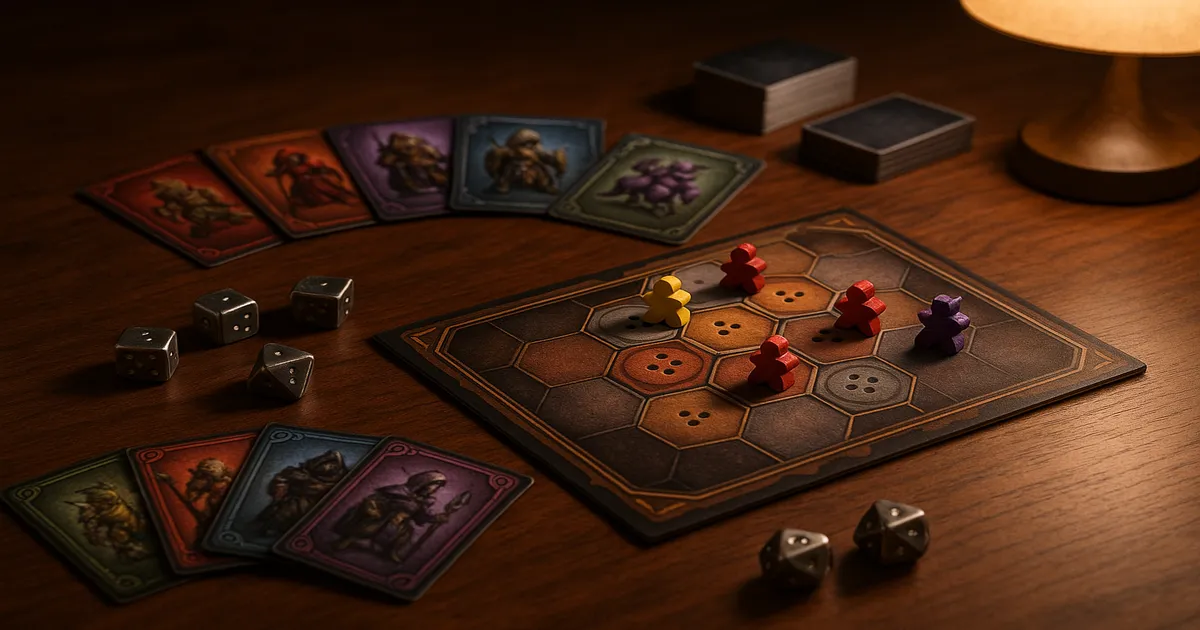
The box is roughly the size of a thick paperback. On the table you’re looking at about 1.5 square feet — cards laid out in a simple arrangement, nothing more. No map tiles, no miniature trays, no sprawl.
Honest take on component quality: the cardstock is functional, not premium. No linen finish, and the tokens are on the smaller side. For $25 this is exactly what you’d expect — it doesn’t feel cheap, just appropriately priced. If you’re planning to play this a lot, pick up a pack of sleeves before your first session. (Dragon Shield Matte Standard sleeves) The cards will see real handling, and sleeving them takes about ten minutes.
The insect-scale art is genuinely charming. Familiar Gloomhaven monsters rendered from a bug’s-eye view gives the artists a fun angle to work with, and they make the most of it.
How to Play Gloomhaven Buttons & Bugs: Core Rules
The Two-Card Rule (The Heart of the System)
At the start of each round, you choose two cards from your hand. You play the top action of one card and the bottom action of the other. That’s it — that’s the central decision of every turn. You never play both actions from a single card. This one rule is the engine that drives the entire Gloomhaven system, and once it clicks, everything else follows.
Initiative Order
Every ability card has an initiative number. Lower number means you act earlier. After selecting your two cards, you pick which one sets your initiative for the round. Enemy initiative is determined by flipping the top card of each enemy type’s ability deck. Then everyone acts in initiative order — simple, clean, no fuss.
Turn Structure
- Select two cards from your hand
- Flip enemy ability cards to determine their initiative
- Determine full initiative order (player + all enemy types)
- Execute actions in order — your actions on your turn, enemy AI on theirs
- Apply ongoing effects (Poison, Wound, etc.)
- Check win/loss conditions
Resting: Short vs. Long
This is the rule that trips up nearly every new player.
- Short rest: Randomly discard one card from your discard pile (you may pay 1 HP to draw again and keep the second result if you don’t like the first). Recover the rest. Takes no turns.
- Long rest: Choose exactly which card to lose from your discard pile, recover everything else, and gain 2 HP. Costs your entire turn.
Short rests are faster but riskier. Long rests give you control but sacrifice a turn — which stings when enemies are closing in.
The Attack Modifier Deck
Every attack — yours and the enemies’ — triggers a draw from the relevant attack modifier deck. You might draw +0, +2, a miss, or a critical. This is drawn after you declare the attack. Forgetting to draw, or drawing at the wrong time, is a common rules error that quietly warps the game balance.
Conditions
Poison deals 1 damage at the end of the affected figure’s turn — not when applied, not at the start of the turn. Wound works the same way. Stun prevents any actions on the figure’s next turn. Muddle gives disadvantage on attacks. Immobilize prevents movement. Keep a reference card nearby; condition timing is the most frequently forgotten rule in the game.
Common Mistakes in Buttons & Bugs (And How to Avoid Them)
Playing both actions from one card. This is the big one. Top of one card, bottom of the other — always. No exceptions.
Improvising enemy AI. The enemy rules are simple but must be followed precisely. If the enemy moves via the shortest path and attacks the closest target, do exactly that. Don’t eyeball it.
Forgetting Poison timing. Poison damage happens at the end of the poisoned figure’s turn, not when the condition is applied. In a tight scenario, this timing can decide the game.
Burning loss cards in round one. It feels great until round six when you’re out of meaningful options. Loss cards are a budget — allocate them across early, mid, and late game before the scenario starts.
Ignoring the scenario objective. Not every scenario asks you to kill everything. Sometimes you need to reach a location or survive a number of rounds. Charging into combat when you should be running for the exit is a fast way to lose.
Strategy Tips for Winning More Scenarios
Hand Management Comes First
Your hand is your lifespan. When you can’t select two cards at the start of a round, you’re exhausted and the scenario is lost. Count your hand every single round — not just when it starts feeling thin. Plan your rests before you need them, not after.
Use Initiative Tactically
Going fast isn’t always right. If a dangerous enemy is about to charge you, a high-initiative card lets you move away before they reach you — potentially wasting their entire turn. New players default to low initiative constantly, and it costs them. Sometimes letting enemies commit first is the smarter move.
Focus Fire
Killing one enemy completely is almost always better than spreading damage across three. Fewer enemies means fewer attacks against you, which preserves both your HP and your hand. Learn each enemy type’s ability deck — they’re finite, and experienced players track which cards have been played to anticipate what’s coming next.
Read the Scenario Card Twice
Once for setup, once for the objective and special rules. Some scenarios have reinforcement mechanics or timed elements that completely change how aggressively you should play. If a scenario feels impossibly hard, check your rules before assuming the balance is off — a rules error is usually the culprit.
Buttons & Bugs vs. Other Games in the Series
vs. Gloomhaven and Frosthaven: Those are massive campaign games with miniatures, dozens of hours of content, and setup that takes 20 minutes on its own. They’re excellent, but they’re a commitment. Buttons & Bugs preserves the core card-play decision-making and strips away everything else. You lose the campaign depth and the social experience, but you gain something you can actually play on a Tuesday night.
vs. Jaws of the Lion: If you play with other people, start with Jaws of the Lion. It has a built-in tutorial campaign, supports 1–4 players, and sits at a more accessible weight than mainline Gloomhaven. If you play solo only, Buttons & Bugs is the better starting point — cheaper, faster, and purpose-built for one player.
Similar solo card games worth knowing:
- Arkham Horror: The Card Game — Similar hand management and scenario structure, but it’s a living card game with a much higher long-term cost.
- One Deck Dungeon — Simpler and dice-based. Good for players who want something even lighter.
- Friday (Freitag) — The classic benchmark for solo card games. Deck-building survival, very different mechanically, but worth knowing.
Buttons & Bugs sits in a genuinely unique spot: the only truly portable Gloomhaven experience, designed for solo from the start, and smart enough to keep the decision-making that makes the system worth learning.
Frequently Asked Questions About How to Play Gloomhaven Buttons & Bugs
Is Gloomhaven Buttons & Bugs a good introduction to the Gloomhaven system?
For solo players, it’s probably the best introduction available. The two-card selection mechanic, attack modifier decks, conditions, and enemy AI are all present — just at a lower complexity level. If you want to learn the system before committing to Gloomhaven or Frosthaven, this is a low-cost, low-risk way to do it. Groups should start with Jaws of the Lion instead.
Can Gloomhaven Buttons & Bugs be played with more than one player?
No. It’s strictly a solo game — designed for exactly one player with no multiplayer rules or components. This isn’t a limitation; it’s a deliberate design choice. For two or more players, Jaws of the Lion is the right starting point.
How many scenarios does Buttons & Bugs include?
Buttons & Bugs includes a series of linked scenarios on cards, giving it a light campaign structure. You’ll get several hours of content across a first playthrough, with additional replayability from different class choices and difficulty settings.
How long does a scenario take to play?
Most scenarios run 20–45 minutes once you know the rules. Your first couple will take longer as you look things up, but the game moves quickly once the rules click. It’s one of the faster dungeon crawler experiences available — which is a big part of the appeal.
Is it worth buying if you already own Gloomhaven?
Yes, if you ever want to play solo without setting up the full game. The two experiences scratch genuinely different itches. Gloomhaven is a campaign commitment; Buttons & Bugs is a 30-minute tactical puzzle you can play on a weeknight. At $25, it’s not a hard call for anyone who already loves the card system.