Quick Answer: Gloomhaven 2nd Edition is a 1–4 player cooperative dungeon crawler where players use a hand of ability cards — not dice — to fight monsters, complete scenarios, and build a persistent mercenary campaign. Monster AI runs itself, no game master needed. Expect 60–120 minutes per scenario and well over 100 hours for a full campaign.
Learning how to play Gloomhaven 2nd Edition is one of those things that looks terrifying from the outside and clicks surprisingly fast once you’re actually playing. Yes, the box weighs about 20 pounds. Yes, the rulebook has a table of contents. But the core loop is genuinely elegant, and the 2nd edition’s reorganized rulebook makes that first session far less painful than it used to be. This guide covers everything: the rules, the campaign structure, common mistakes, and whether this is actually the right game for your group.
How Does Gloomhaven 2nd Edition Work?
What Kind of Game Is It?
Gloomhaven is a cooperative tactical dungeon crawler set in a dark, morally ambiguous fantasy world — designed by Isaac Childres and published by Cephalofair Games. You and up to three friends play mercenaries pursuing personal goals across a branching campaign of 95+ scenarios. There’s no dungeon master. The game runs itself through a scenario book, monster AI decks, and event cards.
BGG rates the complexity at roughly 3.9/5, which is genuinely heavy. You won’t fully understand it in your first session. That’s fine — it rewards the investment.
What Changed in the 2nd Edition?
The 2nd edition (released 2024) isn’t a complete overhaul. Think of it as Cephalofair finally getting to fix everything the community complained about for years. The rulebook was reorganized from scratch, character classes were rebalanced, card readability improved, and the insert was redesigned. Most of the errata from the original got folded into the base rules. If you played 1st edition, you’ll feel at home immediately — just with fewer headaches.
What’s in the Box
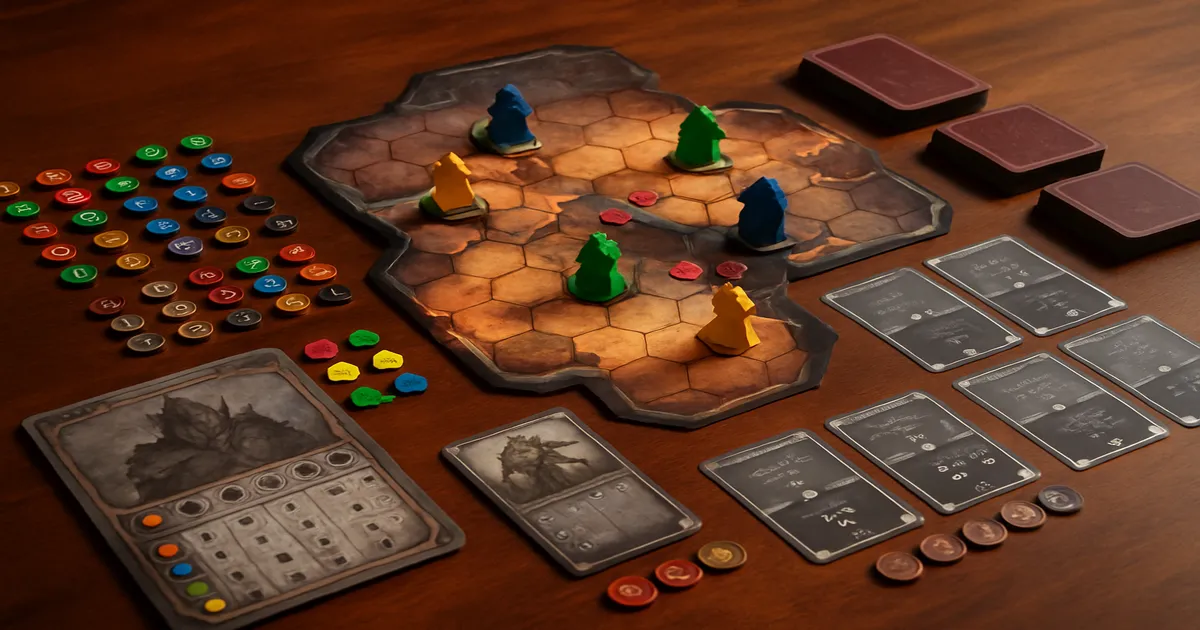
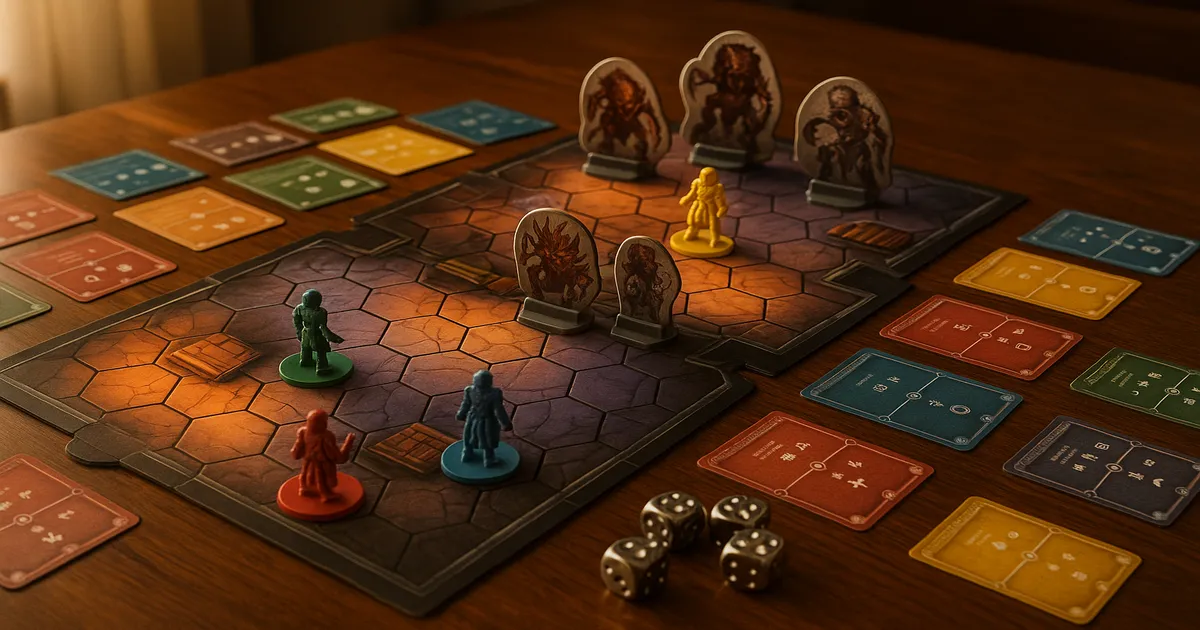
The component list is staggering:
- Hex-grid dungeon map tiles (thick, double-sided cardboard)
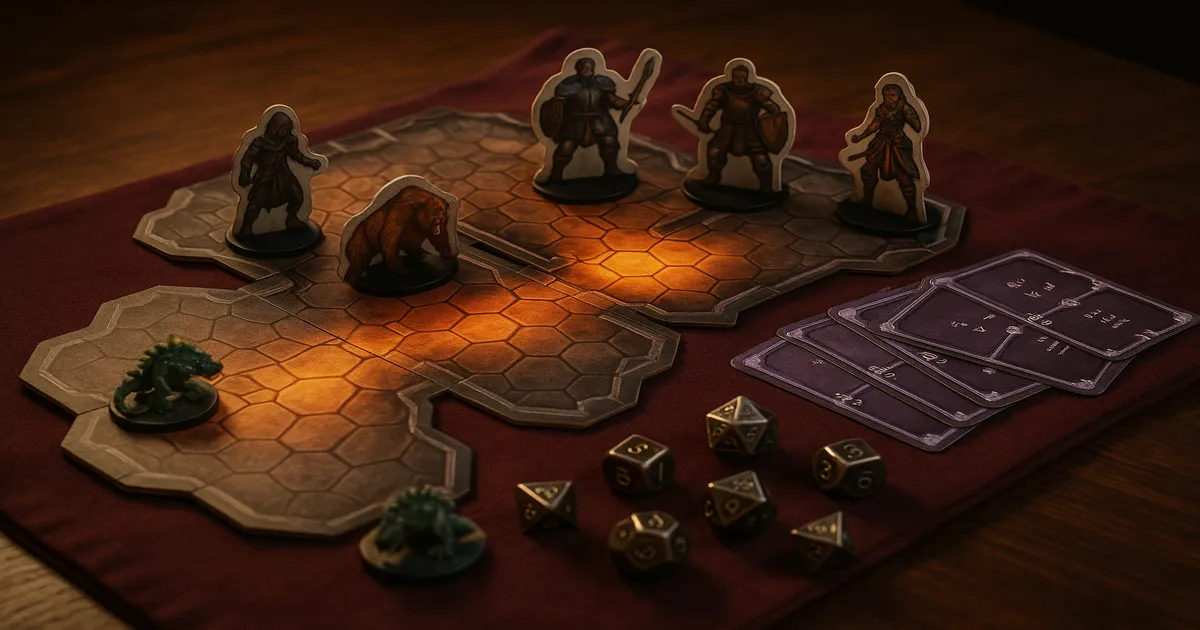
- 17 character miniatures and dozens of monster miniatures
- Ability card decks for each character class
- Monster ability decks and stat cards
- Attack modifier decks (one per player, one for monsters)
- Item cards, condition tokens, coin tokens
- Element board tracking Fire, Ice, Air, Earth, Light, and Dark
- Large-format scenario book and campaign world map
- Sticker sheets and sealed envelopes for campaign progression
- HP/XP dials and player aid cards
Map tiles are thick and durable. Miniatures are detailed but unpainted — painting them is a fun optional project, not a requirement. Card stock improved over 1st edition, though sleeving is still widely recommended. (Dragon Shield Standard Matte) The rulebook improvement is the real star here. The 1st edition version was notoriously rough; this one is actually well-organized.
Budget at least 3×4 feet of table space for a full scenario. Setup takes 10–20 minutes until you develop a system — a good organizer cuts this significantly. Teardown takes roughly the same. Experienced groups stop noticing it.
How to Play Gloomhaven 2nd Edition: Core Rules
The Card System
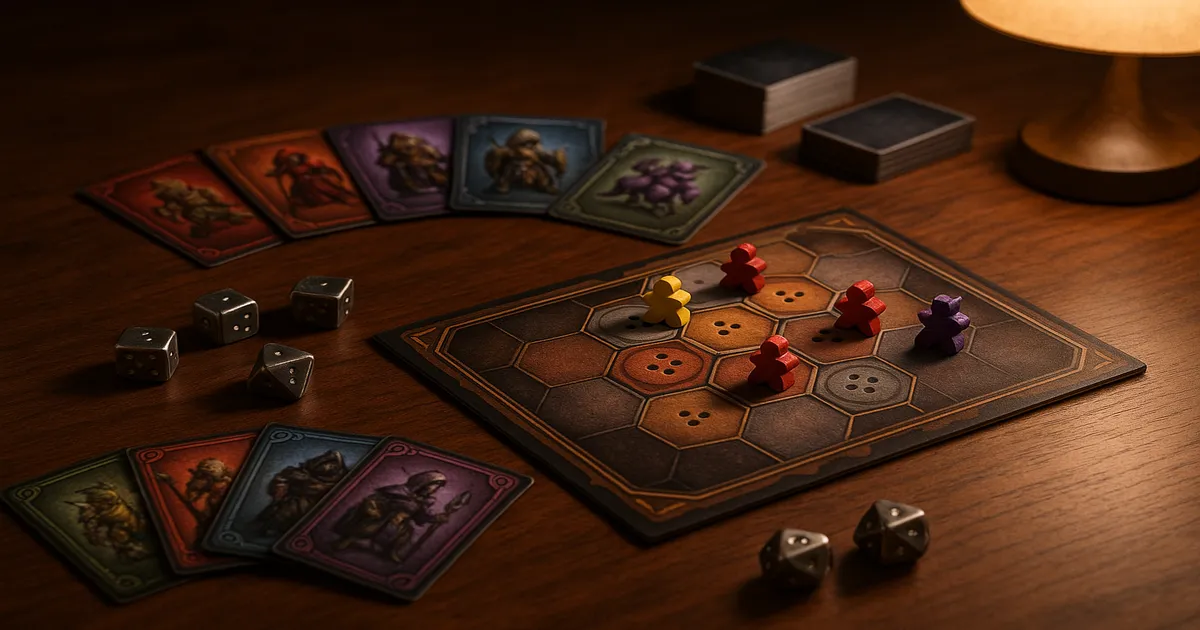
This is what makes Gloomhaven different from every other dungeon crawler. Your character has a hand of 10–12 ability cards. Each card has a top action and a bottom action.
On your turn, you secretly select two cards and place them face-down. Everyone reveals simultaneously. You then use the top action of one card and the bottom action of the other — not both halves of the same card. That’s the most common rules mistake new players make, so burn it into your brain now.
Cards are either discarded (recoverable via rest) or lost (gone for the scenario). When you can’t play two cards at the start of your turn, you’re exhausted and out of the fight.
Initiative and Turn Order
Each card has an initiative number from 1 to 99. When you play your two cards, you pick one to declare your initiative. Lower numbers act earlier. Monster initiative comes from drawing a card from that monster type’s ability deck — one draw per round, per monster type.
Everyone acts in initiative order. This makes card selection a genuine tactical decision: a powerful card with slow initiative might cost you when timing matters.
How Monster AI Works
Monsters don’t need a human controller. Each round, a card is drawn from each monster type’s ability deck, telling you what that type does — move, attack, apply a condition. Monsters then follow a focus priority system: they target the nearest figure they can reach, with tiebreakers going to the lowest-HP figure, then the one with the most recent initiative.
Learning to predict and manipulate monster focus is one of the deeper skills in the game. It takes a few sessions to click, but once it does, you’ll start positioning very differently.
The Element System
Six elements sit on a central board. Some abilities infuse an element; others consume an active element for a bonus effect. The rule that trips everyone up: an element infused this round is only available next round. You can’t infuse and consume in the same turn. This creates a coordination puzzle between players that’s more interesting than it sounds.
The Attack Modifier Deck
Every attack draws a card from your personal attack modifier deck, which modifies the damage. Cards range from -2 to +4, with special Miss and 2× Critical cards. Over the campaign, perks let you remove bad cards and add good ones. It’s a satisfying long-term progression system that makes your character feel meaningfully different by the end of a campaign.
Resting
Short rest: Shuffle your discarded cards and randomly recover all but one (which is lost). Fast, but you don’t control what you lose.
Long rest: Recover all discarded cards, choose one to lose, and heal 2 HP. Costs your entire turn for that round. Worth it when you need a full reset.
Winning and Losing
Win conditions are scenario-specific — kill all enemies, open a specific door, escort a figure, survive X rounds. Loss conditions: all characters become exhausted before the objective is complete, or a specific failure trigger fires. Being exhausted isn’t the same as dying. Actual character death has harder consequences and is relatively rare.
Common Mistakes New Players Make
Playing both halves of the same card. Top of one card, bottom of the other. Always.
Getting element timing wrong. Infuse this round, consume next round — not the same turn.
Incorrect monster focus. Monsters follow a specific priority system. They don’t just charge whoever’s closest.
Burning loss cards too early. Those cards with the flame symbol are gone for the scenario. Save them for the moment that actually matters.
Playing at too high a difficulty. This is the single most common reason new groups have a bad time. Start at the recommended level or drop it by one. There’s no shame in it, and you’ll have more fun.
Skipping city and road events. They have real mechanical consequences — gold, conditions, reputation changes. Don’t treat them as optional flavor.
Strategy Tips
Hand Management Is Everything
Think of your hand as a resource bar that depletes across the whole scenario, not a per-turn toolkit. Rest timing matters enormously. A well-timed long rest mid-scenario can extend your effectiveness by several rounds; a poorly timed one lets enemies overrun your position.
Initiative Is a Weapon
Going first isn’t automatically good. Sometimes letting monsters reveal their ability cards before you commit is the smarter play. Going last in a round can be powerful — you act after monsters have moved, letting you clean up positions and set up the next round cleanly. Coordinate with your team: if a teammate needs to heal you, they need to go before you take the hit.
Crowd Control Over Raw Damage
Immobilize, Stun, and Disarm are almost always more efficient than raw damage. A stunned monster doesn’t attack. Prioritize elite monsters (gold bases) first — they hit harder and have better abilities. Use the hex grid intentionally: chokepoints, flanking, and controlling monster focus are all legitimate strategies.
Starting Class Quick Guide
- Brute: Straightforward tank. Position yourself between squishier allies and threats.
- Spellweaver: Fragile but devastating. Stay out of melee, manage your elements, and save your loss cards — they’re some of the most powerful in the game.
- Scoundrel: Burst damage specialist who needs an ally adjacent to the target. Requires close coordination.
- Cragheart: The most forgiving starting class. Versatile mix of damage, healing, and terrain manipulation. Great for new players.
- Mindthief: High skill ceiling. Rewarding to master, punishing when you don’t know what you’re doing.
- Tinkerer: Support and control. Lower damage output, but invaluable in long scenarios where keeping the party alive matters.
Gloomhaven 2nd Edition vs. the Alternatives
Should Beginners Start with Jaws of the Lion?
Honestly, yes. Jaws of the Lion (1–4 players, 60–90 min, BGG weight 3.6/5) is a streamlined 25-scenario version with a built-in tutorial that eases you into the systems over the first few scenarios. It’s not a lesser game — it’s a smarter entry point. Come to Gloomhaven 2nd Edition after you know the card system.
What About Frosthaven?
Frosthaven (1–4 players, 90–150 min, BGG weight 4.0/5) is the natural next step — a standalone sequel with new classes, a crafting system, seasonal events, and a city-building meta-layer. It’s heavier and longer. Play Gloomhaven first; Frosthaven feels like a reward for finishing it.
Other Dungeon Crawlers Worth Knowing
Descent: Legends of the Dark (1–4 players, 90–180 min, BGG weight 3.3/5) leans more narrative and uses a companion app. Less tactical depth than Gloomhaven, but more story-driven. Arkham Horror: The Card Game (1–4 players, 60–120 min, BGG weight 3.5/5) isn’t a dungeon crawler, but if you want a stronger narrative experience in a similar cooperative space, it’s exceptional. Mage Knight (1–4 players, 150–240 min, BGG weight 4.6/5) goes deeper on solo complexity but is a very different beast.
Is Gloomhaven 2nd Edition right for your group?
- New to dungeon crawlers → Start with Jaws of the Lion
- Want strong narrative → Descent: Legends of the Dark or Arkham Horror LCG
- Finished Gloomhaven, want more → Frosthaven
- Primarily solo → Gloomhaven is excellent, but also look at Mage Knight
Frequently Asked Questions
Do I need to play 1st edition before the 2nd edition?
No. The 2nd edition is completely self-contained. No prior Gloomhaven experience required — though if you’ve never played at all, Jaws of the Lion is still the better starting point.
How long does a full campaign take?
A full campaign spans 95+ scenarios, though most groups won’t hit every one due to branching paths. Expect 100+ hours total. Most groups spread this over many months of regular sessions.
Can you play Gloomhaven 2nd Edition solo?
Yes, and it’s genuinely excellent. Solo players control two characters simultaneously, which adds a layer of tactical complexity. The card system and monster AI work just as well with one person at the table.
What’s the best starting class for beginners?
Cragheart. Its flexibility — mixing damage, healing, and terrain manipulation — means you’re rarely locked into a bad position. Brute is also solid if you want a straightforward frontline role. Avoid Mindthief as your first character; it has a high skill ceiling that punishes unfamiliarity with the game’s systems.
Is Gloomhaven 2nd Edition worth buying if you already own 1st edition?
Probably not a must-buy if your 1st edition copy is complete and you’ve been playing with the errata. The improvements are real — better rulebook, rebalanced classes, improved card readability — but they’re refinements, not a reinvention. If you’re buying Gloomhaven for the first time, absolutely get the 2nd edition.