Quick Answer: Everdell is a 1–4 player worker placement and tableau-building game where woodland creatures construct a city of up to 15 cards across four seasons. You gather resources, play cards, and score victory points — the whole thing runs 40–80 minutes and sits at a sweet spot where new players can pick it up in one session but still have plenty to discover on their tenth game.
If you’ve been trying to figure out how to play Everdell board game, you’re in the right place. Designed by James A. Wilson and published by Starling Games, Everdell (2018, 1–4 players, 40–80 minutes, BGG weight ~2.8/5) is one of the most visually striking games on the market — Andrew Bosley’s painterly storybook art does a lot of heavy lifting — but it’s also genuinely clever. The Construction/Critter pairing system alone is worth the price of admission.
What’s in the Everdell Box
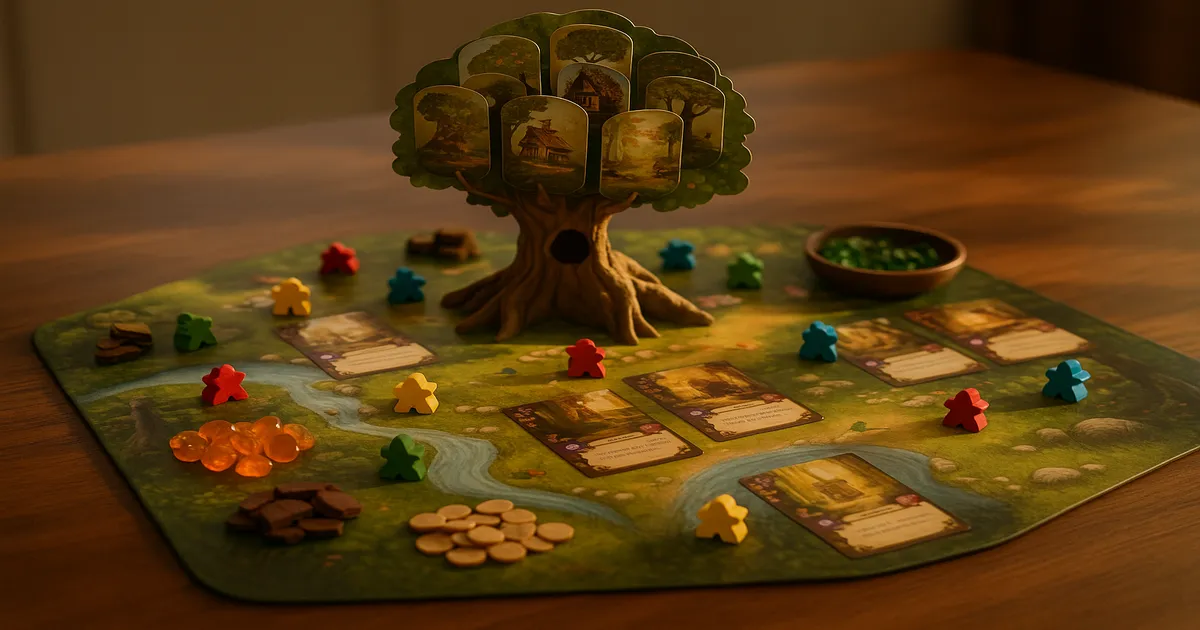
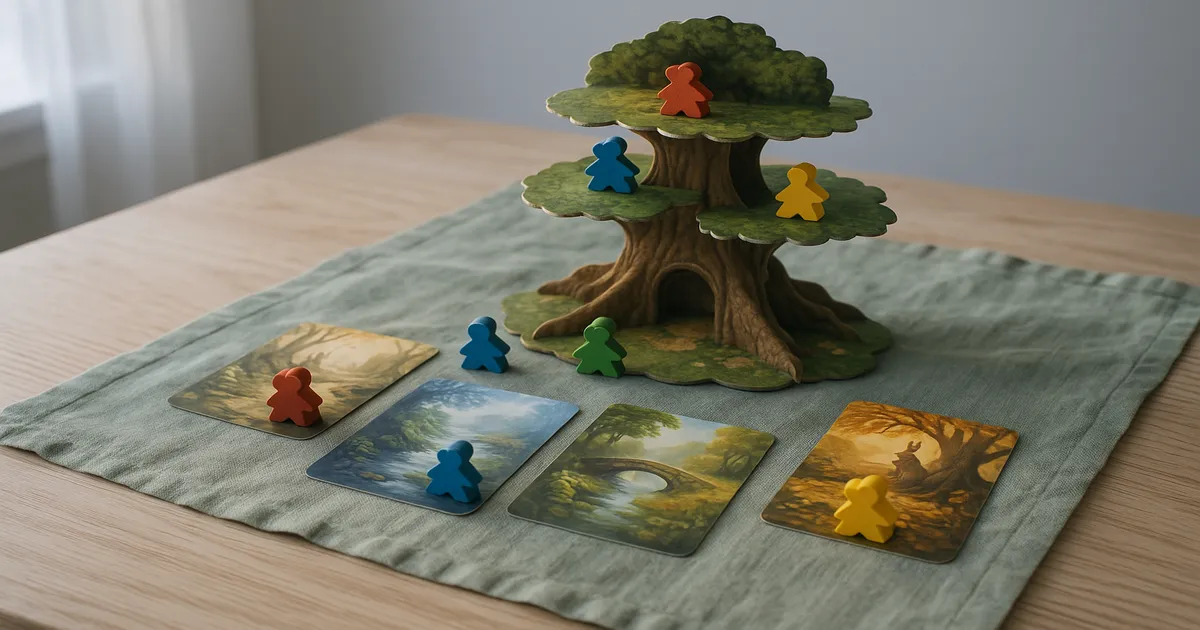
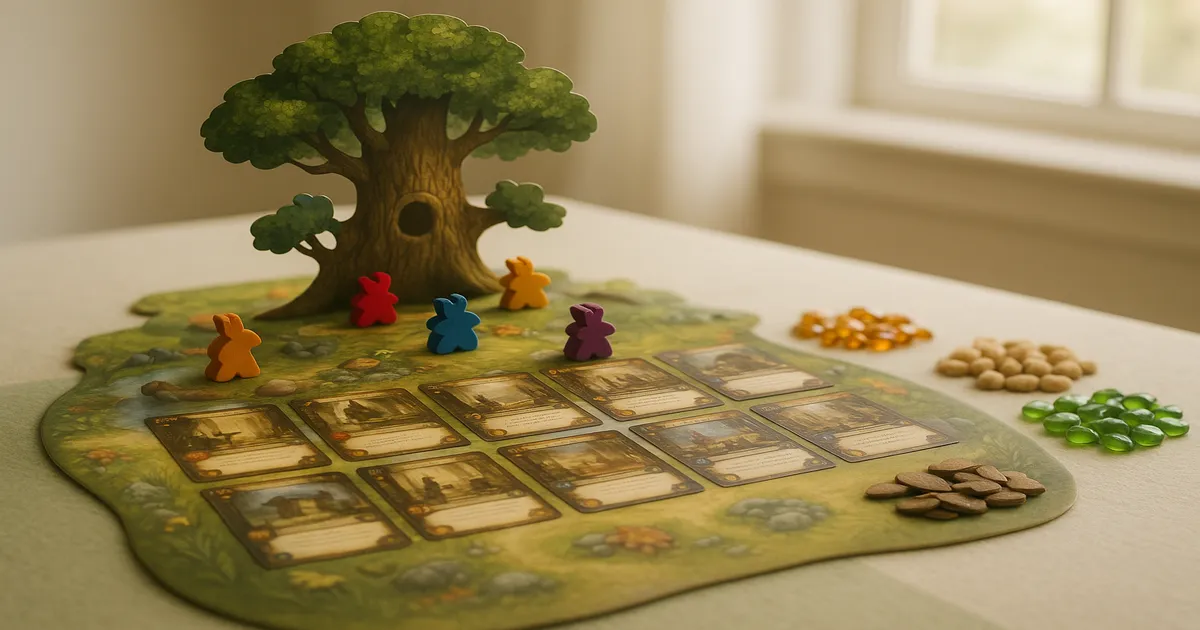
The 3D cardboard Ever Tree is the first thing everyone notices. It towers over the table, holds cards on its branches, and anchors the Meadow at its base. Assembly takes maybe five minutes, and the table presence it creates is exceptional for a game at this weight. It’s mostly aesthetic — but that matters more than some people admit.
Here’s what else you’re working with:
- 128 unique City Cards — no duplicates in the base game
- 11 Event cards (4 basic, 7 special)
- 30 Forest cards (used to build the modular board)
- 4 player mats and 20 wooden worker meeples (5 per player)
- 1 eight-sided die (for the Journey space)
- Resource tokens: Twigs, Resin, Pebbles, and Berries
The cards have a nice linen finish and are worth sleeving — you’ll handle them constantly. (Mayday Games Premium Sleeves) The resource tokens are functional cardboard, and upgrading them to resin or wood versions is one of the most popular aftermarket tweaks for this game. The original insert is genuinely bad; most players move everything into bags or a custom organizer pretty quickly.
How to Set Up Everdell
Setup takes 10–15 minutes once you know the sequence:
- Build the Forest board by randomly selecting Forest tiles. This is where most of the game’s variability lives — different tile combinations mean different resources and actions are available each game.
- Assemble the Ever Tree and place it in the center of the table.
- Populate the Meadow by dealing 8 cards face-up at the base of the tree.
- Place the 4 basic Event cards on the board. Shuffle special events into the main deck.
- Distribute player mats and give each player 2 workers to start Spring.
- Deal starting resources and cards per the rulebook (amounts vary by player count).
Pay attention to those Forest tiles in your first few turns. They determine which strategies are actually viable, and new players often ignore them until it’s too late.
How to Play Everdell: Turn Structure
On your turn, you take exactly one of three actions.
Place a Worker
Send a worker to a space on the Forest board or the Ever Tree to collect resources, draw cards, or trigger special actions. Forest spaces are limited — usually one or two workers max — so competition is real. Workers stay placed until you change seasons.
Play a Card from Your Hand
Pay the resource cost and add a card to your city. Your city caps at 15 cards total, so every slot eventually matters. Here’s what a lot of new players miss: you can take a card directly from the Meadow as part of this action — no worker required. Just pay its cost and play it. The Meadow is a shared card market, not a worker placement space.
Prepare for the Next Season
This is your “pass” — but it’s more strategic than it sounds. When you prepare for a new season, you recall all your workers, gain new ones (Spring → Summer: +1 worker; Summer → Autumn: +2 workers), draw back up to 8 cards, and trigger any relevant card effects. You can do this even if you still have workers on the board. Timing your season change is one of the most interesting decisions in the game.
The game flows through Spring, Summer, and Autumn. Winter isn’t a season you play through — it’s the end-game trigger. Once all players have moved through Autumn, you score.
Everdell Card Types Explained
Constructions vs. Critters: The Core Pairing System
This is the heart of how to play Everdell. Constructions are buildings; Critters are animals. Many Critters are paired with a specific Construction — and if you’ve already built that Construction, you can play the matching Critter for free. No resources. Nothing. New players either miss this entirely or underestimate how much to build around it. It’s the single most powerful mechanic in the game.
Card Colors and What They Do
- Purple (Governance): Ongoing bonuses — reduce costs, reward card types. Often undervalued by new players.
- Green (Destination): Have worker placement spaces on the card itself. Opponents can sometimes use them too.
- Blue (Production): Activate at the start of seasons or when played. Great for resource generation.
- Tan (Traveler): Immediate one-time effects. Play and move on.
- Red (Prosperity): Score bonus VP at game end based on conditions in your city. Read these carefully — you actually have to meet the condition.
Resources
Berries pay for Critters. Twigs, Resin, and Pebbles pay for Constructions — roughly in order of increasing scarcity. Pebbles are the rarest and most expensive. Your hand limit is 8 cards, so you can’t hoard options indefinitely.
How to Win Everdell: Scoring Victory Points
Victory points come from several sources:
- Printed VP values on each card in your city
- Prosperity card bonuses — points based on what else is in your city at game end
- Journey tokens — workers sent to the Journey space score points via a die roll plus remaining resources
- Event cards — 3 VP each for basic events; special events are worth more
- Limited resource conversion at game end
Highest total wins. Ties go to the player with more remaining resources.
The 4 basic Event cards sit on the board the entire game, each worth 3 VP, and new players walk right past them. Their requirements are usually achievable if you’re paying attention. Completing even two is a meaningful swing — don’t ignore them.
Hoarding resources is a losing strategy. The cards you could have bought almost always score more than the conversion rate at game end. Spend aggressively, and when Autumn hits, send workers to Journey to squeeze out those last points.
Common Mistakes New Everdell Players Make
- Paying for a Critter when you don’t have to. If the paired Construction is in your city, the Critter is free. Most common mistake by a wide margin.
- Using a worker to take a Meadow card. You don’t. Meadow cards are taken as part of the Play a Card action — just pay the cost.
- Forgetting to draw cards when changing seasons. You draw back up to 8. Easy to skip in the chaos.
- Misreading card timing. “When played,” “at the start of a season,” and “at any time” are all different. Read carefully.
- Treating 15 cards as a target. It’s a cap, not a goal. A tight 10-card city with great synergies can outscore a bloated 15-card city.
On the strategy side: building resources without spending them is the biggest mistake I see. You’re not saving — you’re wasting. Have 2–3 Construction/Critter pairs in mind by mid-Summer. And if you’re placing workers just to block opponents rather than because you have a good move, it’s probably time to advance your season.
Everdell Strategy Tips
Spring: Prioritize blue Production cards — they compound across seasons. Scout the Forest tiles immediately and figure out which resources are plentiful and which are scarce. Check the Meadow every turn; good cards disappear fast.
Summer: By now you should know which pairs you’re building toward. Watch your opponents’ season timing — when someone advances, their workers come home and those Forest spaces open up. Purple Governance cards that reduce costs are worth more than they look.
Autumn: Stop building the engine. Cash it in. Play your high-VP cards, complete any events you can still hit, and send workers to Journey. Count your remaining city slots and be selective about what fills the last two.
In 2-player games, there’s less competition for spaces, so engine-building is more viable and you can afford to be patient. In 3–4 player games, speed matters — someone will race ahead on events and season changes if you’re not paying attention. The solo mode against Rugwort the rat is a genuine challenge and a great way to learn card interactions without worrying about opponents.
Everdell Expansions: Where to Go Next
Get a few games under your belt with the base game first — it’s a complete, satisfying experience and doesn’t need anything added. When you’re ready:
- Pearlbrook — Adds an underwater realm, ambassador workers, and pearls as a new resource. The best first expansion, and it integrates smoothly without overwhelming the base game.
- Spirecrest — Weather cards and big critters. Adds real complexity; better for experienced groups.
- Bellfaire — Player powers, a market, and 5–6 player support. Good if you need higher player counts.
- Newleaf — Train station and visitors. Lighter and modular; easy to add or remove.
- Farshore — A standalone nautical spinoff. Fun, but a separate purchase decision.
If Everdell clicks for you, Wingspan is the most common next recommendation — both are card-driven engine builders with beautiful art — but Everdell has more worker placement tension and a tighter puzzle feel. Wingspan is more meditative. Viticulture leans heavier on worker placement with less card synergy. Cascadia is significantly lighter and better for younger players. Ark Nova scratches a similar “build an engine from unique cards” itch but is a much heavier game — think of it as Everdell’s intense older sibling.
Frequently Asked Questions About Everdell
Is Everdell good for beginners?
Yes, with a small caveat. The rules are learnable in 20 minutes, and the theme makes the mechanics feel intuitive. The volume of unique card text can be a bit much in your very first game — plan to reference the rulebook a few times. By game two, most players feel comfortable.
How long does a game of Everdell take?
The box says 40–80 minutes, and that’s accurate. New players tend toward the higher end; experienced players often finish in under 60. With a full table of four who know the game, expect around 75 minutes including setup.
Can you play Everdell with 2 players?
Absolutely, and it plays well at two. Less competition for Forest spaces means you can plan more deliberately, and some players actually prefer it for that reason. There’s a slight setup adjustment for player count, but nothing complicated.
Do you need the expansions to enjoy Everdell?
Not even a little. The base game has enough replayability from 128 unique cards and the modular Forest board to keep you busy for many sessions. Expansions are worth exploring once you’ve played 5–10 games and want something new — they’re additions, not corrections.
How does the Everdell solo mode work?
You play against Rugwort the rat, an automated opponent who competes for events and Forest spaces according to a specific ruleset. He doesn’t build a city — he just blocks you and races you to events. It’s a genuine challenge and a good way to learn card interactions. The skills it builds — efficient play and event prioritization — transfer well to multiplayer.