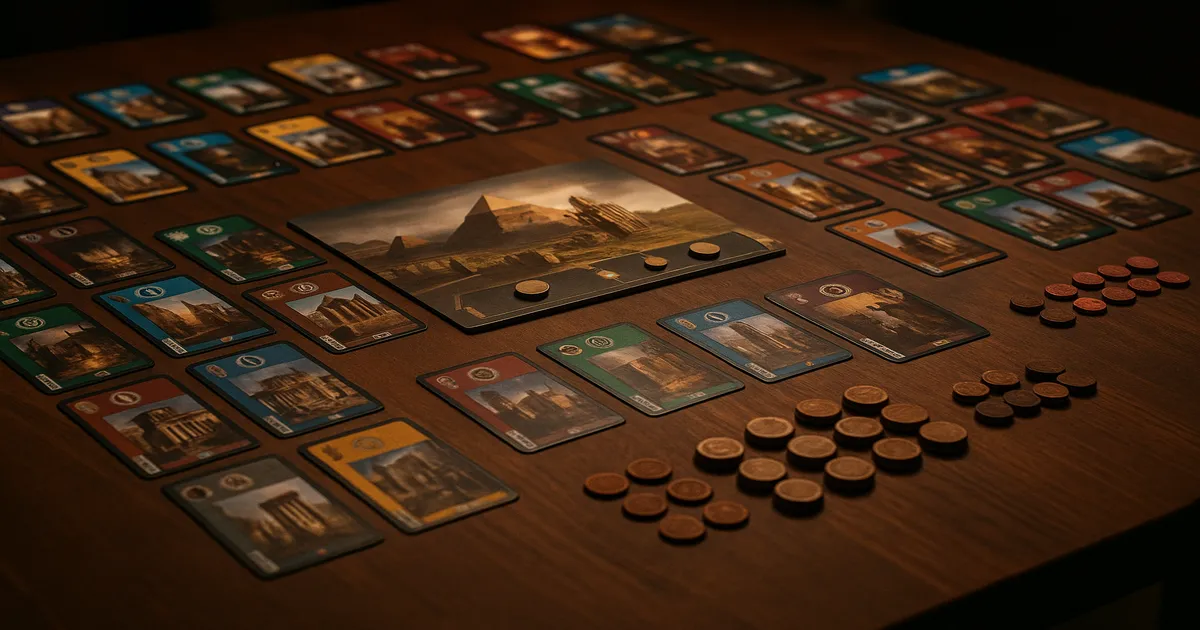
Quick Answer: 7 Wonders is a simultaneous card-drafting game for 2–7 players where everyone builds an ancient civilization across three Ages. Each turn you pick one card from your hand, pass the rest to a neighbor, and choose to build it, discard it for coins, or use it to advance your Wonder. Games run 30–45 minutes regardless of player count, and it won the Kennerspiel des Jahres in 2011 for good reason.
If you want to learn how to play 7 Wonders board game, good news: you picked one of the most elegantly designed games of the last two decades. It scales from three to seven players without adding a single minute of downtime — everyone acts simultaneously, every turn, no exceptions. BGG rates it around 2.3/5 for complexity, which lands it squarely in “accessible to newcomers, satisfying for hobbyists” territory. That’s a rare combination.
7 Wonders at a Glance
2–7 players | 30–45 minutes | BGG weight 2.3/5
The sweet spot is 3–7 players. The official 2-player rules use a dummy “ghost” hand that works but feels awkward — more on that in the FAQ. The 2020 New Edition cleaned up the iconography and upgraded the components significantly, so if you’re buying fresh, get that one.
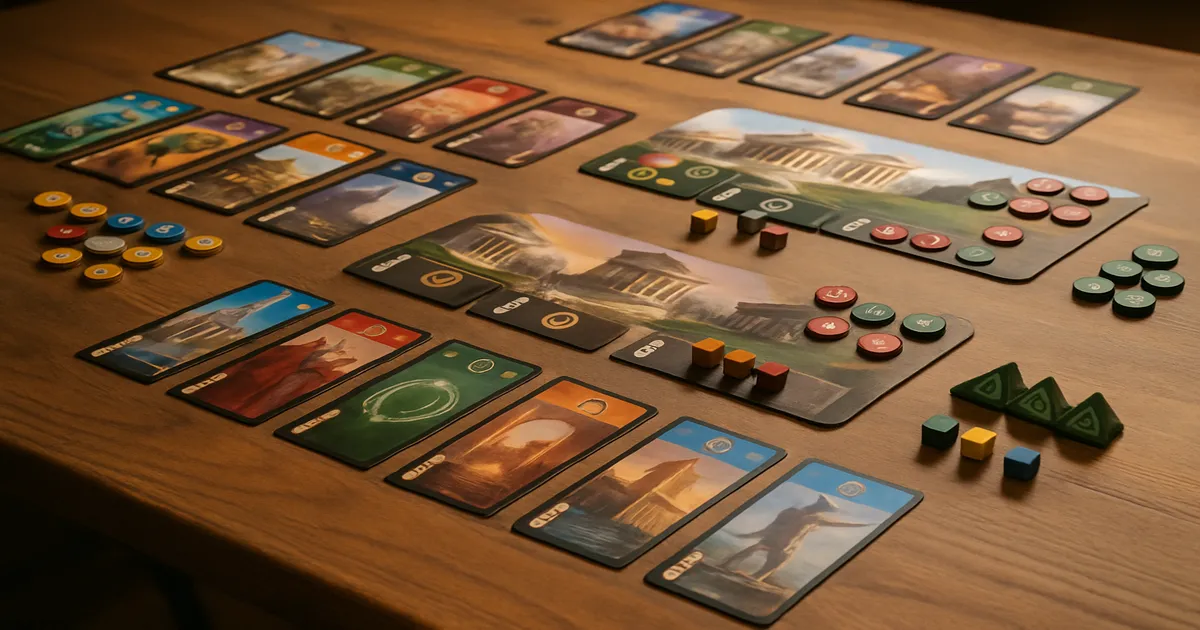
What’s in the Box
Wonder Boards and Starting Resources
There are seven double-sided Wonder boards — one per ancient city (Alexandria, Babylon, Ephesus, Giza, Halikarnassos, Olympia, Rhodes). The A-side is more straightforward; the B-side is more asymmetric and usually more interesting once you know what you’re doing. Each board shows a starting resource in the upper-left corner, which your city produces for free every turn without needing a card.
The Three Age Decks and Card Types
Six card types, color-coded across all three Ages:
- Brown — Raw materials (Wood, Stone, Clay, Ore)
- Grey — Manufactured goods (Glass, Papyrus, Linen/Cloth)
- Yellow — Commercial structures (trading discounts, coins, income)
- Red — Military (shields for conflict resolution)
- Blue — Civilian structures (flat victory points)
- Green — Science (Compass, Tablet, Gear symbols)
- Purple — Guilds (Age III only; powerful end-game scoring)
Age I is cheap and foundational. Age II gets expensive. Age III is where games are won or lost — guilds hit the table, science can explode, and everyone’s scrambling for final points.
Coins, Conflict Tokens, and the Score Pad
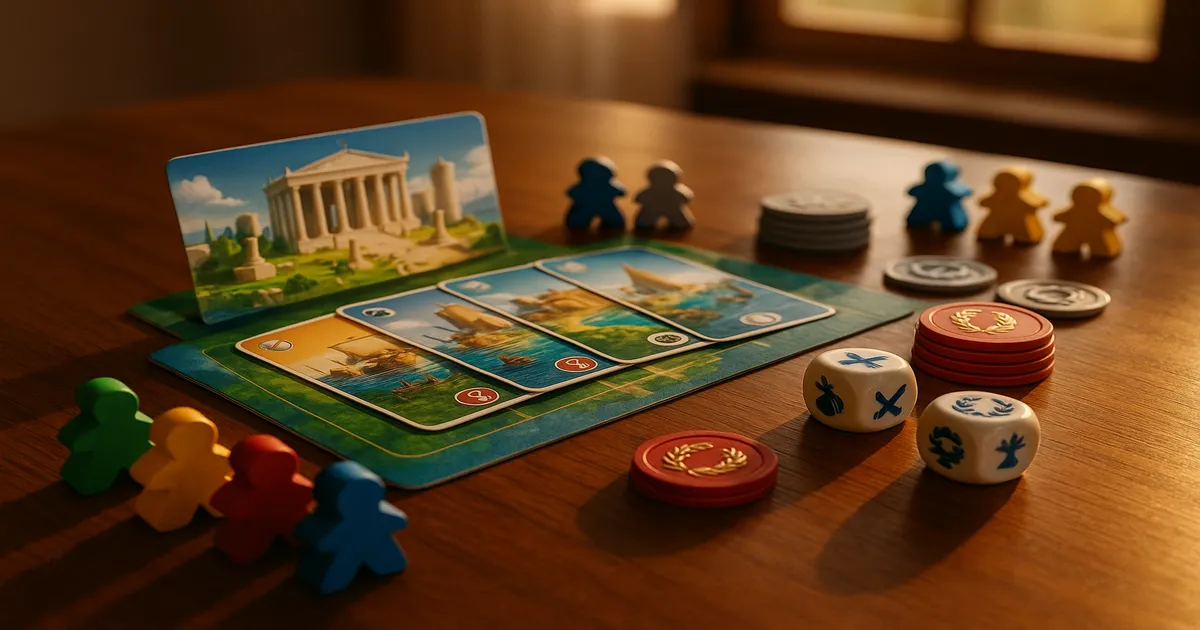
Coins come in denominations of 1 and 3. Conflict tokens track your military wins (+1/+3/+5 VP) and losses (−1 VP) by Age. Use the score pad at game end — it tallies all seven categories and prevents the inevitable argument about who forgot to count their guild.
Original Edition vs. 2020 New Edition
The original 2010 edition has thinner cards and basic cardboard coins that feel cheap. The 2020 New Edition upgrades to linen-finish cards, redesigned iconography, better coin tokens, and a vastly improved insert with labeled card trays. The art style changed too — Miguel Coimbra’s original paintings are more atmospheric, but Etienne Hebinger’s new graphics are easier to read mid-game. Either plays identically; the 2020 edition just feels better.
If you sleeve your cards, you’ll want 68mm × 120mm sleeves.
Setting Up Your First Game
- Shuffle the Wonder boards and deal one to each player (or let people choose — it doesn’t matter much for a first game).
- Each player takes 3 gold coins from the bank.
- Sit in a circle. Your left and right neighbors are the only players you’ll ever trade with or fight — everyone else is irrelevant to your economy.
- Build the Age decks for your player count. The rulebook has a clear table for which cards to remove. Don’t skip this step; it matters.
The 2020 edition’s labeled card trays make sorting by Age much faster once you’ve played a few times. For a first game, budget an extra ten minutes for setup while everyone reads the card icons.
How to Play 7 Wonders: Turn Structure and Core Rules
The Card-Drafting Mechanic
At the start of each Age, every player gets a hand of seven cards. Simultaneously, everyone picks one card face-down, then all reveal at once. Hands then pass — left in Age I, right in Age II, left again in Age III. Repeat until two cards remain: play one, discard the other face-down. That last card is gone forever.
Your Three Options Each Turn
With your chosen card, you do exactly one of these:
- Build it — pay the resource cost (from your own production, coins, or trading) and add it to your city tableau.
- Discard it — take 3 gold from the bank. More useful than new players realize.
- Advance your Wonder — place the card face-down under your Wonder board to complete the next stage. The card itself doesn’t matter; it’s just a payment token. The Wonder stage’s printed benefits are what you’re after.
Free Construction Chains
This is the rule new players forget most often. Many cards have a small symbol in the lower-left corner. If you’ve already built the card that matches that symbol, you build the new card completely free — no resources, no coins. Always check before you pay anything. Always.
Military Conflict at the End of Each Age
When an Age ends, compare your total shield count with each immediate neighbor independently. Beat your left neighbor but lose to your right? You get a win token from one and a loss token from the other. Stakes escalate by Age: wins are worth +1/+3/+5 VP respectively, and losses are always −1 VP.
Resources and Trading
Brown cards give you raw materials. Grey cards — Glass, Papyrus, and Linen — are manufactured goods required for advanced buildings and science cards. New players consistently undervalue grey cards and spend half their coins buying them from neighbors all game. Don’t be that person.
If you need a resource you don’t produce, you can buy it from an immediate neighbor for 2 gold (base cost). You’re buying against their printed production — not anything they themselves traded for. You can’t reach across the table to a player two seats away.
Yellow commercial cards are the most underrated color in the game. The East/West trading cards cut your trade cost from 2 gold to 1 gold for specific resource types — that’s effectively doubling your purchasing power. Many new players skip yellow entirely and wonder why they’re always broke.
How Scoring Works in 7 Wonders
At game end, tally all seven categories simultaneously:
- Military tokens — accumulated win/loss tokens from all three Ages
- Treasury — every 3 coins = 1 VP
- Wonder stages — VP printed on each completed stage
- Civilian (blue) cards — face-value VP, no conditions
- Science (green) cards — calculated by formula (see below)
- Commercial (yellow) cards — some award end-game VP based on card counts
- Guilds (purple cards) — score based on your neighbors’ or your own tableau
Science Scoring: The Formula That Trips Everyone Up
(Compasses)² + (Tablets)² + (Gears)² + (7 × number of complete sets of all three symbols)
So if you have 3 Compasses, 2 Tablets, and 1 Gear: 9 + 4 + 1 + 7 = 21 points from six cards. Science rewards commitment — dabbling is usually worse than ignoring it entirely. Either go all-in or spend those picks elsewhere.
Guild Cards: High-Risk, High-Reward
Purple guild cards are Age III only, and they score based on what’s already been built — by you, your neighbors, or both, depending on the card. The Builders’ Guild scores 1 VP per Wonder stage built by you and your two neighbors. Sit between two Wonder-heavy players and that’s potentially 8–10 points from a single card. Guilds reward consistency and punish scattered strategies.
Ties at game end are broken by coin count — whoever has more gold wins.
Common Mistakes New Players Make
- Ignoring free chains — check the lower-left symbol before paying for anything
- Trading with non-neighbors — only left and right, full stop
- Forgetting the last card — when two cards remain, play one and discard the other; that final card is gone
- Treating military as global — you fight each neighbor separately; wins and losses don’t cancel each other
- Botching the science formula — sets of three are the most forgotten part; write it down until it’s memorized
- Spreading too thin — being mediocre at everything usually means losing to the player who committed to one strategy
The discard-for-3-gold option is a real move, not a consolation prize. Sometimes the best card in your hand is worth nothing to you, and 3 coins is genuinely the right play.
Strategy Tips for New and Intermediate Players
Read the Wonder Boards Before Age I
Before cards are dealt, look at every Wonder board in play. Babylon’s B-side lets you play the last card of each Age — devastating for science players. Olympia’s A-side lets you build one card per Age for free. Halikarnassos lets you pull cards from the discard pile; timing that with Age III guilds can swing a game entirely.
Science: All In or Stay Out
The minimum viable science investment is roughly 3 of one symbol (9 points) or 1 of each (7 points plus the squares). Below that threshold, blue civilian cards would’ve scored more. Above it, the exponential scaling takes over and science becomes one of the strongest strategies in the game.
Military: A Tax, Not a Strategy
Think of military as damage mitigation. Losing all three Ages to both neighbors can cost you 6–9 VP in loss tokens alone. At minimum, aim to tie. At higher player counts, military is less impactful per card because you still only fight two opponents regardless — other strategies become relatively more valuable.
Hate Drafting
Sometimes you take a card purely to stop your neighbor from getting it, then discard it for 3 gold. This is a legitimate tactic. If your left neighbor is one science card away from a devastating set and you’re about to pass them the perfect piece, taking it and banking the coins is often the correct play.
How 7 Wonders Compares to Similar Games
vs. Sushi Go! — Lighter (BGG weight ~1.2), faster (15–20 minutes), no tableau building. Better for casual groups or younger players. 7 Wonders has meaningfully more depth; Sushi Go! is the cleaner gateway experience.
vs. 7 Wonders Duel — For two players, just get Duel instead. Designed specifically for two by Antoine Bauza and Bruno Cathala, it features a military track, a science victory condition, and card layout that creates genuine tension every turn. The base game’s ghost-hand variant works, but it’s a pale imitation.
vs. Terraforming Mars — The natural next step if you love 7 Wonders and want more complexity (BGG weight ~3.2, 90–120 minutes). Neither replaces what 7 Wonders does at its player count and speed.
If you have 3–7 people who want a strategic game that fits inside an hour with zero downtime, 7 Wonders is hard to beat. It’s also one of the best gateway euros I’ve seen — it teaches resource management, opportunity cost, and engine building without ever feeling like homework.
Frequently Asked Questions
How long does a game of 7 Wonders take?
A full game runs 30–45 minutes. Because all players act simultaneously, play time barely changes whether you have three players or seven. Add setup and end-game scoring and you’re looking at under an hour total.
Is 7 Wonders good for 2 players?
Not really. The ghost-hand variant works mechanically but loses a lot of the interaction and strategic tension that makes the game sing. 7 Wonders Duel was designed from the ground up for two players and is widely considered one of the best 2-player games ever made — start there if you’re primarily a 2-player household.
What’s the hardest part of 7 Wonders to learn?
Science scoring trips up almost everyone. The formula — squares of each symbol count plus 7 points per complete set of all three — is unintuitive until you’ve done it a few times. Free construction chains are the other common stumbling block; new players frequently pay for cards they could build for free.
What’s the difference between 7 Wonders and 7 Wonders Duel?
7 Wonders Duel is a standalone 2-player game, not an expansion. It shares the ancient civilization theme and some card DNA, but the mechanics are completely different — cards are laid out in a pyramid formation rather than passed hand-to-hand, and there are two instant-win conditions (military domination and scientific supremacy) alongside the standard point victory.
Do I need any accessories to play 7 Wonders?
Not strictly, but a card organizer makes setup dramatically faster once you own the game. The 2020 edition’s insert is decent, but a dedicated insert organizer is worth it if you play regularly.