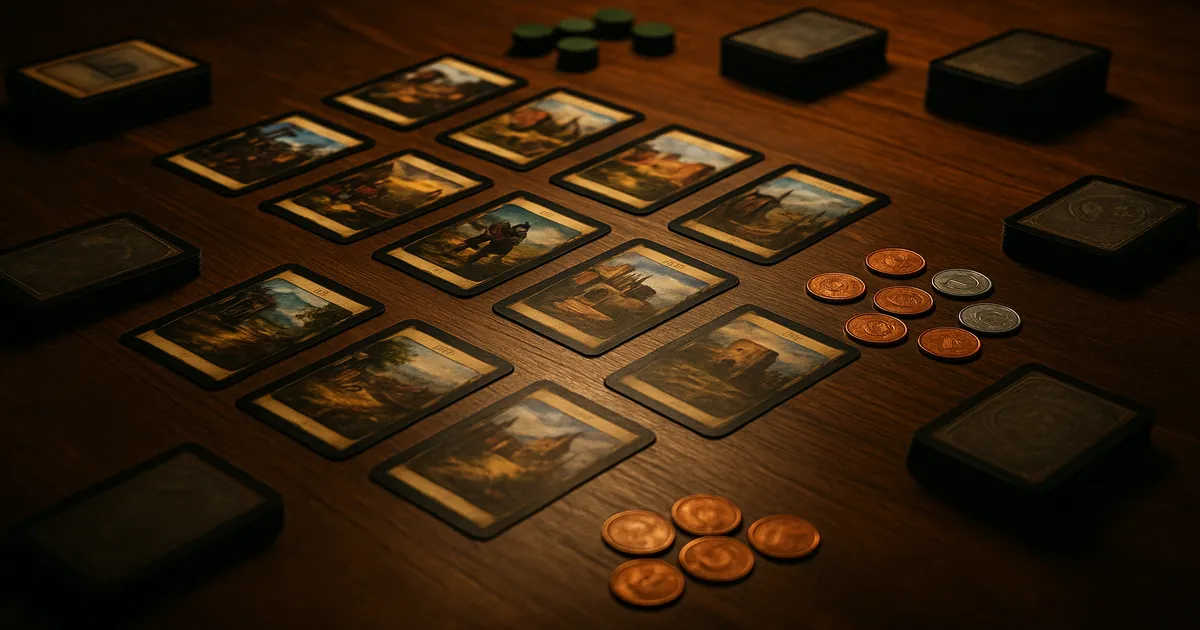
Quick Answer: Dominion is a 2–4 player deck-building card game where everyone starts with the same weak 10-card deck and spends the game buying better cards from a shared supply. You’re racing to accumulate Victory Points before the Province pile runs out — but buy them too early and you’ll clog your deck. Whoever has the most VP when the game ends wins. It plays in 30–60 minutes and won the Spiel des Jahres in 2009.
If you want to learn how to play the Dominion card game, you’re in good company. It’s been in the BGG Top 30 for over a decade, and it basically invented the deck-building genre. This guide covers the 2nd Edition base set — the version you’ll find on shelves today.
What Is Dominion? A Quick Game Overview
Donald X. Vaccarino designed Dominion in 2008, and it genuinely changed tabletop gaming. Before it, “deck building” wasn’t a game category — it was just something you did in Magic: The Gathering before you played. Dominion made building your deck the game itself, and designers have been riffing on that idea ever since.
The theme is medieval kingdom expansion — you’re a monarch acquiring lands, villages, markets, and military forces. Honestly, the theme is light. It gives each card some personality, but what keeps people coming back is the system, not the story.
2–4 players | 30–60 minutes | BGG weight 2.33/5
What’s in the Box
The 2nd Edition comes with 500 cards total:
- Treasure cards: Copper (1 coin), Silver (2 coins), Gold (3 coins)
- Victory cards: Estate (1 VP), Duchy (3 VP), Province (6 VP), Curse (–1 VP)
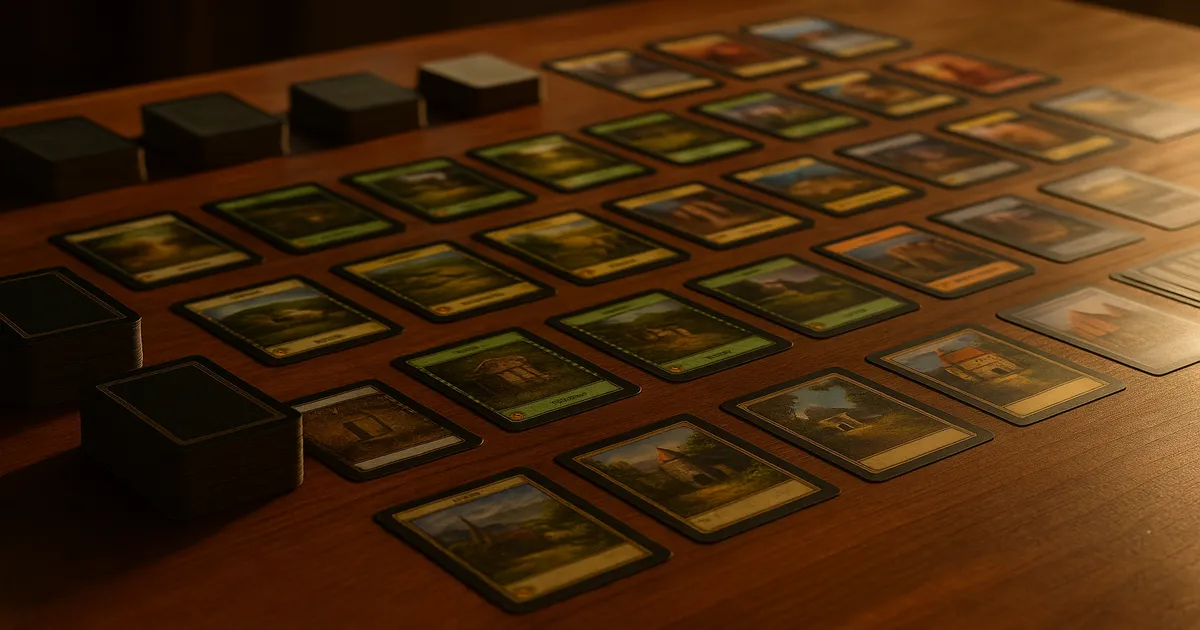
- 26 Kingdom card piles — the action cards that make each game different
- Randomizer cards — one per Kingdom card, used to randomly select your 10-pile setup
- Trash mat — a cardboard mat where permanently removed cards go
The card stock is adequate but not great. If you play regularly, sleeve your cards — they show wear fast. (Dragon Shield Matte Perfect Fit Sleeves) Fair warning: this game takes up a lot of table space. Clear the whole table before you start.
Setting Up Your First Game of Dominion
Laying Out the Supply
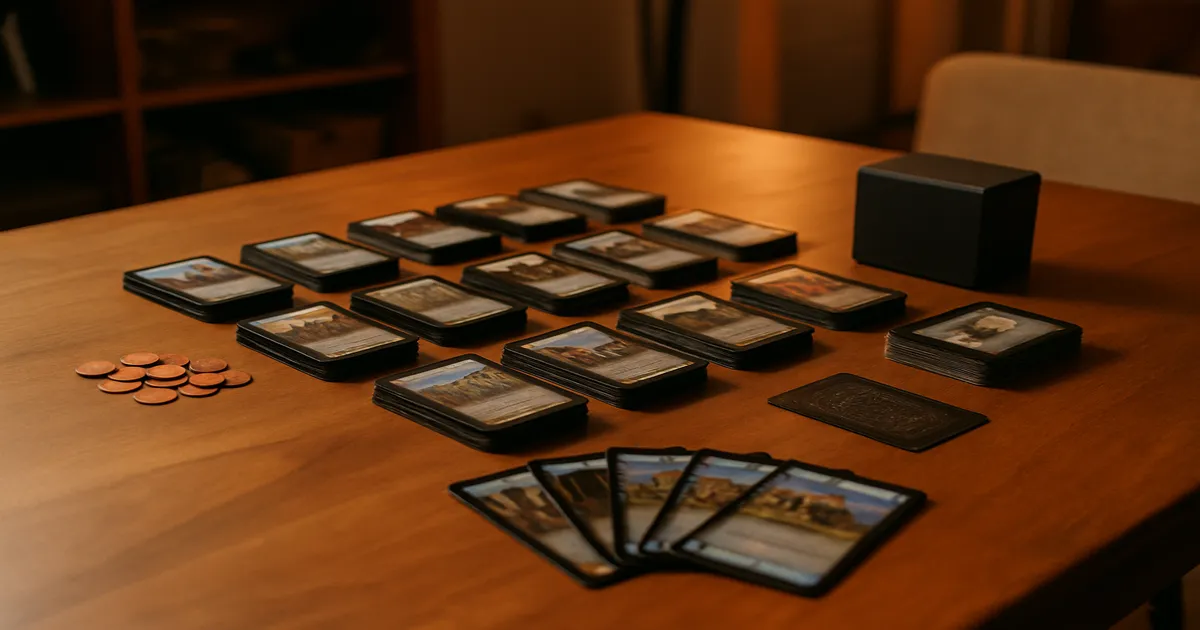
The Supply is the shared pool of cards everyone buys from. Set it up in the center of the table:
- Place the Copper, Silver, and Gold piles (use all Copper and Silver; 30 Gold cards)
- Place the Estate, Duchy, and Province piles — card counts scale with player count (8 Provinces for 2 players, 12 for 3–4)
- Place the Curse pile (10 Curses for 2 players, 20 for 3 players, 30 for 4 players)
- Place your 10 chosen Kingdom card piles
Dealing Starting Decks
Every player gets an identical starting deck: 7 Copper + 3 Estates. Shuffle it, draw 5 cards. That’s your opening hand. Everyone starts on exactly equal footing — what separates players is every decision from here on out.
Choosing Kingdom Cards
You choose 10 of the 26 Kingdom card piles for each game. Randomly drawing them is the standard method, and that’s what the Randomizer cards are for. For your first game, skip the random draw. The rulebook includes a recommended First Game setup, and I’d use it — some Kingdom combinations are confusing or combo-heavy in ways that make a bad teaching experience. Once everyone understands the core loop, go random.
How to Play Dominion: The Action–Buy–Cleanup Turn Sequence
Phase 1: The Action Phase
You start each turn with 1 Action. Play one Action card from your hand — or none at all, everything is optional. Some Action cards give you +1 Action (or more), letting you chain effects together. Cards that don’t give +Action are called “terminals” — you can only play one per turn unless something else gives you more Actions.
Phase 2: The Buy Phase
Play as many Treasure cards from your hand as you want, then spend those coins to buy one card from the Supply. The bought card goes to your discard pile, not your hand — you won’t see it until your deck reshuffles. You start each turn with 1 Buy, and some cards give you additional Buys. There’s no change-making: if you have 7 coins and buy a 5-cost card, those remaining 2 coins are gone.
Phase 3: The Cleanup Phase
Put everything — played cards, remaining hand — into your discard pile. Draw 5 new cards. Pass play to the left.
One Rule That Trips Up New Players
If your draw pile runs out in the middle of drawing cards, immediately shuffle your discard pile into a new draw pile and keep drawing. Don’t wait until Cleanup. This applies during your turn and during other players’ turns if a card effect makes you draw.
How to Win: Victory Points and the End-Game Trigger
Scoring Victory Points
At the end of the game, count VP across your entire deck — hand, draw pile, and discard pile combined:
- Estate: 1 VP
- Duchy: 3 VP
- Province: 6 VP
- Curse: –1 VP (easy to forget)
- Some Kingdom cards like Gardens have variable VP based on deck size
What Ends the Game
The game ends immediately when either of these happens:
- The Province pile is empty, OR
- Any 3 Supply piles are empty (any combination — Kingdom cards, Curses, Treasures, anything)
Ties go to whoever took fewer turns. New players are almost always surprised by how fast the game ends — keep an eye on those piles.
The Core Strategic Tension
Victory cards are dead weight in your deck. A Province sitting in your hand does nothing on your turn. But you need them to win. Buy them too early and your deck gets sluggish. Buy them too late and the game ends before you’ve accumulated enough. Figuring out when to make that shift is the central skill of Dominion, and it takes a few games before it clicks.
Common Mistakes New Players Make
Rules mistakes:
- Forgetting to draw 5 cards at Cleanup — sounds obvious, happens constantly
- Playing Treasure cards during the Action phase — Treasures go in the Buy phase
- Putting bought cards in your hand — they go to the discard pile
- Treating Actions and Buys as mandatory — you can skip both; sometimes buying nothing is correct
- Not reshuffling mid-turn when your draw pile empties
Strategic mistakes:
Buying too many terminals is the big one. If you have three Action cards that don’t give +Action, you can only play one of them per turn — the others just sit there. You need Village-type cards to support a hand full of terminals.
Other common traps: skipping Silver to chase expensive Kingdom cards (Silver is boring but reliable), never trashing your starting Coppers and Estates (a leaner deck cycles faster), buying Estates early in the game (almost never correct), and not noticing when Supply piles are running low.
Dominion Strategy: From Beginner to Intermediate
Start With Big Money
The simplest strategy that actually works: buy Silver early, aim for Gold, buy Provinces when you can hit $8. That’s it. Don’t overthink the Kingdom cards on your first few plays. This approach — called Big Money — is a solid baseline that will beat players who buy too many Action cards without a plan.
Always count how many Provinces are left. It’s the single most important number on the table.
Terminals, Engines, and When Each Wins
A terminal Action card doesn’t give +Action — you can only play one per turn without support. An engine is a deck built around chaining Actions together: Villages feed terminals, draw cards refill your hand, and the whole thing snowballs. A well-built engine beats Big Money. A poorly built one loses to it badly.
The 5/2 opening split — when your first hand gives you $5 to spend — is often game-defining. Many of the strongest base set cards cost $5, so hitting that number on turn one or two is a real advantage.
Key Cards to Know
- Chapel ($2): Trash up to 4 cards per turn. The most powerful card in the base set. If it’s in the Kingdom, buy it almost every time — a lean deck is a fast deck.
- Witch ($5): Draw 2 cards and give every opponent a Curse. Get one early; Curses are –1 VP each and the pile runs out fast.
- Village ($3): +1 Card, +2 Actions. The glue that holds Action chains together.
- Moat ($2): Draw 2 cards, and reveal it to block attacks. Cheap, useful, and the only defense against Witch in the base set.
- Gardens ($4): Worth 1 VP per 10 cards in your deck. Enables a completely different strategy — buy lots of cheap cards, inflate your deck, and race to end the game on piles.
When to Start Buying Victory Cards
There’s no universal answer, but a rough rule: start buying Provinces when your deck can reliably hit $8. If you’re cycling quickly and generating strong hands consistently, that’s your signal. Watch your opponent too — if they’re already greening, you need to respond.
In close endgames, Duchy dancing matters. Grabbing a Duchy (3 VP) instead of a Province can swing the final score when the Province pile is nearly empty and you’re within striking distance.
Expansions and Similar Games
Which Dominion Expansion to Buy Next
After the base set, Intrigue 2nd Edition is a solid first expansion — it adds more player interaction and works as a standalone game. Seaside is widely considered the best expansion; Duration cards (effects that persist into your next turn) add a fascinating planning dimension without much extra complexity.
Prosperity goes bigger with Platinum ($5 coins) and Colony (10 VP cards), making for longer, higher-powered games. Hinterlands adds on-gain reactions that change how you think about buying. Adventures, Empires, Renaissance, and Menagerie are all excellent but better suited to players who know the base set well.
Before buying any expansion, check out Dominion.games — the official digital version run by Shuffle iT. It has every expansion available, and trying a set online before buying physical is genuinely smart.
Games Like Dominion Worth Trying
- Star Realms — lighter, built for 2 players, direct combat, costs under $20. Great if you want faster games with more conflict.
- Ascension — uses a shared rotating card row instead of fixed piles, which means more variance. Good if you like a looser, more chaotic experience.
- Clank! — deck building on a board with push-your-luck dungeon crawling. Pick this if you want more physical presence and a clear adventure theme.
- Legendary: A Marvel Deck Building Game — cooperative play with a superhero theme. Great if your group prefers working together.
Frequently Asked Questions About the Dominion Card Game
How many players can play Dominion?
The base game supports 2–4 players. Some expansions extend this to 6. It plays well at all counts, though 2-player games tend to be the most strategic and move the fastest.
How long does a game of Dominion take?
Most games run 30–60 minutes. Experienced players in a 2-player game can finish in under 20 minutes. Larger player counts and complex Kingdom setups push toward the longer end.
What’s the best strategy for beginners?
Buy Silver early and often, aim for Gold, and don’t buy Estates. Watch the Province pile and start buying Provinces when you can reliably hit $8. Avoid loading up on Action cards until you understand how terminals and +Action cards interact.
What’s the difference between Dominion 1st and 2nd Edition?
The 2nd Edition (2016) swapped out six Kingdom cards from the original set, slightly improved the card stock, and significantly rewrote the rulebook for clarity. If you’re buying new, get the 2nd Edition — it’s the better product and the version all current strategy resources reference.
Can you play Dominion online for free?
Yes. Dominion.games (run by Shuffle iT) is the official digital version. It’s free to play with the base set; expansions require a subscription or one-time purchase. It’s an excellent way to practice, learn new expansions, or play when you can’t get people to the table.