Quick Answer: Clank! Catacombs is a 2–4 player deck-building dungeon crawler where you build a card hand, explore a randomly generated tile dungeon, grab a valuable artifact, and race back to the surface before the dragon kills you. Every turn you play all five cards from your hand to generate movement, combat, purchasing power, and noise — that last one feeds the dragon bag and determines how much damage you take during attacks. The player with the most points at the end wins.
If you’re trying to figure out how to play Clank! Catacombs, the good news is that the core loop clicks pretty fast. You’re a thief sneaking into a dragon’s underground lair, building your deck as you go, and making increasingly sweaty decisions about how deep to push before turning back. Designed by Andy Clautice and published by Renegade Game Studios in 2022, it’s a fully standalone game — no prior Clank! experience needed, and no prior Clank! experience will save you when the dragon bag turns against you.
What Is Clank! Catacombs?
2–4 players | 90–120 minutes | BGG weight ~2.9/5 | Age 13+
You and up to three other thieves are raiding the same dungeon at the same time, and only one of you is walking out with the best haul. The dungeon itself is built tile by tile as you explore it — that’s the game’s big innovation over earlier Clank! titles. No two games look the same, and no amount of prior experience tells you what’s around the next corner.
What Makes It Different from Other Clank! Games
The original Clank! uses a fixed printed board, and after enough plays you start memorizing optimal routes. Clank! Catacombs solves that entirely. Every time you move into an unexplored area, you draw and place a new tile, so the dungeon literally doesn’t exist until someone walks into it. Same push-your-luck dragon bag tension the series is known for, but now layered onto a dungeon that surprises everyone at the table — including people who’ve played a hundred hours of Clank!.
Components: What’s in the Box
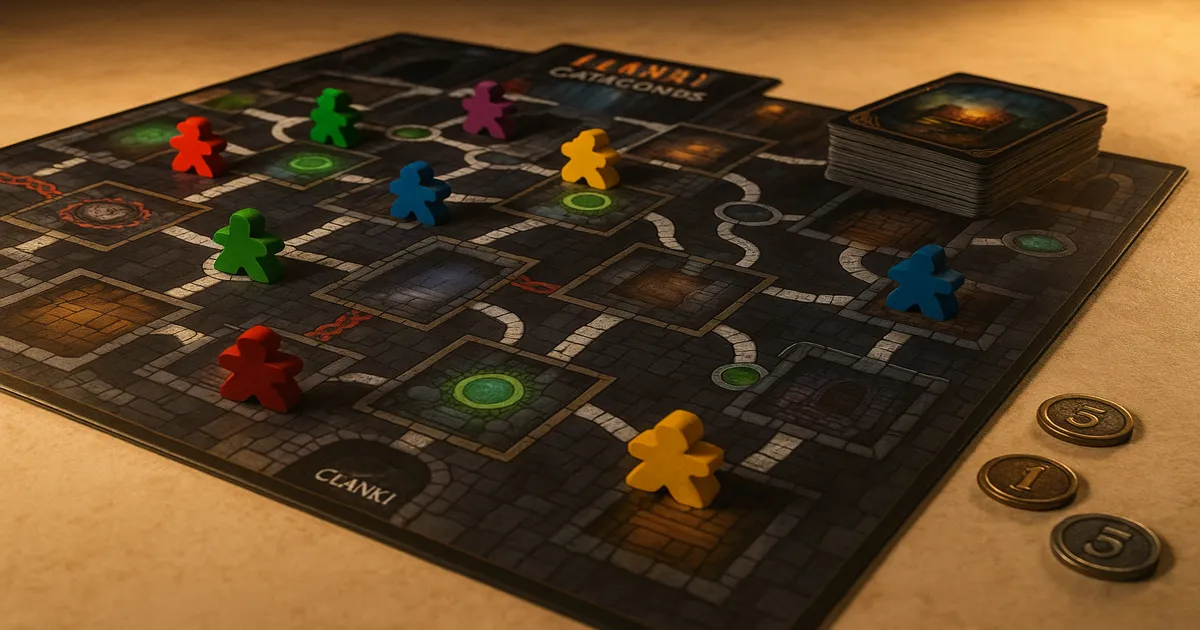
The production quality is genuinely good. Dungeon tiles are thick double-sided cardboard with satisfying heft, and the modular board they create looks impressive once it’s spread out. Fair warning: this dungeon spreads. You’ll want a large table.
Main components:
- Double-sided dungeon tiles (the bulk of the box)
- Fixed starting area board
- Player starting decks: Burgle, Stumble, and Sidestep cards
- Large reserve/market deck
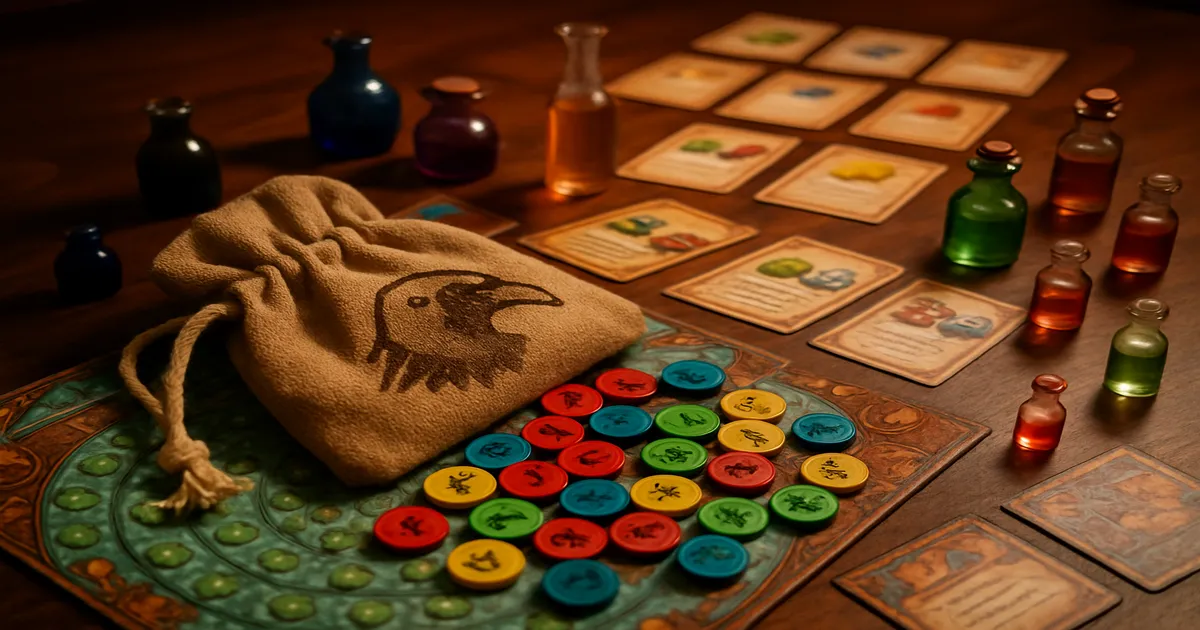
- Cloth dragon bag with colored player cubes and black dragon cubes
- 4 player pawns and individual player boards
- Health tokens, artifact tokens, secret tokens, gold tokens, mastery tokens
- Dragon Rage track board
- Player reference cards
The cards get shuffled constantly and the market deck sees a lot of handling — sleeving them is worth it. (Dragon Shield Matte Perfect Fit)
The box insert is fine but not great. Most regular players end up using bags or a custom organizer to speed up setup, which genuinely makes a difference when you’re staring down a 20-minute teardown.
How to Set Up Clank! Catacombs
Setup takes longer than a fixed-board Clank! game — plan for 15–20 minutes the first time. It gets faster once you know the routine.
Preparing the dungeon: Place the starting area board in the center of the table, then shuffle all dungeon tiles into a face-down draw pile. That pile is your dungeon — none of it exists yet. Place artifact tokens on the designated spots on the starting board; more will appear as tiles are drawn.
Building the dragon bag: Load the cloth bag with the correct number of each player’s colored cubes (check the rulebook for your player count) plus the black dragon cubes. The exact ratio matters — this bag is your damage system for the whole game.
Dealing starting decks: Each player gets an identical starting deck of 10 cards (Burgle, Stumble, and Sidestep in set quantities), shuffles it, and draws five cards for their opening hand. Seed the market row with cards from the reserve deck and you’re ready to go.
How to Play Clank! Catacombs: Turn Structure
This is the part people get wrong most often, so read it carefully.
Step 1 — Play All Five Cards
All of them. Every turn. You can’t hold cards back, even if you don’t want the effects. Each card generates some combination of:
- Skill — spend to buy cards from the market
- Boots — spend to move through rooms
- Swords — spend to fight monsters
- Gold — spend on artifacts or items
- Clank! — generates noise cubes (bad)
Step 2 — Spend Your Resources: Move, Fight, Buy, Explore
Take these actions in any order you like. Moving into an unexplored tile edge means drawing a new dungeon tile and placing it legally — corridors must connect, rooms must align. This is where the game gets spatially interesting and occasionally chaotic.
Step 3 — Resolve Clank! and Add Noise Cubes
Any Clank! symbols you generated this turn go into the Clank! area as cubes of your color. They sit there until an attack sweeps them into the dragon bag.
Step 4 — Refill the Market Row and Trigger Dragon Attacks
Here’s the trigger people miss: dragon attacks fire when a card with the dragon symbol is revealed during market row refill — not at the end of the round. When an attack triggers, a number of cubes equal to the current Dragon Rage track value are drawn from the bag. Each cube of your color means 1 damage to you.
Step 5 — Draw Back Up to Five Cards
Refill your hand from your personal deck. If your deck runs out, shuffle your discard pile and keep drawing.
The Dragon Bag and Depth Line Explained
The dragon bag starts with a mix of your colored cubes, other players’ cubes, and black dragon cubes. Black cubes deal damage to every player simultaneously — they’re the game’s way of punishing everyone when the dungeon gets loud. When cubes are drawn during an attack, only cubes matching your color damage you personally.
The randomness is the point. You might dump a ton of Clank! into the bag and skate through three attacks untouched, or you might add one cube and immediately draw it. That tension is what makes the game work.
The depth line is something new players consistently forget about until it’s too late. Dungeon tiles are organized by depth, and if you’re below the depth line when a dragon attack triggers, you draw additional cubes beyond the normal amount. Being deep in the dungeon is already dangerous. The extra draws can knock you from full health to critical in a single bad attack.
Dragon Rage escalation is the game’s best design feature. The track climbs as the game progresses — early attacks might draw 2–3 cubes, but late-game attacks can draw 7 or more. An attack that felt harmless in round two can be lethal in round six. This creates a natural clock that forces everyone’s hand whether they’re ready or not.
How to Win: Scoring and Escape
You need a major artifact. Not optional, not a bonus — without one, your final score takes a serious hit. Deeper artifacts are worth more points, but getting to them means longer exposure to dragon attacks and a harder escape route. That tradeoff is the central tension of every game.
To escape, move your pawn back to the starting area. Once you’re out, your score is locked in and you collect the escape bonus — it’s worth real points, so factor it into your decision of when to turn back.
If you hit 0 health, you’re rescued, but you only score what you’re already carrying. No escape bonus, no points for anything you hadn’t grabbed yet. You’re not eliminated — you just watch the rest of the game while everyone else makes the same mistakes you did.
Final scoring:
- Artifact value
- Gold collected
- Secret tokens
- Points on purchased cards
- Mastery tokens
- Bonuses from specific card combinations
Highest total wins. Ties are broken by gold.
Common Mistakes New Players Make
- Dragon attacks trigger on card reveal, not end of round. When you flip a dragon-symbol card to refill the market, the attack happens immediately. This catches people off guard constantly.
- The depth line penalty is brutal. New players forget this until they’re suddenly at 2 health wondering what happened.
- Skill doesn’t carry over. Use it or lose it. Whatever Skill you don’t spend this turn is gone.
- All five cards must be played. If a card generates Clank! you didn’t want, tough — add those cubes.
- Escaping without an artifact is a trap. You can do it, but your score will be rough.
- Early attacks feel harmless. They’re not — they’re loading the bag. The dragon gets you later.
Strategy Tips for How to Play Clank! Catacombs Well
Early game: Get deep quickly. Cards that generate multiple Boots are your best early buys. The player who reaches a high-value artifact first has a real advantage. Keep Clank! generation low while your deck is thin — every cube you add increases risk.
Mid game: Commit to a plan. Fast light-artifact run, or deep high-value run — pick one and buy cards that support it. Grab secret tokens when they’re convenient; they’re underrated and experienced players scoop them up while newcomers ignore them.
Late game: Know when to run. This is where most experienced players lose games — they stay one turn too long. Once you have a solid artifact and a reasonable score, start heading out. The escape bonus is worth more than you think, and the dragon gets nastier every turn you delay.
Always: Thin your deck. Cards that remove Stumble and Burgle from your deck dramatically improve consistency. Prioritize them when they appear in the market.
How Clank! Catacombs Compares to Other Clank! Games
| Game | Board Type | Best For |
|---|---|---|
| Clank! (2016) | Fixed | Best entry point, simplest rules |
| Clank! In! Space! (2017) | Fixed | Excellent card pool, sci-fi theme |
| Clank! Legacy: Acquisitions Incorporated (2019) | Fixed + permanent changes | Campaign players, 10-session commitment |
| Clank! Catacombs (2022) | Modular tiles | Best replayability, experienced groups |
Honest take: if you’ve never played Clank!, start with the original or In! Space! — they’re cheaper and the rules overhead is lower. Catacombs is the best version for groups who’ve already fallen in love with the formula and want something that doesn’t get stale.
Similar games worth knowing:
- Quacks of Quedlinburg — shares the push-your-luck bag mechanism in a lighter, faster package
- Dominion — the foundational deck-builder; no dungeon, but essential context for the genre
- Thunderstone Quest — heavier dungeon deck-builder if you want more crunch
Frequently Asked Questions
Do you need to play the original Clank! before playing Clank! Catacombs?
No. Clank! Catacombs is fully standalone and the rulebook doesn’t assume any prior knowledge. That said, if you find the original on sale, it’s worth picking up — the card pool is different and it makes a great lighter option for the same group.
How does the dragon bag work in Clank! Catacombs?
The cloth bag holds colored cubes (one color per player) and black dragon cubes. When you play a card with the Clank! symbol, you add cubes of your color to the Clank! area. When a dragon attack triggers, cubes are drawn randomly from the bag — each cube matching your color deals 1 damage to you, and black cubes hurt everyone. The number of cubes drawn increases as the Dragon Rage track climbs.
Is Clank! Catacombs good with 2 players?
It works at 2, but it’s better at 3–4. With only two players, the dungeon exploration feels a bit lonely and the bag tension is less dynamic — fewer competing colors means attacks feel more predictable. If 2-player is your main count, the original Clank! or Clank! In! Space! might actually suit you better.
What happens if you’re knocked out in Clank! Catacombs?
You’re rescued and removed from the dungeon, but you only score points for items already in your possession at that moment. No escape bonus. You’re not eliminated — you wait out the remaining turns while other players finish, then compare scores at the end.
How long does Clank! Catacombs take to play?
Setup runs 15–20 minutes for new players, closer to 10 once you know the game. Play time is 90–120 minutes at 3–4 players; 2-player games tend to run shorter. A custom insert or labeled component bags cuts setup time significantly.