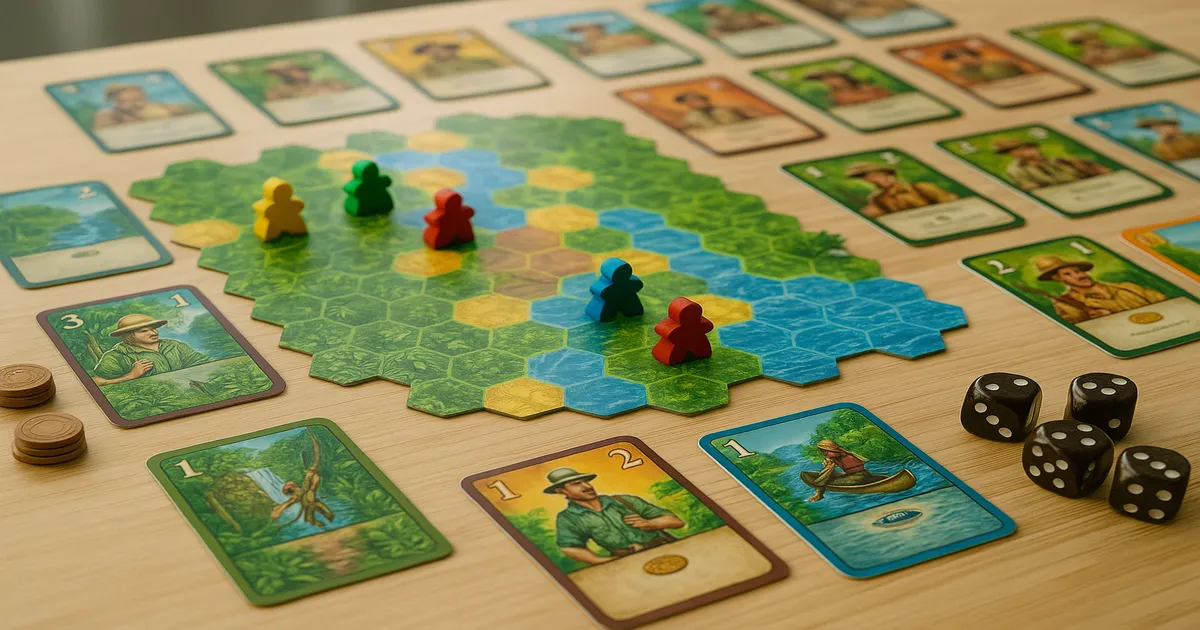
Quick Answer: Quest for El Dorado is a deck-building race game for 2–4 players designed by Reiner Knizia where you build a personal card deck and spend terrain-matching cards to move your explorer across a modular hex-tile board. First player to reach the El Dorado hex wins. It plays in 45–75 minutes, is recommended for ages 10+, and sits at a very approachable BGG weight of 1.9/5.
If you’ve been wondering how to play Quest for El Dorado, here’s the good news: the rules are genuinely simple. Knizia’s whole design philosophy is minimal rules, deep decisions — you can teach this to a non-gamer in about ten minutes, and it earned a Spiel des Jahres nomination in 2017 for exactly that reason. What trips people up isn’t the rulebook. It’s a handful of specific rules that are easy to misread, and a strategic layer that only becomes visible once you’ve played a few times. This guide covers both.
What’s Inside the Box
The Modular Board
There’s no fixed board here — just a collection of thick cardboard hex tiles you arrange into a winding path before each game. You’ve got starting tiles, path tiles in three terrain types (jungle, swamp, desert), and the El Dorado tile at the far end. The rulebook includes several recommended configurations, and the modular system means no two games look quite the same.
Cards: Starting Decks and the Market
Each player starts with an identical 8-card deck — a mix of basic terrain cards and coin cards. The market (called the “Camp”) is a row of face-up card stacks that everyone draws from. What you buy from that market is the central strategic decision of the game.
The iconography is excellent: a leaf for jungle, a water drop for swamp, a sun for desert, and a coin for purchasing. Four symbols, that’s it. You can read the board from across the table without squinting.
Component Quality
Thames & Kosmos editions are well-regarded here. The cards are sturdy, the hex tiles are thick and vibrant, and the whole thing looks inviting on the table. Some players swap the wooden explorer pawns for custom resin figures, (Meeple Source custom painted meeples) but that’s purely cosmetic.
Game Setup
Building the Board
For your first game, use the beginner configuration from the rulebook — it’s clearly labeled and takes about five minutes to lay out. Tiles connect end-to-end to form a winding path. Place barrier tokens on the designated hexes as shown, and the El Dorado tile goes at the far end.
Preparing the Market
Sort the market cards into their stacks and lay them out in a row where everyone can reach them. Each stack shows a face-up card — that’s what’s available to buy. When a stack runs out, it’s gone for the rest of the game. Popular cards disappear fast, so don’t sleep on them.
Dealing Starting Decks
- Give each player an identical 8-card starting deck.
- Each player shuffles and draws 4 cards.
- Determine a starting player (any method works — the rulebook suggests the most recent jungle explorer).
- Play proceeds clockwise.
How to Play Quest for El Dorado: Turn Structure
Phase 1: Play Your Cards
Play any cards from your hand face-up. Each card shows terrain symbols, coins, or both. You’re generating movement points and purchasing power for this turn.
Phase 2: Move Your Explorer
Spend terrain-specific movement points to advance across hex tiles. This is the rule that catches people out: movement points are terrain-specific. Jungle cards only move through jungle hexes. Desert cards only move through desert hexes. You can’t mix and match, and unspent movement points are lost at the end of your turn — no banking.
You can move multiple hexes in one turn if you have enough matching cards, and you can cross multiple terrain types if you’ve got the right cards for each.
Phase 3: Buy One Card from the Market
You may buy exactly one card per turn by spending coin symbols. Purchased cards go straight to your discard pile — they won’t appear in your hand until your deck cycles. You can skip buying entirely if nothing useful is available.
Phase 4: Discard and Draw Back Up to Four
Discard everything — played cards, unplayed cards, all of it. Draw 4 new cards. If your draw pile is empty, shuffle your discard pile into a new one first. The first player to land on the El Dorado hex wins immediately.
Barrier Tiles and Special Cards
How Barrier Tiles Actually Work
This is the most commonly misread rule, so I’ll be blunt: a barrier requires a single card that meets or exceeds the barrier’s value — not a combination of cards adding up to it. A “Jungle 3” barrier needs one card showing 3 jungle symbols. Three separate 1-symbol cards won’t cut it.
Plan for barriers early. If you’re approaching a high-value barrier without the right card in your deck, buy it now — not two turns from now.
Special Cards Worth Knowing
Multi-terrain cards like the Adventurer are the most flexible cards in the game. An Adventurer can be used as any terrain type, which makes it invaluable at terrain transitions and barrier tiles. New players consistently undervalue these. Honestly, the Adventurer is the best single card in the base game market — if it’s available and you don’t have one, you probably want it.
Blocking
Only one explorer can occupy a hex at a time. In narrow corridors, this creates real blocking opportunities. Parking your explorer in a chokepoint can cost your opponent multiple turns. In 2-player games especially, deliberate blocking is a legitimate — and often decisive — tactic.
Common Mistakes New Players Make
Rules mistakes:
- Buying multiple cards per turn. You get one.
- Treating movement as universal. Jungle cards don’t cross deserts.
- Banking movement. Unspent movement is gone when your turn ends.
- Misreading barrier tiles. Single card, not a combination.
- Forgetting to draw back to 4. Sounds trivial, happens constantly.
Strategic mistakes:
- Over-buying cheap cards. Every card you buy stays in your deck permanently — there’s no deck-thinning in the base game. A bloated deck of 20 weak cards is much slower than a lean deck of 12 strong ones.
- Ignoring the market entirely. Some new players just run their starting deck and wonder why they fall behind. Buying well is how you win.
- Buying cards that don’t match upcoming terrain. Study the board before you buy anything. Stocking up on desert cards when the path ahead is mostly jungle is a mistake you’ll feel for the rest of the game.
How to Win Quest for El Dorado: Strategy Tips
Early Game: Read the Board First
Before you buy anything, look at the full board layout. Count the hexes by terrain type. Find the barriers and note what value they require. This takes thirty seconds and shapes every purchase decision you make. Don’t neglect coins either — coin-generating cards early let you buy better cards sooner, and that compounds.
Mid Game: Match Your Deck to What’s Coming
As you move through the board, shift your purchasing focus toward upcoming terrain. If a long swamp section is three or four turns away, start buying blue cards now — they’ll cycle into your hand by the time you need them. Save your flexible multi-terrain cards for bottlenecks, not easy single-terrain stretches where a basic card would do the same job.
Late Game: Stop Buying
When you’re 4–5 hexes from the finish, stop buying cards. Seriously. Any purchase at that point just dilutes your hand when you need clean, efficient movement. Some experienced players build what I’d call a “sprint deck” — a focused set of cards almost entirely in one terrain type that dominates the board’s final section. If the endgame is mostly jungle, a fast-cycling jungle deck is nearly unstoppable.
The Core Principle
Every unnecessary card you buy dilutes your draws. Treat each purchase as a permanent commitment, because it is. Tempo matters too — falling 6–8 hexes behind is very hard to recover from, so don’t sacrifice movement chasing cards that won’t pay off in time.
Quest for El Dorado vs. Similar Games
vs. Dominion
| Feature | Quest for El Dorado | Dominion |
|---|---|---|
| Victory Condition | Racing (positional) | Points accumulation |
| Board | Modular hex tiles | None |
| BGG Weight | ~1.9/5 | ~2.3/5 |
| Play Time | 45–75 min | 30–60 min |
| Best For | Families, gateway gamers | Deck-building purists |
Dominion is the genre’s founding text and worth playing eventually, but El Dorado is the better starting point for most people. The racing format gives you a clear narrative — you always know who’s winning and why, which matters a lot when you’re playing with newer gamers.
vs. Clank!
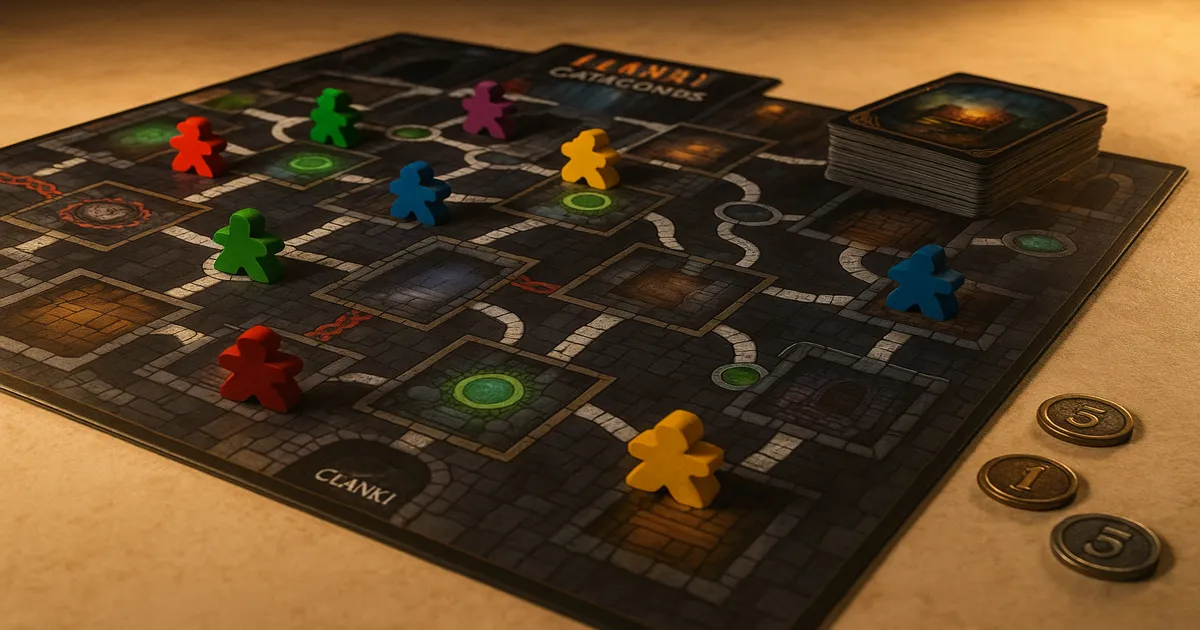
Clank! (2–4 players, 60–90 minutes, BGG weight 2.4/5) is the natural next step after El Dorado. It’s more complex, more chaotic, and has higher player interaction — a dungeon delve where noise attracts a dragon that damages everyone. If you’ve played El Dorado a dozen times and want more crunch, Clank! is the move. (Clank! A Deck-Building Adventure)
Other Games Worth Considering
- Ticket to Ride — Similar accessibility, route-building instead of deck-building, great for the same audience
- Star Realms — Faster, more combative two-player deck-builder if you want something quicker
- Thunderstone Quest — Heavier deck-building with dungeon exploration; a clear step up in complexity
Expansions: What to Add After the Base Game
The Golden Temples is the one to buy first. It adds new terrain types and cards that slot cleanly into the base game without overwhelming it. After that:
- Heroes & Hexes — Adds asymmetric hero characters with unique abilities, which changes the dynamic considerably
- Dangers & Demons — Introduces obstacle mechanics and new card types
- The Fountain of Youth — New map tiles and cards, mostly for extending replayability
Get comfortable with the base game across five or six plays before adding anything. The base game alone has enough board configurations to stay fresh for a long time.
Frequently Asked Questions
How many cards do you draw per turn in Quest for El Dorado?
You always draw back up to 4 cards at the end of your turn, after discarding everything. If your draw pile runs out mid-draw, shuffle your discard pile into a new draw pile and keep drawing.
Can you buy more than one card per turn?
No — exactly one card per turn, or skip buying entirely. This is one of the most commonly broken rules in casual play, so it’s worth clarifying before the game starts.
How do barrier tiles work?
A barrier requires a single card whose value meets or exceeds the threshold — not multiple cards adding up to it. A “Jungle 3” barrier needs one card showing 3 jungle symbols. Three 1-symbol cards won’t break it.
Is Quest for El Dorado good for 2 players?
Yes, it works really well at 2. The blocking mechanic becomes more deliberate and tactical with fewer people on the board, and the race feels more personal. It’s honestly one of my preferred player counts.
What’s the best first expansion?
The Golden Temples. It adds new terrain and cards that integrate smoothly without significantly increasing complexity — the most seamless expansion and the one most often recommended as the natural next step.