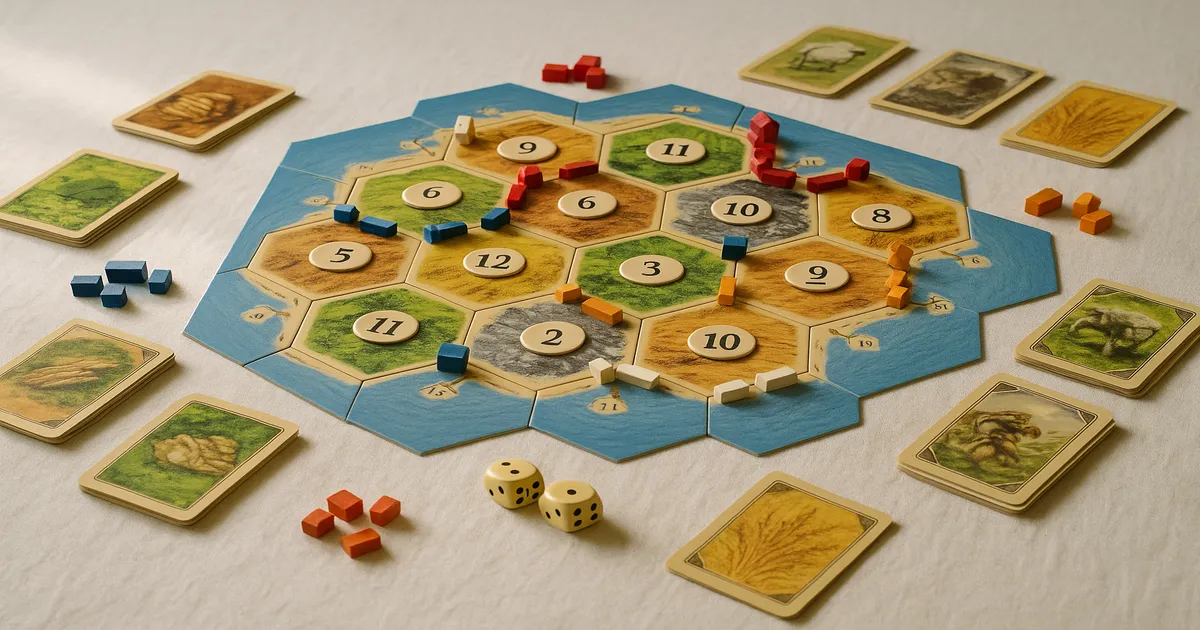
Quick Answer: Catan is a 2–4 player resource-trading game where you build settlements and cities on a modular hex island, collect resources when the dice roll your numbers, and race to reach 10 Victory Points first. Games run 60–120 minutes, the complexity sits around 2.3/5, and you can teach the rules in about 10–15 minutes.
Catan is one of those games almost everyone has heard of — and for good reason. Learning how to play Catan is genuinely easy, but there’s enough strategic depth to keep you replaying that opening placement in your head on the drive home. Designed by Klaus Teuber and first published in 1995 by Kosmos (and later licensed to Mayfair Games in North America, now published by Asmodee), it’s sold over 32 million copies across 40+ languages and won the Spiel des Jahres in 1995. Not bad for a game about trading sheep.
What Is Catan?
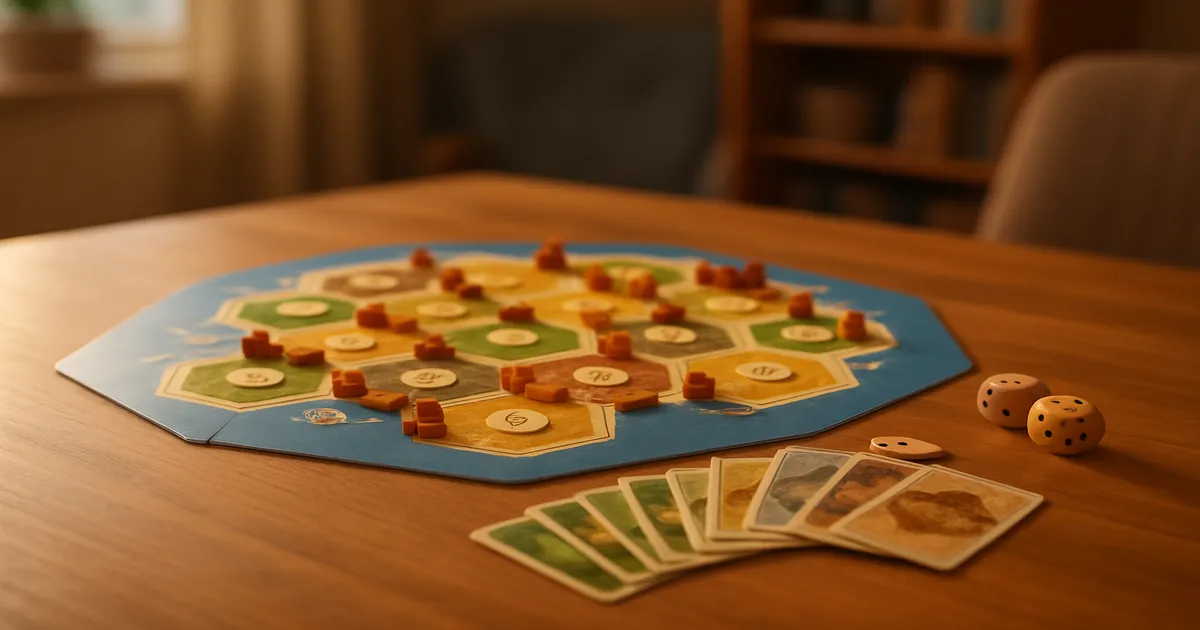
You’re a settler colonizing the island of Catan — a fictional landmass assembled from hexagonal terrain tiles. Every game produces a different island, which means the strategic landscape shifts each time you sit down. You’ll build roads to expand, settlements and cities to generate income, and trade resources with your opponents to fill the gaps your own production can’t cover.
Catan matters historically because it changed what mainstream Western board games could look like. Before it, most were trivia-based or pure luck. Catan brought the German-style “Eurogame” sensibility — meaningful decisions, player interaction, no player elimination — to a mass audience. It’s the game that introduced millions of people to hobby gaming, and it still does that job better than almost anything else on the shelf.
What’s in the Box
The standard edition includes everything you need for 2–4 players: (Catan Base Game)
- 19 terrain hexes — Forest, Hills, Pasture, Fields, Mountains (3–4 of each), and one Desert
- 6 sea frame pieces that border the board
- 9 harbor tokens (a mix of 2:1 specific-resource and 3:1 general)
- 18 number tokens (marked 2–12, labeled A–R for setup)
- 95 resource cards across five types: Lumber, Brick, Wool, Grain, Ore
- 25 development cards (Knights, Progress cards, Victory Point cards)
- 4 sets of player pieces — 5 settlements, 4 cities, and 15 roads per player
- 2 six-sided dice, 1 Robber pawn, reference cards, and the Longest Road/Largest Army bonus cards
Component quality is solid. The hex tiles are thick and well-illustrated, the plastic pieces have a satisfying weight, and the modular board looks genuinely impressive on the table. The resource cards are standard cardstock — if you play regularly, sleeve them.
One detail worth knowing: the 6 and 8 number tokens are printed in red. That’s intentional — they’re the most frequently rolled numbers, and the color coding is a constant visual reminder of their value during play.
How to Set Up Catan
Board Assembly
- Connect the six sea frame pieces into a ring.
- Randomly place the 19 terrain hexes inside the frame.
- Distribute the number tokens using the A–R spiral system printed in the rulebook (or randomly, if your group prefers — experienced players often skip the spiral).
- Place harbor tokens on the designated frame spots.
- Put the Robber pawn on the Desert hex.
Starting Placement: The Most Important Decision in the Game
Each player places two settlements and two roads using a reverse snake draft: players go 1→2→3→4, then 4→3→2→1. Whoever goes last in round one places twice in a row — a real advantage.
This opening placement is arguably the single most impactful decision you’ll make. My strong advice: prioritize diversity over concentration. You want access to as many of the five resource types as possible across your two settlements, even if that means accepting slightly lower-probability numbers. A player locked out of Ore early will struggle to build cities all game.
How a Turn Works
Roll the Dice and Collect Resources
Every turn opens with a dice roll. Every player — not just the active player — collects one resource card for each settlement adjacent to a hex showing that number, and two cards for each city. This is what keeps non-active players engaged: everyone cares about every single roll.
Trade
The active player can trade with anyone at any mutually agreed ratio. Bank trades default to 4:1 (four of any one resource for one of anything else), but harbors improve that rate. A 3:1 harbor lets you trade any three identical resources, and a 2:1 harbor on a specific resource type is a genuine economic edge if you’re producing that resource consistently.
Build or Buy
Spend resources to build. Here’s the cost breakdown:
| Build Action | Cost |
|---|---|
| Road | 1 Lumber + 1 Brick |
| Settlement | 1 Lumber + 1 Brick + 1 Wool + 1 Grain |
| City (upgrades a settlement) | 3 Ore + 2 Grain |
| Development Card | 1 Ore + 1 Wool + 1 Grain |
You can build multiple things in a single turn as long as you can afford them.
Rolling a 7: The Robber
Rolling a 7 doesn’t produce resources. Instead:
- Any player holding more than 7 resource cards must immediately discard half (rounded down). This catches people off guard constantly — don’t hoard.
- The active player moves the Robber to any terrain hex, blocking production there until it moves again.
- The active player steals one random card from a player with a settlement or city adjacent to the Robber’s new location.
Knights from the development deck also trigger the Robber, which makes them more useful than they first appear.
How to Win Catan
First to 10 Victory Points on their own turn wins — the game ends immediately, no last round for anyone else.
Ways to score:
- Each settlement = 1 VP
- Each city = 2 VP (replaces the settlement it upgrades)
- Longest Road bonus = 2 VP (minimum 5 consecutive road segments)
- Largest Army bonus = 2 VP (minimum 3 Knights played, more than anyone else)
- Victory Point development cards = 1 VP each, revealed only when winning
Both Longest Road and Largest Army can be stolen. If you hold Longest Road with 6 segments and an opponent builds 7, they take the card and your 2 VP go with it. These swings can flip a game in one turn, so always know where your opponents stand.
Keep your Victory Point cards hidden. There’s no rule against revealing them early, but it just tells everyone exactly how close you are. Don’t do it.
Catan Strategy Tips
Diversify your starting resources. I’ve watched players lose games entirely because they couldn’t produce Brick or couldn’t produce Grain. Your second settlement doesn’t need to be near your first — treat it as a separate production engine covering whatever your first one misses.
Chase high-probability numbers. Two dice produce a bell curve. 7 is the most common result (but triggers the Robber), followed by 6 and 8 — each with five ways to roll them out of 36 combinations. Then 5 and 9. A settlement on a 6 will produce far more often than one on a 3 or 11.
Pick a victory path and commit. The three main routes are Longest Road, Largest Army, and city/settlement expansion. Chasing all three simultaneously spreads you too thin. In my experience, cities are underrated — upgrading settlements is usually more efficient than placing new ones once you have three or four on the board.
Trade from surplus, and create competition. Never hand an opponent the resource they need to win on their next turn — always run a quick mental check before agreeing to anything. When you want something, offer the trade to multiple players at once. Competition between sellers works in your favor.
Use the Robber politically. Targeting the leader creates table dynamics that benefit you and opens doors for negotiation. Other players will often trade more favorably with you if you’re keeping the leader in check.
Common Mistakes New Players Make
Forgetting to discard on a 7. The most frequently missed rule in the game. If you’re holding 8+ cards when a 7 hits, you discard half immediately — before the Robber moves. Keep your hand lean.
Clustering starting settlements. Both settlements near one resource type feels safe but creates a bottleneck you’ll fight all game. Diversity beats concentration almost every time.
Not trading enough. Catan is a trading game. Players who hoard and refuse to negotiate slow themselves down and frustrate everyone else at the table.
Misreading harbors. A 2:1 harbor only applies to one specific resource type. The 3:1 harbor applies to any resource. They’re not interchangeable.
Aimless road-building. Roads are cheap, which makes them feel low-stakes. But unless you’re chasing Longest Road, burning Lumber and Brick on roads you don’t need is a real cost.
Expansions and What to Try Next
Official Catan Expansions
Seafarers adds ships and island exploration. Low added complexity, great for groups who love the base game and want more of it.
Cities & Knights introduces commodities, city improvements, and a barbarian invasion mechanic. It’s significantly heavier than the base game — this is a different experience, not just “more Catan.” If your group bounced off Catan because it felt too light, try this one.
Traders & Barbarians is scenario-based with several different gameplay modes — good variety for groups that want something fresh without fully committing to Cities & Knights.
5–6 Player Extension does exactly what it says. Games run longer and the trading gets chaotic in the best way.
Games to Play After Catan
| Game | Why It Fits |
|---|---|
| Ticket to Ride | Route-building, less negotiation, slightly simpler |
| Carcassonne | Lighter, faster (~45 min), great tile-placement gateway |
| Wingspan | Engine-building, minimal conflict, excellent components |
| Chinatown | If you love Catan’s trading and want it as the whole game |
| Concordia | The natural next step — resource management without dice luck |
Frequently Asked Questions
What happens when you roll a 7 in Catan?
Rolling a 7 triggers the Robber instead of producing resources. Any player holding more than 7 resource cards must immediately discard half (rounded down). The active player then moves the Robber to any terrain hex, blocking its production, and steals one random resource card from a player adjacent to the Robber’s new location.
How many Victory Points do you need to win Catan?
10 Victory Points, reached on your own turn. The game ends immediately — there’s no last round for other players to catch up.
How do harbors work in Catan?
A 3:1 harbor lets you trade any three identical resources for one of anything. A 2:1 harbor is tied to a specific resource type and lets you trade just two of that resource for one of anything else. You can only use a harbor if you have a settlement or city on one of its two adjacent coastal intersections.
Can you trade Development Cards with other players?
No. Development Cards can’t be traded or given away — they’re personal and can only be used by the player who drew them.
How does Longest Road work?
The Longest Road bonus (2 VP) goes to the first player who builds a continuous road of at least 5 segments. It can be stolen if another player builds a longer continuous road. The game measures the longest unbroken path through your network, not your total road count. Opponents can break your road by placing a settlement on a junction in the middle of it.