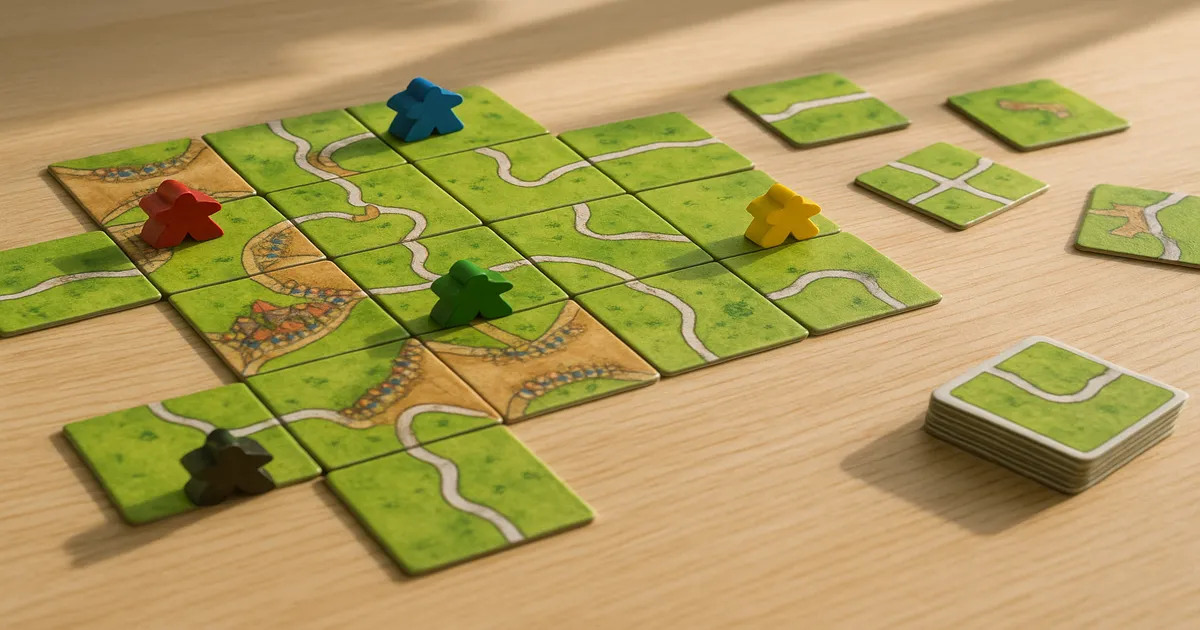
Quick Answer: Carcassonne is a tile-placement game for 2–5 players where each turn you draw a tile, place it so edges match, optionally place a meeple to claim a feature, and score anything that completes. Games run 30–45 minutes once everyone knows the rules, it clicks within one round, and it won the Spiel des Jahres in 2001 for good reason.
If you’re looking for a how to play Carcassonne video walkthrough, the embedded video above covers the full turn structure visually. Everything below gives you the written detail to back it up — rules, strategy, common mistakes, and all the farmer scoring confusion sorted out.
How to Play Carcassonne: The Core Loop
Every turn follows the same four steps:
- Draw a tile from the face-down stack
- Place it legally — every touching edge must match (road to road, city to city, field to field)
- Optionally place a meeple on a feature of that tile
- Score any features that just completed
That’s the whole game. Repeat until the tiles run out.
Carcassonne (2–5 players, 30–45 minutes, BGG weight 1.89/5) is about as accessible as modern board games get. You’re building a shared medieval landscape tile by tile, and your little wooden figures — meeples — claim cities, roads, and fields to score points. Most points wins.
One thing worth knowing upfront: farmer scoring happens only at the end of the game and is often the single biggest scoring event of the whole session. New players ignore it. Experienced players win with it.
What’s in the Box
Designed by Klaus-Jürgen Wrede and first published in 2000, Carcassonne is set in the medieval landscape of southern France — the region surrounding the famous walled city of the same name. The second edition base game includes:
- 72 land tiles (one starting tile with a distinctive dark back)
- 40 wooden meeples in 5 colors (8 per player)
- 1 scoreboard that wraps around the play area
- 1 rulebook
- Some editions include The River expansion (12 tiles) as a built-in intro module
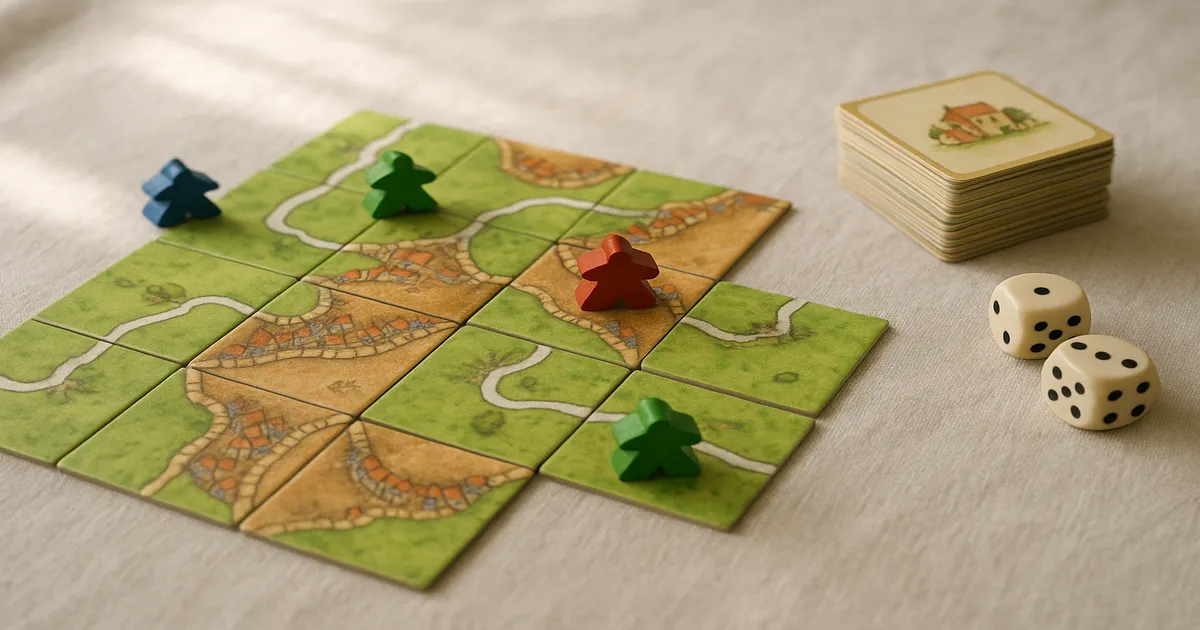
The tile art is clean and functional — you can read a tile’s features at a glance, which matters when you’re quickly checking legal placement. A finished five-player game looks genuinely lovely on the table, like a patchwork medieval map.
Bonus trivia: the word meeple was coined specifically in relation to Carcassonne. A player named Alison Hansel reportedly combined “my” and “people” to describe the wooden figures, and the term stuck so hard it’s now universal hobby vocabulary. It started here.
Turn Structure: Step by Step
Step 1 – Draw a Tile
Flip a tile face-up from the stack. Whatever you drew is what you’re working with — there’s no hand of tiles, no choice. Adapting to what you get is half the game.
Step 2 – Place the Tile Legally
Place your tile adjacent to any tile already on the table. Every touching edge must match its neighbor: road to road, city wall to city wall, green field to green field. If a tile genuinely has no legal placement anywhere on the board, discard it — this is rare but it does happen.
Step 3 – Place a Meeple (Optional)
After placing your tile, you may place one meeple from your supply onto a feature of that tile. The key restriction: you cannot place a meeple on a feature that already contains any meeple — yours or anyone else’s. You can only ever place on the newly drawn tile, and only on features that aren’t yet connected to occupied segments.
This is where most new player mistakes happen. Burn it into memory now.
Step 4 – Score Completed Features Immediately
The moment a feature closes, score it and return all meeples on it to their owners. Don’t wait until the end of the round — score immediately, every time.
- Completed city: 2 points per tile + 2 points per pennant (the shield icons on some city tiles)
- Completed road: 1 point per tile
- Completed monastery: 9 points flat (the monastery tile itself plus all 8 surrounding tiles filled)
Getting meeples back is just as valuable as the points. A meeple stuck in an unfinished city is a meeple that can’t score you anything new.
End Game Scoring
Incomplete Features
When the last tile is placed, everything still on the board scores at reduced rates:
- Incomplete cities: 1 point per tile + 1 point per pennant
- Incomplete roads: 1 point per tile
- Incomplete monasteries: 1 point per tile present (the monastery itself plus however many surrounding tiles exist)
Half-built cities hurt. Leaving a large city open late in the game is a genuine strategic risk, not just a minor inefficiency.
How Farmer Scoring Works
Farmers are meeples placed flat in a field (the green areas) rather than standing upright on a road or city. They never return during the game — once placed, a farmer stays until final scoring.
At game end, each field is evaluated. For every completed city that a field touches, the player with the most farmers serving that field scores 3 points per completed city (2nd edition rules). If you’re using an older rulebook, be aware the 1st edition used a different calculation — this is one of the most common sources of confusion in the game.
I’ve seen farmer scoring swing games by 20+ points. A player who quietly placed two farmers in a sprawling central field while everyone else raced to finish cities will often win going away. Don’t ignore it.
Determining the Winner
Highest total score wins. Ties are rare given the scoring granularity, but if they happen, tied players share the victory.
Common Mistakes New Players Make
Meeple placement errors. The most common mistake is trying to place a meeple on a feature that’s already occupied. You can’t do it directly. What you can do is connect your separate tile segment to an occupied feature through clever tile placement — which is actually a powerful tactic, not a mistake.
Forgetting to score immediately. Score the moment a feature closes. Forgetting to return meeples is even worse — it artificially starves you of pieces for the rest of the game.
Misunderstanding farmer rules. Farmers lie flat (visual cue that they’re different). They never return during play. Fields can connect across many tiles — a farmer placed early can end up serving six or more completed cities by game end.
A few other slip-ups worth flagging:
- The starting tile has a dark back and goes down first, face-up, before play begins. Don’t shuffle it into the stack.
- Monastery scoring requires all 8 surrounding tiles filled for the full 9 points. Not 7. Not “mostly surrounded.”
- Unplaceable tiles get discarded. The official rule isn’t “draw again” — though plenty of groups house-rule it otherwise.
Strategy Tips for Winning at Carcassonne
Manage your meeples. Your seven meeples are your most important resource. New players consistently lose because they scatter meeples across slow-to-complete features and then can’t claim anything new. Complete things early, get meeples back, keep your supply fluid.
Don’t sleep on roads. Roads complete fast, return meeples quickly, and carry low risk. A few well-placed road meeples early will keep you scoring consistently while other players wait on their cities.
The meeple merger is the move. This is what separates players who’ve read the rules from players who actually understand the game. If an opponent has a meeple in a large, valuable city, you can place your own meeple in a separate city segment and then play tiles that connect the two segments. Now you both share the feature — and share the points when it completes. Used offensively, it dilutes your opponent’s scoring. Used defensively, it lets you piggyback on cities you couldn’t have built alone. It’s the most elegant interaction in the game.
Track the tile distribution late. There are only so many tiles that close a four-sided city or extend a particular road. When the stack is running low, you can make better decisions about whether to keep investing in a feature or cut your losses. Monasteries in the center of the board complete much more reliably than ones placed near corners or edges.
How Carcassonne Compares to Other Gateway Games
Carcassonne vs Kingdomino — Kingdomino (2–4 players, 15 minutes, BGG weight 1.26/5) is a simpler tile-placement puzzle with no meeples and no area control. Great for younger kids or very casual groups, but there’s less interaction and less depth. Think of it as Carcassonne’s little sibling.
Carcassonne vs Ticket to Ride — Ticket to Ride (2–5 players, 45–75 minutes, BGG weight 1.86/5) uses a fixed board and card drafting rather than tile drawing, which makes it feel more structured and less chaotic. Carcassonne has more emergent interaction; Ticket to Ride has cleaner long-term planning. Both are excellent — they scratch different itches.
What makes Carcassonne stand out is the combination: a shared landscape you build together, meeple merging that creates real player interaction without direct conflict, and meaningful scaling from 2 to 5 players. Add over a dozen expansions for when the base game starts feeling familiar, and you have something that can grow with you for years.
If you want to protect your tiles from wear, especially with repeated plays, a set of square card sleeves is worth considering.
Frequently Asked Questions
How does farmer scoring work in Carcassonne?
At game end, each field scores 3 points (2nd edition rules) for every completed city it touches. The player with the most farmers in a field claims those points; ties result in shared scoring. Farmers never return during the game, so placing one is a long-term commitment — but it’s often the largest single scoring event of the whole session.
Can you play Carcassonne with 2 players?
Absolutely, and it’s a legitimately different experience — tighter, more tactical, more directly confrontational. The meeple merger becomes a sharper weapon, and every tile placement carries more weight. Many players actually prefer it at two. The rules don’t change; you just each have more meeples relative to the tiles in play.
How long does a game of Carcassonne take?
A two-player game typically runs 30–35 minutes once both players know the rules. A full five-player game can stretch to 60 minutes, especially with new players. First-time games with teaching time usually land around 45–60 minutes regardless of player count.
What’s the best Carcassonne expansion for beginners?
Inns & Cathedrals is the standard first recommendation. It adds a second large meeple and modifies city and road scoring in ways that deepen strategy without adding much complexity. Most experienced players consider it a near-essential addition to the base game.
Is Carcassonne good for kids?
Yes, for kids around 7 and up. The tile-matching mechanic is intuitive, the meeple placement is tactile and satisfying, and games don’t overstay their welcome. Younger kids may struggle with farmer scoring strategy, but you can skip that rule for the first few games and introduce it once the basic loop feels comfortable.