Quick Answer: Cascadia Rolling Rivers is a roll-and-write spin-off of the Spiel des Jahres 2022-winning Cascadia, set in the Pacific Northwest. Each turn, dice or cards reveal options that all players act on simultaneously — everyone marks their own sheet to route rivers and place wildlife. It plays in 20–40 minutes, supports up to six players, and is lighter and faster than the base game, making it one of the friendliest entries in the Cascadia family.
If you want to learn how to play Cascadia Rolling Rivers, here’s the good news: the core loop is dead simple. Generate options, pick one, mark your sheet, repeat. The interesting part is how those choices stack up across a full game. Below is a complete breakdown of the rules, scoring, strategy, and how Rolling Rivers compares to its tile-laying big sibling.
Game Overview: What Is Cascadia Rolling Rivers?
The Cascadia Family
Cascadia was designed by Randy Flynn, published by Flatout Games in partnership with AEG, and released in 2021. It won the Spiel des Jahres in 2022 — the most prestigious award in tabletop gaming — and it earned it. The game nails that rare balance between being easy to teach and genuinely interesting to play. Rolling Rivers joins a growing family that includes Cascadia: Landmarks and various scoring card packs.
Roll-and-write spin-offs of beloved games are having a real moment right now (Wingspan: Nesting is another good example), and Rolling Rivers fits that trend perfectly: same Pacific Northwest theme, same satisfying scoring system, but faster and more portable.
Theme and Setting
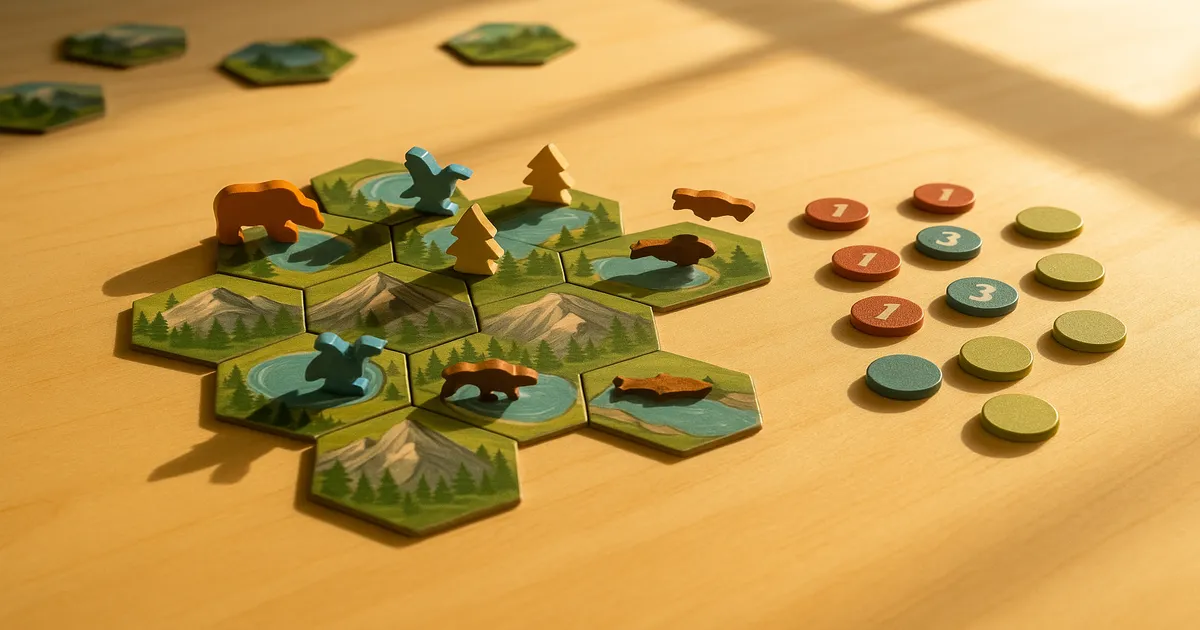
You’re still deep in Pacific Northwest wilderness — old-growth forest, salmon runs, elk grazing at dusk. The “Rivers” subtitle does real thematic work: routing waterways across your personal sheet is central to the game, and the wildlife (bears, elk, salmon, hawks, foxes, and butterflies) that made the base game so charming all return.
Player Count, Play Time, and Complexity
- Players: 1–6
- Play time: 20–40 minutes
- BGG weight: ~1.5/5
The simultaneous play structure means six players takes about the same time as two. That’s genuinely rare, and it makes Rolling Rivers a strong pick for larger groups where other games would start to drag.
Components: What’s in the Box?
Player Sheets and Writing Tools
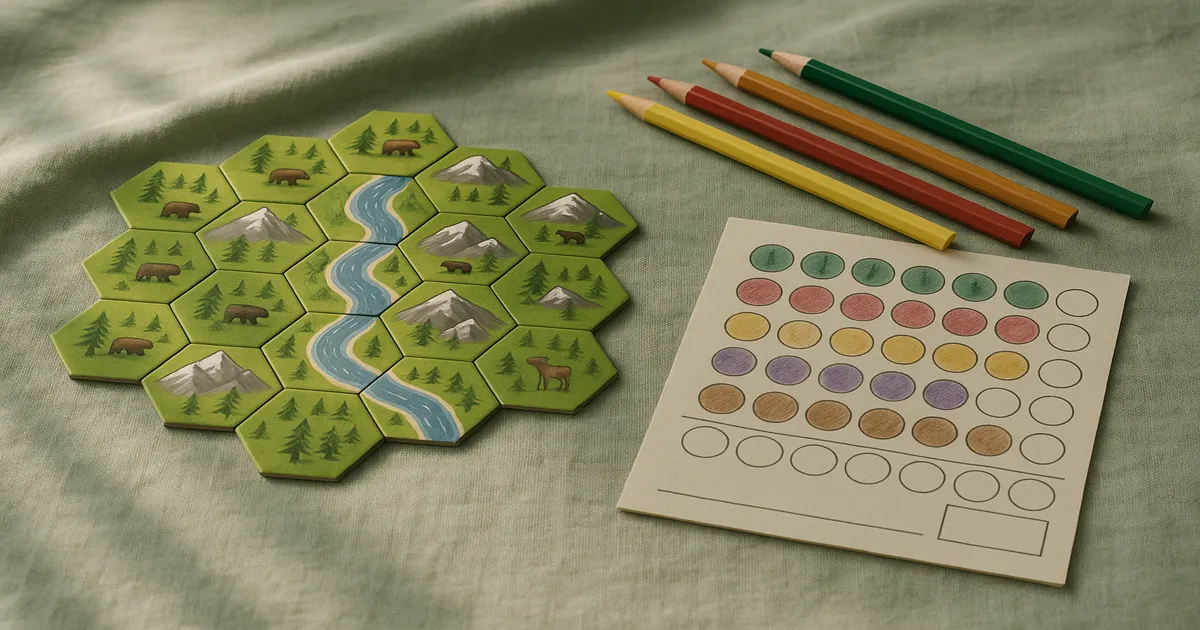
Each player gets a personal sheet — typically a pad of paper sheets, with a dry-erase board option in deluxe editions. Your sheet is your entire game: it holds your river network, your wildlife placements, and your scoring regions.
Dice and Scoring Cards
Custom dice drive the action each round, featuring habitat and wildlife iconography tied to the Pacific Northwest theme. Scoring cards — one per wildlife type — are selected during setup and define what patterns earn points. This is the variable setup system inherited from the base game, and it’s what keeps Rolling Rivers replayable over dozens of sessions.
Art and Production
Flatout Games has a genuine reputation for beautiful production, and the naturalistic Pacific Northwest artwork carries over from the base game. Roll-and-writes can feel like afterthoughts in terms of physical presentation, but this one punches well above average for the format.
Setup
Before anything else, select one scoring card per wildlife type. These cards define how each animal scores — and reading them before the game starts isn’t optional, it’s the single most important prep step. I’ve watched players spend an entire game placing hawks in rows when the active card rewards clusters. Don’t be that person.
Once cards are chosen:
- Give each player a sheet and a pencil.
- Place the shared dice or card deck within easy reach.
- Read all active scoring cards aloud together — even experienced players benefit from a quick recap.
- Since play is simultaneous, there’s no seating order to sort out.
That’s genuinely it. Setup takes maybe two minutes, which is a big part of the appeal.
How to Play Cascadia Rolling Rivers: Turn-by-Turn Rules
Step 1 — Roll or Reveal
At the start of each round, dice are rolled (or cards flipped) to reveal the available options. All players see the same results — this shared information is what makes simultaneous play work without any chaos.
Step 2 — Choose
Each player independently picks from the available options. You might be choosing a habitat type to mark, a wildlife symbol to place, or both. The tension is real: what’s best for your sheet might be completely different from what your neighbor needs, even though you’re both looking at identical options.
Step 3 — Mark Your Sheet
Once you’ve chosen, mark your sheet. This might mean:
- Drawing a river segment to extend your connected network
- Placing a wildlife symbol in a habitat region
- Filling a habitat area to work toward coverage bonuses
Adjacency matters. Wildlife generally needs to go in the correct habitat type, and river segments need to connect to existing routes. You can’t scatter marks randomly and hope they link up later — that’s a trap new players fall into constantly.
Step 4 — End of Round
After everyone marks their sheet, the round ends and a new one begins. The game ends when a trigger condition is met — typically a filled sheet, an exhausted deck, or a set number of rounds. Check your rulebook for the exact trigger.
Scoring in Cascadia Rolling Rivers
River Network Scoring
Your connected river network scores based on length or completeness. A single long connected path outscores several short disconnected ones, so fragmented rivers are a real liability. Every time you mark an isolated segment thinking “I’ll connect it later,” you’re gambling with your score.
Wildlife Pattern Scoring
This is where most of your points come from. Each wildlife type scores according to its active scoring card — adjacency clusters, rows, specific configurations. Wildlife scoring dominates in the Cascadia family, so don’t neglect it while you’re busy routing rivers.
Habitat Coverage and End-Game Bonuses
Fully covering habitat regions earns bonus points, and there may be end-game objectives rewarding specific accomplishments. A rough final tally might look something like: 14 points from your river network + 22 from wildlife patterns + 6 from habitat bonuses + 4 from end-game objectives = 46 total. Exact point values will be in your rulebook.
Strategy Tips for Cascadia Rolling Rivers
Plan Your River Network Early
Anchor your river from the fixed starting points on your sheet and plan outward. Branches give you flexibility; a single linear path is fragile. If you can think two turns ahead and keep your network connectable, you’ll score significantly better than players who just react turn by turn.
Read the Scoring Cards — Seriously
Read them before turn one. Then cluster your wildlife deliberately. Watch for the salmon-river synergy specifically: if salmon score based on proximity to river tiles, routing your river through salmon-heavy areas earns double duty from the same placements.
Commit in the Mid-Game
Early game, keep your options open. Mid-to-late game, commit. Players who struggle are usually the ones who hedge all the way to the final rounds and end up with half-finished patterns everywhere. Pick your two or three best scoring paths by round four or five and go hard on them.
Know When to Pivot
Track your running score. If a scoring path clearly isn’t coming together by the midpoint, cut your losses and pivot — don’t throw good placements after bad just because you’ve already invested in a direction. The sunk cost fallacy hits hard in roll-and-writes.
Common Mistakes New Players Make
Ignoring river connectivity. Disconnected river segments score nothing (or very little). New players mark isolated sections thinking they’ll connect them later, then run out of turns. Route with connectivity in mind from round one.
Skipping the scoring cards. If you don’t know what patterns score points before you start, you’re playing blind. This is the most common mistake at new player tables, and it’s entirely avoidable.
Hoarding flexibility too long. Waiting for the perfect option sounds smart but usually isn’t. Forced suboptimal placements in the late game are worse than slightly imperfect-but-deliberate placements early.
Missing mid-game bonus triggers. Some roll-and-writes reward intermediate milestones — completing a region, hitting a threshold. If you’re not watching for these, you’ll leave points on the table without realizing it.
Cascadia Rolling Rivers vs the Base Cascadia Game
Key Differences
| Cascadia | Cascadia Rolling Rivers | |
|---|---|---|
| Format | Tile-laying | Roll-and-write |
| Players | 1–4 | 1–6 |
| Play time | 30–45 min | 20–40 min |
| BGG weight | ~1.9/5 | ~1.5/5 |
| Table presence | High | Low-medium |
| Portability | Moderate | Excellent |
Which One Should You Buy?
If you want the full experience — physical tiles, wooden tokens, that satisfying mosaic spreading across the table — get the base game. (Cascadia) If you want something faster, cheaper, easier to travel with, or playable with five or six people, Rolling Rivers is the better call. They also complement each other well if you end up owning both, which is a perfectly reasonable outcome.
Similar Games Worth Trying
- Wingspan: Nesting — nature-themed roll-and-write, very similar vibe
- Cartographers — map-drawing flip-and-write, excellent spatial puzzle
- Railroad Ink — pure network routing, extremely accessible
- Trek 12 — path-building roll-and-write with good tension
- Welcome To… — flip-and-write gateway game, great for non-gamers
- Aqua Garden — nature-themed, close thematic cousin to Rolling Rivers
Frequently Asked Questions About Cascadia Rolling Rivers
What’s the difference between Cascadia and Cascadia Rolling Rivers?
The base Cascadia is a tile-laying game where you draft and place physical habitat tiles and wooden wildlife tokens, supporting 1–4 players in about 30–45 minutes. Rolling Rivers is a roll-and-write spin-off where players mark personal sheets instead, supports up to 6 players, and plays faster at 20–40 minutes. Both share the Pacific Northwest theme and wildlife scoring system, but they’re distinct games — not the same experience.
Can you play Cascadia Rolling Rivers solo?
Yes. Like most roll-and-writes, it includes a solo mode where you play against your own score or a target threshold. The simultaneous play structure means the solo experience is essentially identical to multiplayer, just without anyone to commiserate with when the dice go wrong.
How long does a game take?
Most sessions run 20–40 minutes. Because everyone acts simultaneously, player count barely affects play time — six players takes roughly the same time as two, which is one of Rolling Rivers’ genuine strengths over other games in this weight class.
Is it good for families and kids?
It’s a solid family game. The ~1.5/5 BGG weight puts it firmly in gateway territory, and the Pacific Northwest wildlife theme tends to land well with kids. Players around 8 and up should handle the rules fine, though the scoring card strategy adds enough depth to keep adults genuinely engaged rather than just going through the motions.
Is Cascadia Rolling Rivers a standalone game or an expansion?
Standalone. You don’t need to own the base Cascadia to play it — it’s a separate product in the Cascadia family, not an add-on.