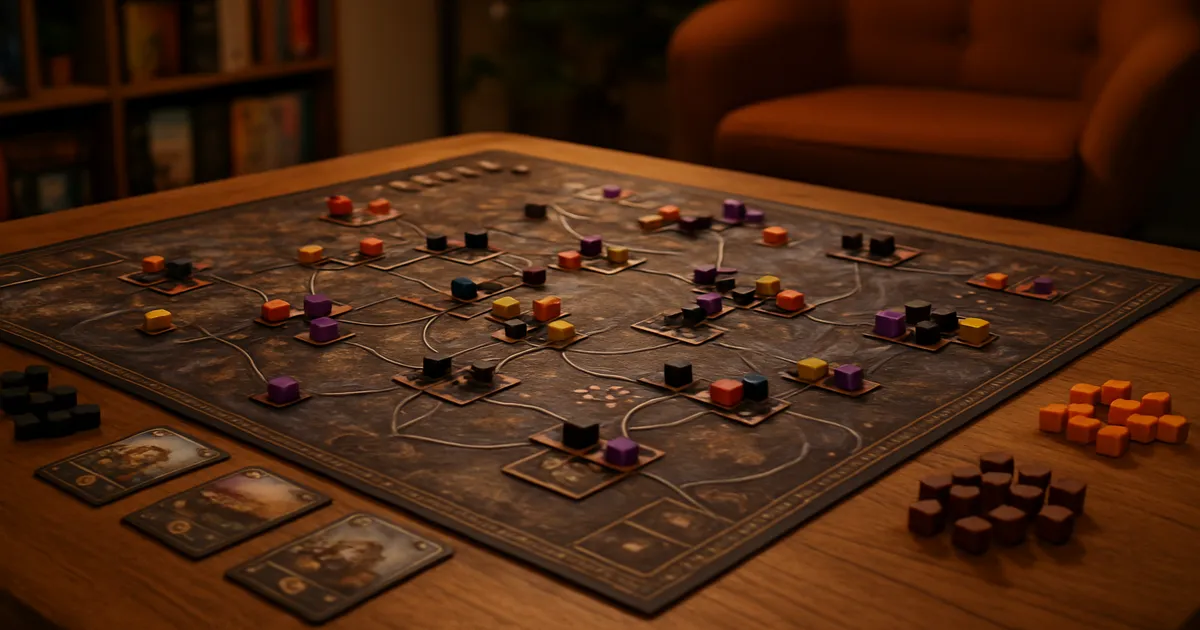
Quick Answer: Board Game Arena (BGA) is the best place to play Brass: Birmingham online — it’s free, enforces the rules automatically, supports async play, and has a large active community. Designed by Gavan Brown, Matt Tolman, and Brendan Dodds, and published by Roxley Games, it’s a top-5 BGG-ranked heavy economic strategy game (2–4 players, 60–120 minutes, BGG weight ~3.9/5) set during the Industrial Revolution. There’s a real learning curve, but BGA makes it far more approachable than wrestling through the rulebook alone.
If you’ve been wondering how to play Brass: Birmingham online without drowning in a 20-page rulebook, you’re in the right place. This guide covers where to play, how the rules actually work, what trips up new players, and how to start thinking strategically — all with the online experience in mind.
Where to Play Brass: Birmingham Online
Board Game Arena (BGA): Best for Most Players
BGA is the clear recommendation for almost everyone. It’s free — a premium subscription unlocks some perks, but you don’t need it — and it automatically enforces the rules so you can’t make illegal moves. There’s a built-in tutorial, and the player base is large enough that you can find an open table or get matched within minutes.
You can play real-time or async. Both work well, and I’ll explain which to pick below.
Tabletopia: Pretty, But Not for Beginners
Tabletopia gives you a 3D virtual tabletop in your browser — you’re moving physical-looking pieces around a digital table. It looks great and feels closer to the real thing. The problem? Zero rules enforcement. You and your group have to already know the game, which makes it a poor choice if you’re learning. Stick to Tabletopia once you’ve got a few games under your belt and want the tactile feel without setting up the physical copy.
Tabletop Simulator on Steam: Most Flexible, Most Work
Tabletop Simulator costs around $20 on Steam, and you’ll need to track down and install the community mod for Brass: Birmingham on top of that. It’s the most customizable option, but also the most effort, with no automation whatsoever. If you already own TTS for other games, the mod is worth a look. Otherwise, don’t start here.
Platform Comparison
| Platform | Cost | Rules Automation | Async Support | Player Base |
|---|---|---|---|---|
| Board Game Arena | Free (premium optional) | Full | Yes | Large |
| Tabletopia | Free | None | Limited | Small |
| Tabletop Simulator | ~$20 | None | No | Small |
Brass: Birmingham Rules Overview
The Two Eras: Canal and Rail
The game runs across two eras. In the Canal Era, you build industries and connect them with canals. In the Rail Era, canals are replaced by railroads and the board opens up considerably.
Here’s the thing that shocks every new player: at the end of the Canal Era, all canals and all Level 1 industries are wiped from the board. They still score VP before removal — but if you built a Level 1 coal mine and never depleted it, it scores nothing and disappears. Plan accordingly.
Turn Structure: Actions and Cards
Each turn you take 1 or 2 actions. Each action costs 1 card from your hand, so a two-action turn burns 2 cards. Simple enough — but card management is where the real decisions live.
You start each era with 8 cards. Cards are either city-specific or industry-specific, and every card has dual purpose: use it to build in the matching city, or spend it as a wild to take any non-build action anywhere. Cards are more flexible than new players realize.
The Five Actions
- Build — Place an industry tile in a city matching your card. This is how coal mines, iron works, breweries, cotton mills, manufacturers, and potteries get onto the board.
- Network — Build a canal (Era 1) or railroad(s) (Era 2) to connect cities. Requires coal and sometimes iron.
- Develop — Remove your lowest-level industry tiles from your player board so you can build higher-level, higher-VP versions sooner.
- Sell — Flip your manufactured goods by connecting them to a merchant tile. This triggers income bumps and is how goods score points.
- Loan — Take £30 and drop your income track by 3 spaces. Useful early; increasingly painful late.
Resource Rules: Coal, Iron, and Beer
This is where most confusion happens. Coal must come from a connected coal mine — there needs to be a canal or rail link between your build location and the mine. Iron is global: any iron works on the board can supply you regardless of network connection.
Beer becomes essential in Era 2 for building rail links and selling goods. You can use beer from your own breweries or from merchant cities. Running out of beer access in the Rail Era is genuinely crippling.
One more thing worth knowing: you can use resources from other players’ mines. You don’t pay them. Their mine gets depleted, which actually helps them score. Don’t avoid doing this out of politeness — it’s core to how the game works.
How Scoring Works
Points come from three sources:
- Industry tiles on the board at the end of each era (each tile has a printed VP value)
- Canal/rail links (each link scores based on the industries in the cities it connects)
- Merchant bonuses — bonus tiles at merchant locations awarded to whoever sells there first
Unsold goods score zero. A cotton mill you built but never sold is worthless. Selling isn’t optional — it’s the whole point.
Getting Started on Board Game Arena
Creating an Account and Finding a Game
Go to boardgamearena.com, create a free account, and search for “Brass: Birmingham” in the game library. You can join an open table or create your own and invite friends. For your first game, join an open async table at 2 or 3 players rather than jumping into a real-time 4-player game.
The BGA Tutorial and What It Misses
BGA has a built-in tutorial for Brass: Birmingham. It’s functional and worth doing, but it doesn’t cover everything. Supplement it with Rodney Smith’s Watch It Played video on YouTube — it’s the community standard for learning this game and covers edge cases the BGA tutorial glosses over.
Async vs. Real-Time: Which Should You Choose?
For new players, async is the better choice, and it’s not close. Games can span several days, but that means you can actually study the board before each turn. Real-time is great once you know what you’re doing — making decisions under time pressure while you’re still figuring out resource rules is rough.
Reading the Action Log and Board State
BGA’s action log is one of its most valuable features. It shows exactly what every opponent did on their turn — which cards they played, which resources they consumed, where they built. Get in the habit of reading it before every turn.
A few other BGA-specific features worth knowing:
- The notes feature — use it to track which merchant tiles are in play and what goods they accept
- The undo function — available for some actions, but not all. Once resources are consumed, you often can’t undo. Think before you click.
- Opponent income tracks — visible at all times. Knowing who’s cash-poor is real strategic information.
Common Mistakes New Players Make
The Canal Era wipe is the biggest one. New players build Level 1 industries they never deplete and canals they never connect meaningfully, then watch everything vanish. Anything you build in Era 1 needs to either be sold or depleted before the era ends, or be Level 2 or higher.
Coal vs. iron sourcing trips people up constantly. Coal needs a network connection; iron doesn’t. If you’re building a railroad and there’s no connected coal mine, you’re stuck — even if there’s a full mine on the other side of the board.
A few more worth calling out:
- Not selling goods — Building manufacturers and cotton mills is pointless if you never sell them. Selling triggers income bumps and earns VP.
- Ignoring the income track — Players who don’t build income early run out of money by mid-game. A few bumps in Era 1 can mean dozens of extra pounds over the course of the game.
- Over-investing in coal mines — Coal mines only score if they’re fully depleted at era end. A half-empty mine scores nothing. Build coal mines to use them, not to sit on them.
- Forgetting beer in Era 2 — Plan where your breweries are going before the Rail Era starts. Being beer-stranded is a game-losing position.
Brass: Birmingham Strategy for Online Play
Canal Era: Build Tight, Sell Fast
Keep your Era 1 network compact. Canals are cheap, but spreading too thin means you can’t reach merchants in time to sell. Build a coal mine or two early to fuel your own builds — and let opponents deplete them, which scores you points. Then prioritize selling. Every sold good bumps your income, and income is the compounding resource of this game.
Rail Era: Beer First, Then Expand
Before Era 2 begins, figure out where your breweries are going. Beer is the bottleneck of the Rail Era. Once that’s secured, build rails through cities with high-value industries — yours or your opponents’. Links score based on what’s connected, so a rail through a city full of Level 4–5 industries is worth far more than one through empty space.
The double-link Network action in Era 2 — where you can build two rail links in a single action — is powerful. Use it to leap across the map rather than plodding one link at a time.
Take a Loan Early, Sell Early, Win More
I’ve watched players spend all of Era 1 building impressive industry networks while never selling anything. By mid-game they’re broke, unable to take meaningful actions, watching better-positioned players pull away. A loan in round 1 or 2 is almost always correct. An income bump from selling goods in round 2 pays dividends for the rest of the era. Early income wins games.
Don’t Sleep on the Develop Action
Develop is one of the most underused tools in the game. Spending an action to remove your Level 1 and 2 tiles from your player board means you can immediately build Level 3, 4, or 5 industries — which score dramatically more VP. It feels like “doing nothing,” but it’s an investment that pays off hard in Era 2.
Check the Merchant Tiles Before You Build Anything
Merchant tiles are placed randomly at setup and specify which goods they accept. Before you decide where to build your industries, check what merchants are on the board and where they are. Building a cotton mill when all the cotton merchants are on the opposite side of the map from your network is a slow road to losing.
Reading Opponents on BGA
BGA’s action log and visible income tracks give you information that’s harder to track in a physical game. Check opponent income tracks regularly — a cash-poor opponent is less likely to contest a city you want. Use the notes feature to track merchant tiles and plan your sell routes before Era 2 starts.
Brass: Birmingham vs. Brass: Lancashire — Which Should You Play Online?
Birmingham adds pottery and manufacturers as industry types, giving you more variety and decision space. It also uses variable merchant tiles, which changes sell routes every game and adds significant replayability. Lancashire is slightly simpler, uses fixed merchant locations, and has a tighter focus on the cotton industry.
Both are on BGA, but Birmingham has the larger player base by a wide margin — you’ll find games faster and face more experienced opponents. For most players, Birmingham is also the better design: the variable merchants and additional industry types make each game feel distinct.
Lancashire is worth playing if you want the “original” experience or prefer a tighter, more constrained design. But if you’re new to the series, start with Birmingham.
Frequently Asked Questions
What is the best platform to play Brass: Birmingham online?
Board Game Arena. It’s free, enforces the rules automatically, supports both async and real-time play, and has by far the largest active player base. Tabletopia and Tabletop Simulator are alternatives, but neither offers rules automation, which matters a lot when you’re learning.
Is Brass: Birmingham hard to learn online?
Yes — BGG rates it ~3.9/5 for complexity, and that’s earned. That said, BGA’s automation prevents illegal moves and removes a lot of the rules-tracking burden. Supplement the BGA tutorial with Rodney Smith’s Watch It Played video and play your first game async so you have time to think. Most players feel comfortable after two or three games.
Can you play Brass: Birmingham solo online?
There’s no official solo mode, and none of the major online platforms offer one. Fan-designed solo variants exist, but they’re not implemented on BGA, Tabletopia, or Tabletop Simulator in any polished form. If solo play is your priority, this probably isn’t the game to start with.
How long does an online game take?
A real-time 2-player game between experienced players runs about 60–90 minutes. A 4-player game with newer players can easily hit 2+ hours. Async games span several days — most BGA async games use a 24-hour turn timer.
What happens at the end of the Canal Era?
All canals are removed from the board, and all Level 1 industry tiles are removed as well. They score VP before removal, but any Level 1 industries that weren’t fully depleted score nothing. This is the single most important rule to internalize before your first game — it completely changes how you should approach Era 1.