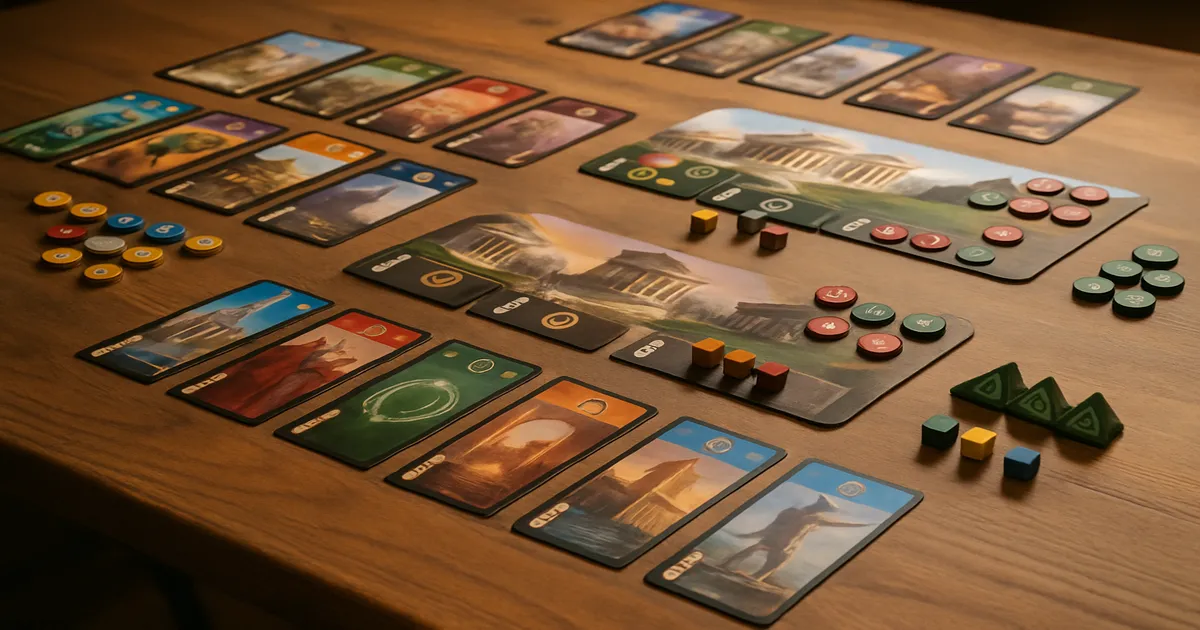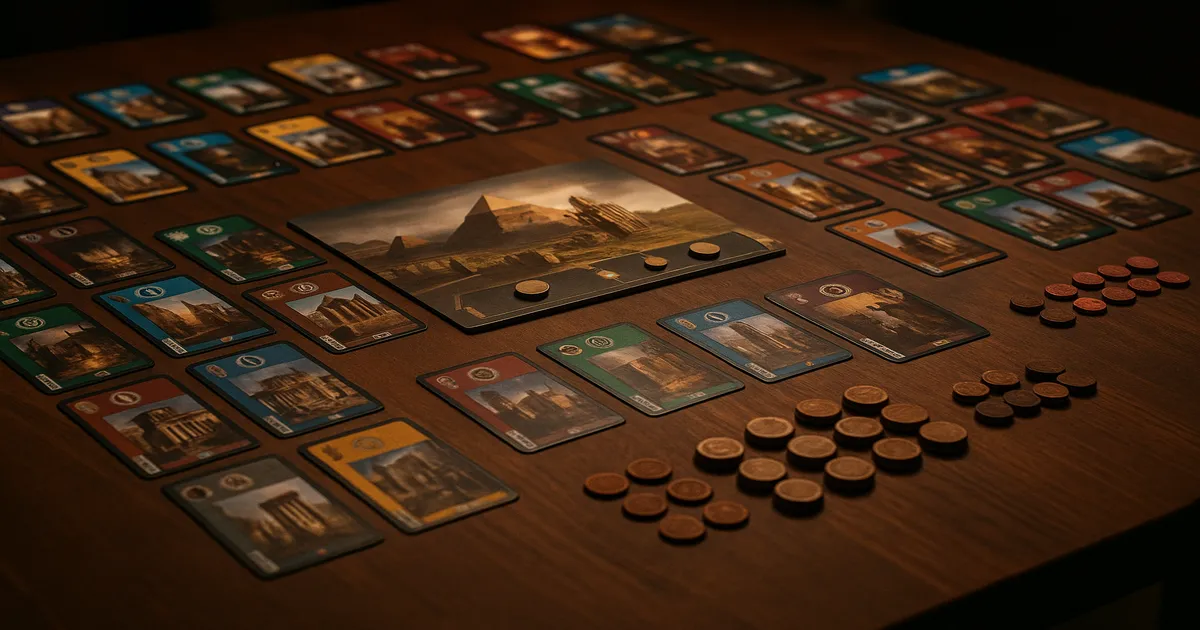
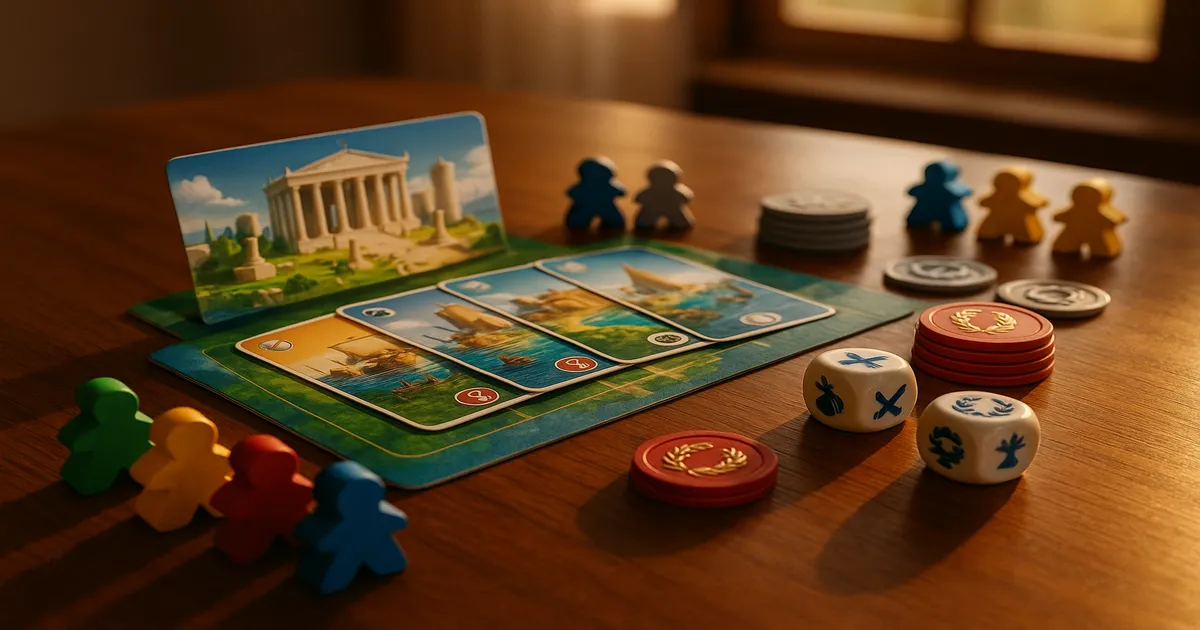
Quick Answer: In 7 Wonders Architects, each player races to complete all five stages of their personal Wonder board by collecting resource cards from a shared central deck. On your turn, flip cards one at a time and keep the first card of a color you don’t already have — anything you skip gets passed to a neighbor. The game ends when someone finishes their Wonder or the Progress Track is completed, then everyone counts up victory points. It plays 2–7 players in about 25–30 minutes, rated 8+, with a BGG weight of roughly 1.6/5.
If you’re trying to figure out how to play 7 Wonders Architects, you’re in the right place. This is one of those games that looks more complicated than it is — most people have it down within a single round. The tricky bits are the card-passing rules and knowing which end-game triggers to watch for, so that’s where we’ll spend the most time.
What Is 7 Wonders Architects?
Antoine Bauza designed 7 Wonders Architects in 2021, published by Repos Production. It became a go-to recommendation for families and casual game nights almost immediately, and for good reason: you’re building one of the Seven Wonders of the Ancient World, racing 2–6 opponents to finish first, and the whole thing wraps up in half an hour.
- Players: 2–7
- Age: 8+
- Play time: 25–30 minutes
- BGG weight: ~1.6/5
How Architects Differs from the Original 7 Wonders
This is a standalone game, not an expansion. It shares a theme and artist (the excellent Miguel Coimbra) with the original 7 Wonders from 2010, but plays like an entirely different game.
| Feature | 7 Wonders Architects | 7 Wonders (Original) |
|---|---|---|
| BGG Weight | ~1.6 | ~3.0 |
| Play Time | 25–30 min | 30–45 min |
| Player Count | 2–7 | 3–7 |
| Drafting Style | Draw from shared deck | Pass hands simultaneously |
| Ages | 8+ | 10+ |
| Best For | Families, casual groups | Experienced gamers |
Architects isn’t a dumbed-down version of the original — it’s a genuinely different game that happens to share the same setting. The original rewards deep strategic planning and simultaneous hand-drafting decisions. Architects is faster, more accessible, and honestly the better pick for 90% of game nights.
Components and Setup
What’s in the Box
Component quality is genuinely good for the price:
- 7 double-sided Wonder boards (14 total configurations)
- Central card deck (~100+ cards in six colors)
- Progress token board and progress tokens
- Conflict tokens (positive and negative military markers)
- Coin tokens and victory point tokens
- Cat standee
- Rulebook (concise, well-illustrated)
The cards are thick, the Wonder boards are large and sturdy, and the box insert actually works — everything has a dedicated slot. Setup takes about two minutes once you’ve played before. (7 Wonders Architects)
Setting Up the Game
- Each player randomly receives a Wonder board and picks which side to play.
- Shuffle the full card deck and place it face-down in the center.
- Set up the Progress Token board where everyone can reach it.
- Place the cat standee nearby.
- Check your Wonder board’s first stage — some require starting coins, so distribute those now.
First-time setup takes under five minutes.
How to Play 7 Wonders Architects: Turn Structure and Card Types
Drawing and Drafting Cards
On your turn, flip cards from the top of the shared deck one at a time. Here’s the rule that trips up almost every new player:
- If the card is a color you already have in your hand, you must pass it to one of your neighbors.
- If it’s a new color you don’t yet have, you keep it and your turn ends.
- You can keep flipping past colors you already hold — each one goes to a neighbor — until you hit something new.
Passing isn’t optional. Flip a second gray card when you already have one? It goes to a neighbor, no exceptions. This creates constant tension between what you need and what you’re handing to the people sitting next to you.
Card Colors and What They Do
- Gray (Raw Materials): Stone, wood, clay, glass — the building blocks for completing Wonder stages.
- Yellow (Commerce): Provide coins or special abilities.
- Blue (Civilian): Straight victory points. Reliable and underrated.
- Green (Science): Collect matching symbols for set bonuses and Progress Track advancement.
- Red (Military): Shields that determine conflict outcomes.
- Purple (Guild): Powerful end-game scoring cards. Rare — grab them when you can.
Military Conflict and the Cat Cards
Cat cards are a special sub-type within the blue civilian cards. When one is flipped during any player’s turn, military conflict resolves immediately between all neighboring pairs. The player with fewer shields in each pairing takes a Conflict token — a negative point penalty. The cat standee tracks how many conflict rounds have happened.
Military can hit you two or three times during a game, and each loss compounds. Ignoring red cards entirely is one of the most common and costly mistakes new players make.
Building Your Wonder and Winning the Game
Completing Wonder Stages
Each Wonder has five stages, each requiring specific gray resource cards. When you have the required resources in hand, discard them to complete that stage and unlock its printed ability. Abilities range from bonus coins to extra shields to science boosts, and they vary by Wonder.
Don’t stockpile gray cards. Resources sitting in your hand do nothing — spend them.
The Progress Token Track
Every time you collect three green science cards with matching symbols, your marker advances on the shared Progress Token track. Each space grants a powerful bonus: extra points, coins, military strength, or other effects. The track is also an end-game trigger — if it’s fully advanced, the game ends immediately.
Push science hard enough and you can force the game to end on your terms. That’s a real win condition, not just a side effect.
End-Game Triggers and Scoring
The game ends when either:
- A player completes all five stages of their Wonder, or
- The Progress Track is fully advanced.
Then everyone scores:
- Completed Wonder stages — points printed on your board
- Blue civilian cards — face value points
- Green science sets — bonus points for matching symbol sets
- Progress tokens earned — varies by token
- Military results — positive tokens add points, negative tokens subtract
- Coins — converted to points at a set rate
Highest total wins. Ties? Just play again — it’s a 25-minute game.
Common Mistakes New Players Make
Forgetting the mandatory pass. When you flip a card matching a color you already hold, passing it isn’t a choice — it’s required. I’ve seen this misplayed in probably half the first games I’ve taught.
Hoarding gray resources. Holding four gray cards without building anything means you’re not progressing. Sitting on resources feels safe but costs you the game.
Skipping military entirely. Two or three shields is usually enough to avoid being the weakest player in conflicts. You don’t need to dominate — you just can’t be the obvious target every time a cat card drops.
Going halfway on science. Science scoring is exponential. Picking up two green cards and stopping is usually a waste. Either commit early or pivot to blue civilian cards and let science go.
Not reading your Wonder’s stage abilities. Each Wonder is different. Some abilities are game-changing if you know they’re coming. Read your board before the first turn.
Underestimating how fast the game ends. If an opponent is on Stage 4, the game might be over in three turns. Always know where everyone stands.
Strategy Tips for How to Play 7 Wonders Architects Well
Know Your Wonder Before You Draft
Look at your Wonder board before you take a single card. Some Wonders reward military, others lean into science, others are pure point engines. Aligning your drafting to your Wonder’s natural bonuses from turn one is worth more than any individual card decision.
Science: All In or Not at All
The more matching sets you complete, the more powerful science becomes — it’s not linear. Going halfway is almost always a mistake. Either chase it aggressively from the start, or pivot to blue civilian cards and don’t look back.
There’s also a timing angle: pushing the Progress Track through science can trigger the end game when it suits you. If you’re ahead on Wonder stages, forcing an early end is a legitimate win condition.
Military: Enough, Not Everything
You don’t need to win every conflict. Two or three shields puts you in a safe position against most neighbors. Spending all your turns chasing red cards while neglecting Wonder construction is a trap. Collect enough to not be the weakest player — that’s usually sufficient.
Endgame Awareness
Count stages constantly. Yours, your neighbors’, everyone’s. If you’re on Stage 3 and two opponents are on Stage 4, shift into urgency mode. Blue civilian cards are your best fallback — consistent, no-strings-attached points that don’t require a long setup.
What to Play Next
If you love Architects, the 7 Wonders Architects: Medals expansion adds medal tokens that layer in additional scoring opportunities without breaking the core game’s simplicity. It’s the obvious next purchase.
For other games in the same ballpark:
- Sushi Go! — Even lighter card drafting with simple set collection. Great for the same crowd.
- Splendor — Resource collection and engine building at a similar weight. Excellent at two players.
- Azul — Abstract tile-drafting, similar play time, beautiful components. A natural step sideways.
- Wingspan — A step up in complexity, but a natural next game once your group wants more depth.
Frequently Asked Questions About How to Play 7 Wonders Architects
What’s the difference between 7 Wonders and 7 Wonders Architects?
The original 7 Wonders (2010) uses simultaneous hand-drafting — everyone picks from a shared hand and passes it along. It’s more complex, plays 3–7, and has a BGG weight around 3.0. Architects (2021) uses a deck-draw system where players flip cards one at a time from a central pile, plays 2–7, and weighs in at about 1.6. Same theme, same artist, completely different games.
How does military work in 7 Wonders Architects?
Military resolves whenever a Cat card is flipped — not at the end of the game. At that moment, all neighboring pairs compare shield counts, and the player with fewer shields takes a negative Conflict token. You build shields by collecting red military cards throughout the game. Conflict can trigger two or three times per game, so those tokens add up fast.
What do cat cards do in 7 Wonders Architects?
When a Cat card is flipped from the deck, military conflict triggers immediately between all neighboring players. Everyone compares shields, losers take a Conflict token, and the cat standee advances to track how many resolutions have occurred. Cat cards also count as blue civilian cards for end-game scoring.
How do green science cards score in 7 Wonders Architects?
Collecting three green cards with matching symbols advances your marker on the Progress Token track, earning a powerful bonus token. The more matching sets you complete, the more points and tokens you accumulate. The scoring is exponential — which is exactly why half-committing to science rarely pays off.
Does 7 Wonders Architects work at two players?
Yes, and it works better at two than the original 7 Wonders does. The card-passing mechanic still functions, military conflict still triggers normally, and the game plays in well under 25 minutes. The decisions feel slightly less layered than with four or five players, but it’s a solid two-player option.