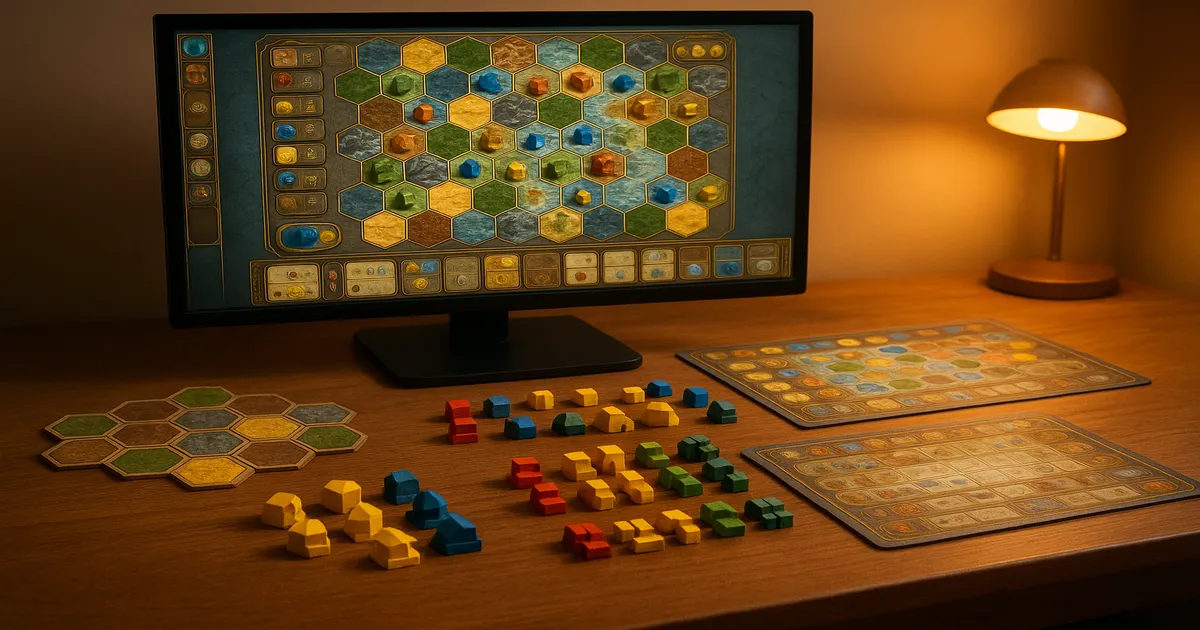
Quick Answer: Terra Mystica is a heavy strategy euro (BGG weight 3.95/5) where 14 asymmetric factions compete on a hex map by terraforming terrain and building up their economies. You can play it online for free at BoardGameArena (best for beginners), through the official Digidiced app or Steam version (best UI and solo AI), or via a Tabletop Simulator mod. If you’re just starting out, go with BGA — it automates all the fiddly scoring and resource tracking that makes the physical game so demanding to learn.
Learning how to play Terra Mystica online is genuinely easier than cracking open the physical rulebook — not because the digital versions teach you better, but because they handle all the bookkeeping automatically. Income phases, power bowl calculations, round scoring — it all just happens. For a game this complex, that’s a massive relief. You can focus on actual decisions instead of frantically cross-referencing the rulebook every other turn.
Where to Play Terra Mystica Online
BoardGameArena (BGA): Free Browser Play
BGA is where I’d send any first-timer. It’s free, browser-based, and enforces every rule automatically — you literally cannot make an illegal move. Resource tracking, income calculation, round scoring: all handled. You just think about strategy.
BGA also publicly displays faction win-rate statistics broken down by player count, which is genuinely useful when you’re picking a faction. The visual interface is functional rather than pretty, but it gets the job done.
Digidiced: Official App and Steam Version
The Digidiced version is the official adaptation, and it shows. (Terra Mystica) The UI is the best of any platform — cleaner faction boards, more polished presentation. More importantly, it has a real AI opponent, which makes it the best option for solo practice. Even the easier difficulty levels will catch rules you’ve been getting wrong.
It’s available on iOS, Android, and Steam. Not free, but worth it if you want to grind out games against AI before facing humans.
Tabletop Simulator: Community Mod
TTS gives you maximum flexibility — any house rules, any expansion, any configuration you want. (Tabletop Simulator on Steam) The catch: it enforces nothing. You need to already know the rules and handle all tracking yourself. Not a learning tool. But if your group already knows the game and wants total control, it works well.
Yucata.de: Free Async Alternative
Yucata is free and browser-based like BGA, but the interface is noticeably older. It’s a solid async option, though most players will be better served by BGA’s cleaner implementation.
Async vs. Real-Time: Which Is Better for Learning?
Async, full stop. Terra Mystica has a lot of interconnected scoring vectors, and being able to sit with a position for a few hours before committing is genuinely valuable. BGA and Yucata both support async. Real-time games on BGA work too, but you’ll feel rushed on cult track decisions until the game really clicks.
Platform Comparison
| Platform | Cost | AI | Play Style | Best For |
|---|---|---|---|---|
| BoardGameArena | Free | No | Async / Real-time | Beginners, human play |
| Digidiced / Steam | Paid | Yes | Async / Real-time | Solo practice, polished UI |
| Tabletop Simulator | Paid | No | Real-time | Experienced groups |
| Yucata.de | Free | No | Async | Async purists |
Terra Mystica Rules: Core Gameplay Explained
The Hex Map and Terraforming
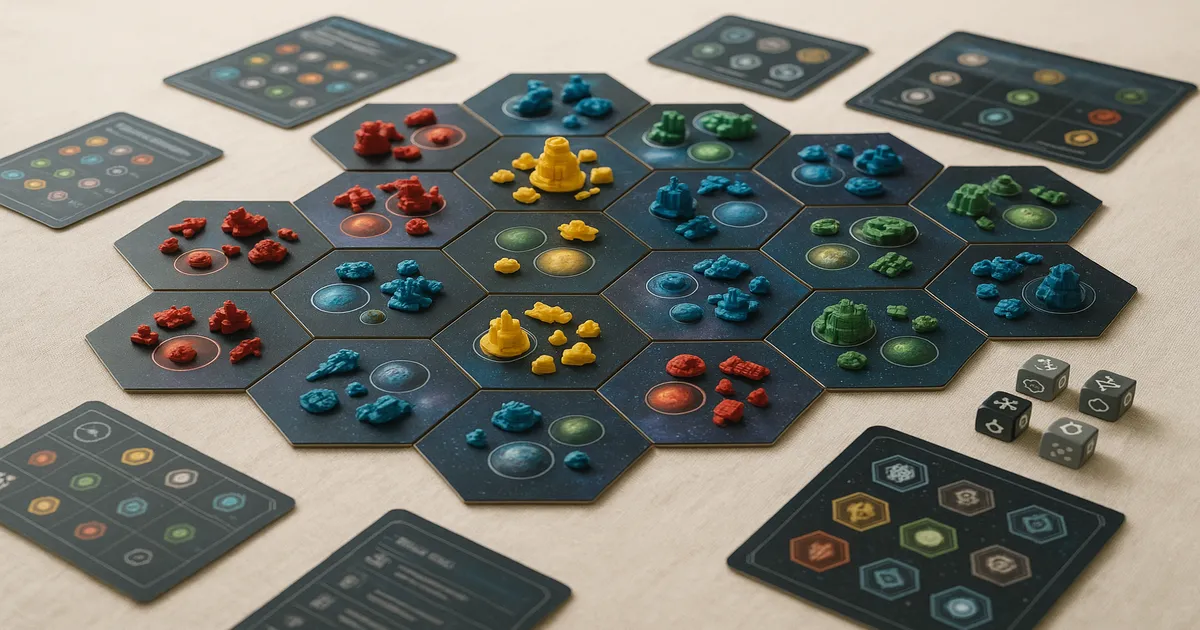
The board is a hex grid covered in seven terrain types. Each faction has a home terrain — Witches live in Forests, Mermaids on Lakes, and so on. Before you can build on a hex, you transform it into your home terrain by spending shovels (converted from workers). The terrain wheel tells you how many transformation steps separate any two terrain types.
Building Types and Upgrades
Buildings follow an upgrade path:
- Dwelling → Trading House (your main income engine)
- Trading House → Stronghold (unlocks your faction’s special power) or Temple (cult track bonuses)
- Temple → Sanctuary
You start by placing Dwellings and work upward. Getting to your Stronghold is a priority most factions can’t afford to delay.
The Four Resources: Workers, Coins, Priests, and Power
Workers pay for terraforming and building. Coins pay for upgrades and certain actions. Priests advance your position on cult tracks. Power is the most interesting resource — it cycles rather than disappearing when spent.
How the Power Bowl System Works
This trips up almost every new player. Your power tokens sit across three bowls. Power advances Bowl 1 → Bowl 2 → Bowl 3 as you gain it. You spend from Bowl 3, which sends tokens back to Bowl 1.
The tricky part: if you want to gain X power but Bowl 1 is empty, you must burn (permanently discard) ⌊X/2⌋ tokens from Bowl 2 to make room. Gaining 4 power could cost you 2 tokens permanently if your bowls are mismanaged. Digital platforms handle this automatically — which is exactly why playing online first helps you internalize the rule before it bites you in a physical game.
Cult Tracks: Fire, Water, Earth, and Air
Four elemental cult tracks reward advancement with mid-game bonuses and significant end-game VP. Top position on each track scores 8 VP at game end; second gets 4, third gets 2, fourth gets 1. Ties split the points.
Round Structure and Turn Order
Six rounds, with players taking one action at a time — not a full turn’s worth at once. When you’re done, you pass, ending your participation in that round. Passing first gets you first pick of bonus tiles for next round, but you go last when that round begins.
The Seven Action Types
- Transform and Build — spend workers to terraform, optionally place a Dwelling
- Advance Shipping or Digging — improve terraforming efficiency or river reach
- Upgrade a Building — move up the building chain
- Send a Priest to a Cult Track — advance on Fire, Water, Earth, or Air
- Power Actions — spend Bowl 3 power for resources or board actions (first-come-first-served)
- Special Actions — faction or bonus tile abilities, once per round only
- Pass — end your round and claim a bonus tile
How Scoring Works
Round Scoring Tiles
Each round has a scoring tile that rewards a specific action with bonus VP — things like “2 VP per Dwelling built this round” or “3 VP per Trading House upgrade.” Tiles are randomized each game but revealed at the start, so you can plan around them from turn one.
Towns: How to Found Them and Why They Matter
A town forms when you have a connected cluster of buildings with a combined power value of 7 or more. You immediately draw a Town Tile (one-time bonus — priests, power, VP, etc.) and score VP. Towns are one of the bigger VP swings in the game. Missing opportunities to found them is a classic beginner mistake.
End-Game Scoring
Three things score at game end:
- Cult track standings — 8/4/2/1 VP for first through fourth on each track
- Largest connected building network — VP based on size
- Leftover coins — 1 VP per 3 coins remaining
None of these is complicated on its own. The challenge is weighing all three simultaneously while you’re still playing. That’s what separates intermediate players from beginners.
Choosing Your Faction: Beginner’s Guide
The 14 Factions at a Glance
| Faction | Home Terrain | Playstyle |
|---|---|---|
| Witches | Forest | Expansion via aerial leap |
| Mermaids | Lakes | Town founding at range |
| Dwarves | Mountains | Surprise tunneling |
| Halflings | Plains | Flexible digging |
| Engineers | Wasteland | Bridge-building, wide presence |
| Chaos Magicians | Swamp | Aggressive early terraforming |
| Nomads | Desert | Cheap building, wide expansion |
| Giants | Volcano | Powerful but expensive terraforming |
| Fakirs | Desert | Long-range carpet flying |
| Alchemists | Swamp | Power-focused economy |
| Darklings | Swamp | Priest-heavy cult track dominance |
| Swarmlings | Lakes | Fast building, town rushing |
| Auren | Forest | Favor tile engine |
| Cultists | Plains | Cult track advancement on others’ actions |
Best Factions for New Players
Halflings and Engineers are my picks for anyone’s first few games. Halflings have cheap digging, so you’re not locked into tight positioning from the start — you can be flexible about where you settle. Engineers can build bridges to connect isolated clusters, which makes town founding more forgiving when your starting position isn’t ideal.
A Few Faction-Specific Notes
Witches should beeline for the Stronghold as early as reasonably possible. The free Dwelling placement ability lets you leap to terrain you couldn’t otherwise reach — that’s their whole game. Pair it with Air cult track investment and they’re strong in experienced hands.
Chaos Magicians get two shovels per terraforming action instead of one. Use this to claim territory aggressively in Rounds 1 and 2 before opponents establish their positions. Powerful, but punishing if you don’t press the early advantage.
Mermaids can skip river hexes when determining adjacency for town founding. Sounds narrow; it’s actually huge. You can found towns no other faction could assemble from the same position.
Cultists are heavily dependent on opponents’ actions and underperform at low player counts. Check BGA’s win-rate data before picking them at 2 or 3 players.
Common Mistakes When Playing Terra Mystica Online
Mismanaging the power bowls. Burning power from Bowl 2 isn’t optional when Bowl 1 is empty. New players often think they can just decline power gain to avoid the burn — the math still applies regardless.
Missing passive power gain from adjacency. You gain power when an opponent builds next to your buildings, not when you build. Position your buildings to maximize the chance opponents trigger this for you.
Ignoring cult tracks until Round 5. By then, three other players are sitting at position 9 or 10 and the end-game VP race is already decided. Even one or two priests per game in a focused track makes a real difference.
Placing Dwellings everywhere without upgrading. Trading Houses are what generate workers and coins each income phase. A player with five Trading Houses will outpace a player with ten Dwellings economically within two rounds.
Passing early out of habit. Passing first gets you first pick of bonus tiles but puts you last next round. That trade-off deserves actual thought every single round.
Strategy Tips for Winning Online
Read the round scoring tiles before placing starting Dwellings. All six are visible from the start. If Round 1 rewards Dwellings built, plan to expand aggressively. If Round 2 rewards Trading House upgrades, have Dwellings ready to convert. This one habit will improve your results immediately.
Upgrade to Trading Houses earlier than feels comfortable. The income compounds across every subsequent round. Most experienced players aim for two or three Trading Houses by end of Round 2.
Commit to one or two cult tracks. Pick the tracks your faction naturally supports and go deep. Spreading evenly across all four almost never wins — you end up scoring 1 VP on each instead of 8 VP on one.
Use async play to calculate end-game scoring. In Round 5, sit on your turn and work through cult track standings, count network sizes, estimate remaining coins. It’ll tell you whether to sprint a cult track or coast on network VP.
Check the game log. Every action is logged in digital play. If an opponent has been sending priests to Fire every round, they’re going for the top position — contest it or pivot away. That information simply doesn’t exist in a physical game unless you’re paying very close attention.
Terra Mystica vs. Gaia Project
Gaia Project (2017), by the same designers (Jens Drögemüller and Helge Ostertag), is widely considered a refinement of Terra Mystica. The hex map and faction asymmetry are still there, but the terrain wheel is replaced by a more intuitive planet type system, cult tracks become tech tracks, and federation tokens replace towns. Faction balance is generally better — fewer factions feel like they’re fighting uphill.
It’s on BGA and Digidiced, so if you’re already comfortable with Terra Mystica on those platforms, the transition is easy. Gaia Project is the slightly more polished game, but Terra Mystica’s faction variety and zero-randomness design still make it worth playing on its own terms.
If you want the physical copy of either game, both benefit from a good insert organizer — the component count is brutal without one.
Frequently Asked Questions
Is Terra Mystica free to play online?
Yes. BoardGameArena offers Terra Mystica completely free in-browser with no download required. Yucata.de is also free. The Digidiced app and Steam version are paid, but offer a solo AI opponent that the free platforms don’t have.
How many players is Terra Mystica?
Terra Mystica supports 2–5 players. Some factions scale better at certain player counts — Cultists, for example, are significantly weaker at 2 or 3 players since their ability depends on opponents taking actions near them.
How long does a game of Terra Mystica take online?
A real-time game on BGA typically runs 90–150 minutes for experienced players, longer for beginners. Async games can stretch over several days, which is actually ideal for learning — you get time to think through each decision properly.
Do I need to know the rules before playing on BGA?
Not strictly. BGA enforces all rules automatically and won’t let you make illegal moves. That said, understanding why you’re doing things — especially the power bowl system and cult track scoring — will make you a much better player much faster. Skim the rules summary on BGA before your first game.
Is Terra Mystica still worth playing in 2024?
Absolutely. It’s been in the BGG Top 50 for over a decade for a reason. No randomness in the core gameplay, 14 factions that play genuinely differently, and replayability that comes from combining different factions, maps, and round tile configurations. The digital versions have only made it more accessible — the automation removes the physical game’s biggest friction point and lets you focus on what makes Terra Mystica great.