Quick Answer: Orléans is a bag-building euro game for 2–4 players where you draw wooden follower tokens from a cloth bag each round, assign them to action spaces on your player board, and execute actions like moving across a medieval map, building trading stations, and recruiting new followers. The game runs 18 rounds, takes about 90 minutes, and the player with the most victory points wins. It’s one of the best bag-building games ever made — and once you understand the token economy, it clicks faster than its BGG weight of 3.0/5 suggests.
If you’ve played a deck builder and thought “this would be better with tactile wooden tokens and a map,” learning how to play Orléans is going to feel like a revelation. Designed by Reiner Stockhausen and first published by dlp games in 2014, Orléans drops you into medieval France as a merchant building influence across the Loire Valley — through trade, farming, scholarship, and a lot of careful bag management.
What’s in the Orléans Box
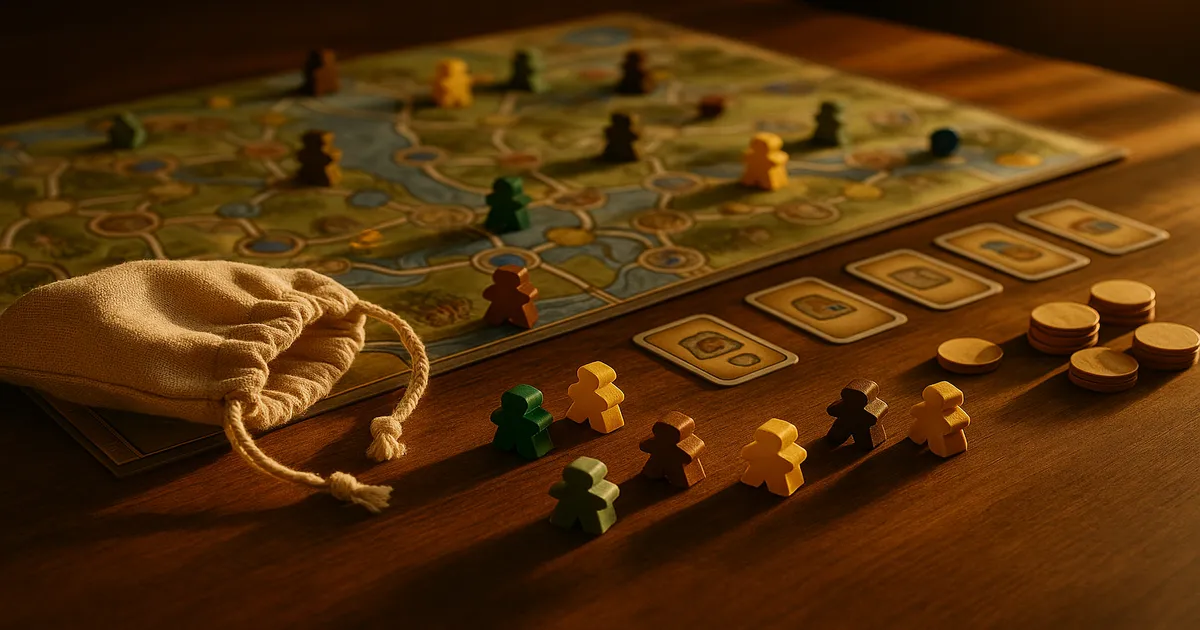
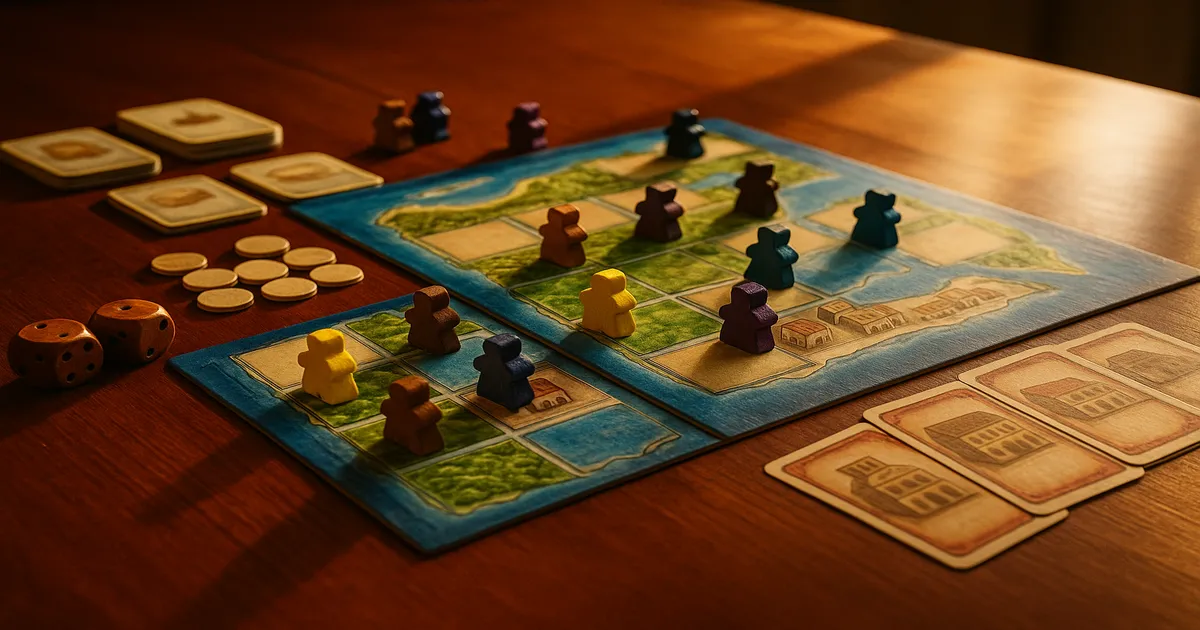
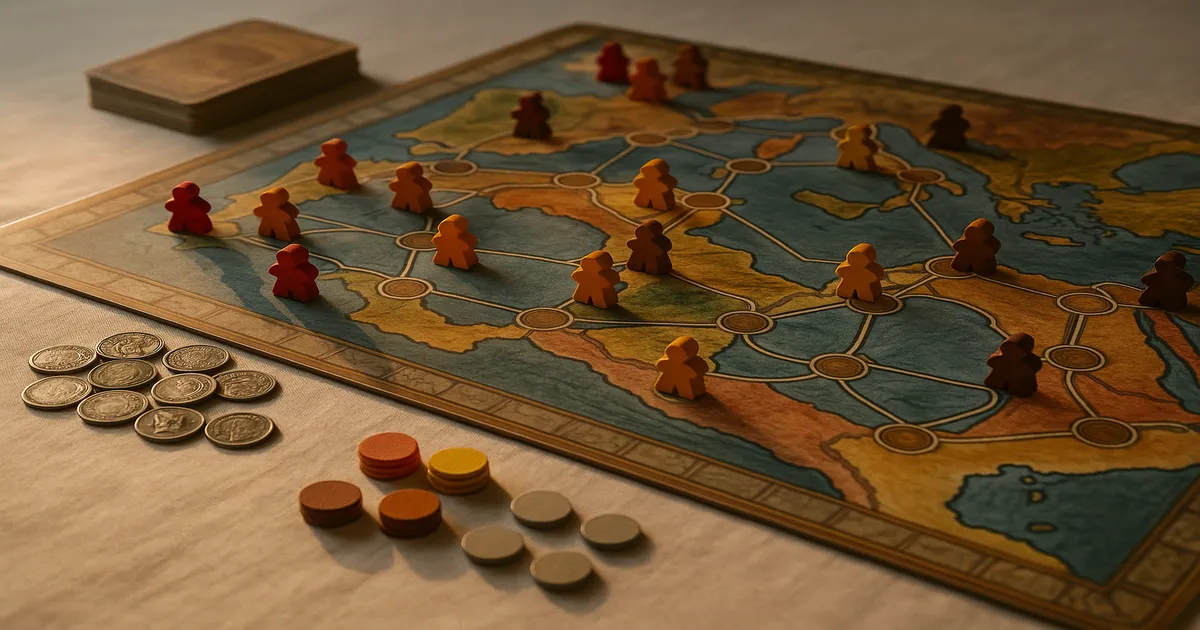
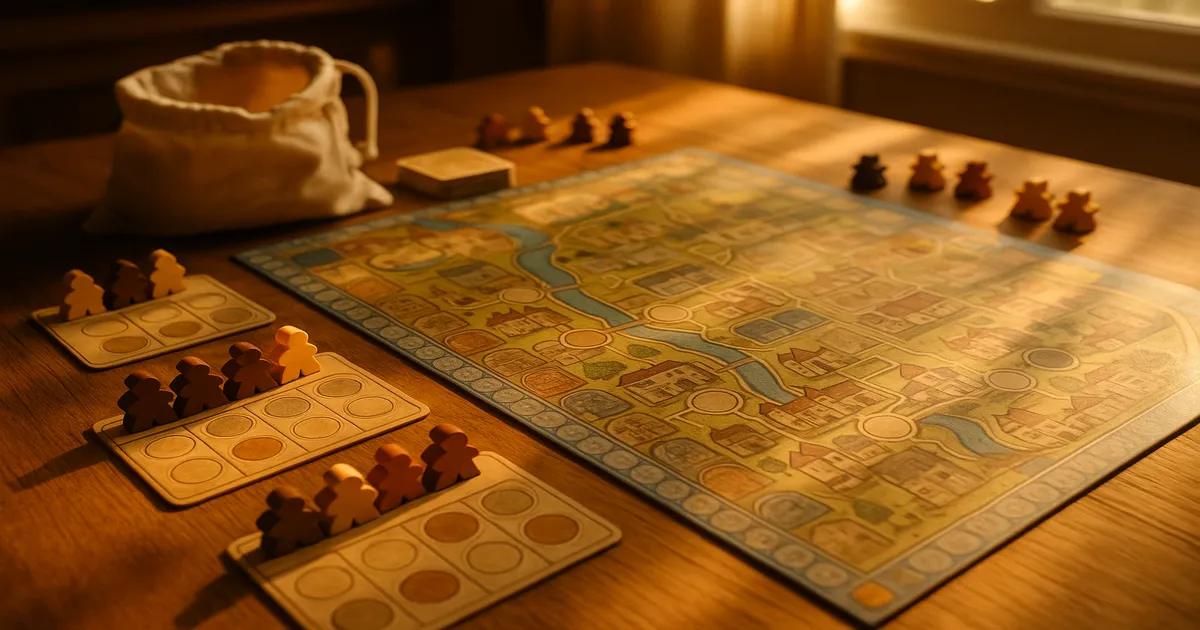
The central board is a richly illustrated map of the Orléans region, showing towns connected by roads and waterways. It dominates the table in the best way — plan for a large playing surface. Each player also gets their own player board showing all available action spaces, which looks busy at first but becomes intuitive after a round or two.
This is where Orléans earns its reputation for tactile satisfaction: every player gets a real drawstring cloth bag plus a set of small wooden follower tokens in their color. There are also trading station markers (little wooden houses), goods tokens in five types (grain, cheese, wool, wine, and brocade), and coin tokens. The sheer volume of wooden bits gives the game a satisfying physical weight.
The 18 event cards drive the round structure — one flipped per round, applying a global effect. Citizen tiles are unique character cards with special powers; the iconography can be small and occasionally cryptic, so keeping the rulebook handy for your first game isn’t weakness, it’s just smart. The Beneficial Deeds board is a separate small track that new players almost always underestimate — more on that later.
The art leans into a warm medieval manuscript aesthetic, earthy tones and period illustrations, and the whole spread looks genuinely beautiful on the table.
How to Play Orléans: Setup
Place the central board in the middle of the table and distribute goods tokens to their printed locations on the map. Set up the Beneficial Deeds board nearby. Arrange the 18 event cards in their fixed sequence — this is not a shuffled deck, events follow a predetermined order, which matters for planning.
Each player takes a player board, a cloth bag, a set of follower tokens in their color, trading station markers, and a starting allocation of coins. Place development track markers at the starting positions on each player board. Every player begins with the same starting bag: a small set of followers covering the basic token types. Add these to your bag before round one. Citizen tiles are shuffled and made available for acquisition during play.
Setup takes 10–15 minutes once you know the game. For your first session, walk through the board placement and bag preparation together — it’s a better use of time than trying to explain everything verbally before anyone can see the components.
How Each Round of Orléans Works
Phase 1: Event
Flip the top event card and apply its effect immediately. Events range from plague (which removes tokens from your drawn supply) to income rounds that give everyone coins. Reading the event card before you plan your round is non-negotiable — ignoring it is one of the most costly mistakes new players make.
Phase 2: Draw Followers from Your Bag
Each player draws tokens from their bag — four to start. That number can increase as you develop the Scholar (Scriptorium) track, which is one of the most powerful early investments in the game. Drawn tokens sit in front of you, ready to be assigned.
Phase 3: Planning (Simultaneous and Secret)
Here’s where Orléans does something clever: everyone plans at the same time, secretly assigning drawn tokens to action spaces on their player board. This keeps downtime low even at four players. Commit to your plan — trying to react to opponents during this phase is a trap.
Phase 4: Actions
Players execute their planned actions in any order. The core options:
- Move along roads (requires Knights)
- Move along waterways (requires Boatmen)
- Build Trading Stations in towns on the map
- Recruit new followers into your bag
- Develop one of the five tracks: Farmers, Craftsmen, Traders, Scholars, Knights
- Use Citizen tile powers for unique effects
Each action space requires a specific combination of follower types — getting this right will save you a lot of first-game confusion.
Phase 5: Followers Return
Used followers go to your personal supply, not back into your bag. Your bag only refills when it’s completely empty. This is the single most commonly misunderstood rule in Orléans, and it matters enormously for how you pace your recruiting.
Follower Types: Your Workforce
| Follower | Color | Primary Use |
|---|---|---|
| Farmer | Orange | Agriculture actions |
| Boatman | Blue | River movement |
| Craftsman | Gray | Building and construction |
| Trader | White | Trade and market actions |
| Scholar | Green | Development track advancement |
| Knight | Red | Road movement |
Most actions require two or more follower types in combination — moving along a river road might need a Boatman plus a Knight, for example.
The Monk token (dark brown) acts as a wild card for any action space. Experienced players build entire strategies around getting Monks into their bag early, and it’s hard to argue against that. New players consistently undervalue the Monk. Recruiting one or two in the first few rounds pays dividends for the rest of the game.
Citizen tiles are acquired during play and grant unique powers — some one-time, some ongoing. If you spot a citizen that synergizes with your developing strategy, prioritize grabbing it before someone else does.
Scoring and How to Win Orléans
The game ends after round 18, and all scoring happens at the end. Victory points come from:
- Trading Stations placed on the map
- Position on the five development tracks
- Goods tokens collected (brocade and wine are worth the most — don’t sleep on these)
- Remaining coins converted to VP
- Citizen tiles with end-game bonuses
- Beneficial Deeds track position
The Beneficial Deeds track deserves special mention. It’s a shared board where players spend tokens to gain benefits and accumulate end-game points. At higher player counts, the best spaces get claimed fast. Treating it as optional is a mistake I see constantly — by the time new players realize how many points they’ve left on the table, it’s round 15 and there’s nothing to be done about it. Ties are broken by remaining coins.
Common Mistakes New Players Make
Recruiting too aggressively early. Adding too many tokens dilutes your bag — you’ll draw the wrong combinations constantly and waste turns. Quality over quantity, especially in rounds 1–3.
Forgetting how the bag refills. It only refills when completely empty. Players sometimes expect a gradual trickle back in. It doesn’t work that way.
Ignoring the event card. A plague event when you’re counting on a full draw can ruin a carefully constructed round if you haven’t accounted for it. Read it first, then plan.
Neglecting map presence. Trading Stations are a major VP source and provide passive benefits. Don’t get so absorbed in your player board that you never expand onto the map.
Skipping the Scriptorium track. One extra token per draw, over 18 rounds, is a massive cumulative advantage. It’s not glamorous, but it’s probably the most powerful early investment in the game.
Orléans Strategy Tips
Early game: Push the Scholar/Scriptorium track first. Drawing five or six tokens instead of four compounds over the entire game. Recruit a couple of Monks while you’re at it — wild cards dramatically improve consistency.
Mid game: Get Trading Stations onto the map before round 8 or so. Towns at road and river intersections, or those with goods bonuses, are worth prioritizing. On your player board, commit to two or three development tracks rather than dabbling in all five. Orléans rewards specialists. If an opponent is dominating the Trader track, pivot early — catching up in round 12 is nearly impossible.
Late game: Once you’re past round 13 or 14, anything that takes multiple rounds to pay off isn’t worth pursuing. Shift focus to converting what you have — make sure your goods and coins translate into points, and that you’ve secured any citizen tile bonuses you’re counting on.
General principle: A reliable bag beats a spectacular one. Orléans punishes inconsistency. A bag that produces the combinations you need every round will outperform a bloated bag that occasionally fires on all cylinders but usually doesn’t. And at three or four players, the Beneficial Deeds track is not optional. Someone is going to use it heavily — make sure it’s you.
Expansions and Similar Games
Orléans Expansions
Trade & Intrigue is the first expansion and the one to pick up after your third or fourth base game. It adds trading contracts, intrigue cards, and meaningful player interaction — the base game can feel slightly solitaire at times, and this expansion addresses that without overcomplicating things.
Invasion shifts the game into cooperative and semi-cooperative scenario territory, which is a fun change of pace if your group enjoys that style. Orléans Stories is a newer campaign-style version of the system — a bigger commitment, but worth it if your group is hooked on the core mechanics.
If you’re planning to play Orléans regularly, a good insert or organizer makes setup dramatically faster.
Games Like Orléans
- Altiplano — Same designer, same bag-building core, but uses a rondel instead of a map. More puzzle-like, slightly more opaque. Worth playing for comparison.
- Dominion — The grandfather of deck building. No map, no tokens, but if you want to understand where bag building came from conceptually, start here.
- Viticulture — Medieval European theme, worker placement, easier to learn. Good gateway to the heavier euro space.
- Tzolk’in — Heavier and more complex, with an unforgettable gear mechanism for action timing. If Orléans feels comfortable, Tzolk’in is a natural next step.
- Gùgōng — Map movement plus euro engine building via card drafting. A solid alternative if you love the geographic strategy element of Orléans.
What makes Orléans hard to replace is the specific combination: physical token bag building, map movement, and simultaneous planning. No other game does all three in quite the same way.
Frequently Asked Questions About How to Play Orléans
How long does a game of Orléans take?
About 90 minutes. Experienced groups can finish in 75; first-timers often run closer to two hours. The simultaneous planning phase keeps things moving — there’s very little sitting around waiting for other players.
How many players can play Orléans?
The base game supports 2–4 players. Some expansions extend that to 5. It plays well at all counts, though the Beneficial Deeds track gets more competitive — and more important — as player count increases.
What is bag building and how does it work in Orléans?
Bag building is a mechanic where you start with a small collection of tokens and gradually improve its composition over the course of the game — analogous to deck building in card games. In Orléans, you draw tokens from your bag each round and assign them to action spaces. Over time, you recruit better followers to make your draws more powerful and consistent.
Is Orléans hard to learn?
It has a BGG complexity weight of around 3.0/5, which puts it solidly in medium-heavy territory. The rules themselves aren’t complicated, but there are a lot of moving parts to track simultaneously. Most players feel comfortable by round 4 or 5 of their first game. I’d call it approachable for anyone who’s played modern euro games before — less so as a true gateway game for non-gamers.
What’s the best first expansion for Orléans?
Trade & Intrigue, without question. It adds player interaction the base game lacks, introduces trading contracts that create interesting decisions, and integrates cleanly without significantly increasing complexity. Play the base game a few times first, then add it in.