Quick Answer: Race for the Galaxy is a 2–4 player sci-fi card game where everyone simultaneously picks one of seven phases each round — then all chosen phases happen, but only the person who picked a phase gets its bonus. You spend cards to play cards, building a tableau of worlds and developments worth victory points. First player to 12 tableau cards (or when the VP supply runs out), the round ends and highest VP wins. It takes 30–60 minutes, has a BGG weight of 2.99, and the learning curve is real — but so is the payoff.
Learning how to play Race for the Galaxy is one of those experiences that feels frustrating for about two sessions and then clicks in a way that makes you want to play it every night. The iconography is dense, the rulebook is notoriously rough, and the first time someone settles a military world you’ll probably argue about whether they need to pay cards for it. They don’t. But once it all clicks, this is one of the best card games ever made — fast, deep, and endlessly replayable.
Race for the Galaxy Components: What’s in the Box?
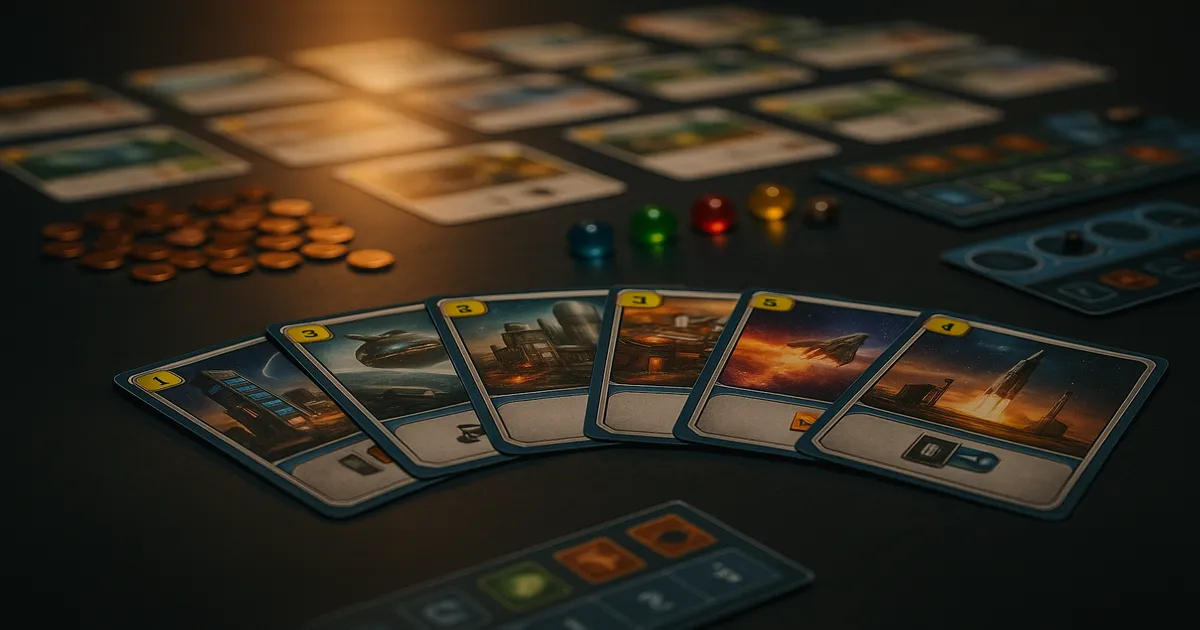
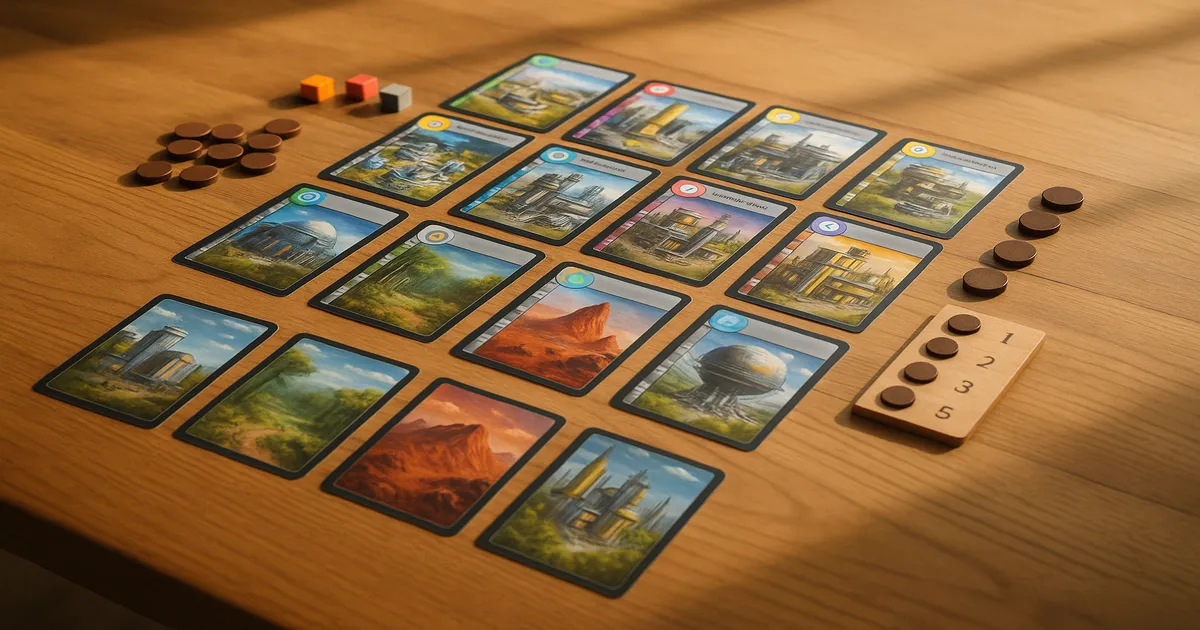
The base game comes with 109 cards, 7 phase cards per player (28 total, color-coded by player), VP chips in 1s and 5s, good markers (small colored discs), and player aid cards. Those player aid cards are not optional — every new player needs one in front of them for the first several games, full stop.
Card Types: Worlds vs. Developments
Every card in the deck is either a world (circle icon) or a development (diamond icon). Worlds are planets you settle; developments are technologies you build. They’re paid for and scored differently, so getting that visual distinction straight is the first thing to nail down.
The art is evocative sci-fi illustration — each card has its own character — but the real card language is icons. Race for the Galaxy is almost entirely icon-driven, which makes it language-independent once learned and genuinely fast to play. Getting there is the hard part.
Component Quality and Sleeving Advice
Honestly, the components are functional, not luxurious. The cardstock is fine, but cards get handled constantly, so sleeving is worth it. The cards are standard 63.5mm × 88mm — grab a set of sleeves and you’re sorted. The game’s value is entirely in its design, not its production.
Race for the Galaxy Rules: Setting Up the Game
Each player gets a randomly dealt start world, which goes directly into their tableau. Start worlds have unique ongoing powers — read yours before the game begins, because new players forget these constantly. The number of cards you draw to start varies by start world, usually 4–6.
Shuffle the remaining cards into a central draw pile. Set out VP chips scaled to player count (roughly 12 per player). Each player holds all seven phase cards in hand every round and gets them back after each round — they’re never permanently discarded.
How to Play Race for the Galaxy: Round-by-Round Breakdown
The Seven Phases Explained
There are five core phases (numbered I through V). Here’s what each one does:
| Phase | Name | What Everyone Does | Chooser’s Bonus |
|---|---|---|---|
| I | Explore | Draw 2, keep 1 | Draw more, keep more |
| II | Develop | Play a development by discarding cards equal to its cost | Cost reduced by 1 |
| III | Settle | Play a world (pay cards or use military) | Payment discount or military bonus |
| IV | Consume | Use goods for VP chips or cards | Double VP chips |
| V | Produce | Place goods on production worlds | Produce on one extra world |
Simultaneous Phase Selection: The Core Mechanic
Every round, all players secretly pick one phase card from their hand and place it face-down. Then everyone reveals simultaneously. Every phase that at least one player chose gets executed — by everyone — in numerical order (I through V). Phases nobody picked are skipped entirely.
This is the mechanic that makes Race for the Galaxy what it is. You’re constantly asking: what will my opponents pick, and can I get a free ride on it? A player who picks Develop gets their cost discount; everyone else still gets to develop that round, just without the bonus. Prediction and timing are everything.
How Goods Work: Production and the Face-Down Card Rule
When you produce a good on a production world, you take a card from the draw pile — not your hand — and place it face-down on that world. That face-down card represents the good. When you consume it, the card is discarded. This trips up nearly every new player. Goods never come from your hand.
End-Game Triggers and How to Win
The game ends at the close of any round where a player has 12 or more cards in their tableau, or the VP chip supply runs out. Crucially, the round always finishes completely — nobody stops mid-phase. Then everyone totals VP from tableau cards, accumulated VP chips, and any bonus-scoring developments. Highest total wins; ties go to whoever has more cards in hand plus goods.
Race for the Galaxy Strategy: Building a Winning Engine
The Five Main Strategy Archetypes
- Military Conquest — Build military strength, settle military worlds for free. Fast and aggressive.
- Trade/Consume Engine — Produce goods, trade for cards, consume for VP chips. Slower to build, massive late-game output.
- Development Rush — Use cost-reduction powers to slam 6-cost developments quickly.
- Alien/Uplift Specialist — Focus on a specific card type for enormous synergy VP from bonus developments.
- Hybrid/Opportunistic — Genuinely requires deep card knowledge. Not recommended for new players.
Why 6-Cost Developments Are Game-Changers
The 6-cost developments — cards like Galactic Federation or New Galactic Order — score 6 VP base, plus additional VP tied to your tableau composition. Most winning strategies are built around one or two of these. If you see one that fits what you’re building, prioritize it hard.
Mastering the Consume-Produce Loop
Selecting Produce one round and Consume (for VP) the next is one of the most reliable engines in the game. The double-VP bonus for choosing Consume is enormous and almost never worth skipping. I’ve watched new players ignore Consume for entire games and then wonder why they’re losing by 15 points. Don’t be that player.
Phase Selection as a Metagame
If you know your opponent will pick Settle — because they’ve got worlds ready to play — you can pick Develop and get your discount while still settling alongside them for free. This kind of prediction is what separates good players from great ones. Watch opponents’ tableaux constantly.
Two-Player Strategy: Key Differences
Two-player Race is a noticeably different game. You can’t rely on opponents to trigger phases you need, so you’ll self-cover more phases yourself. Military is relatively stronger at two players for the same reason — your opponent is less likely to trigger Settle for you, making the free-settlement bonus more valuable. Games also play faster and more aggressively.
Common Mistakes New Players Make in Race for the Galaxy
Rules Mistakes That Derail Your First Games
- Thinking only the phase-chooser executes the phase. Everyone does. The chooser just gets the bonus. This is the single most common misunderstanding.
- Paying cards for military worlds. Military worlds are conquered using your military strength (a running total from your tableau), not paid for with cards.
- Using hand cards for goods. Goods come from the draw pile, face-down onto the world.
- Stopping the game mid-round when a trigger fires. The round finishes completely before anyone scores.
- Thinking phase cards are gone after use. They return to your hand every round.
Strategic Traps That Hold Beginners Back
Over-exploring is the big one. Drawing cards feels productive, but it’s often the weakest thing you can do. The game rewards building, not hoarding. Ignoring the Consume phase — or not selecting it when you have goods — is a points leak that compounds every single round.
And don’t forget your start world power. It’s easy to miss and it genuinely matters.
Race for the Galaxy Tips to Improve Quickly
Commit to a strategy by round 2 or 3. Flexibility sounds good in theory, but without deep card knowledge it just means you build a mediocre engine that does nothing well. Pick an archetype early based on your start world and opening hand, then pursue it.
Treat your hand size like a health bar. Dropping below 3–4 cards without a plan to replenish is a death spiral. You can’t develop or settle without cards to pay, and you fall further behind every round.
Watch the end-game clock. When an opponent has 9–10 tableau cards, start accelerating your scoring immediately — the game could end in two or three rounds. A player with five production worlds is almost certainly picking Produce. Use that information.
Explore sparingly. Explore is justified when you’re genuinely card-starved or hunting a specific card for your engine. Experienced players explore rarely. If you’re picking Explore more than once every three or four rounds, you’re probably building too slowly.
How Race for the Galaxy Compares to Similar Games
Race for the Galaxy vs. San Juan
San Juan (BGG weight 1.9) uses the same card-as-currency concept and role selection, but roles are chosen sequentially rather than simultaneously, and there’s no goods system or military. It’s significantly more accessible. If someone in your group bounces off Race for the Galaxy’s complexity, San Juan is a great consolation prize — and a genuinely good game in its own right, not just a lesser version.
Race for the Galaxy vs. Jump Drive
Jump Drive is the answer to “I want to play Race for the Galaxy but the learning curve is killing us.” Same designer (Tom Lehmann), same universe, same card types — dramatically simplified rules. Play Jump Drive two or three times before attempting the full game. It teaches tableau-building logic without the phase-selection metagame layered on top, and the transition to Race for the Galaxy becomes much smoother.
Race for the Galaxy vs. Terraforming Mars and Wingspan
Terraforming Mars (weight 3.3) scratches a similar sci-fi engine-building itch but runs 2–3 hours and plays out on a board. Wingspan (weight 2.4) is excellent engine building with card synergies, but it’s nature-themed and more approachable. Neither has Race for the Galaxy’s phase-prediction metagame — which is either the thing you love most about it or the exact thing that makes you bounce off it.
Who Should Play Race for the Galaxy?
Race for the Galaxy is best for players who enjoy reading opponents, building tight engines, and are willing to invest a few sessions in learning a system. It’s not a great fit for casual play, direct conflict, or groups with a low tolerance for upfront complexity. If that’s your group, Jump Drive or San Juan will serve you better.
Frequently Asked Questions About Race for the Galaxy
How long does a game of Race for the Galaxy take?
The box says 30–60 minutes, which is accurate for new and intermediate players. Experienced players — especially at two — often finish in 20–30 minutes. It’s one of the best complexity-to-play-time ratios in the hobby.
Is Race for the Galaxy hard to learn?
Yes, genuinely. The BGG weight is 2.99/5, but the learning curve feels steeper than that because almost all information is conveyed through icons rather than text. Most players need two or three full games before things feel natural. Playing Jump Drive first helps significantly.
How many players is Race for the Galaxy best for?
The base game supports 2–4 players. Expansions — starting with The Gathering Storm — add a solo mode and push the count to 5 or 6. The two-player game plays quite differently from three or four: faster, more self-reliant, and arguably more strategic. It’s excellent in its own right.
What’s the difference between worlds and developments?
Worlds (circle icon) are planets you settle; some require military strength instead of card payment. Developments (diamond icon) are technologies you build by paying cards equal to their cost. Both contribute VP and ongoing powers to your tableau, but they’re played during different phases — Settle vs. Develop — and scored differently.
What’s the best starter strategy for beginners?
Focus on the Consume-Produce loop: get a couple of production worlds, produce goods, and select Consume for double VP chips. It’s not flashy, but it’s reliable, it teaches the core loop, and the double-VP bonus is one of the most powerful things in the game. Avoid over-exploring and commit to your engine by round three.