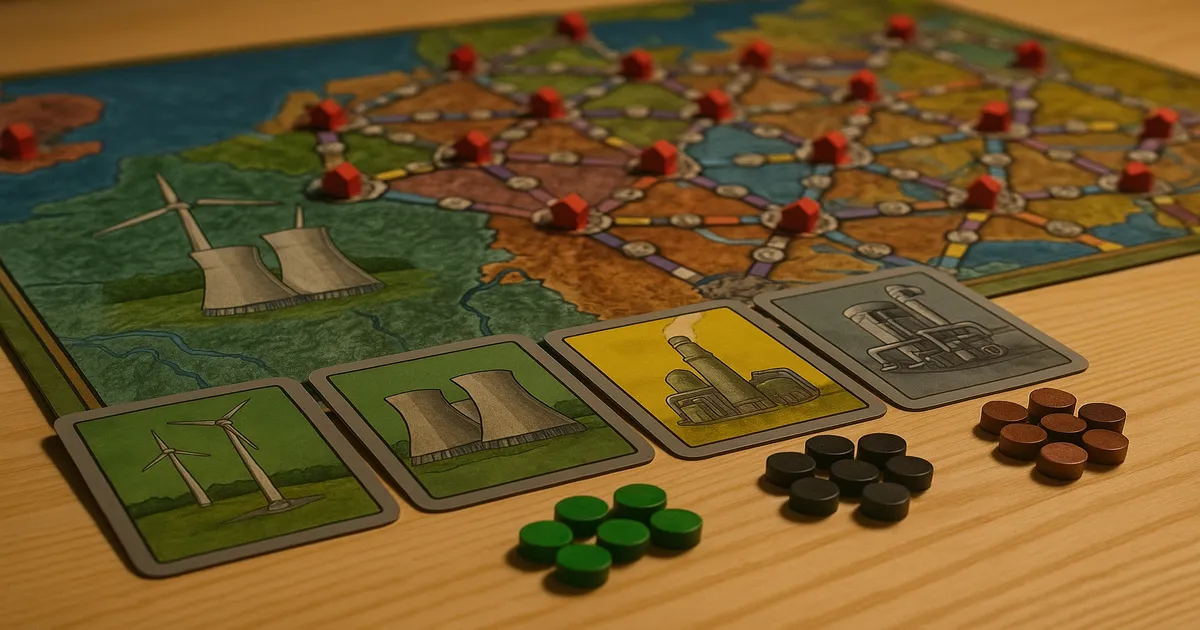
Quick Answer: Power Grid is a medium-heavy economic board game for 2–6 players where you build an electrical network, bid on power plants, and buy fuel to power cities for income. The game runs 120–150 minutes and has a BGG weight of ~3.0/5. Its defining twist: being in the lead is often a disadvantage, because the player with the most cities goes last in most beneficial phases.
Learning how to play Power Grid is one of the better investments you can make as a tabletop gamer. Designed by Friedemann Friese and published in English by Rio Grande Games, it looks intimidating on the table — the map, the resource market, the stacks of cardboard money — but it clicks into place surprisingly fast once you grasp the core logic. The auctions, the resource market, the city-building: everything feeds into a single elegant system that rewards planning without punishing newcomers too harshly.
What Is Power Grid and How Does It Work?
Power Grid puts you in charge of an energy company competing to power the most cities across a national map. Each round you’ll bid on power plant cards at auction, buy fuel from a shared market, pay to connect new cities to your network, and then fire your plants to earn income. The player who can power the most cities when the end-game trigger fires wins.
- Players: 2–6 (best at 4–5)
- Play time: 120–150 minutes
- BGG weight: ~3.0/5
The Core Tension That Makes Power Grid Special
Most economic games reward the leader. Power Grid deliberately punishes them. The player with the most cities goes last when bidding on power plants and buying resources — meaning trailing players get first pick of everything good. It’s a catch-up mechanism built directly into the turn structure, and it keeps games competitive right to the end. Once you understand that, the whole game opens up.
What’s in the Box?
- Double-sided game board (Germany on one side, USA on the other)
- 84 power plant cards
- Resource tokens: coal, oil, garbage, uranium
- Wooden house tokens in 6 player colors
- Elektro currency bills in multiple denominations
- Resource market board
- Player summary cards
- Step 2 and Step 3 cards (these shuffle into the power plant deck)
The base game’s components are honest but unflashy — cardboard money, simple wooden houses, small resource tokens. They do the job. The table footprint is genuinely large, though: you’ll need the map, the resource market board, the power plant market, and each player’s plant display all spread out at once, so clear some space.
Which Edition Should You Buy?
Power Grid Recharged (2020) is the version to get. It streamlines a few rough rules from the original and is now the standard edition in print. Power Grid Deluxe (2014) upgraded to metal resource tokens and better card stock — worth hunting down if you play often and want nicer bits — but Recharged is the cleaner product for new players.
How to Play Power Grid: Setup
Choose Your Map Regions by Player Count
The full map has more regions than you’ll use in a single game. You activate only a subset depending on player count — this is non-optional and essential for balance. A 3-player game on all six regions feels empty and disconnected. The region selection rule keeps the map tight and competitive, so don’t skip it.
Set Up the Power Plant Market
Shuffle the power plant deck, then insert the Step 2 card somewhere in the lower third and the Step 3 card near the bottom. Deal out 8 cards face-up, sorted numerically: the 4 lowest-numbered cards form the active market (available for purchase), and the next 4 form the future market (visible but not yet buyable). Set the card numbered 13 aside — it starts the game removed from play.
Distribute Starting Resources and Money
Seed the resource market board according to the chart in the rulebook. Each player starts with a set amount of Elektro (the exact figure varies by player count). Nobody starts with a power plant — you’ll buy your first one in the opening auction.
Setup takes 10–15 minutes the first time. Do it carefully. A misseeded resource market or wrong region selection will quietly warp the whole game.
How to Play Power Grid: The Five Phases
Every round follows the same five phases in order. After two or three rounds, it becomes automatic.
Phase 1 – Determine Turn Order
Rank players by number of cities in their network, most to fewest. Ties go to whoever owns the highest-numbered power plant. The player in first place goes last in Phases 2 and 3. This is the rule new players forget most often — it’s counterintuitive, and it matters enormously.
Phase 2 – Auction Power Plants
Starting with the last-place player and moving toward first, each player may bid on one power plant from the active market (the 4 cheapest visible cards). The minimum bid is the number printed on the card. Bidding is open — anyone can raise the price. You can only win one plant per round, and you don’t have to bid at all. After each purchase, the market slides: the bought card is replaced, the cheapest remaining card moves up, and a new card fills the bottom. If you end up with a fourth power plant, discard one immediately down to three.
Phase 3 – Buy Resources
Players buy fuel from the central resource market in reverse turn order — last place shops first. Resources are priced on a tiered track: the more that’s been bought, the more expensive what remains. You can only store resources on your plants, and each plant has a maximum capacity (usually double what it burns per round). You cannot buy more than you can store — this is a hard rule, not a suggestion.
Phase 4 – Build Cities
Again in reverse turn order, players pay to connect new cities. Each city has three slots at increasing costs — the first player to connect pays the base entry fee, the second pays more, the third even more. You also pay the printed route cost between cities on the map. Both costs come out of your pocket simultaneously, so budget for both.
Phase 5 – Bureaucracy
Everyone simultaneously fires their plants by removing stored resources. You earn income based on how many cities you successfully power — not how many you’ve connected. The income track is sharply exponential: powering 10 cities pays dramatically more than powering 6. After income is collected, the lowest-numbered plant in the market is removed and placed under the deck, a new card is drawn, and the next round begins.
Game Steps and Win Condition
The Three Game Steps
Power Grid escalates through three steps over the course of the game:
- Step 1: Only the first slot in each city is open. Standard resource costs.
- Step 2: Triggered when the Step 2 card is revealed from the deck. Second city slots open immediately; resource costs increase.
- Step 3: Triggered by the Step 3 card. Third slots open, and the Step 3 card reshuffles back into the remaining deck, accelerating the draw toward game end.
These cards trigger immediately when revealed — not at the end of the round. This catches new players off guard every time. If Step 2 appears during the auction phase, you apply the changes right then and continue the round under Step 2 rules.
How the Game Ends
The game ends at the end of the round in which any player connects the threshold number of cities:
| Players | Cities to Trigger End |
|---|---|
| 2 | 14 |
| 3 | 15 |
| 4–5 | 17 |
| 6 | 20 |
The winner is whoever can power the most cities on that final turn — not who triggered the end. That distinction creates genuine last-round drama. Tiebreaker is most Elektro remaining.
Common Mistakes New Players Make
- Forgetting turn order reversal. The leader goes last in Phases 2 and 3. New players run Phase 2 in the wrong direction constantly.
- Buying from the future market. Only the 4 cheapest plants are available. The top 4 are visible but off-limits.
- Overstocking resources. You cannot buy more than your plants can hold. Full stop.
- Keeping 4 plants. When you acquire a fourth, discard immediately to three.
- Missing Step card triggers. They fire mid-round, not at round end.
- Forgetting route costs. You pay the inter-city connection cost plus the city entry fee. Budget for both.
Overbuilding in Round 1 is the classic beginner blunder — you spend everything on cities, then can’t afford a good power plant or resources. The income track rewards patience: one big expansion from 7 to 12 cities beats three small ones. Also watch for anyone quietly cornering uranium plants in the early rounds. That’s usually a slow path to a win, and most new players don’t notice until it’s too late.
Power Grid Strategy Tips
Early Game: Efficiency Over Raw Power
The most important number on a power plant card isn’t how many cities it powers — it’s how much fuel it burns to do it. A plant that burns 1 coal to power 3 cities is dramatically better than one that burns 3 coal for the same output. Look for that ratio. Claim a geographic corner of the map early, too. Clustering your cities cuts connection costs significantly over a full game.
Mid Game: Sandbagging and Expansion Bursts
Sandbagging — deliberately staying in last place — is a legitimate strategy, not a gimmick. Last place gets first pick of plants and cheapest resources. If you can stay near the bottom while quietly building an efficient plant portfolio, a single big expansion turn can jump you past everyone. Time that burst to coincide with a jump into a higher income bracket and you’ll pull ahead fast. Also watch the Step 2 trigger closely: if you’re still running Step 1 plants when fuel prices rise, you’ll feel it immediately.
Late Game: Count What They Can Power, Not What They’ve Built
In the final rounds, count what opponents can power, not just what they’ve connected. Someone might have 18 cities on the map but only be able to fuel plants for 12. That’s who you’re actually racing. Wind and solar plants — no fuel cost, ever — become extremely valuable late when coal and oil prices spike. Grab one in the mid-game if you can. Resource denial is also real: buying fuel you don’t strictly need to starve an opponent in the final round is aggressive, but it works.
Never spend yourself dry. Liquidity beats hoarding cities almost every time.
Similar Games Worth Considering
| Game | Weight | Key Similarity | Key Difference |
|---|---|---|---|
| Brass: Birmingham | 3.9/5 | Network building, economic depth | More thematic, no auction, action-based |
| Age of Steam | 3.9/5 | Rail network, income track | Harsher, more punishing |
| Ticket to Ride | 1.9/5 | Route building on a map | Much lighter, no resource management |
| Container | 3.3/5 | Player-driven market economy | Shipping theme, more abstract |
Choose Power Grid if you want a deep economic game with meaningful auctions and very little luck. The inverted turn order is one of the most studied catch-up mechanisms in modern game design, and the emergent resource economy — driven entirely by what players buy, not random draws — is genuinely special.
Choose Brass: Birmingham if you want similar strategic depth with more thematic immersion and a slightly more modern design sensibility.
Choose Ticket to Ride if you want the map-building feeling but need something accessible for a mixed-experience group.
Choose Age of Steam if your group actively enjoys punishing economic games and doesn’t mind real financial pressure at the table.
Frequently Asked Questions About How to Play Power Grid
How many cities do you need to end the game?
It depends on player count: 14 cities for 2 players, 15 for 3, 17 for 4 or 5, and 20 for 6. Once any player connects that many, you finish the current round and then determine the winner — whoever can power the most cities, not who triggered the end.
What’s the difference between Power Grid and Power Grid Recharged?
Recharged (2020) is a revised edition that cleans up some of the original’s rougher rules and updates the components. The core game is the same, but Recharged is easier to teach and is the current standard version in print. If you’re buying new, get Recharged.
Can you buy more resources than your power plants can store?
No. Each power plant has a maximum storage capacity — typically double what it burns per round. You cannot purchase resources beyond what your plants can hold. It’s one of the most commonly misunderstood rules for new players.
Does the leader always go last in Power Grid?
In Phases 2 (auction) and 3 (resource buying), yes — the player with the most cities goes last. Ties break in favor of whoever owns the highest-numbered power plant. The same reverse order applies in Phase 4 (building). Turn order is recalculated at the start of every round.
What’s the best player count for Power Grid?
Four or five players is the sweet spot. At those counts the resource market gets genuinely competitive, the map feels appropriately tight, and the auction has real tension. Six works but adds significant play time. Two players is functional but loses some of the economic competition that makes the game sing.