Quick Answer: Spirit Island is a 1–4 player asymmetric cooperative game (90–120 minutes, BGG weight 3.9/5) designed by R. Eric Reuss and published by Greater Than Games. Players control ancient nature spirits defending a fictional island from colonial invaders. Each round you grow your spirit, play power cards, then watch the invaders ravage, build, and explore — your job is to outpace the destruction before the island falls. It’s one of the most complex and rewarding cooperative games ever made.
Learning how to play Spirit Island is genuinely a bit of a project. This is a BGG weight 3.9/5 game, and the rulebook knows it. But the complexity is earned. Once the system clicks, Spirit Island is unlike anything else on the table: a fully predictable enemy AI, eight wildly asymmetric spirits, and a premise that flips the usual conquest fantasy on its head. You’re not the colonizers here. You’re the island fighting back.
What Kind of Game Is Spirit Island?
Spirit Island is a cooperative puzzle. The invaders follow rigid, predictable rules — no hidden information, no dice for their actions — which means every round is about reading the board state and responding intelligently. That predictability is what makes the game feel fair even when it’s punishing you.
The theme is deliberate and resonant. You’re playing ancient spirits of the land — lightning, rivers, creeping vines — protecting the indigenous Dahan people from colonial expansion. It’s a rare inversion in a hobby full of conquest games, and it gives the whole experience a weight that most cooperatives don’t have.
The Core Loop in Plain English
Each round, you gain energy, choose which power cards to play, then watch the invaders move through three steps in strict order: Ravage (deal damage), Build (grow in strength), Explore (spread to new lands). Your powers resolve around that invader phase — some fast enough to prevent damage, some slow enough to clean up after. The goal is to generate Fear and destroy invaders faster than the island gets destroyed.
Components Overview
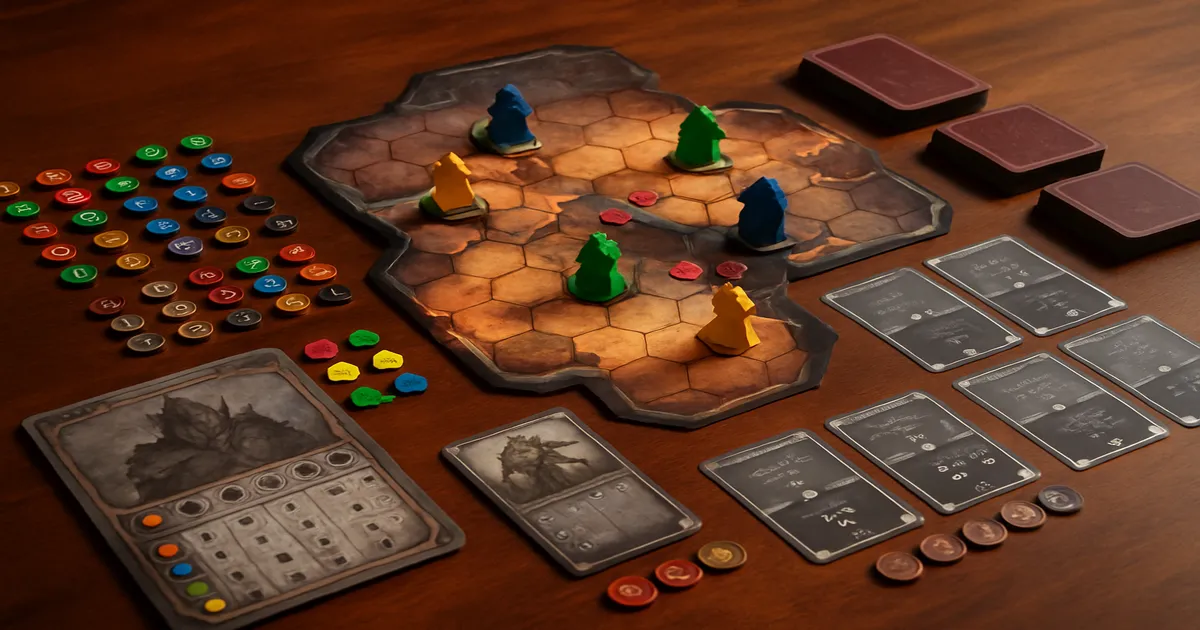
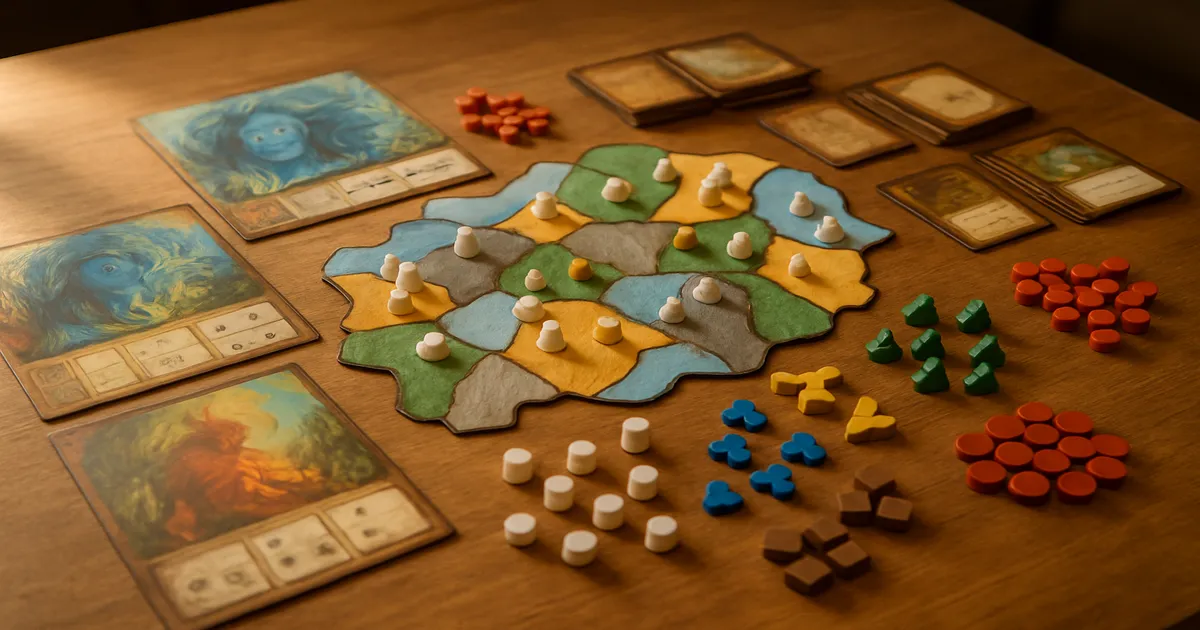
The base game includes four double-sided modular island boards that connect to form the full island — one board per player. Each board is divided into terrain types: Mountain, Jungle, Wetland, Sand, and Coastal. Invader pieces come in three sizes: small Explorers, medium Towns, and large Cities, all in white plastic. Brown Dahan pieces represent the indigenous people sharing the island with you.
Spirit panels are thick, durable boards with clear iconography — honestly some of the best-designed player boards in the hobby. Each of the eight spirits has its own panel and matching power deck, which means each player is essentially running a different game.
The Card Decks You Need to Know
- Minor Power Deck — ~40 cards, cheap and flexible, available to all spirits
- Major Power Deck — ~22 cards, expensive and powerful, but grabbing one costs you a permanent card discard
- Invader Deck — the engine driving the colonial spread; fully visible at all times
- Fear Cards — your reward for terrorizing the invaders; each one has an escalating effect
- Blight Cards — scenario-modifying cards that track island health
The linen-finish cards in later print runs feel great, and the island boards are thick and readable. I’d still recommend sleeving the spirit power cards since they see a lot of handling. (Dragon Shield Matte Standard) At four players, this game takes up a full dining table. The visual spread is genuinely impressive.
How to Set Up Spirit Island
Each player takes one island board and connects them to form the full island, then seeds the boards with starting Dahan and Invader pieces following the setup diagram. There’s a Quick-Start setup that simplifies this for your first game — use it.
Each player selects a spirit panel and places starting Presence tokens exactly as indicated. Don’t improvise here; the starting positions are carefully balanced. Take your spirit’s unique power deck, shuffle it, and draw four cards. For a first game, the rulebook recommends Lightning’s Swift Strike and A Spread of Rampant Green, and that advice is solid. Both are intuitive and teach you different things about how the game works.
The Invader Deck is assembled by shuffling three separate groups of terrain cards (Stage I, II, and III) and stacking them in order — this pacing structure is what gives the game its escalating tension, since Stage III cards are nastier and will hit eventually. Set up the Fear track with tokens based on player count, shuffle the Fear cards face-down, and place the Blight card with its starting tokens beside the island.
Turn Structure: The 5 Phases of Each Round
Phase 1 — Spirit Phase
Each spirit gains energy based on their current energy track, then players simultaneously choose which power cards to play face-down. You’re limited by your card plays stat and need enough energy to pay for everything you’ve chosen. Running out of card plays is just as limiting as running out of energy — they’re two separate resources.
Phase 2 — Fast Powers
Flip your chosen cards face-up and resolve all fast powers (lightning bolt symbol) in whatever order the players agree on. This is when you destroy invaders before they Ravage, push Explorers out of dangerous terrain, or protect Dahan. The order matters — talk it through before you start resolving.
Phase 3 — Invader Phase
This is the mechanical heart of the game, and the order is non-negotiable:
- Resolve Fear Cards earned this round
- Ravage — Invaders in Ravage lands deal damage to Dahan and Blight the land if total damage reaches 2+
- Build — Explorers become Towns, Towns become Cities, in Build lands
- Explore — New Explorers appear in lands matching the newly flipped terrain card, adjacent to existing Towns/Cities or on any Coastal land
Ravage → Build → Explore, always. New players frequently swap Build and Explore, which makes the game noticeably easier than intended.
Phase 4 — Slow Powers
Slow powers (moon symbol) resolve now. These are typically more powerful than fast powers but can’t prevent damage — they’re better for cleanup, repositioning, or setting up the next round.
Phase 5 — Time Passes
Discard played power cards to your personal discard pile. Advance the Invader Deck: the Explore card becomes the Build card, the Build card becomes the Ravage card, and a new card flips for Explore. Reset any per-round tokens and start again.
Win and Loss Conditions
How to Win
Every time you generate Fear, tokens move along the track. Enough Fear advances a Terror Level — there are three, each with a progressively easier win condition:
- Terror Level 1: Destroy all Cities
- Terror Level 2: Destroy all Towns and Cities
- Terror Level 3: Generate enough Fear (you can win without destroying anything)
Some Fear cards also trigger immediate victory, so read them carefully when you earn them.
How to Lose
- Blight pool empties — If you need to place Blight and there’s none left on the Blight card, the island is destroyed
- Invader Deck runs out — Time expires; the colonizers have won
- Any spirit loses all Presence — Even one eliminated spirit ends the game
The Blight Cascade Rule
This is the rule most new players miss, and it changes everything. When Blight is added to a land that already has Blight, it cascades — one Blight automatically spreads to an adjacent land. If that adjacent land also has Blight, it cascades again. A single bad Ravage can spiral into four or five Blight placements. Play without this rule and the game feels manageable; play with it correctly and you’ll understand why prevention is everything.
Key Strategic Fundamentals
Read the Invader Deck every round. It’s fully visible. You can see exactly which terrain will be Explored, which will Build, and which will Ravage this round and next. Spirits who ignore this are always reacting; spirits who read ahead are preventing. This single habit separates struggling players from winning ones.
Don’t neglect Presence expansion. Your energy and card play tracks only improve as you place more Presence on the board. Skipping expansion to play more cards this round stunts your engine badly by mid-game.
Fast powers prevent damage. Slow powers respond to it. A fast power that destroys three Explorers before Ravage is almost always worth more than a slow power doing the same damage afterward — because the Ravage already happened.
Use Dahan as weapons. After Ravage resolves, surviving Dahan in that land each deal 2 damage to invaders. Powers that move Dahan into invader-heavy lands before Ravage can set up devastating results: the invaders Ravage, then get wiped out by the Dahan response.
Don’t hoard cards and avoid Major Powers. New players tend to cling to their starting deck. If a Major Power solves a problem your spirit can’t otherwise handle, take it — the permanent discard is worth it.
Common Rules Mistakes
- Swapping Build and Explore — it’s Ravage → Build → Explore, always
- Forgetting the coastal Explore rule — Explorers appear in matching terrain adjacent to Towns/Cities or on any Coastal land, regardless of terrain type
- Missing Blight cascade — already-Blighted lands spread Blight to neighbors when hit again
- Skipping Dahan counterattack — surviving Dahan deal 2 damage to invaders after Ravage; this is a separate step, not part of Ravage itself
- Gaining energy at the wrong time — energy is gained at the start of the Spirit Phase, not the end
- Mixing Growth options — you pick one complete Growth option, not mix elements from different ones
Which Spirit Should You Play First?
Lightning’s Swift Strike is the most straightforward learning experience — fast, hits hard, and teaches you the importance of phase timing. A Spread of Rampant Green suits players who want an aggressive, board-filling feel with strong Dahan synergy. River Surges in Sunlight excels in multiplayer as a support spirit, and Vital Strength of the Earth is slow but incredibly durable — forgiving for players who need time to learn the systems.
Once you’ve got a few games in, Shadows Flicker Like Flame rewards careful planning with excellent mobility, and Thunderspeaker unlocks the full potential of Dahan management.
Avoid Bringer of Dreams and Nightmares until you understand the standard win path — it wins through Fear generation alone, which is confusing before you’ve internalized the baseline. Ocean’s Hungry Grasp has the highest skill ceiling in the base game; managing the push-into-ocean mechanic correctly takes real experience.
If you want a gentler entry point altogether, Horizons of Spirit Island is an official standalone product with five simpler spirits and a lower price point — it’s also the best gift for someone who’s curious but intimidated by the full box.
Scaling Difficulty: Adversaries and Expansions
Each of the six base Adversaries represents a colonial nation with unique rule modifications across six difficulty levels. Brandenburg-Prussia makes the Build phase more efficient and dangerous; England adds extra Blight pressure. You can dial in exactly how hard you want the game to be, and combining an Adversary with a Scenario multiplies the challenge further.
Branch & Claw is the right first expansion — it adds Event cards that make each round feel more dynamic, two new spirits, and Beasts/Wilds tokens that interact with the island ecosystem. It’s the most seamlessly integrated expansion and the one that feels most like “more Spirit Island.”
Jagged Earth is the largest expansion (10 spirits, Aspect cards that modify base spirits, new Adversaries) and is best saved until you’re comfortable with the base game. Nature Incarnate pushes complexity further with Incarna tokens. And if you want to introduce a new player to the system, Horizons remains the best tool for that job.
One more practical note: at four players, Spirit Island takes up a serious amount of table space. A dedicated insert or organizer makes setup and teardown dramatically faster.
Frequently Asked Questions About How to Play Spirit Island
How long does a game of Spirit Island take?
Experienced players typically finish in 90–120 minutes. New players learning together should expect 2–3 hours, especially at higher player counts. Solo games run closer to 60–90 minutes once you know the rules.
Is Spirit Island good for solo play?
It’s excellent for solo. You control one or two spirits and play against the Invader Deck as usual — no rule changes needed. The predictable invader AI makes it a satisfying puzzle rather than a luck-dependent slog, and many players consider it one of the best single-player board game experiences available.
What’s the best starting spirit for beginners?
Lightning’s Swift Strike is the most commonly recommended, and for good reason — it’s fast, hits hard, and teaches phase timing without overwhelming you. A Spread of Rampant Green is a close second if you want a more board-presence-focused experience.
How does the Invader Phase work?
Three sequential steps: Ravage (invaders deal damage to Dahan and Blight lands), Build (invaders grow stronger), then Explore (new Explorers appear based on the newly flipped terrain card). After Ravage resolves, surviving Dahan counterattack. The order is fixed — mixing it up is one of the most common new player errors.
How is Spirit Island different from Pandemic?
Pandemic (2–4 players, 45–60 minutes, BGG weight 2.4/5) is significantly simpler and faster. Both are cooperative, but Pandemic’s roles are lightly asymmetric while Spirit Island’s spirits play like completely different games. Spirit Island also uses a fully visible, predictable enemy system rather than card-draw randomness, and the strategic depth is in another league. If Pandemic feels too easy, Spirit Island is the natural next step — just expect a steeper learning curve.