Quick Answer: Yes, you can play Codenames with 2 people using the official cooperative variant in the base game — one player is the Spymaster, one is the Operative, and you work together to find all agents in as few turns as possible. It’s genuinely fun, but if two players is your usual situation, Codenames Duet was built from the ground up for exactly that and is worth knowing about before you spend any money.
Codenames is one of those rare games that earns its reputation. It won the 2016 Spiel des Jahres — the most prestigious award in tabletop gaming — and it’s easy to see why. The box says 2–8 players, but if you’re figuring out how to play Codenames with 2 people, the answer is a bit more nuanced than that player count implies. The game is at its best with four or more. That said, the 2-player mode is legitimate, well-designed for what it is, and plenty of people play it regularly.
Codenames Basics: What You Need to Know First
How the Game Normally Works
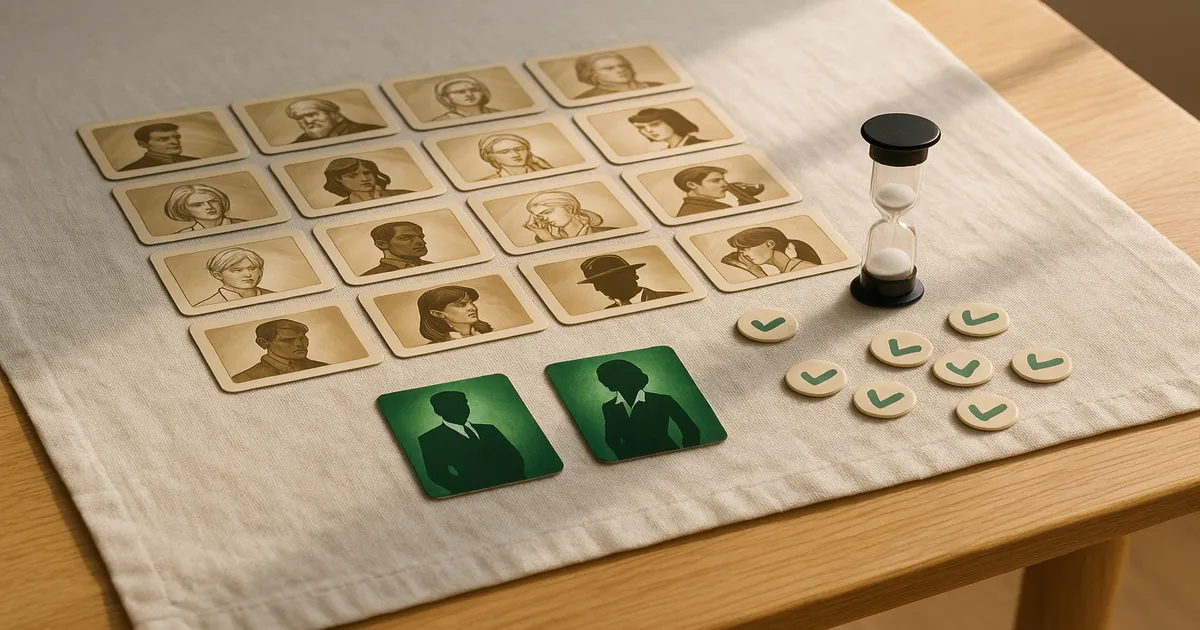
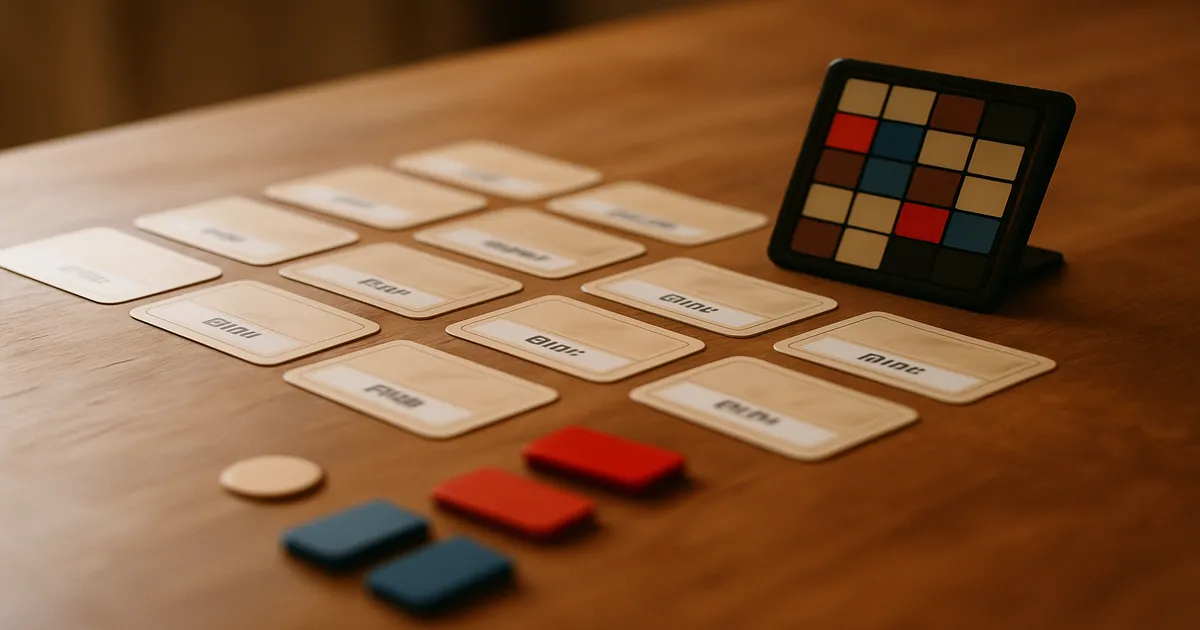
Two teams compete to identify their secret agents hidden among 25 words laid out in a 5×5 grid. Each team has a Spymaster who can see a secret key card showing which words belong to which team. The Spymaster gives one-word clues to their teammates, who try to guess the right words without landing on the other team’s agents — or the Assassin, which ends the game instantly.
The tension lives in that Spymaster role. You can see everything, but you can only communicate through a single word and a number. It’s a wonderful, agonizing puzzle.
What’s in the Box
- 200 double-sided word cards (400 unique words total)
- 40 key cards showing agent, bystander, and assassin placement
- 1 card stand for the key card
- 8 red agent cards, 8 blue agent cards
- 1 double agent card (marks which team has 9 words instead of 8)
- 7 innocent bystander cards
- 1 assassin card
Components are modest but functional — thick cardstock, clear fonts, clean design. At $20–$25, there’s nothing to complain about.
The Grid, the Key Card, and the Assassin
The 25 words are split between Red agents, Blue agents, neutral bystanders, and one Assassin. Only the Spymasters know which is which, thanks to the key card hidden in the stand. One team always has 9 words to find (because they go first), the other has 8.
The Assassin is the game’s sharpest rule: touch that word and your team loses immediately, no matter what. It’s not a penalty — it’s a full stop. That one rule is responsible for most of the game’s drama.
How to Play Codenames with 2 Players: The Official Rules
Setting Up for Two
Setup is identical to the standard game. Lay out 25 word cards in a 5×5 grid. One player takes the Spymaster role and looks at a key card (placed in the stand so only they can see it). The other player is the Operative. No teams, no competition — just the two of you against the board.
Turn Structure: Clues and Guesses
The Spymaster gives a one-word clue followed by a number — “River: 2,” for example — meaning two of your agents’ words connect to that clue. The Operative thinks out loud (encouraged, even in 2-player) and starts guessing.
Here’s how a turn plays out:
- Spymaster announces their clue word and number
- Operative thinks out loud and touches a card
- Spymaster reveals what it is (agent, bystander, or assassin)
- If correct, the Operative may keep guessing — up to the clue number, plus one bonus guess
- The turn ends when the Operative guesses wrong, hits a bystander, or chooses to stop
That “plus one” matters. If the clue was “River: 2,” the Operative gets up to 3 guesses total. You’re never forced to use all of them.
Scoring in 2-Player Mode
You’re not racing another team — you’re racing yourself. The goal is to find all agents in as few turns as possible. The rulebook includes a scoring table: fewer turns means a better result. Think of it like golf, except you actually want the low score. It’s a surprisingly effective motivator and gives the mode a competitive hook even without an opponent.
Win and Loss Conditions
You win when all agents are identified. You lose the moment either player triggers the Assassin — instant loss, no exceptions. This is what keeps the 2-player mode tense even without another team breathing down your neck.
Common Mistakes When Playing Codenames with Two People
Rules Mistakes New Players Make
- Forgetting the +1 bonus guess. You always get one more guess than the number called. A lot of new players miss this entirely.
- Thinking you must use all your guesses. You don’t. Stopping early is often the right call.
- Treating the Assassin as just a bad guess. It ends the game. Don’t soften that rule — it fundamentally changes how you approach clue-giving.
- Illegal clue words. You can’t use any word visible on the board, and you can’t use words that share a root with a board word. No saying “Swimming” if “Swim” is in the grid.
- Carrying over guesses. Unused guesses from a previous turn are gone. Each turn starts fresh.
Strategic Errors That Cost You the Game
The biggest Spymaster mistake is overreaching — trying to link four or five words with one clue and accidentally pulling the Operative toward the Assassin. Two or three safe connections beat five risky ones every time.
On the Operative side, the most common error is overriding the Spymaster’s intent. If your partner said “Ocean: 2” and you’ve found one obvious word, trust that there’s a second one — don’t start free-associating into territory they never intended. They’ve seen the key card. You haven’t.
Strategy Tips for 2-Player Codenames
Spymaster Tips: Building Better Clues
Before your first clue, spend a moment mapping the entire board. Mentally sort all 25 words: yours, theirs, bystanders, and especially the Assassin. Know your danger zones before you open your mouth.
- Identify “poison” words first — words that sit dangerously close in meaning to the Assassin. Avoid cluing toward them until the Assassin is conceptually far enough away.
- Think in clusters of 2–3. Linking three words safely is almost always better than reaching for five recklessly.
- Use “1” clues strategically. A single-word clue to clear a dangerous word off the board can open up much better multi-word clues later.
- Check your opponents’ words too. Ask yourself: “Could this clue also point to a bystander or the Assassin?” If you hesitate, reconsider.
Operative Tips: Guessing More Accurately
Talk through your reasoning out loud, even if it feels silly. Verbalizing your thought process helps you catch your own mistakes — and in a 2-player game, the Spymaster at least knows which direction your thinking went wrong, without giving anything away.
Know when to stop. If you’ve found the obvious connections and the next guess feels like a stretch, it probably is. A wrong guess costs you turns, which costs you score.
Using the Bonus Guess Well
This is the mechanic most people underuse. The bonus guess isn’t just an extra shot at the current clue — it’s a tool for clearing unfinished business from earlier turns. If you got two of three words from “River: 3” last turn, the Spymaster can give a new clue this turn and you can use the bonus guess to finally nail that third word. Good teams track their previous clues and use the bonus accordingly.
House Rule Variants for 2-Player Codenames
Competitive 2-player: Each player acts as both Spymaster and Operative for their own team, alternating turns. Write your clue down before your turn so you can’t cheat. It works, but it loses most of what makes Codenames special — the shared “aha!” moments, the debate, the social deduction. Worth trying once.
Timed variant: Set a 10-minute timer and see how many agents you can find. This is probably my favorite unofficial tweak — it adds urgency without changing any rules, and it makes the Operative’s deliberation feel genuinely high-stakes.
Adjusting difficulty: The simplest dial is the turn limit. Too easy? Reduce the turns you allow yourselves. New and getting crushed? Give yourselves a few extra to breathe.
Should You Buy Codenames Duet Instead?
Codenames Duet (2–4 players, 15–30 minutes) flips the structure entirely. Both players are Spymasters simultaneously, using a double-sided key card — each player sees a different version of the grid, with different words marked as agents. You’re giving clues to each other, which creates a genuinely cooperative puzzle the base game’s 2-player mode can’t fully replicate. It also includes a campaign mode with a map of cities to unlock, adding long-term goals the base game lacks entirely.
Base Game vs. Duet: A Quick Comparison
| Codenames (Base) | Codenames Duet | |
|---|---|---|
| Designed for 2 | No (adapted) | Yes |
| Both players Spymasters | No | Yes |
| Campaign mode | No | Yes |
| Works with larger groups | Yes | Yes (up to 4) |
| Price | ~$20–25 | ~$20–25 |
If you play Codenames almost exclusively with one other person, buy Duet. It’s not just “better for 2” — it’s a meaningfully different and more satisfying cooperative experience. The base game’s 2-player mode is a workaround. Duet is the real thing.
That said, if you mostly play with groups of four or more and just occasionally want a 2-player session, the base game is the better all-rounder. You don’t need both.
Other 2-Player Word Games Worth Considering
- Wavelength (2–12 players) — You give clues on a spectrum rather than a grid. Less about words, more about reading your partner’s mind. Works beautifully at 2 and is genuinely underrated.
- Just One (3–7 players) — Cooperative and hilarious, but needs at least 3 to work.
- Decrypto (3–8 players) — More complex, involves encoding and intercepting clues across multiple rounds. Needs at least 3 to shine.
For pure 2-player word gaming, Duet is still the top pick in this category. Wavelength is the best alternative if you want something with a different feel.
Frequently Asked Questions
Can you play Codenames with just 2 players?
Yes — the official rulebook includes a cooperative 2-player variant where one player is the Spymaster and the other is the Operative. You work together to find all agents in as few turns as possible. It works well, though the game is designed around larger groups. If 2 is your usual count, Codenames Duet is a better fit.
What’s the difference between Codenames and Codenames Duet?
The base game is a competitive team game for 4–8 players, playable at 2 with a cooperative variant. Codenames Duet is designed specifically for 2–4 players and makes both players Spymasters simultaneously using a double-sided key card. Duet is cooperative from the ground up — not an adaptation.
What happens if you guess the Assassin in Codenames?
Your team loses immediately. The Assassin is an instant-loss condition — the game ends right there, regardless of how well you were doing. This applies in the 2-player cooperative mode too, and it’s the main source of tension when you’re playing without an opposing team.
How many guesses do you get per turn in Codenames?
You get the number stated in the clue, plus one bonus guess. If the Spymaster says “Ocean: 3,” the Operative can guess up to 4 times that turn. You’re never required to use all your guesses — stopping early is often the smarter play.
Is Codenames Duet worth buying if you already own Codenames?
If you play frequently with just one other person, yes. The cooperative experience Duet offers is genuinely different from the base game’s 2-player mode — not just a marginal improvement. If you mostly play Codenames with larger groups and rarely sit down at 2, you can skip it.