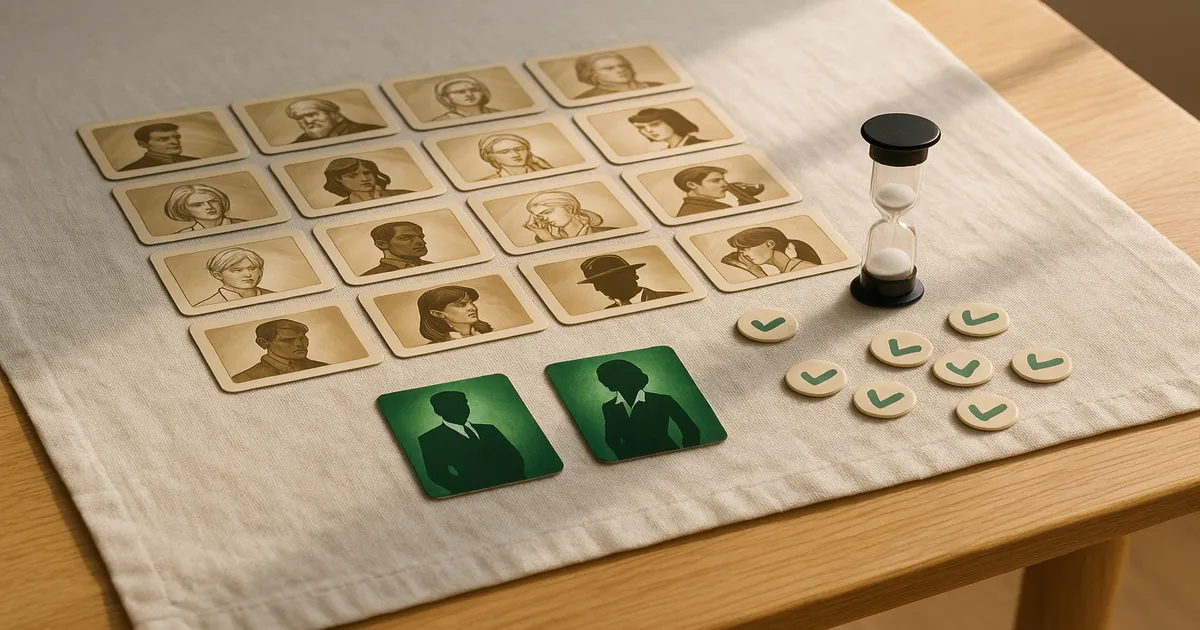
Quick Answer: Codenames Duet is a cooperative two-player word game where both players work as secret agents, giving one-word clues to help each other identify 15 agent words hidden in a 5×5 grid. Each player sees a different side of a double-sided key card — so you’re working with asymmetric information — and touching the wrong word ends the game instantly. You’ve got 9 timer tokens to get it done. (2 players, 15–30 minutes, BGG weight 1.8/5, rated ~7.9)
If you’re trying to figure out how to play Codenames Duet, the rules themselves aren’t the hard part. The challenge — and the fun — comes from the asymmetric key card system and the relentless timer pressure. Most new pairs lose their first few games. That’s fine. That’s kind of the point.
What Is Codenames Duet?
Codenames Duet came out in 2017, designed by Vlaada Chvátil and Scot Eaton and published by Czech Games Edition — the same team behind the original Codenames (2015). Where the original is a competitive party game for two opposing teams, Duet strips that out entirely and rebuilds it for two players working together. Same grid, same one-word-clue mechanic, completely different experience.
It’s consistently rated around 7.8–8.0 on BoardGameGeek, which for a light word game is genuinely impressive. It shows up on “best games for couples” lists constantly, and that reputation is earned. The BGG complexity weight of 1.8/5 means it’s accessible — no board game experience required — but there’s enough depth here to keep experienced players engaged for a long time.
What’s in the Box
- 200 double-sided word cards (400 unique words total)
- 64 double-sided key cards
- 1 card stand
- 15 green agent tokens
- 2 black assassin tokens (one per side of the key card)
- 9 sand-colored timer tokens
- Campaign map booklet
- Rulebook
The cards are standard cardstock — functional, not fancy. If you’re planning to play this regularly, sleeving is worth it. The card stand is simple cardboard, but it does its job and creates a nice visual centerpiece on the table.
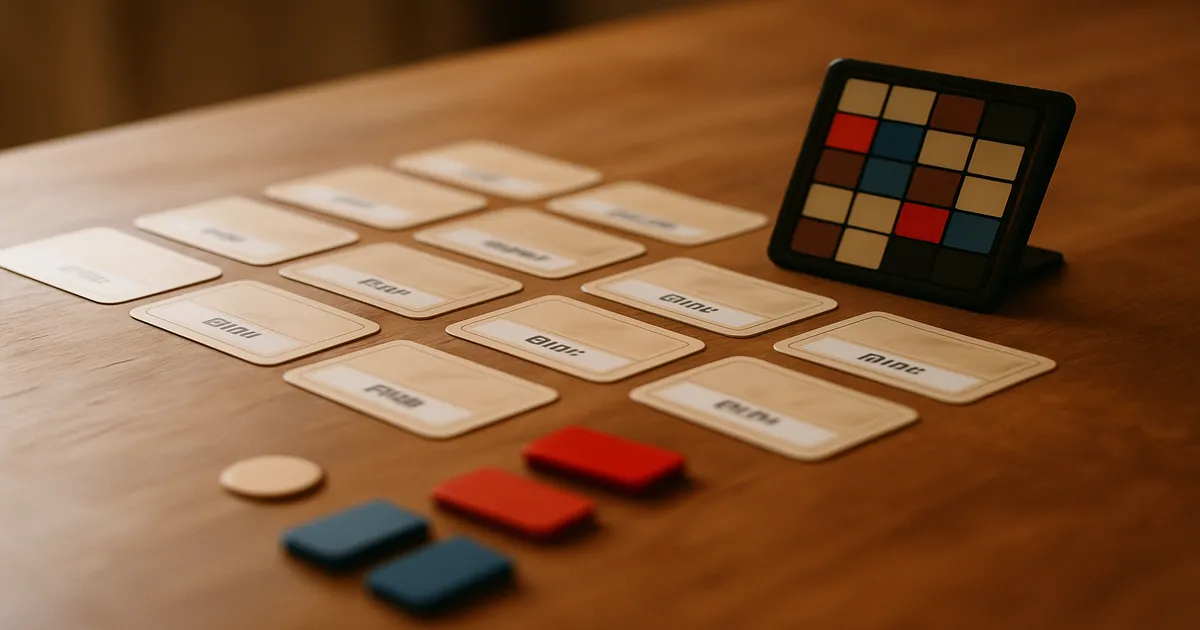
The key card is what makes Duet special. It sits in the stand between the two players so each person sees a different side — meaning you each have private information about which words are agents, which are assassins, and which are neutral. No other mainstream word game does this, and it changes everything about how you think through your clues.
How to Set Up Codenames Duet
Shuffle the word cards and deal 25 face-up in a 5×5 grid. Pick a key card and slot it into the stand between you and your partner. Double-check that each person is looking at their correct side before you start — flipping it by accident ruins the game.
Each side of the key card shows the same 5×5 layout, but with a different color pattern:
- Green squares — agent words your partner needs to identify
- Black squares — assassins; if your partner touches one, you lose instantly
- Beige squares — neutral bystanders; no harm done, but a wasted guess
Here’s the part that trips up a lot of new players: some squares appear as agents on both sides of the key card. Those overlapping words are doubly efficient — correctly guessing one clears it from both players’ boards simultaneously. Across both sides combined, there are 15 total agent words to find.
How to Play Codenames Duet: Turn Structure
Step 1: The Spymaster Gives a Clue
One player is the Spymaster for the turn. They give a single word followed by a number — “Ocean: 3,” for example — meaning they think three words on the grid connect to that clue. The clue word can’t be any word currently visible on the grid, a derivative of a grid word, or a proper noun.
Step 2: The Guesser Touches Cards
The other player touches cards they think match the clue, one at a time. They can guess up to the stated number plus one bonus guess, and they can stop at any point. After each touch, the Spymaster places the appropriate token on that card based on their key card: green for agent, black for assassin, beige for bystander. Touch a black square and the game ends immediately.
Step 3: Roles Reverse
Once the guessing phase ends — either because the guesser stopped or ran out of guesses — roles switch. The former guesser becomes the Spymaster and gives the next clue.
The Timer
Every time a clue is given, one timer token is removed. You start with 9. Run out before finding all 15 agents and you lose.
Do the math: 9 tokens, 15 agents. You need to average more than 1.6 correct guesses per clue just to break even. Cautious, single-word clues aren’t just inefficient — they’re mathematically losing plays. Efficiency isn’t a bonus strategy. It’s mandatory.
Win and Loss Conditions
You win when all 15 agent words are correctly identified before the timer tokens run out.
You lose two ways:
- By assassin — Either player touches a word that appears as a black square on their partner’s key card. Instant game over, no matter how many agents you’ve already found.
- By time — The 9-token supply runs out before all 15 agents are identified.
Common Mistakes New Players Make
Forgetting that assassins are asymmetric. This is the big one. New players assume the assassins are shared between both sides of the key card — they’re not. A word that’s completely safe on your side might be your partner’s instant-loss word. You can see your own assassins but not your partner’s, which means a clue that seems totally reasonable to you could accidentally point toward disaster.
Ignoring the bonus guess. Guessers are always allowed one more guess than the stated number. Beginners forget this constantly, which leaves agents on the board and burns tokens for nothing.
Playing it too safe. I’ve watched new players give “1” clues all game and then wonder why they ran out of tokens with six agents still on the board. You need multi-word clues, and you need them consistently.
Missing overlapping agent squares. When a word is an agent on both sides of the key card, guessing it correctly clears it for both players at once. Experienced Spymasters scan for these before giving any clue — it’s the single biggest efficiency lever in the game.
Strategy Tips for How to Play Codenames Duet Well
Giving Better Clues
Before anything else, scan your key card for overlapping agent squares — words that appear green on both sides. Building clues around those is your highest-value play. Then, before you commit to any multi-word clue, mentally verify that none of your target words are assassins on your partner’s side. You can see their assassins on your key card, so use that information.
Think in semantic clusters: colors, animals, places, emotions. A clue that bridges two clusters — “Jungle: 3” for PYTHON, AMAZON, and WILD — is the kind of efficient play that wins games. And use the number itself to communicate: a clue of “4” signals confidence; a clue of “1” signals caution.
Making Smarter Guesses
Start with your most confident pick, not a random one. If you’ve used your confident guesses and you’re uncertain about the bonus, stopping is often the right call. A neutral card wastes a guess but doesn’t end the game. An assassin does.
Pay attention to what’s already been revealed. Every eliminated card updates your picture of what’s left, and that should inform how you interpret future clues.
Playing as a Partnership
Develop shared vocabulary over time. Couples and close friends who play Duet regularly get noticeably better because they start to understand how each other thinks about word associations. The game actively rewards that kind of familiarity.
Don’t talk through your reasoning during the game — that’s against the rules and removes the whole challenge. Save the debrief for after. Post-game conversations about why a clue landed or didn’t are genuinely useful and make you better next session.
Campaign Mode
The campaign map booklet adds an optional layer of long-term progression that’s rare in word games. It’s a series of missions on an adventure map, each with slightly different rules — adjusted token counts, special constraints, escalating difficulty. Some missions reduce your token supply below 9, which forces even tighter efficiency.
For new pairs, I’d actually recommend starting with the campaign rather than ignoring it. It naturally teaches you to play efficiently without anyone having to lecture you about it. The progressive structure also gives you a reason to keep coming back, which is more than most games in this category offer.
How Codenames Duet Compares
vs. Original Codenames
| Feature | Codenames (2015) | Codenames Duet |
|---|---|---|
| Player Count | 4–8+ | 2 (scalable to teams) |
| Mode | Competitive | Cooperative |
| Key Card | Single, shared | Double-sided, asymmetric |
| Timer | None | 9-token limit |
| Best For | Game nights, parties | Couples, pairs |
If you don’t already own the original, it’s worth picking up both — they scratch very different itches. (Codenames)
Other Cooperative Word Games Worth Trying
Just One (3–7 players, Spiel des Jahres 2019 winner) is a great pick if you need something for a larger group — simpler than Duet but genuinely fun. Wavelength has a similar “reading your partner’s mind” quality and works well for 2–6 players. Letter Jam (also from Czech Games Edition) is excellent for dedicated word game fans who want something meatier.
What Duet does that none of these do: the asymmetric hidden-information key card. That’s a genuinely original mechanic, and it’s why Duet stands alone in its category.
Frequently Asked Questions About How to Play Codenames Duet
Can you play Codenames Duet with more than 2 players?
Yes — split into two teams, with each team sharing a role (one team gives clues, the other guesses). It works fine, though the game is clearly designed for two people. The asymmetric key card setup functions the same way with teams.
How hard is Codenames Duet for beginners?
Expect to lose your first few games. The rules are simple (BGG weight 1.8/5), but the timer math is unforgiving and the asymmetric assassin system catches new players off guard. Most pairs start winning consistently after three to five sessions together.
How long does a game of Codenames Duet take?
About 15–30 minutes per game. It plays fast, which makes it easy to replay immediately after a loss — and you’ll want to.
Can Codenames Duet cards be mixed with the original Codenames?
Yes, with some adaptation. The word cards are compatible, so you can shuffle them together to expand your word pool. The key cards are not interchangeable between the two games since they’re designed for different setups, but mixing the word cards is a common house rule for players who’ve exhausted the base vocabulary.
Is the campaign mode worth playing?
Absolutely, especially for new players. It eases you into tighter efficiency requirements gradually, and the adventure map framing gives you a satisfying sense of progress. Don’t skip it just because it’s optional.