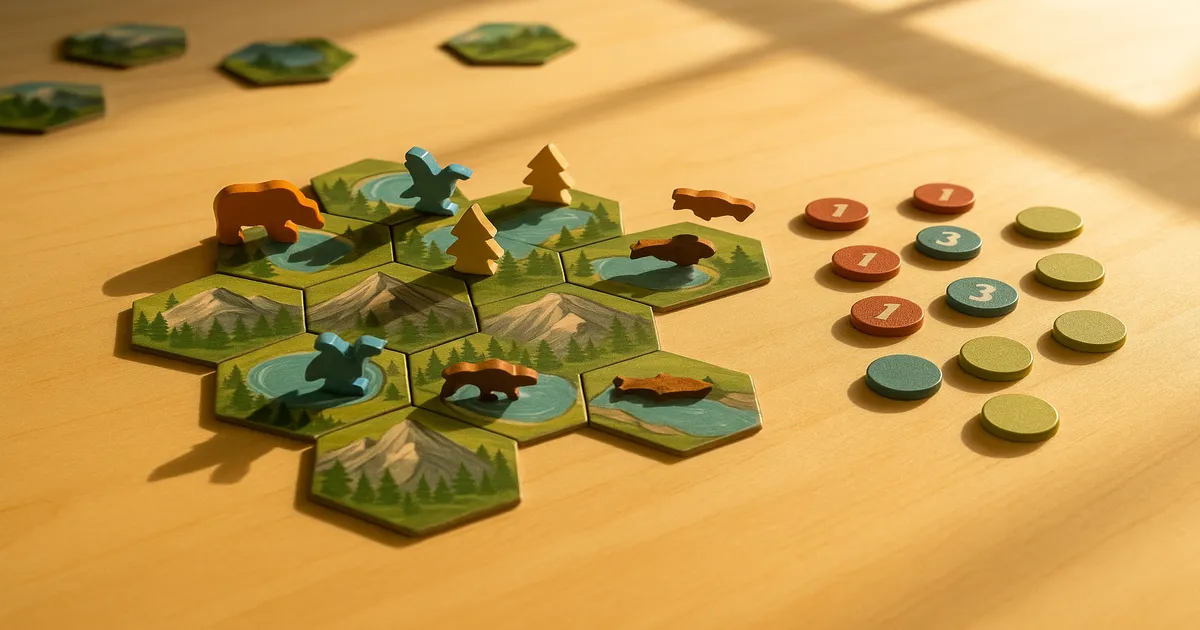
Quick Answer: Cascadia Alpine Lakes is part of the Cascadia family of games — the tile-drafting, wildlife-placement game designed by Randy Flynn that won Spiel des Jahres 2022. Each turn you draft a habitat tile and wildlife token from a shared market, build out your personal nature reserve, and score points at game end through wildlife scoring cards, habitat corridors, keystone tiles, and nature tokens. It plays 1–4 players in 30–45 minutes with a BGG weight around 1.9/5. Transparency note: “Alpine Lakes” may refer to a specific edition, regional variant, or newly released product — verify the exact version you own against the publisher’s official rulebook before play, as some component details may differ slightly from what’s covered here.
Learning how to play Cascadia Alpine Lakes is one of the more pleasant rules-learning experiences in modern tabletop gaming. The core system is simple enough to explain in five minutes, but the rotating wildlife scoring cards mean every game asks something different of you. If you’ve already played the base Cascadia game, Alpine Lakes will feel immediately familiar. Either way, this guide covers everything — rules, scoring, and strategy — regardless of which edition you’re holding.
What Is Cascadia Alpine Lakes?
Designer, Publisher & Awards
Cascadia was designed by Randy Flynn and developed by Flatout Games, published in North America by AEG (Alderac Entertainment Group) and by Osprey Games in some markets. It released in 2021 and won the Spiel des Jahres 2022 — the most prestigious award in hobby gaming. That award matters here: it’s not handed to complicated games. Cascadia earned it by being genuinely elegant, and it’s been sitting comfortably in BGG’s top 100 ever since.
How Alpine Lakes Fits Into the Cascadia Family
The Cascadia product line has grown to include the base game, the Landmarks expansion, additional scoring card packs, and various edition variants. Alpine Lakes is likely one of these editions — probably featuring art or tile content themed around alpine lake environments within the Pacific Northwest ecosystem. If you’re unsure exactly what’s in your box, cross-reference with the official AEG or Flatout Games website before assuming any component differs from the base game.
Who Is This Game Best For?
Families with kids 10+, casual gamers who want something meatier than Ticket to Ride without the rules overhead of Wingspan, and anyone who responds to gorgeous naturalistic art. Nature lovers especially tend to fall for it. It’s also one of the best solo games in its weight class — more on that later.
Components & Setup
What’s in the Box
- 85 habitat tiles across five terrain types: mountains, forests, prairies, wetlands, and rivers
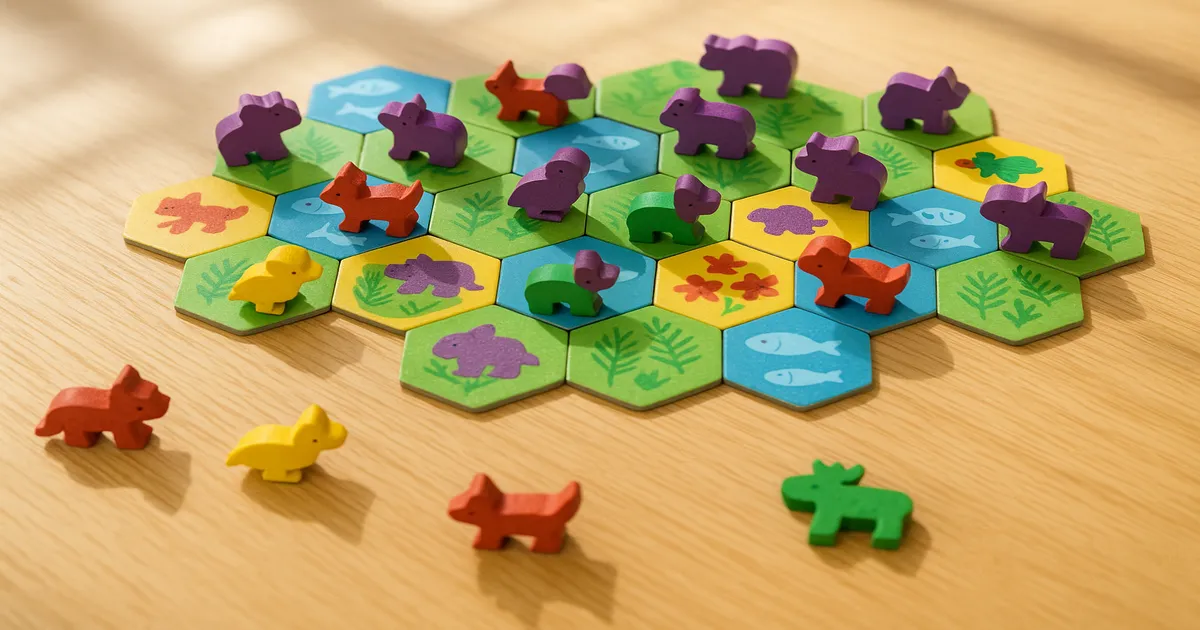
- 100 wooden wildlife tokens — 20 each of bear, elk, salmon, hawk, and fox
- 25 wildlife scoring cards — 5 per animal type, 3 randomly selected per game
- Starting tile clusters — unique 3-tile starters for each player
- Wooden nature tokens (laser-cut pinecones)
- Cloth draw bag for tiles and tokens
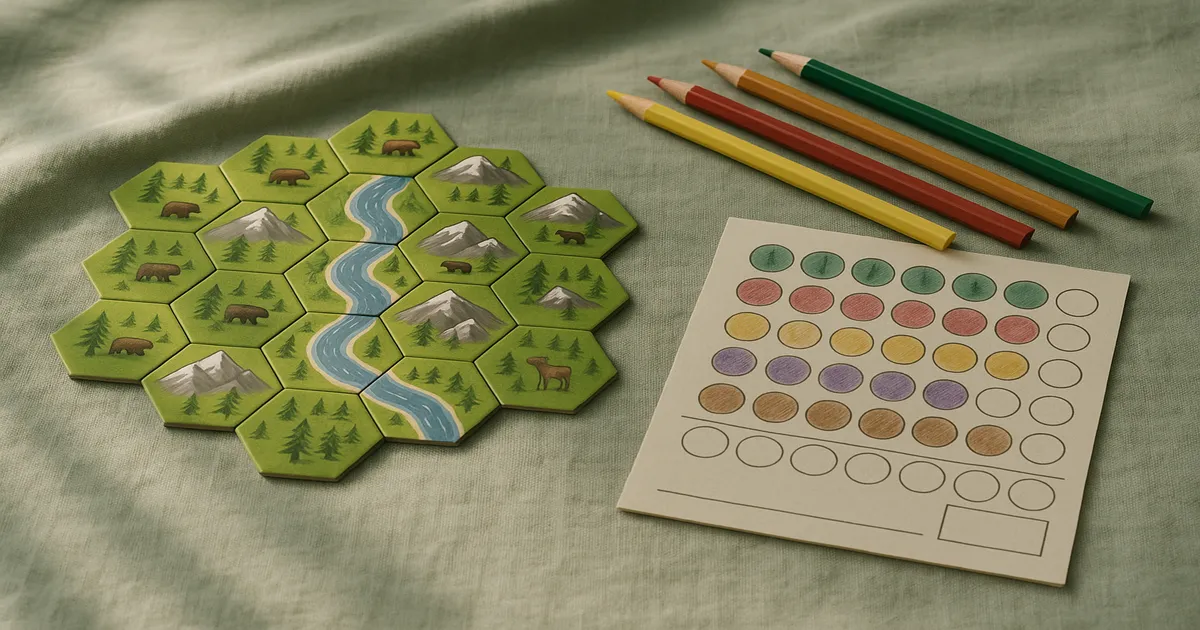
- Scoring pad
The tiles are thick, satisfying cardboard that don’t slide around once placed. The wildlife tokens are chunky silk-screened wooden discs, and the pinecone nature tokens are legitimately delightful little laser-cut pieces that everyone picks up and fidgets with. Beth Sobel’s art is the real star: soft, warm, naturalistic illustration that makes your growing nature reserve look genuinely beautiful on the table.
If you want to protect those tiles and cards for the long haul, it’s worth picking up a good insert to keep everything organized between sessions.
How to Set Up Cascadia Alpine Lakes
- Give each player a starting tile cluster (3 connected tiles).
- Randomly draw and reveal 3 wildlife scoring cards per animal type (15 cards total) — set these face-up where everyone can see them.
- Fill the central market with 4 face-up habitat tile and wildlife token pairs drawn from the bag.
- Place the remaining tiles and tokens in the cloth bag.
- Give the first player marker to whoever most recently visited a national park — or just pick randomly.
How a Turn Works in Cascadia Alpine Lakes
Step 1 — Choose a Tile and Wildlife Token Pair
The market always shows 4 tile-token pairs. On your turn, you take one pair — both the tile and the token sitting on it. You can’t take just the tile or just the token unless you spend a nature token.
Step 2 — Place Your Habitat Tile
Your new tile must connect orthogonally to at least one tile already in your nature reserve. There’s no restriction on which terrain types can be adjacent — you’re just building outward from your starting cluster. The shape of your reserve matters a lot for corridor scoring, so think a turn or two ahead.
Step 3 — Place Your Wildlife Token
Each habitat tile has 1–3 animal icons printed on it, indicating which token types are legal there. You must place your token on any tile in your reserve that shows that animal’s icon — including tiles placed in previous turns. You can also choose not to place a token at all, which is occasionally the right call.
Step 4 — Replenish the Market
Draw a new tile-token pair from the bag and add it to the market. Play passes left.
The Nature Token (Pinecone) Rule
Whenever three or more identical wildlife tokens appear simultaneously in the market, every player immediately receives one nature token. This happens before the active player takes their turn, so everyone benefits equally.
You can spend a nature token to do one of two things:
- Take any tile and any token from the market as separate items, ignoring normal pairing
- Flip a wildlife token you’ve already placed, replacing it with a token of your choice from the supply
Unspent nature tokens are worth 1 point each at game end.
Scoring: How to Win Cascadia Alpine Lakes
Wildlife Scoring Cards
This is the part that makes Cascadia sing. At setup, you randomly selected 3 scoring cards per animal — those cards define exactly how that animal scores this game. Bears might score for isolated pairs. Salmon might score for runs of 4 or more. Hawks might need spacing between them.
Read all 15 active cards before you place anything. I’ve watched players spend three turns placing salmon tokens before realizing the active card rewards groups of exactly three — and they’d already spread them across their reserve. Don’t be that person.
Habitat Corridor Bonuses
At game end, for each terrain type, only your single largest contiguous group scores the corridor bonus. Not all your forest tiles — just the biggest connected forest. Two separate forest groups of 4 tiles each doesn’t score the same as one connected group of 8. This trips up new players constantly.
Keystone Tile Bonus Points
Any tile in your reserve that shows only one animal icon is a keystone tile and awards +1 bonus point. Easy to forget, but in a close game they add up fast.
Nature Token Points
Each pinecone you didn’t spend = 1 point. Simple — but don’t let that tempt you into hoarding them. Spending one to fix a bad wildlife placement is almost always worth more than saving it.
Sample End-Game Score
Say you finish a 4-player game with this:
- Wildlife: 8 pts from salmon runs, 5 from hawks, 3 from bears
- Corridors: Largest forest = 7 tiles (7 pts), largest mountain = 4 tiles (4 pts), river = 2 tiles (2 pts)
- Keystones: 3 single-icon tiles = 3 pts
- Nature tokens: 2 unspent = 2 pts
Total: 34 points. Winning scores typically fall between 60–80 in a full game, so scale this up across all five animal types and larger corridors.
Strategy Tips for Cascadia Alpine Lakes
Early Game: Build Flexibility First
Read every active scoring card before you place a single token. Then prioritize tiles that accept multiple animal types in your first few turns — they keep your options open as the game develops. Overcommitting to one animal in turns 1–3 is the most common way to paint yourself into a corner.
Mid Game: Corridors vs. Wildlife
River and wetland tiles are scarcer than mountains and forests, so when they appear in the market, take them seriously even if the paired token isn’t ideal. A long river corridor can be worth 6–8 points on its own. Also watch what other players are ignoring — if a tile keeps getting passed over, there’s usually a reason.
Late Game: Count, Deny, and Hunt Keystones
Before extending a corridor in the final few rounds, count exactly how many tiles are in your current largest group. Sometimes merging a secondary group into your main one is worth more than extending an already-dominant corridor. And if the game is close, taking a tile your opponent desperately needs — even if it’s suboptimal for you — is completely legitimate.
Nature Token Strategy
Spend nature tokens mid-game to fix bad wildlife placements. A misplaced hawk token that’s blocking your scoring pattern is costing you 3–5 points — spending a pinecone to flip it is a clear win. Saving them all for 1 pt each at game end feels conservative but usually costs you more than it gains.
Solo Mode
Solo Cascadia uses a target score threshold system rather than a high-score-chase. It’s genuinely good, and I’d recommend a few solo sessions specifically to get comfortable with different scoring card combinations before sitting down with a group.
Common Mistakes New Players Make
Skipping the wildlife scoring cards at setup. The scoring cards aren’t optional reading — they are the game. Five minutes at setup saves twenty minutes of confusion at scoring.
Placing tokens without a plan. Wildlife tokens are permanent unless you spend a nature token to flip one. Dropping tokens randomly in early turns because “it felt fine” is the single biggest score drain I see from new players.
Misunderstanding corridor scoring. Only your largest contiguous terrain group scores. Two separate forests don’t combine. Build one big corridor deliberately rather than spreading tiles across disconnected patches.
Forgetting keystone tile bonuses. Check your tiles at game end — single-icon tiles are easy to overlook but can add 3–5 free points you didn’t realize you’d earned.
Misusing nature tokens. Two failure modes: spending them frivolously on turn 2 because you wanted a specific token, or hoarding them all game for 1 point each. Mid-game correction is their best use.
Missing the three-matching-tokens trigger. Designate someone to watch for it. It happens more than you’d think and gets missed constantly in early games.
Cascadia Alpine Lakes vs. Other Editions & Similar Games
The Landmarks Expansion
Cascadia: Landmarks is the confirmed major expansion, adding landmark tiles that layer new scoring mechanisms on top of the base game. Worth adding after 5–10 plays once you’re comfortable with wildlife and corridor scoring.
Similar Games Worth Knowing
| Game | What’s Similar | Key Difference |
|---|---|---|
| Azul | Tile-drafting from a shared market | Abstract, no wildlife variability |
| Wingspan | Nature theme, card-driven scoring | Much heavier (~2.9/5), longer |
| Ticket to Ride | Corridor-building, accessible weight | Network routes, not tile-laying |
| Calico | Tile-laying, pattern scoring | Slightly lighter, quilt theme |
| Isle of Cats | Tile-laying, complex scoring | Heavier, polyomino placement |
What Cascadia does better than all of them at its weight: replayability. With thousands of possible scoring card combinations, it’s genuinely different every game.
Frequently Asked Questions About Cascadia Alpine Lakes
How does wildlife scoring work in Cascadia Alpine Lakes?
At setup, 3 scoring cards are randomly selected for each of the 5 animal types — 15 cards total. Each card defines a specific pattern that animal must form to score (runs, isolated pairs, groups, spacing, etc.). At game end, you score each animal type according to its active card only. Reading all 15 cards before your first placement is the single most important thing you can do.
What happens when three matching wildlife tokens appear in the market?
When three or more identical wildlife tokens appear simultaneously in the central market, every player immediately receives one nature token (a wooden pinecone). This triggers before the active player takes their turn, so everyone benefits equally.
Can you move wildlife tokens after placing them?
No — once placed, a wildlife token is permanent. The only exception is spending a nature token, which lets you flip one already-placed token and replace it with a token of your choice from the supply. This is exactly why early placements matter so much.
How does solo mode work?
Solo mode plays with the same rules as multiplayer but uses a target score threshold — you’re trying to hit a specific point total rather than beat opponents. It’s a great way to practice reading scoring card combinations and is one of the better solo implementations in its weight class.
Is Cascadia Alpine Lakes good for families and beginners?
Yes, genuinely. The turn structure — pick a pair, place a tile, place a token, refill — is easy to teach in minutes, and the naturalistic art keeps the table inviting. The wildlife scoring cards add just enough depth that experienced gamers won’t feel like they’re playing a children’s game. A BGG weight of ~1.9/5 puts it firmly in family-game territory.