Quick Answer: A Feast for Odin is a 1–4 player Viking worker placement game where you send Vikings to gather goods, then fit those goods like Tetris pieces onto personal boards to cover negative point spaces and earn bonuses. It’s genuinely heavy (BGG weight ~4.0/5), plays in 60–180 minutes depending on player count, and was designed by Uwe Rosenberg. Use the beginner board for your first game — trust me on this one.
If you’ve been staring at the 24-page rulebook for A Feast for Odin and wondering where to even begin, you’re not alone. Learning how to play A Feast for Odin is one of the more daunting tasks in modern board gaming — not because any single rule is hard, but because there are so many of them stacked on top of each other. This guide cuts through the noise and gives you what you actually need to sit down and play.
What Is A Feast for Odin?
Uwe Rosenberg — the designer behind Agricola and Caverna — published A Feast for Odin in 2016 through Feuerland Spiele (Z-Man Games handles the English edition). It’s widely considered the peak of his “feed your people” design lineage. The twist that sets it apart from everything else in his catalog is the polyomino tile-laying system: the goods your Vikings gather aren’t just points, they’re physical puzzle pieces you fit onto your personal board to eliminate penalty spaces and unlock bonuses.
The game runs 1–4 players, takes roughly 30 minutes per player once everyone knows the rules, and sits at a BGG weight of about 4.0/5. That’s genuinely heavy. If you’ve never played a euro game above a 3.0, expect a steep first session.
If you want to own a copy, grab it before your first game so you can follow along with the components. (Feast for Odin by Z-Man Games)
What’s in the Box
The first time you open A Feast for Odin, the sheer volume of stuff is alarming. Here’s what you’re working with.
The central action board is one large board shared by all players, featuring 61 action spaces organised in columns by category. This is where your Vikings go to do things — hunt, fish, craft, raid, trade, explore.
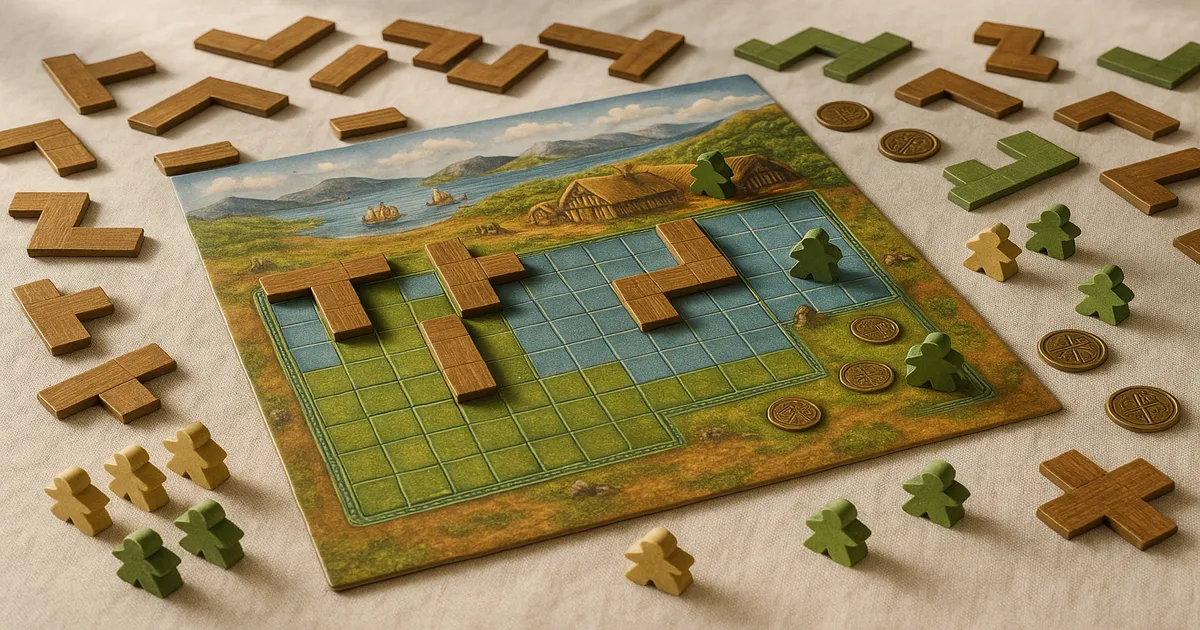
Personal home boards are double-sided. The beginner side has fewer penalty spaces and a more forgiving layout for tile placement. Play the beginner side for at least your first two games. The standard side adds real complexity once you know what you’re doing.
Polyomino goods tiles are the visual centrepiece — 300+ thick cardboard tiles in various shapes, colour-coded by goods type. Fish, grain, meat, whale meat, clothing, jewellery — each has its own shape and size.
Everything else: Viking meeples (your workers), longship tiles, weapon tiles, debt tiles (the thing you really don’t want), silver coins in multiple denominations, and island boards for colonisation.
Fair warning: at 3–4 players, this game needs a genuinely big table.
How to Play A Feast for Odin: Round Structure
A Feast for Odin plays over exactly 7 rounds, each following the same five-phase sequence. Get this structure into your head early — it’s the skeleton everything else hangs on.
Phase 1: Income
At the start of every round, each player collects silver based on the income spaces visible on their boards. New players skip this constantly. Don’t. Silver is your most flexible resource, and falling behind on it early creates a cascade of problems.
Phase 2: Action Phase
Players alternate placing one Viking at a time onto the central action board, continuing until everyone has placed all their workers or passed. Each space holds only one Viking (with a few exceptions), so contested spaces go to whoever gets there first. This is where most of the game’s tension lives.
Phase 3: The Feast
After the action phase, you must feed your Vikings. This requires specific food goods — meat, fish, milk, grain — in quantities based on how many workers you have. Silver cannot substitute for food. If you can’t feed everyone, you take debt tiles worth −3 points each. A couple of those can genuinely cost you the game.
Phase 4: Emigration
Players may optionally send a Viking to colonise an island board. These add scoring potential but also add more spaces you’ll need to fill with tiles. More on the risk/reward of this below.
Phase 5: Cleanup
Workers return to their owners, the round marker advances, and you do it all again.
The Action Board: What the 61 Spaces Actually Do
Sixty-one spaces sounds overwhelming, but they cluster into logical categories.
Hunting, whaling, and fishing generate meat, whale meat, and fish — your primary food sources and some of your most useful board-filling goods. Whale meat tiles are large and cover a lot of board space, which makes those spaces hotly contested at higher player counts.
Farming and crafting give you grain and beans, and let you convert raw goods into processed versions: grain becomes flour becomes bread; fish becomes stockfish; meat becomes dried meat; wool becomes clothing. Processed goods are worth significantly more per tile space. Taking crafting actions is almost always worth it.
Trading and raiding let you exchange goods at market rates or send longships to attack for silver, goods, and sometimes special items. Raiding columns are among the most contested spaces in the game.
Exploration and emigration unlock new island boards. More scoring potential, but only if you can fill them.
Special actions let you take additional Viking workers for the round (powerful but costs an action) or grab weapon tiles that contribute to end-game scoring.
The Polyomino Puzzle: Filling Your Personal Boards
This is where A Feast for Odin becomes unlike anything else — and where most new players get confused.
Goods tiles come in polyomino shapes: L-pieces, T-pieces, straight lines, squares. When you acquire a good, you place its tile on your personal board. The rules are strict: tiles must be placed orthogonally adjacent to an existing tile or the board edge, diagonal adjacency doesn’t count, and tiles can’t overlap. Simple rules, endlessly interesting puzzle.
Most spaces on your home board start with negative values: −1, −2, −3. Every uncovered negative space at game end costs you those points. The entire tile-laying game is fundamentally about eliminating these penalties while chasing bonuses — certain spaces grant rewards when covered, like free silver or extra goods. Cover those early and they compound over the remaining rounds.
Through exploration and emigration, you can add smaller island boards to your tableau. These have their own negative spaces and bonuses. The strategic question is always: do I have enough goods to fill this? A half-filled island board is a net negative. Don’t take islands speculatively.
Scoring
After 7 rounds, add everything up.
Positive: bonus spaces covered on all boards, points from colonised islands, leftover silver (converted at a fixed ratio), weapon tiles, ship tiles, and any special tile bonuses.
Negative: every uncovered penalty space on every board you own, plus debt tiles at −3 each.
The player with the highest total wins. A common late-game shock is realising how badly those uncovered spaces add up — you can have a great action phase and still lose badly if your boards are half-empty.
Common Mistakes New Players Make
Skipping the income phase. Happens in almost every first game. Put a reminder token on the table.
Misreading tile placement rules. Diagonal adjacency doesn’t count. I’ve seen this derail entire games when someone realises mid-game they’ve been placing tiles wrong.
Ignoring negative point spaces. New players focus on what they’re gaining rather than what they’re losing. Those −2 and −3 spaces will quietly devastate your score.
Misunderstanding the feast. You need specific food types in specific quantities. You can’t throw silver at the problem. Plan your food supply before the feast phase arrives.
Grabbing too many island boards. Acquiring a new island feels exciting. Finishing the game with two half-filled boards and −15 points from uncovered penalties does not.
Strategy Tips
Build a food engine first, then pivot. Rounds 1–2 should establish a reliable food source. Once you’re confident you can feed your Vikings each round without scrambling, redirect your actions toward generating and processing scoring goods.
Process your goods. Raw fish and raw meat take up the same tile space as stockfish and dried meat but score far less. Clothing and jewellery are even better if you can get the supply chain running.
Fill your board from the edges inward. Starting at the corners gives you more flexibility for awkward shapes later. Start in the middle and you’ll paint yourself into corners with oddly shaped gaps.
Solo mode is worth your time. Rather than competing against an automa, you play against a score target — reach a threshold and you “win” at that difficulty level. It’s a pure optimisation puzzle and one of the best solo implementations in the hobby. It’s also the perfect way to learn the game’s systems without the social pressure of a multiplayer session.
How A Feast for Odin Compares to Similar Games
| Game | BGG Weight | Key Difference |
|---|---|---|
| Agricola | 3.6/5 | More punishing, tighter scarcity, no polyominoes |
| Caverna | 3.7/5 | More options, less punishing than Agricola, no polyominoes |
| Le Havre | 3.5/5 | Card-driven, smaller scale, no polyominoes |
| A Feast for Odin | 4.0/5 | Most complex, polyomino puzzle adds a unique layer |
A Feast for Odin is the most complex of the Rosenberg catalogue, but it’s also arguably the most replayable — the combination of 61 action spaces and the spatial puzzle means games rarely feel the same twice.
If A Feast for Odin feels like too much right now, these are worth playing first:
- Raiders of the North Sea — Same Viking theme, BGG weight ~2.2, much more accessible
- Patchwork — Rosenberg’s 2-player polyomino game; an excellent primer for the tile-laying mechanic specifically
- Viticulture — Seasonal worker placement, lighter, beautiful production
- Tzolk’in: The Mayan Calendar — For players who want comparable complexity with a completely different mechanism
One more thing: A Feast for Odin has a lot of small tiles and tokens that benefit enormously from a good insert or organiser. The base box insert is functional but not great for setup speed.
Frequently Asked Questions About How to Play A Feast for Odin
How long does a game of A Feast for Odin take?
Plan for roughly 30 minutes per player once everyone knows the rules. Two players can finish in 60–90 minutes; four players should expect closer to 3 hours. First-game sessions always run longer — budget an extra hour.
Is A Feast for Odin good for beginners?
It’s not a beginner game. BGG rates it at 4.0/5 complexity, which puts it firmly in heavy euro territory. That said, if you’re a motivated learner who’s comfortable with complex games, the beginner board makes the first session manageable. Get a few medium-weight euros under your belt first.
How does feeding Vikings work?
At the end of each round’s action phase, you pay specific food goods based on your worker count. The game specifies which goods count as food and in what quantities — silver cannot substitute. If you can’t pay, you take debt tiles worth −3 points each, which add up fast.
What’s the difference between the beginner board and the standard board?
The beginner board has fewer negative point spaces and a more forgiving arrangement for tile placement. The standard board has more penalty spaces and requires tighter planning to cover them. Both sides are the same physical size — it’s a complexity difference, not a mechanical one.
Does A Feast for Odin have a good solo mode?
Yes, and it’s genuinely one of the better solo implementations in the hobby. You play against a score target rather than an automa opponent — hit the threshold and you win at that difficulty level. It’s a clean optimisation puzzle and a great way to learn the game at your own pace.