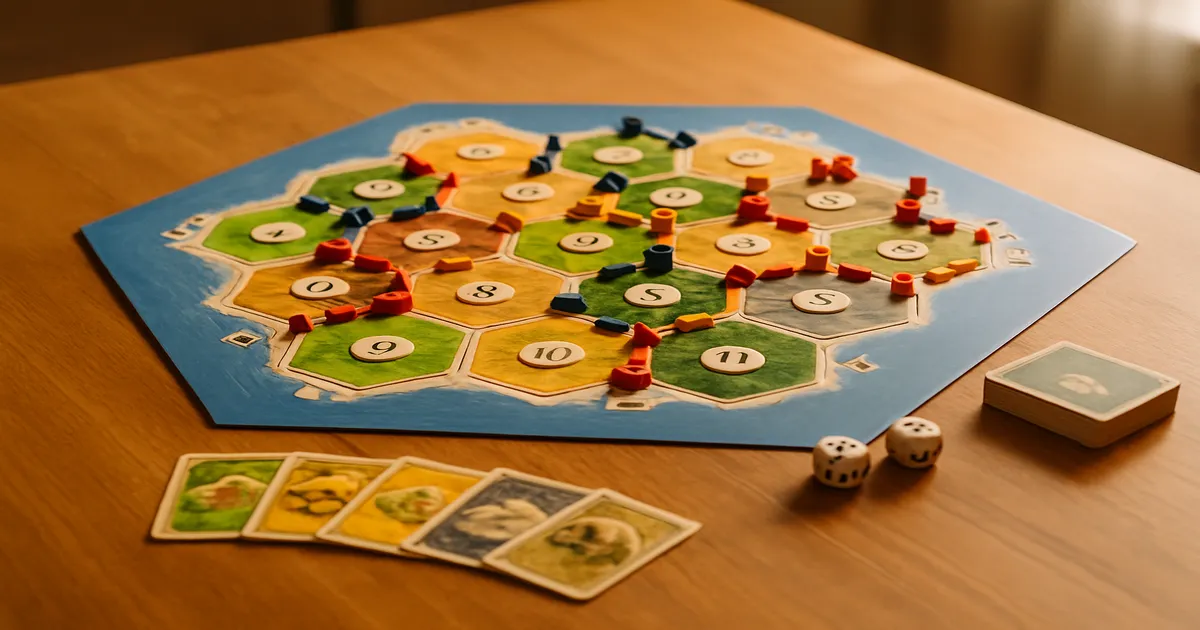
Quick Answer: Catan is a 3–4 player resource-gathering and trading game where you build settlements, cities, and roads to reach 10 Victory Points first. You can play it online for free at Colonist.io (browser, no account needed), through the official Catan Universe app, or on Board Game Arena — all of which handle rules enforcement and resource tracking automatically, which makes them genuinely great for beginners.
Figuring out how to play Catan online is easier than most people expect. The platforms do the heavy lifting — no counting resource cards, no forgetting the distance rule, no arguments about whether someone has too many cards when a 7 rolls. If you’ve ever bounced off the physical game because of rules confusion, starting online is actually the smarter move.
How to Play Catan Online: Choosing the Right Platform
| Platform | Cost | Devices | Async Play? |
|---|---|---|---|
| Colonist.io | Free (premium optional) | Browser | Yes |
| Catan Universe | Freemium | PC, Mac, iOS, Android, Steam | Limited |
| Board Game Arena | Free (premium optional) | Browser, App | Yes |
| Tabletop Simulator | $20 one-time (Steam) | PC, Mac | No |
Colonist.io: Best Free Browser Option
Colonist.io is where I’d send anyone who just wants to play right now. Open a browser, create a room, share the link — done. The interface is clean and functional, async play means you can run a game over a few days if schedules don’t line up, and it costs nothing. It’s not the prettiest platform, but it works reliably and the rules implementation is faithful.
Catan Universe: The Official Digital Version
Catan Universe is the officially licensed version, and it shows — polished 3D visuals, animated dice, cosmetic DLC if you want to customize your board. The tutorial is genuinely good for complete beginners. The catch is the freemium model: the base game is free, but expansions cost extra, and matchmaking can feel thin outside peak hours.
Board Game Arena: Best for Competitive Play
BGA has a massive active player base and a proper ranking system, which means you’ll actually find games quickly. The visual style is functional rather than beautiful, but the rules enforcement is airtight — you literally cannot make an illegal move. If you want to improve and play against people who know what they’re doing, this is the place.
Tabletop Simulator: Most Flexible, Most Setup
Tabletop Simulator is a $20 Steam purchase that lets you play almost any board game in a physics-simulated 3D environment. For Catan, you’ll need to download a community mod and manage the rules yourself. It’s great for expansions that aren’t available elsewhere, but overkill if you’re just learning.
Where to start: Colonist.io if you want free and fast. Catan Universe if you want a tutorial. Board Game Arena once you’ve got the rules down and want real competition.
Catan Rules: What You Actually Need to Know
The Board
The island of Catan is 19 hexagonal terrain tiles arranged randomly each game — that randomness is a big part of why it stays interesting after hundreds of plays. Harbor tokens around the edges offer better trade rates. Each interior hex gets a number token (2–12) with probability dots underneath.
The Five Resources
Every terrain type produces one resource:
- Forest → Lumber
- Hills → Brick
- Mountains → Ore
- Fields → Grain
- Pasture → Wool
- Desert → Nothing (and starts with the Robber)
How Resource Production Works
When the active player rolls, every hex matching that number produces resources for every player with a settlement or city touching it. Settlements collect one card; cities collect two. You’re earning on other players’ turns, not just your own — one of Catan’s cleverest design choices.
Trading
During your turn, you can negotiate freely with other players. If no one’s dealing, trade with the bank at 4:1. Harbors improve this: a generic 3:1 harbor drops the rate to three of any resource; a specific 2:1 harbor lets you trade that resource at two-for-one.
Building Costs
| Build | Cost | VP Value |
|---|---|---|
| Road | 1 Lumber + 1 Brick | 0 (enables expansion) |
| Settlement | 1 Lumber + 1 Brick + 1 Wool + 1 Grain | 1 VP |
| City (upgrades settlement) | 2 Grain + 3 Ore | 2 VP (net +1) |
| Development Card | 1 Ore + 1 Grain + 1 Wool | Varies |
How to Win
You need 10 VP on your turn. Sources:
- Settlements: 1 VP each (max 5 in play)
- Cities: 2 VP each (max 4 in play)
- Longest Road: 2 VP bonus — requires a continuous road of at least 5 segments
- Largest Army: 2 VP bonus — requires at least 3 played Knight cards
- Victory Point development cards: 1 VP each, kept secret until you win
Turn Structure: What Happens Each Round
Roll and collect. Add the dice, every matching hex pays out. Online platforms distribute resources instantly — no passing cards, no missed payouts.
The Robber (rolling a 7). Any player holding more than 7 cards must immediately discard down to half, rounded down — so 9 cards means keeping 4 and discarding 5, not the other way around. Then the active player moves the Robber to any hex, blocking its production, and steals one random card from a player adjacent to that hex. Platforms prompt the discard automatically, which eliminates one of the most common rules arguments in the physical game.
Trade. Offer trades to anyone, use bank or harbor rates if negotiations fail. Online quick-trade buttons speed things up — but don’t let the pace pressure you into bad deals.
Build. Spend resources on roads, settlements, cities, or development cards. You can build multiple things in one turn if you have the resources.
Development cards. You can play one per turn, before or after rolling. The rule most people get wrong: you cannot play a development card the same turn you bought it. It has to wait until your next turn. Platforms enforce this automatically.
Initial Placement: The Decision That Shapes the Whole Game
Your first two settlements determine your resource access for the entire game. No single trade or Robber placement will matter as much as getting this right.
Number Probability
There are 36 possible dice combinations. Key numbers:
- 6 or 8: 5/36 each (~14%)
- 5 or 9: 4/36 each (~11%)
- 4 or 10: 3/36 each (~8%)
- 3 or 11: 2/36 each (~6%)
- 2 or 12: 1/36 each (~3%)
A settlement on a 6 produces roughly four times as often as one on a 2. Online platforms display probability dots on every hex, making this easy to compare at a glance.
What Makes a Good Spot
Don’t evaluate one hex in isolation — every settlement touches three. A spot with a 6, an 8, and a 9 is dramatically better than a spot with a 6, a 3, and a 2, even though both have one high-value number.
I’ve found the most consistent first placement covers three different resources, with at least one being ore or grain. Cities and development cards are the most efficient VP paths in the game, and both require ore and grain. Without access to them, you’ll be trading at terrible rates to stay competitive.
Common First-Placement Mistakes
- Picking a spot because one hex has a 6, ignoring that the other two are a 3 and a 2
- Placing both starting settlements on the same resources
- Ignoring what’s scarce on the board — if no one else has ore, a middling ore number is still worth taking
Strategy Tips for Playing Catan Online
Ore-grain strategy. Cities double your resource output and are worth 2 VP each; development cards offer VP and utility. Lock up strong ore and grain numbers early, then prioritize upgrading settlements to cities. You’ll fall behind on roads, but you’ll pull ahead on VP where it counts.
Brick-lumber strategy. Go wide early — roads and settlements to grab good spots before opponents can. Works best when the board has several strong open positions. The risk: you stall once the island fills up and you need ore/grain to keep scoring.
Stay under 7 cards. A 7 rolls roughly every six turns. Losing half your hand to it is genuinely painful. Spend proactively, even if you’re building something slightly suboptimal.
Development card tactics:
- Knights are underrated. Three played knights earns Largest Army (2 VP) and lets you move the Robber off your best hex whenever you need to.
- Road Building can swing the Longest Road bonus or open new territory.
- Year of Plenty is best used to grab the exact two resources you need for a critical build this turn.
- Monopoly — save it for when the leader is clearly stockpiling one resource. Announcing “wool” when someone has six wool cards is devastating.
Endgame: count VP and hide your win condition. Settlements, cities, and special cards are all public. Hidden VP development cards aren’t — someone sitting at “7 VP” might actually be at 9. Don’t telegraph your own win. If you’re at 8 VP with a hidden VP card in hand, just play your winning card on your turn when no one can react.
Longest Road is volatile as a final 2 VP. If an opponent has roads that could break yours, don’t rely on it — build redundant connections or find another path to 10.
Rules People Get Wrong (and Online Pitfalls)
- The 7-card discard: You discard DOWN TO half, rounded down. Nine cards means you keep 4 and discard 5.
- Development cards can’t be played the turn you buy them. Full stop.
- Longest Road can be broken. Someone builds a longer continuous path through your network, they take the card and your 2 VP.
- Largest Army requires a minimum of 3 played knights — you don’t get the bonus at 2.
- Cities replace settlements — you swap the piece, you don’t add to it.
Online-specific tip: use the statistics panel. Most platforms show resource production probability by player, which tells you immediately who’s over- or under-performing relative to their numbers.
Expansions and Alternatives
Seafarers adds ships, island exploration, and gold hexes — a natural extension that keeps the same feel. Available on Colonist.io and Catan Universe.
Cities & Knights is a bigger leap: commodities, city improvements, and barbarian attacks raise the complexity significantly. It’s almost a different game, and I’d only recommend it after you’ve played base Catan a dozen times. Available on Catan Universe.
Catan plays poorly at two players — the trading element collapses without a third party. If you’re a pair looking for something similar, these are worth a look:
| Game | Weight | Players | Time | What’s Different |
|---|---|---|---|---|
| Ticket to Ride | 1.86 | 2–5 | 45–75 min | No trading, lower conflict |
| 7 Wonders | 2.32 | 2–7 | 30 min | Card drafting, simultaneous play |
| Wingspan | 2.45 | 1–5 | 40–70 min | Engine-building, low confrontation |
| Agricola | 3.64 | 1–4 | 90–150 min | Worker placement, more complex |
All four are available on Board Game Arena.
Frequently Asked Questions
Is Catan free to play online?
Yes. Colonist.io and Board Game Arena both offer Catan for free with optional premium upgrades. Catan Universe lets you play the base game free, but expansions cost extra. Tabletop Simulator requires a $20 Steam purchase.
Can you play Catan online with 2 players?
Technically yes, but it’s not great. The trading mechanic — which is central to the game — doesn’t work well with only two people. If you’re a pair, you’d be better served by a game designed for two.
What’s the best website to play Catan online?
Colonist.io for free casual play. Board Game Arena if you want ranked games and a competitive community. Catan Universe if you want the official tutorial and polished presentation.
How long does an online game of Catan take?
Most real-time games run 45–75 minutes, faster than the physical game because resource distribution and rule enforcement are automated. Experienced players can finish in under an hour. Async games take longer overall, but each individual turn only takes a few minutes.
Do I need to know the rules before playing Catan online?
No — and learning online first is often easier. Platforms enforce all the rules automatically, so you can’t make illegal moves. Catan Universe has a built-in tutorial, and even without one, a few games on Colonist.io with the rulebook nearby is a perfectly solid way to learn.